
Market Insights: Tuesday, December 16th, 2025
Market Overview
US stocks diverged on Tuesday as investors digested a mixed labor market picture while big tech and AI leadership tried to stabilize. The tech-heavy Nasdaq snapped a three-day losing streak with a 0.23% gain, helped by a record close in Tesla, even as the S&P 500 slipped 0.28% and the Dow fell 0.62%, or roughly 300 points. The delayed November nonfarm payrolls report showed the US economy added 64,000 jobs, more than expected, but also revealed that the unemployment rate climbed to 4.6%, its highest level since 2021, and that October actually saw a loss of 105,000 jobs after revisions. That combination of softening labor conditions and still-resilient job creation reinforced the sense of an economy slowing but not breaking, and it sharpened the debate over whether the Federal Reserve in 2026 will halt or accelerate policy easing as it weighs labor market risks against still-sticky inflation. A plurality of traders continues to price in roughly two rate cuts next year, betting that a Trump-influenced Fed and the administration’s One, Big, Beautiful Bill will lean toward support rather than restraint, even as officials stress their independence. The jobs data now set the stage for Thursday’s November CPI release, which, paired with today’s report, will make up a large chunk of the “great deal of data” Chair Powell has said the Fed will study before its late-January decision. At the stock level, Tesla surged to a new all-time high on growing optimism around its robotaxi ambitions and broader AI push, marking a sharp contrast with some legacy automakers: Ford said it would take a $19.5 billion charge as it pivots away from prior EV plans and refocuses its strategy, underlining how brutal the transition to next-generation mobility has become. Broader risk sentiment was mixed but not panicked: crude slid again, gold held near records, Bitcoin bounced, and Treasury yields edged lower, all consistent with a market that is becoming more selective, more data-dependent, and more willing to rotate leadership rather than abandon risk altogether.
SPY Performance
SPY extended its recent choppy pullback on Tuesday, opening at $679.08, briefly pushing up to an intraday high of $681.08, then sliding to a low of $674.98 before rebounding into the close to finish at $678.84, down 0.28% on the day. Trading volume climbed to 93.94 million shares, meaningfully above average and a clear sign that the ongoing battle between bulls and bears is being fought with real capital, not just noise. The early push toward the $681 area failed to gain traction, and once price slipped back below $680, sellers gradually pressed SPY toward the key $675 zone that overlaps with the 50-day moving average. Buyers stepped in decisively on the first test of that level, sparking a steady afternoon climb that pulled price back toward the high $670s by the close. Even so, SPY remains below both the critical $685 region where bulls regain full control and the $680 line that has served as the dividing line between bullish and bearish momentum in recent sessions.
Major Indices Performance
Index performance on Tuesday underscored the evolving rotation beneath the surface. The Nasdaq added 0.23%, helped by strength in Tesla and a generally firmer tone across many growth and AI-related names after several days of pressure. In contrast, the Dow fell 0.62%, reflecting weakness in more cyclical and value-oriented names that have recently been asked to shoulder more of the market’s leadership burden. The S&P 500 tracked SPY with a 0.28% decline, while the Russell 2000 dropped 0.55%, signaling ongoing concern about smaller-cap earnings leverage and sensitivity to the slowing but still-expanding economic backdrop. The split between a firmer Nasdaq and softer Dow and Russell fits a market that is trying to balance renewed interest in select growth stories with worries that parts of the real economy may be cooling more quickly than previously thought.
Notable Stock Movements
Tuesday marked one of the stronger sessions in recent days for the Magnificent Seven, with most of the group closing in the green and leadership again concentrated in Tesla, which rallied 3.06% to finish at a fresh record high. Investors continue to reward Tesla’s pivot toward robotaxis, humanoid robots, and AI chips, viewing the company less as a traditional automaker and more as a leveraged play on next-generation mobility and automation. Most of the other marquee names in the group also participated in the upside, signaling that the recent AI and megacap unwind is not a one-way street and that investors are still willing to own select high-quality growth when the narrative and positioning line up. The main outlier was Alphabet, which slipped 0.54%, underscoring that leadership remains rotational even within the megacap complex. Outside of the Magnificent Seven, sentiment around more traditional auto and industrial names was more cautious, particularly after Ford’s announcement of a $19.5 billion charge as it pivots away from certain EV investments. That decision highlighted how difficult it has become for legacy players to keep pace with the capital intensity and technological demands of the EV and autonomy race.
Commodity and Cryptocurrency Updates
Commodities and crypto painted a nuanced picture of macro expectations and risk appetite. Crude oil fell 2.88% to $56.04, pushing back toward the key $56 level that our model has highlighted as the dividing line between a constructive basing pattern and a deeper downside break. We have been calling for crude to drift toward $60 for several months, and while Tuesday’s move increases the risk of additional near-term weakness, the broader view remains that if oil can hold above $56, a rally back toward $60 and potentially $70 is still very much in play, particularly if global demand remains resilient and producers maintain supply discipline. Gold slipped just 0.06% to about $4,332, effectively unchanged and still hovering near record highs, reflecting persistent demand for hedges against policy missteps, inflation surprises, and geopolitical shocks even as equities remain within striking distance of their peaks. Bitcoin, by contrast, rose 1.57% and closed above $87,500, bouncing after its recent pullback and signaling that risk appetite in crypto remains intact. That rebound helped offset some of the broader risk-off tone in traditional assets and supports the view that while enthusiasm has cooled at the margin, the overarching risk environment has not flipped decisively bearish.
Treasury Yield Information
The 10-year Treasury yield slipped 0.77% to close near 4.168%, providing a modest tailwind for risk assets even as equities failed to mount a sustained rally. In our framework, yields below 4.5% are broadly supportive for stocks, while a move toward 4.8% tends to create more consistent headwinds for valuations, and a sustained break above 5% has historically been associated with more serious equity stress. At 5.2%, our model suggests the probability of a 20% or greater equity correction rises substantially, making that level an important risk marker to monitor. Tuesday’s decline in yields, occurring alongside a modest equity pullback and a rally in Tesla and Bitcoin, reinforces the idea that the recent weakness in stocks is still driven more by positioning, valuation, and internal rotations than by a sudden deterioration in the rates backdrop. However, with the November jobs report now in hand and CPI due on Thursday, the rate outlook for 2026 remains very much data-dependent and could shift quickly if inflation or labor conditions surprise in either direction.
Previous Day’s Forecast Analysis
In Monday’s newsletter, our model projected SPY’s maximum range for Tuesday between $674 and $688, emphasizing that the $675–$685 band remained the primary battleground while the longer-term trend stayed bullish above $640. We highlighted that the options landscape continued to show Put-side dominance, which typically aligns with more directional movement and increased sensitivity to hedging flows. The roadmap stressed that as long as SPY held above the $680 region and could reclaim $683–$686, attempts to push toward $689–$690 were likely, but that gains into that zone would probably be slow and choppy due to heavy overhead resistance. On the downside, we noted that a decisive loss of $680 would shift the base case toward a slide to $677 and then $675, with $670 coming into play if selling pressure intensified, especially around key economic releases. Our preferred strategy favored long entries on failed breakdowns that quickly reclaimed $680, while treating bounces into the mid-$680s and especially toward $689–$690 as potential areas for tactical shorts given how often those upper levels have repelled price in recent sessions.
Market Performance vs. Forecast
Tuesday’s tape largely echoed the structure laid out in Monday’s forecast while leaning more toward the bearish side of the anticipated range. SPY stayed within the projected $674–$688 band, opening at $679.08, briefly testing the $681 region, and then grinding lower to an intraday low just under $675 before rebounding to close at $678.84. The move below $680 and toward $675 tracked closely with our downside path, confirming that the loss of $680 would embolden bears and invite a test of deeper support. At the same time, the first touch of the $675 area was vigorously bought, in line with our view that this level, which aligns with the 50-day moving average, would attract dip buyers on the initial test. However, the rebound stopped short of reclaiming $680 in a decisive way and never came close to challenging the $683–$686 resistance band, underscoring that the near-term edge has shifted toward the bears even though the longer-term bull trend remains intact. Traders who respected the $680 line as the separator between bullish control and rising bearish momentum had clear cues: the failure to hold above $680 favored risk-off or tactical shorts on bounces, while the strong defense of $675 argued against pressing shorts aggressively into the hole.
Premarket Analysis Summary
In Tuesday’s premarket report, published at 8:10 AM with SPY trading near $680.26, we set the bias level at $681 and outlined a cautious, level-driven roadmap. On the upside, we flagged targets at $681, $683–$683.50, $684, and $685, noting that there were “murmurs of at least some attempt at a rally” but emphasizing that as long as price stayed beneath $681, the market remained challenged. The plan favored selling rejections of targets back down toward $679 and possibly $677 while treating all lower levels as potential springboards for rallies, and we were explicit about being cautious with shorts entered too close to support. Should a strong rally materialize or price break above $681, we expected efforts to retake the $683–$683.50 zone with the possibility of an extension toward $685, though we stressed that the overall state remained fragile and that we were “not overly aggressive to the upside.”
Validation of the Analysis
The intraday sequence matched the premarket blueprint closely, particularly around the bias and support levels. After the open, SPY’s early push toward the $681 area failed to secure a sustained hold above the bias, validating the view that the tape remained challenged beneath that threshold. From there, price drifted lower, moving through $679 and eventually testing the $677 area and then the critical $675 region that we identified as strong support and a likely location for a rally attempt. True to that script, the first move into $675 held and produced a steady afternoon climb back toward the high $670s, turning those lower levels into attractive long zones for traders who avoided chasing breakdowns. At the same time, the modest nature of the rebound and SPY’s inability to reclaim $681 or engage meaningfully with the higher upside targets reinforced the idea that the rally attempts were fragile and that the dominant short-term bias remained sideways to down. Overall, the day’s tape confirmed the premarket message: treat upticks beneath $681 with skepticism, respect the power of $675 as support, and look to fade extremes rather than assume a clean trend in either direction.
Looking Ahead
Looking ahead to Wednesday and the back half of the week, the macro calendar takes a brief pause before ramping up again. Wednesday has no scheduled economic releases, which means price action is likely to be driven primarily by technical levels, dealer positioning, and any surprises from corporate headlines. Thursday brings a fresh test with CPI and Unemployment Claims, reports that will be scrutinized in light of Tuesday’s labor data as investors refine their expectations for the pace and timing of the Fed’s 2026 easing cycle. Friday then delivers Final GDP and Core PCE, giving markets a more complete read on growth and inflation as the year winds down. With SPY stuck in a well-defined $675–$685 range and leadership rotating between megacap tech, value, and cyclicals, the stage is set for a larger move once an external catalyst breaks the stalemate. Until that happens, traders should expect continued back-and-forth price action inside the range and treat each test of major support or resistance as an important information point for the next leg.
Market Sentiment and Key Levels
After Tuesday’s session, market sentiment remains delicately balanced between a longer-term bullish structure and a near-term environment that increasingly favors tactical bears. SPY’s close at $678.84 leaves price in the lower half of the $675–$685 band that has defined recent trade, with repeated failures above $685 and persistent tests of $680 and now $675 signaling that the easy phase of the rally has faded. The broader trend remains bullish above $640, but the bulls’ advantage continues to narrow as more time is spent grinding sideways and probing key supports. For Wednesday, we see resistance at $680, $683, $686, and $690, with the $680–$686 band still acting as a heavy lid due to stacked resistance, dealer positioning, and the market’s recent inability to sustain strength above those levels. On the downside, support sits at $678, $675, and $670, with $675 carrying extra importance as it coincides with the 50-day moving average and the first line of defense for the bull channel that has been in place since the April lows. A sustained push back above $680–$683 would tilt the field modestly back toward the bulls and open the door for another run at $686–$690, while a clean break below $675 would likely accelerate selling toward $670 and possibly $660 as stops trigger and dip buyers step back.
Expected Price Action
Our AI model projects SPY’s maximum range for Wednesday between $674 and $686, a slightly narrower band than earlier in the week and one that points to choppy action with intermittent trending periods. The Put side continues to dominate in a tightening options band, which often coincides with rangebound movement punctuated by sharp but short-lived pushes as hedging flows interact with key levels. Given that SPY closed below both $685 and $680, the near-term edge leans toward the bears, with price likely to remain trapped between $675 and $685 until an external catalyst—such as Thursday’s CPI—forces a clearer breakout. If SPY can hold above $678 overnight and into the open, we expect attempts to retest $680 and then $683, but gains above $681–$683 are likely to be capped by heavy resistance unless buying pressure materially improves. On the downside, a loss of $678 would put a retest of $675 back on the table, and a break of $675 would open the door to $670, where we would again expect more determined dip-buying attempts. Traders should be prepared for intraday whipsaws around these levels and remain flexible rather than anchoring too strongly to a single directional view.
Trading Strategy
In this environment of elevated but contained volatility and well-defined support and resistance, our preferred strategy remains tactically nimble with a mild bullish bias that is conditional on holding key levels. For long setups, we favor entries near support around $675–$678, particularly on failed breakdowns that quickly reclaim those levels, with clear invalidation if SPY breaks and holds below $675. Upside targets for these longs sit at $680, $683, and then $686, with partial profits recommended at each level and stops trailed higher to protect gains. For traders comfortable with short exposure, we like failed breakouts near $680 and especially around $683–$686 as candidates for tactical shorts, with downside targets at $678, $675, and then $670. Short trades should be sized modestly and managed actively, given that they are still operating against a broader bull trend that could reassert itself if macro data or policy headlines turn more supportive. With the VIX sitting near 16.48 and firmly in neutral, risk-on territory, defined-risk option strategies, disciplined profit-taking, and respect for stop-losses remain paramount.
Model’s Projected Range
SPY’s projected maximum range for Wednesday is between $674 and $686, with the Put side dominating in a narrowing band that signals choppy price action with intermittent trending periods. The market moved slightly lower today after falling more than 1% intraday, with SPY closing down 0.28% at $678.84 on significantly higher than average volume. Price finished below $685 where bulls regain full control and below $680 where bears grow more aggressive. Bulls and bears remain locked in a battle, with the longer-term edge still favoring the bulls but the near-term edge shifting toward the bears. Price is likely to stay trapped between $675 and $685 until an external catalyst forces a breakout, and today the bulls defended $675, buying the dip and pushing price back toward unchanged. Overnight SPY rallied to just over $681 before selling off and reaching $677.50 which was bought on the first test. By the open price had recovered to $679.22, briefly teasing a move above $680 before chop dominated. After about thirty minutes $680 failed, triggering a slow and choppy grind lower that broke the overnight low after testing it several times which saw SPY reach $675.06 before reversing. From just after noon, price moved steadily higher into the close. The $675 level, which aligns with the 50 DMA, was clearly defended on the first test, though its durability on future tests remains uncertain. While the rebound from $675 limited further downside, today’s action does not support a Santa Rally, especially with price pulling back to the 50 DMA. Overnight the bulls must hold above $678 to attempt another move toward $685. A break of $678 opens the door to a retest of $675, and a failure there likely leads to $670. As emhasized for several days, $680 remains the critical line separating bull control from growing bearish momentum. Resistance for Wednesday sits at $680, $683, $686, and $690, while support rests at $678, $675, and $670. Gains above $681 are likely capped by heavy resistance, while a break below $670 could quickly send price toward $660. The broader trend remains bullish above $640, though the bulls’ advantage continues to narrow. For Wednesday we prefer shorts near $680 on failed breakouts and longs near $675, as the market is likely to remain rangebound until a catalyst shifts the dynamic. Crypto rose today after bitcoin reached $85K, while most MAG stocks rallied except Alphabet. The VIX fell 0.12% to 16.48 and remains in neutral, risk-on territory. Traders should stay flexible with a mild bullish bias while exercising caution near the highs, as confidence in a Santa Rally has softened even though a few red days do not invalidate the broader uptrend. SPY ended the day in the lower third of the bull channel that has been in place since the April lows.
Market State Indicator (MSI) Forecast
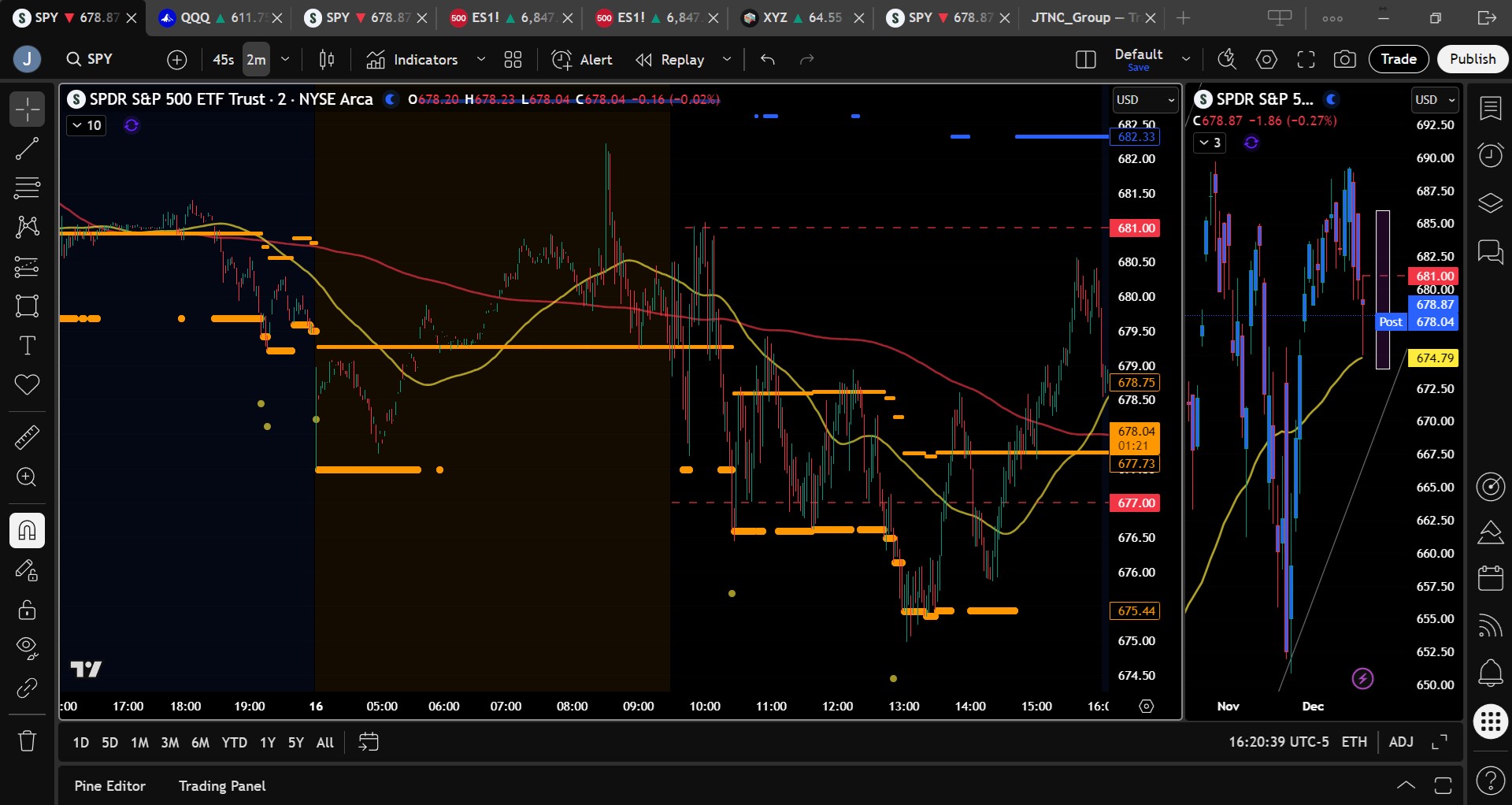
Current Market State Overview:
The MSI ended the session in a Ranging Market State with SPY closing in the lower half of the range. There were no extended targets after SPY reached $675, but there were occasions during the day’s sell off where the MSI printed extended targets below. But they were sporadic which did not support the day’s decline and as such, the big bounce off the 50 DMA was to be expected. There were no other extended targets overnight and as such, the herd did not appear to be participating in the day’s action. As such it was a slow, grind of a day with the MSI in a bearish state for most of the session. Overnight, the MSI rescaled lower but bounced between a bearish and ranging state until the open when the MSI rescaled lower several times until reaching the 50 DMA. For Wednesday the MSI is projecting sideways to down prices, with support at $677.73 and resistance at $682.35.
Key Levels and Market Movements:
On Monday we stated, “a repeat of today is likely, with sideways to down price action,” and noted, “The bulls must defend $680 on any overnight retest or the bears will press lower,” while also adding, “If $680 fails, SPY likely drops to $677 and then $675.” With this context and with the MSI opening in a Ranging Market State below $680, we looked for a short to target a possible retest of $677. We waited for SPY to break out of the MSI ranging state and entered short at the bearish state, MSI resistance at $679.25 about ten minutes after the open. Price dropped toward MSI support near $677.44, where we took quick profits just above that level to lock in a clean first trade. SPY then reversed sharply and returned to the MSI ranging state near $680, which kept us patient. On a second rejection at MSI resistance near $679.25, we reloaded the short and again set T1 at $677.44. This target was reached cleanly and the MSI rescaled lower, allowing us to set T2 at MSI support at $676.56. Once T2 was hit, we moved our stop to breakeven and trailed the remaining position. A strong bounce off $677 carried SPY back to our entry and stopped out the final 10% of our position at breakeven. We considered a third short, but with two solid wins already booked and chop dominating the session, we shifted to profit protection mode and called it a day. While there were several other set ups, including the long off $675, we decided to call it a day before noon going two for two, thanks again to having a clear plan, maintaining patience and discipline, and staying aligned with MSI signals, market structure, and our broader trading framework. The MSI continues to prove its reliability as the cornerstone of our trading process.
Trading Strategy Based on MSI:
Wednesday has no economic news to move the market. Absent an external catalyst, a repeat of today is likely with sideways to down price action. The bulls must defend $678 on any overnight test or the bears will press lower. If $678 holds, the bulls will attempt another push toward $685, but that level is again likely to be sold. If $678 fails, SPY likely drops to $675 and then $670, and a break of $670 brings $660 into play. Crypto and most MAG stocks rose today, which should support a modest recovery tomorrow. The long-term bull trend remains intact above $640, so we slightly favor the bulls on Wednesday as long as price holds above $678. If $678 fails and does not recover quickly, we favor shorts below that level or on low-volume bounces back into $680. Any first, and possibly second, test of $685 remains a strong short candidate. We will also seek longs off the 50 DMA on a first test, but we are unlikely to trade long again on a second or third test of that level. As always, stay alert to macro risks and be prepared to trade what you see in the coming days. Failed breakouts and failed breakdowns continue to offer the highest-probability setups, so remain flexible, avoid trading during Ranging Market States, and ensure all trades are fully aligned with MSI signals. Providing real-time insights into market control, momentum shifts, and actionable levels, the MSI when integrated with our Pre-Market and Post-Market Reports continues to sharpen execution precision and elevate trade quality. If you haven’t yet integrated MSI and our model levels into your process, now is the time. Contact your representative to get started as these tools are designed to support consistency and enhance performance.
Dealer Positioning Analysis
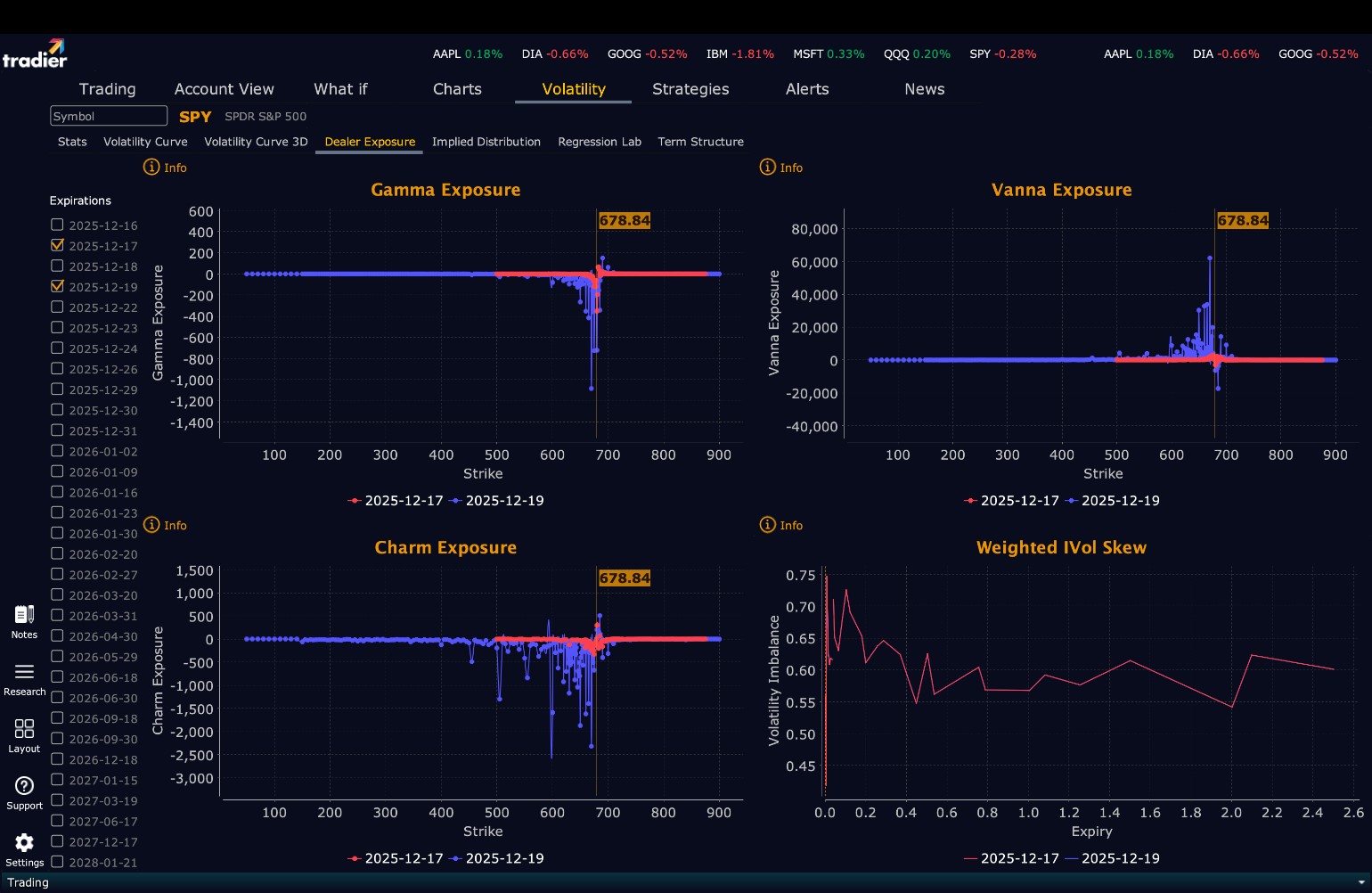
Summary of Current Dealer Positioning:
Dealers are selling SPY $682 to $710 and higher strike Calls while buying $679 to $681 Calls indicating the Dealers’ desire to participate in any rally on Wednesday. The ceiling for tomorrow appears to be $683. To the downside, Dealers are buying $678 to $565 and lower strike Puts in a 3:1 ratio to the Calls they’re selling/buying displaying little concern that prices could move significantly lower on Wednesday. Dealer positioning is unchanged from neutral/slightly bearish to neutral/slightly bearish.
Looking Ahead to Friday:
Dealers are selling SPY $689 to $710 and higher strike Calls while buying $679 to $688 Calls indicating the Dealers’ desire to participate in any rally this week. The ceiling for the week appears to be $700 although $690 is a major hurdle. To the downside, Dealers are buying $678 to $565 and lower strike Puts in a 5:1 ratio to the Calls they’re selling/buying, reflecting a market that is showing some concern about lower prices. For the week Dealer positioning is unchanged from bearish to bearish. We advise reviewing Dealer positioning daily for directional clues. These positions evolve quickly and tracking them is essential for staying ahead of shifting market sentiment.
Recommendation for Traders
Into Wednesday, we suggest continuing to treat the $675–$685 band as the primary decision zone and building your game plan around how SPY behaves at those levels, particularly with a data lull before Thursday’s CPI. On the long side, look for measured entries if price stabilizes above $678 and especially if it successfully defends $675 on any retest, with upside targets at $680, $683, and $686 and a willingness to trail stops higher as those levels are approached. On the short side, focus on failed bounces into $680 or deeper pushes toward $683–$686 rather than chasing weakness lower; use $678, $675, and $670 as logical downside targets and remain alert for signs that buyers are stepping in aggressively near those supports, which would be your cue to pare or exit short exposure. With VIX around 16.48, volatility remains contained but not complacent, favoring defined-risk strategies, disciplined profit-taking, and strict respect for stop-losses over attempts to swing for oversized gains. As we move closer to Thursday’s and Friday’s key data releases, stay flexible, keep size moderate, and let the market’s behavior around the key levels and MSI guidance lead your decisions.
Good luck and good trading!
