
Market Insights: Friday, November 6th, 2026
Market Overview
Wall Street caught its breath Friday after Thursday's bloodbath, but the bounce wasn't enough to save the week. The S&P 500 rose 0.3% and the Nasdaq gained more than 1% after slipping into correction territory the day before, while the Dow slipped 0.4%. At their best levels, the S&P was up 0.7% and the Nasdaq roughly 1.6%, but both still logged their worst weekly performance since June 5. Thursday's carnage was historic, with estimates of the market value wiped out ranging from $2.3 trillion to about $3 trillion. The S&P 500 fell more than 4%, its worst day since the April 2025 tariff crash, and the VIX surged. The PHLX Semiconductor index plunged 12%, its worst day since March 2020, and Nvidia (NVDA) dropped 9%, its worst day since the DeepSeek scare in January 2025. The trigger was Washington. Democrats swept control of the House and Senate, and candidates in both parties campaigned against AI data centers, the massive facilities those chips go into. Investors fear new regulations could slow the buildout boom that pushed chip stocks to records, and that worry fed broader concerns about a slowdown in AI spending. Chip names like Nvidia, AMD (AMD), Micron (MU), and Sandisk (SNDK) clawed back some ground, but the semiconductor gauge still finished in the red, as did Nvidia, AMD, and Intel (INTC). The AI trade remains fragile. Tech (XLK) and Energy (XLE), two big winners of the AI boom, fell 7% and 11% for the week, respectively, and the volatility has fueled speculation that Anthropic may need to cut its valuation ahead of its expected IPO later this month. Uncle Sam is feeling the pain too. Intel has shaved close to $20 billion off the government's stake, and the Trump administration's other chip bets have fared even worse. GlobalFoundries (GFS), Aeluma (ALMU), and Wolfspeed (WOLF) have all lost at least 40% over the past six months, far worse than the PHLX Semiconductor index's drop of over 18% over the same stretch.
The real headline Friday, though, was a blowout jobs report. The Labor Department said the economy added 165,000 jobs in October, crushing expectations of 65,000 to 70,000 and well above September's revised 60,000. The unemployment rate edged down to 4.1% versus the 4.2% forecast. That's a huge jump from the 48,000 monthly average over the past year and way above the roughly 30,000 jobs needed to keep employment steady, with payrolls now averaging 137,000 over the past three months. Wages have lagged, but they finally caught up last month to inflation, which grew 3.1%. The White House took a victory lap, with National Economic Council director Kevin Hassett declaring that "Demand for labor is skyrocketing." He pointed to initial jobless claims at their lowest since World War II and more workers quitting because they're confident they can land something new. Over in energy, Brent crude futures slipped below $100 per barrel as traders weighed the outlook for the Middle East war, with the risk of re-escalation hanging over sentiment.
SPY Performance
SPY opened at $734.82, a modest gap up from yesterday's close of $733.15. After a beating like the one we took yesterday, that small step higher showed buyers were at least willing to poke their heads out. The session low of $734.58 came right near the open, just a hair under the opening print and safely above yesterday's low of $732.71. From there the bulls went to work and pushed SPY to a session high of $742.21. That rally ran out of gas well short of the first resistance at $752.41, though, and the gains slowly bled away through the afternoon. SPY finished at $735.36, giving back most of the intraday bounce and closing much closer to the bottom of the range than the top.
SPY gained 0.32%, a green close on paper but a pretty unconvincing one. The pattern mirrored yesterday in an uncomfortable way. The high came during the session and never got retested, and the close sat near the lows. That tells you sellers were still leaning on every rally, just with less force than before. Volume backed that up. Turnover came in at 52.67 million shares, near average and far calmer than yesterday's frantic liquidation. The panic selling clearly cooled off, but there was no rush of eager buyers to replace it. The fear gauge eased too. The VIX dropped 11.71% to close at 24.88, a welcome pullback, though it remains well above the 20 level and shows traders aren't ready to drop their protection yet.
Today was a breather, not a turnaround. The good news is that yesterday's low of $732.71 held, and SPY never even got close to testing it. That keeps it as the key short-term support, and as long as it holds, the bulls have a floor to build on. The bad news is that the bounce stalled and faded long before reaching broken support turned resistance. $742.21 is now the first hurdle, followed by $752.41, $757.07, and $762.64 above that. Until SPY can close above today's high, the bounce looks more like short covering than real buying conviction. The mix of a fade into the close, average volume, and a VIX still near 25 makes today neutral with a bearish tilt. The bleeding stopped, but the patient is still on the table.
Major Indices Performance
The Nasdaq led the way with a 1.09% gain, bouncing back after taking the hardest hit in the prior session's selloff. Buyers stepped back into growth and tech names, and that renewed appetite for the market's biggest leaders gave the index a clear edge over the rest of the board. Still, a gain of this size only claws back a small slice of the damage, so this looks more like a relief bounce than a full recovery. The fact that tech led, though, is a constructive sign. When the most beaten-up corner of the market is the first to attract buyers, it suggests traders aren't ready to give up on leadership just yet.
The Russell 2000 finished right behind with a 1.03% advance, showing that the risk-on mood stretched well beyond megacap tech. Small-caps had been punished as investors fled the riskier end of the market, so seeing them bounce nearly in step with the Nasdaq tells you buyers were willing to take on risk again. Crude barely budged after its sharp reversal the session before, and that steadier energy picture took some pressure off the smaller domestic companies that feel fuel costs the most. A strong showing from small-caps usually means participation is broadening, which is exactly what a market needs to build a lasting recovery.
The Dow was the lone laggard, slipping 0.46% as money rotated out of the steadier, defensive blue chips that held up best during the prior day's rout. That's a classic flip. The same names investors hid in when fear spiked became a source of cash once the panic eased and traders went hunting for bigger rebounds elsewhere. The S&P 500 landed between the Russell 2000 and the Dow, posting a modest gain that reflected this tug-of-war between growth and defensive names. The VIX dropped 11.71% to close at 24.88, a meaningful cooldown in fear, but it's still sitting well above the key 20 level. That tells you nerves haven't fully settled. With no economic news on Monday's calendar, the indices will trade on technicals and positioning, and the real test is whether growth and small-caps can keep leading or whether this bounce fades into another round of selling.
Notable Stock Movements
Tesla led the Magnificent Seven back to the upside, jumping 4.23% and snapping its three-day losing streak. That bounce only wins back a slice of the double-digit wipeout from the prior session, so calling it a full recovery would be a stretch. Still, it's the first sign that buyers are willing to step in after Tesla's breakdown. The real test is whether this move has staying power or turns out to be a short-lived relief rally. A single green day after a crash like that proves very little, so Tesla needs to build on this before anyone declares the worst is over.
The group swung back to a mostly green day, with NVIDIA, Alphabet, and Meta joining Tesla on the positive side. The exceptions were Amazon, Apple, and Microsoft, and Microsoft took the weakest spot at down 0.99%. That's a notable shift from just a couple of sessions ago, when Microsoft was leading the charge higher. With three of the seven names still in the red, this was more of a split decision than a clean rebound. Investors are clearly picking their spots and favoring the beaten-down names that had the most room to bounce. That's healthier than another round of across-the-board selling, but it falls short of the unified buying that would show real confidence returning to big tech.
The broader market reflected that same mixed tone. Tech-heavy stocks and small caps both posted solid gains, while the Dow slipped into the red, which makes sense given that some of the blue-chip heavyweights were among the laggards. Bitcoin dipped 0.25% to close below $75,752, so speculative assets didn't fully join the rebound. The VIX dropped 11.71% to 24.88, a meaningful pullback in fear, though it's still sitting well above that key 20 level and shows nerves remain on edge. Monday has no economic news on the calendar, so the Magnificent Seven will likely do a lot of the steering. If Tesla can hold its gains and the lagging names start to turn around, big tech could regain its leadership role. But if this bounce fades and the selling picks back up in the heavyweights, the prior session's damage may only be the beginning.
Commodity and Cryptocurrency Updates
Crude oil inched higher, gaining 0.11% to close at $90.62. That's a quiet session after the prior day's bounce, but the black gold is still holding above $90, showing buyers are comfortable keeping the geopolitical risk premium in place. Crude held steady even as risk appetite returned to parts of the market, which suggests supply concerns and geopolitical tensions are still setting the tone for energy rather than shifts in broader sentiment. Crude has rallied well above $70 and continues to defy longer-term model expectations, so the supply disruption story remains front and center. With no economic news on Monday's calendar, energy traders will likely key off supply and geopolitical headlines. A sustained move this far above $70 keeps inflationary pressure alive and could complicate Fed policy if energy prices continue feeding into inflation.
Gold took a breather, slipping 0.96% to close at $4,074. That snaps its two-day winning streak and gives back some of the cushion bulls had built above the key $4,000 level. The pullback makes sense as fear cooled and traders rotated back toward risk assets, which reduced some of the urgency for safe-haven protection. Inflation uncertainty, steady central bank buying, and ongoing geopolitical tensions still support the long-term case. One down day doesn't change the bigger picture, and the recent dip still looks more like a flush than the start of a deeper correction. With a quiet calendar Monday, gold will likely trade on sentiment and the geopolitical backdrop, but as long as it holds above $4,000, bulls stay firmly in charge.
Bitcoin drifted lower, slipping 0.25% to close below $75,752. That's a much milder move after the prior session's beating, but the crypto failed to bounce even as appetite for risk improved across much of the market. Sitting out a relief rally is a warning sign, since Bitcoin usually trades like a high-beta risk asset and should benefit when fear eases. Staying stuck under the $80,000 psychological level keeps the recovery story on shaky ground and leaves the recent base-building effort in question. With no major economic news Monday, Bitcoin will likely take its cues from technicals and the broader risk tone. A push back above $80,000 would repair the damage, while continued weakness would keep the downtrend firmly in play.
Treasury Yield Information
The 10-year Treasury yield rose 0.45% today to close at 4.860, snapping a two-day losing streak and drifting back in the wrong direction. This time the move higher actually looked healthy. The flight-to-safety bid that drove yields down yesterday unwound as investors stepped back into risk, pulling money out of bonds and putting it back into stocks. When yields rise because fear is fading rather than because inflation is heating up, the market can absorb it, at least for now.
Against each threshold, the picture slipped a bit. The 4.5% level where equity valuations start to feel the squeeze is now 36 basis points below today's close, and the 4.8% mark that usually triggers broader selling sits 6 basis points underneath, so the 10-year moved further from escaping the selloff zone instead of breaking through. The 5% serious-risk flag now has 14 basis points of cushion, down from 16 yesterday, and the gap to 5.2%, where the framework calls for a 20% or greater correction, narrowed to 34 basis points.
Equities shrugged off the uptick. The Nasdaq bounced 1.09% and the Russell 2000 gained 1.03%, while the Dow slipped 0.46%. Small caps are usually the most rate-sensitive corner of the market, so their strength tells you traders weren't worried about borrowing costs today. The VIX dropped 11.71% to 24.88, and gold fell 0.96% to $4,074 as the defensive trade unwound alongside Treasuries. Crude held firm, edging up 0.11% to $90.62. That keeps inflation pressure in the background and gives yields a reason to stay sticky above 4.8%.
Monday has no economic news, so bonds will trade on positioning and risk appetite rather than data. The key thing to watch is whether the 10-year can slip back below 4.8% or keeps grinding toward 4.9%. A quiet pullback in yields would give stocks room to extend this rebound. A push toward 4.95% would shrink the 5% cushion to almost nothing and put fragile equities right back under pressure, especially with volatility still elevated.
Previous Day’s Forecast Analysis
Heading into Friday, our AI model projected SPY's maximum range at $719 to $741, with the Put side dominating an expanding band. The model called for trending price action with intermittent chop, and the newsletter carried a bearish bias into the session. That outlook came after Thursday's brutal selloff left SPY sitting right on first support at $733, just above the middle of the projected range. The VIX had jumped 62.49% to 26.99, a violent spike in fear that signaled sellers had grabbed control. With Average Hourly Earnings, Non-Farm Employment Change and the Unemployment Rate due at 8:30 AM ET, followed by Prelim UoM Consumer Sentiment and Inflation Expectations at 10:00 AM ET, the forecast warned of significant volatility, especially in the first hour.
The key battleground was identified as the $733 to $738 zone. On the upside, $735 was first resistance, followed by $738, then $740 and the $741 range top, with $745 just beyond. On the downside, losing $733 was expected to open the door to $728 and $725, with the lowest support at $720 near the $719 range bottom. A break of $720 put $715 in play. The bigger picture was still seen as intact, with structural support near $640 keeping the long-term bull trend alive even as the short-term structure needed repair.
The favored trade was shorting a failed rally into $738 to $740, targeting $735 and then $733, with stops above $741. A decisive break of $733 called for shorting a failed retest from underneath, targeting $728, $725 and eventually $720, with stops just above $735. On the long side, a hold of $733 after the data was framed as a tactical bounce trade, targeting $735, $738, $740 and $741, with stops below $728. A clean retest of $738 as support offered a breakout long toward $740 and $741, with stops below $735. Traders were told to cut size in half, widen stops, avoid chasing the first move off the jobs data, and step aside on shorts if buyers pushed through $740 and held. The bottom line was to short strength into $738 until buyers proved they could take back $741.
Market Performance vs. Forecast
Friday's session delivered a relief bounce that held almost entirely within the model's projected maximum range of $719 to $741. SPY opened at $734.82, reached a high of $742.21, dipped to a low of $734.58 and closed at $735.36, up 0.32%, on volume of 52.67M, near average. The forecast leaned bearish on the strength of a Put-heavy band, and the jobs data and consumer sentiment releases introduced volatility that briefly carried price beyond the base case scenario. The model does not account for how traders will react to major economic releases, and the morning catalysts pushed SPY just past the top of the range before sellers reasserted themselves. The call for trending price action with intermittent chop showed up clearly. SPY ran higher, overshot resistance and then gave back most of the move to finish near the lower end of its daily range.
The key levels framed the session with real precision. The forecast named $733 to $738 as the key battleground, and SPY spent the day anchored to that zone. First support at $733 held firm, with the session low stopping above it. First resistance at $735 became the magnet for the close, with SPY settling less than $1 above that level. The upside map unfolded in order through $738, $740 and the $741 range top, and the high stalled just above it, well short of the $745 extension. The forecast warned that the opening reaction to the jobs data "can reverse quickly," and the fade from the highs back toward $735 confirmed that chop was part of the tape. The downside levels at $728, $725 and $720 went untouched, and the long-term bull trend above structural support near $640 remains firmly intact.
On the rising market side, the playbook delivered. The setup called for buying a hold of $733 as a tactical bounce trade, ideally with the VIX easing back below 26.99, and both conditions were met as support held and fear cooled. Every target on the ladder was reached, from $735 to $738 to $740 and the stretch target at $741. The instruction to take most profits at $741 proved especially valuable, since price could not sustain a move above the range top and slid back toward first resistance. On the falling market side, the push to the session high triggered stops above $741 on the short at $738 to $740, and risk management protocols protected capital before the trade could do damage. The forecast also stated that if buyers pushed through $740 "and hold," shorts should step aside. Buyers did not hold, and the fade back toward $735 showed that sellers still defended the upper end of the zone.
The VIX dropped 11.71% to 24.88, a meaningful cooldown from Thursday's spike, but it remains well above the 20 mark and signals that caution is still warranted. The near-average volume showed a measured relief rally rather than a conviction-driven reversal. The guidance to cut size in half and avoid trading the first minutes after the 8:30 AM ET release kept traders out of the whipsaw that defined the session. The model identified the battleground, held its key support, and capped the rally almost exactly at the top of its projected range. The framework adapts as conditions shift, and Friday showed how well-defined targets, disciplined profit-taking and clear invalidation levels keep traders positioned to capture moves in either direction.
Premarket Analysis Summary
The premarket analysis, posted before the opening bell, set up Friday's session with SPY at $734.28 in a deeply put-dominated tape. Price was bouncing modestly after Thursday's collapse, the worst session in over a year, which erased the entire post-election rally and ran through every level in the stack. The bias hinged on $735, the defining level and the heaviest concentration near price. Holding above it would let the tape stabilize, while losing it cleanly would put $730 back in play with the slide resuming. The expected move ran from $721 to $746, about twelve points and by far the widest yet, and the notes warned that swings in a put-dominated tape tend to accelerate. Upside targets stepped through $736 as the first step, then $740 as a major round number and the first real battle bulls needed to win to prove this was more than a dead-cat bounce. Beyond that, $745 marked where the tape could begin to repair, and $750 was max upside, the spot where last week's selling once stopped and now the ceiling. On the downside, $733 was the first level to watch. Below it, $730 was the most important level and the line in the sand, $725 was the point of last hope and heaviest support, and $720 was max downside at the bottom of the expected move.
The downside map never came into play, and the upside map delivered a solid but incomplete rally. SPY opened at $734.82, just beneath the $735 pivot, and the low of $734.58 never came close to testing $733, let alone the $730 line in the sand. Buyers quickly reclaimed $735, pushed through $736, and won the first real battle at $740, driving price to a high of $742.21 before stalling well short of the $745 repair zone. The rally faded into the close, and SPY finished at $735.36, up 0.32% on 52.67M shares of near-average volume, settling just above the defining $735 level. The VIX dropped 11.71% to 24.88, a meaningful cooling of fear that still left volatility elevated. The key takeaway is that the $735 pivot held exactly as the notes framed it, and bulls showed they could clear $740 intraday. However, giving back most of those gains suggests sellers remain active on rallies, so reclaiming and holding $740 will be the real test of whether this bounce has legs.
Validation of the Analysis
Friday delivered exactly the kind of stabilization session the premarket map outlined, with 735 acting as the pivot from the opening bell to the final print. The notes were written with spot at 734.28, sitting right on what they called "the defining level" and "the heaviest level near price." SPY opened at $734.82, just 54 cents above spot and still a hair under 735. The notes laid out the bullish condition plainly: "hold above it and the tape can stabilize." Sellers took one early shot, pushing SPY to a session low of $734.58, only 42 cents beneath 735. They couldn't break it. The first level to watch at 733 was never touched, sitting $1.58 below the low of the day, and 730, the "line in the sand," never came into play at all. After Thursday's collapse, the fact that the entire downside half of the board went untested says a lot about how well 735 framed the day.
Once 735 held, the upside script played out in order. The notes said "Hold 735 and 740 is the test," with 736 as "the first step." Price cleared 736, then pushed straight into 740, the level the notes called "the first real battle" and the line bulls "need to show this is more than a dead-cat bounce." SPY punched through to a high of $742.21, $2.21 above 740, but it couldn't build on the breakout. 745, "where the tape begins to repair," stayed untouched $2.79 above the high, and the 746 top of the expected move was never threatened. From there the 740 battle went to the sellers, and SPY drifted all the way back to close at $735.36, up 0.32% and just 36 cents above the same 735 pivot where the day started. The notes had warned that "Fridays cut both ways," and the session proved it with a rally and a full fade inside one day. The VIX dropped 11.71% to 24.88, a meaningful cooling of fear that lined up with the stabilization the notes said would follow a hold of 735, even if bulls weren't ready to declare a recovery.
The trading value came from knowing that 735 was the line and that holding it put 740 in play. The first setup was the long on the defense of 735. Buying the $734.58 low with risk tucked below 733 paid 1.42 points into 736, 5.42 points into 740, and 7.63 points into the high of the day. The second opportunity came at 740 itself. The notes framed it as the proving ground for whether this was more than a dead-cat bounce, so a failure to hold above it was a clear signal to take profits and look for a fade. Shorting the move back under 740 paid as much as 4.64 points into the close, and anyone who sold the $742.21 high had a shot at a 6.85-point slide back to the 735 pivot. The map also kept traders out of the worst trade of the day. With 733 never touched, there was no reason to press shorts toward 730 or 725 on the open. Heading into next week, bulls need to reclaim and hold 740 to prove Thursday's damage is being repaired. Bears need a clean break of 735 to put 730 and the breakdown lows back on the table.
Looking Ahead
Monday's economic calendar is completely empty, with no high-impact releases scheduled. That's a big change from Friday's packed lineup, and it means there won't be a single headline number at 8:30 AM or 10:00 AM ET to jolt the market in either direction. Without fresh data to react to, Monday becomes a digestion day. Traders will still be working through the jobs report, wage figures, and consumer sentiment readings from Friday, and the real test is whether Friday's reaction holds up once the weekend has passed and cooler heads take over. Moves that look convincing at the end of the week can get second-guessed on Monday morning, so watch whether buyers or sellers follow through in the first hour.
A quiet calendar gives traders a chance to position without the risk of a surprise economic print. Price action will likely depend on corporate news, sector rotation, and any headlines that come out of the weekend, which can create sudden pockets of volatility even on an otherwise calm day. Light-data sessions can also bring thinner conviction and drifting, range-bound trading, so don't mistake a slow open for a signal. Use Monday to review your positions and tighten your watchlist. Set your key levels ahead of time, keep stops in place, and be patient about adding new exposure until the market shows a clear direction.
Market Sentiment and Key Levels
Friday handed bulls a modest win on paper, but the tape tells a more complicated story. Buyers pushed SPY to a solid intraday pop, then let most of it slip away and finished near the bottom of the day's range. That kind of fade suggests conviction is still thin after Thursday's beating, and it keeps the bounce from looking like a clean reversal. Under the surface, risk appetite did improve. The Nasdaq gained 1.09% and the Russell 2000 rose 1.03%, while the Dow slipped 0.46%. When tech and small caps lead while blue chips lag, that's money rotating back toward growth and higher-beta names, which is a constructive sign after a broad de-risking session. Mega-cap leadership was mostly green, helping steady the cap-weighted averages. Bitcoin dipped 0.25% and gold fell 0.96%, so the safe-haven bid cooled while crypto stayed soft. The biggest shift came in fear gauges. The VIX dropped 11.71% to 24.88, a meaningful pullback in hedging demand, though it's still well above the 20 threshold and signals that traders aren't fully relaxed. Call it a cautious edge for bulls heading into Monday, with plenty left to prove.
SPY closed right on top of first support at $735, and that's the line bulls need to defend. Losing $735 likely sends price toward $730, then $725 and $720. If $720 gives way, there's little to keep SPY from sliding toward $715. On the upside, first resistance sits at $740, and a push through there opens the door to $745, followed by $747 and $750 if buyers can finally hold their gains instead of fading them. Zoom out and the long-term bull trend remains intact, with SPY well above structural support at $640. As long as those key structural levels hold, this remains a broader dip-buying environment, even if the short-term structure is still repairing. Monday's projected maximum range runs from $724 to $749, with the Put side dominating in an expanding band that points to trending price action mixed with intermittent chop. That Put-side tilt is a reminder that sellers haven't left the building. The economic calendar is empty on Monday, so technicals and positioning will drive the tape. Without a data release to spark a move, watch how price reacts at $735 early in the session, since a quick defense there would confirm buyers are stepping in. Keep an eye on whether mega-caps and small caps can extend Friday's leadership, because a stall in both would undercut the rebound. Yields and energy prices remain background factors that could weigh on sentiment if inflation worries build. With SPY sitting in the lower half of the projected range and right on first support, we favor buying dips at $735. Keep position sizes modest with the VIX still elevated, and treat a decisive break below $730 as the signal to step aside.
Expected Price Action
Monday's session brings actionable intelligence generated by our AI model, which projects SPY's maximum range at $724 to $749. With the Put side dominating in an expanding band, the model is calling for trending price action with intermittent chop. There is no economic news due out on Monday, so the market will trade purely on technicals, with price action and positioning driving the tape. Friday's fade off the intraday highs left SPY sitting right on top of the model's first support at $735, in the lower half of Monday's projected range. Closing in the lower half with a Put-heavy tilt to the band keeps our bias bearish heading into Monday, even as the bounce shows sellers are no longer in full control. The VIX dropped 11.71% to 24.88, a meaningful easing of fear, but that reading is still elevated and tells us traders aren't ready to fully relax.
The key battleground for Monday is the $735 to $740 zone. $740 is the first resistance bulls need to clear, and a break through it opens the door toward $745. Above that, $747 and $750 cap the upside, with the $749 top of the model's range sitting just beneath that big round number. On the downside, losing $735 likely sends price toward $730, with $725 below that, right near the $724 bottom of the projected range. The lowest support sits at $720, and if that gives way there is little to keep price from falling toward $715. The bigger picture remains intact, with SPY well above structural support near $640 and the long-term bull trend still firmly in place. As long as price holds above key structural levels, this remains a broader dip-buying environment.
In the short run, the playbook favors buying dips at $735, since SPY finished right on first support. A hold at $735 sets up a long with $740 and $745 as targets, but keep risk tight given the bearish tilt and Put-side dominance. If $735 fails early, step aside on the long side, because Monday likely turns into a trend day toward $730 and $725. Chop is part of the forecast, so don't chase the first move off the open, since early swings can reverse quickly. If buyers push through $740 and hold, that is the signal that last week's damage is being repaired and $745 to $750 comes into play. With no macro catalyst on the calendar and fear cooling but still elevated, Monday sets up as a test of whether bulls can defend $735 or whether sellers use the quiet calendar to press price back toward the bottom of the range.
Trading Strategy
The VIX dropped 11.71% to 24.88, a meaningful cooling in fear after the recent spike, but it still sits well above the 20 mark, which tells us traders haven't fully let their guard down. This is better than last week's panic, but it's still not the tape for full position size. Monday brings no economic news, so there's no scheduled catalyst to blame for whipsaws. The market will trade purely on technicals and positioning. Run about half to two-thirds of normal size, keep stops honest, and remember that the Put side still dominates an expanding band. The model calls for trending action with intermittent chop, so expect sharp counter-moves in both directions even if a trend develops.
In a rising market scenario, buying a hold of $735 is our favored trade and the cleanest setup on the board, since SPY finished right on top of first support after buyers gave back the intraday pop. The trigger is price testing $735, stabilizing and firming up, ideally with the VIX continuing to ease below 24.88 as fear keeps draining out. The first profit target is $740, with $745 next as price works into heavier resistance. Runners can press toward $747, but treat that as the stretch target on a strong rally. Stops on longs belong below $730. If bulls clear $745 and hold it, don't chase the move. Buy a clean retest of $745 as support instead, targeting $747 and then the top of the projected range at $749. Stops on that breakout trade belong below $740. Since a push beyond $749 takes price outside the projected range, take most profits there and let only a small runner ride toward $750.
In a falling market scenario, shorting a failed rally into $745 to $747 is the best setup on the bear side, especially given the Put-heavy structure and the soft finish off the highs. A bounce into that zone that rolls over is the trigger, particularly if the VIX pushes back above 24.88 while price stalls under resistance. The first profit target is $740, with $735 next if sellers keep pressing. Stops on shorts belong above $749, the top of the projected range. If $735 gives way with conviction, flip the playbook and short a failed retest of $735 from underneath, targeting $730 and then $725. Stops on that breakdown trade belong back above $740. Because the projected low sits at $724, take most profits into $725 and keep only a small runner toward $720. If $720 cracks, there is little to keep price from sliding toward $715, but by that point the move is stretched, and that is where shorts should be booking gains, not adding.
The long-term bull trend remains intact above $640, and the bigger picture is still a dip-buying environment. The easing in fear tilts the short-term edge back toward buyers as long as $735 holds. The Put-heavy band means bulls haven't fully earned the benefit of the doubt, so longs should be managed actively rather than left to ride. Keep size moderate, scale out in layers into resistance, respect your stops, and let price confirm before pressing. Buy the dip at $735 until sellers prove they can take out $730.
Model’s Projected Range
SPY's projected maximum range for Monday is $724 to $749, with the Put side dominating in an expanding band that suggests trending price action with intermittent chop. Monday brings no economic news due out so the market will trade on technicals. SPY closed at $735.36, up 0.32%, after opening at $734.82, pushing as high as $742.21 and dipping to a low of $734.58 on lower than average volume, which means buyers gave back most of the intraday pop and finished near the bottom of the day's range. SPY is trading near our model's first support at $735, and with no specific macro catalyst on the radar, price action and positioning will likely drive the tape. If the first resistance at $740 breaks, price could target $745, while a break below the first support at $735 opens the door to $730, and if the lowest support at $720 gives way there is little to keep price from falling toward $715. The long-term bull trend remains intact above $640 with SPY well above structural support. As long as price holds above key structural levels, this remains a broader dip-buying environment. Absent a catalyst, resistance sits at $740, $745, $747, $750, while support rests at $735, $730, $725, $720. We favor buying dips at $735 given SPY closed right on top of first support in the lower half of the projected range. The MAG stocks were mostly green across the board, led by Tesla up 4.23%, with Microsoft the notable laggard, down 0.99%, while Bitcoin slipped 0.25%, closing below $75,752, so leadership tilted toward big tech strength while crypto softened slightly. The VIX closed at 24.88, down 11.71%, suggesting a significant reduction in fear as traders stepped back from hedging even though volatility remains elevated in absolute terms. SPY closed well above structural support near $640, keeping the broader uptrend firmly in place heading into Monday.
Market State Indicator (MSI) Forecast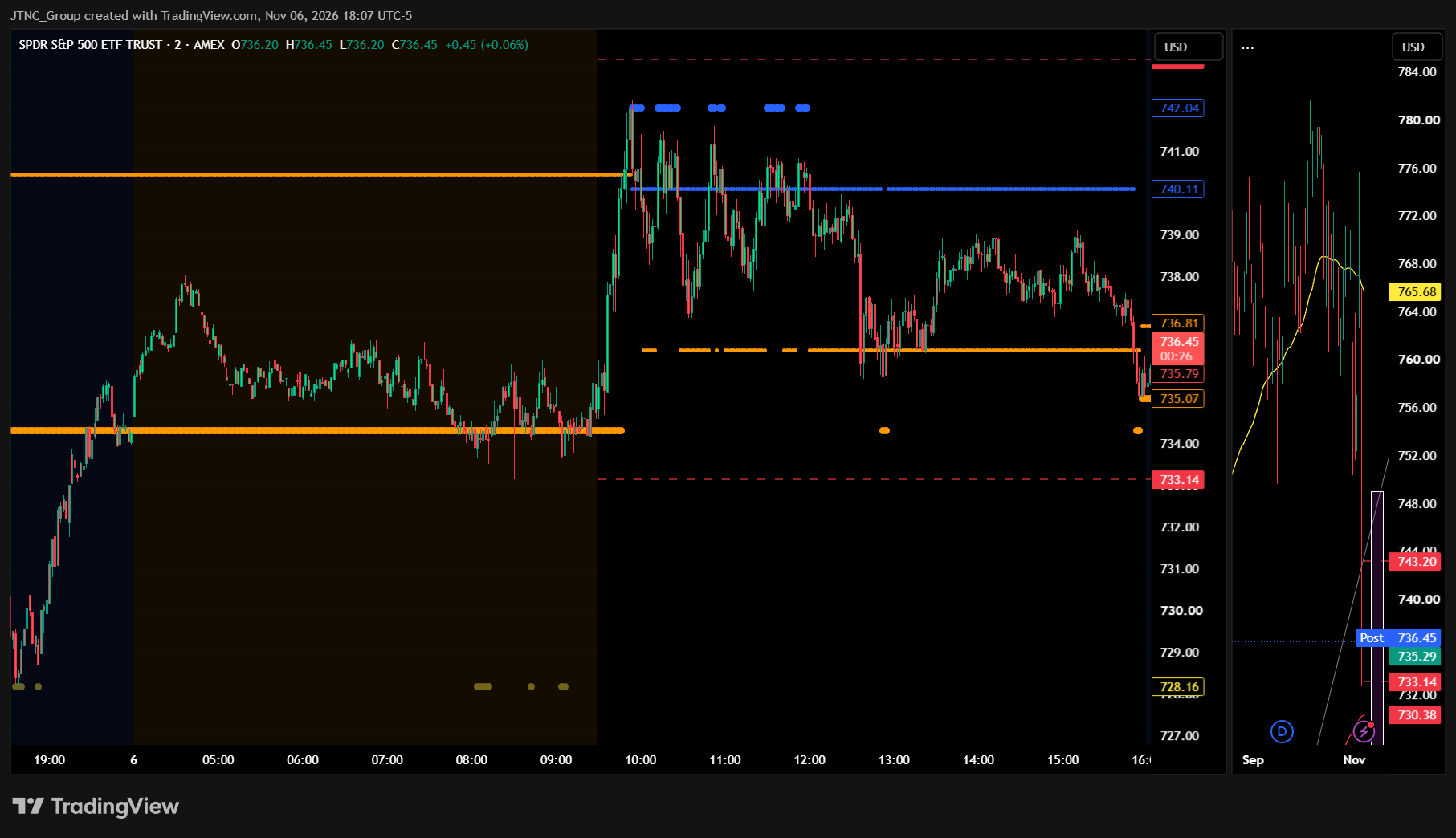
Current Market State Overview:
The MSI ended Friday in a Bearish Trending Market State with SPY closing at $735.36. MSI resistance is $736.81 and MSI support is $735.07 heading into Monday. The MSI did not rescale overnight, but by the open SPY had found support at the overnight MSI support near $734 after dipping below it in the premarket, and it rallied hard off that level. The rally was strong and carried SPY to $742, but there were no extended targets printing above, and SPY quickly fell back. That saw the MSI rescale to a Ranging state, where it spent much of the day before rescaling lower to a Bearish state in the closing minutes. The MSI range is narrow at $1.74, and there were no extended targets printing at the close.
For Monday, a narrow bearish state with no extended targets is forecasting more range-bound trading, absent an external catalyst. Thursday's damage hasn't been repaired. SPY closed above the 200 DMA but below the long-term trend line, which now acts as resistance rather than support, and the bears are still in control. But the MSI is not calling for another leg lower on Monday on its own.
Key Levels and Market Movements:
Thursday we stated, "Bulls want to see overnight price hold Thursday's $732.71 low and reclaim $734.3," and added, "A rally that stretches to $740.44 and fails is a higher-quality short with the same targets," while also noting, "A reclaim of $740.44 with the MSI rescaling higher and extended targets printing above would be the first sign the bears are losing control." The bulls got the first part of their wish. SPY held Thursday's $732.71 low overnight, dipped below MSI support near $734 in the premarket, and found support there by the open. It opened at $734.82 after the jobs data and rallied hard, pushing through $740.44 to a high of $742.21. But that was as good as it got. No extended targets printed above, which told us the herd wasn't participating, and SPY quickly fell back into the range. The MSI rescaled to a Ranging state and stayed there for much of the day as SPY chopped between the high $730s and the low $740s, then rescaled lower to a narrow Bearish state in the closing minutes as price drifted back toward the afternoon lows. SPY settled at $735.36.
Two trades followed. The first was buying the dip to MSI support near $734 after the premarket breakdown failed, riding the opening rally toward $740.44 and the $742 high. The second was selling that $742 failed breakout once it was clear no extended targets were printing above, targeting a move back into the range, which SPY delivered as it faded through the afternoon. Two trades, and both were good ones.
SPY gained 0.32% on volume of 52.67 million shares, near average, and the VIX dropped 11.71% to 24.88. That's still elevated, so fear has cooled but hasn't left. A small green close after a 4.39% drop is not a reversal, but it did hurt the bears a bit. It was a readable day with substantial setups, all identified through proper context, patience, and flexibility while leveraging the MSI, premarket levels, and market structure rather than forcing trades. The MSI continues to prove its reliability as the cornerstone of our trading process.
Trading Strategy Based on MSI:
Monday has no economic news on the calendar, so price will be driven by positioning and by how the market digests Thursday's technical damage. The MSI closed in a narrow $1.74 Bearish Trending state with no extended targets, which is forecasting range-bound trading absent an external catalyst. $736.81 is MSI resistance and $735.07 is MSI support, with Friday's $742.21 high and the $740 Call wall above, and Thursday's $732.71 low and the 200 DMA near $730 below.
Bulls want to see overnight price hold $735.07 and push back through $736.81 and $740 toward Friday's $742.21 high. To be convincing this time they need the MSI rescaling higher and extended targets printing above, which is exactly what was missing Friday. Bears want to see $735.07 fail with the MSI rescaling lower and extended targets printing below. That would press SPY toward Thursday's $732.71 low and the 200 DMA, and a break there confirms the long-term trend line break with the $725 Put wall the next level of consequence.
In a narrow state with no extended targets, the range edges are the setups. A failed breakdown below $735.07 that quickly reclaims the level offers a long back toward $736.81 and $740. A failed breakout above $736.81 or at $740 without extended targets printing above offers a short back toward $735.07 and $732.71. If the MSI rescales to a trending state with extended targets, trade with it: below $735.07 with extended targets printing below, that level flips to resistance, and traders can sell rallies into it while targeting $732.71 and the 200 DMA; above $740 with extended targets printing above, buy dips while targeting $742.21 and the premarket levels above. A narrow state can rescale quickly, and with the expected range still this large, size down and let the MSI confirm before pressing. For those itching to buy this selloff, wait for the 200 DMA test and an MSI shift rather than guessing at a bottom.
The long-term bull trend remains intact above $640 and failed breakouts and failed breakdowns continue to offer the highest-probability setups. Remain flexible, avoid trading during Ranging Market States unless a clear failed breakout or breakdown presents itself, and ensure all trades are fully aligned with MSI signals. Providing real-time insights into market control, momentum shifts, and actionable levels, the MSI when integrated with our Pre-Market and Post-Market Reports continues to sharpen execution precision and elevate trade quality. If you haven't yet integrated MSI and our model levels into your process, now is the time. Contact your representative to get started as these tools are designed to support consistency and enhance performance.
Dealer Positioning Analysis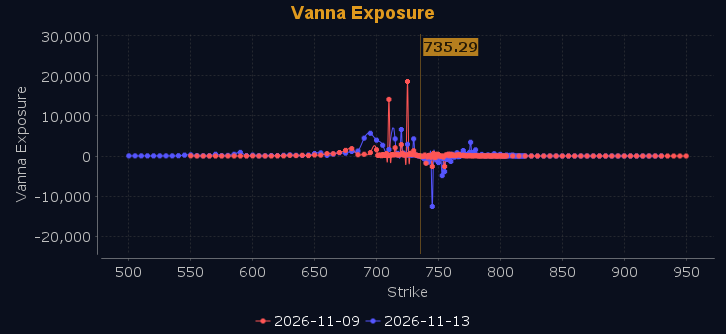
Dealers are selling SPY $736 to $790 and higher strike Calls while buying $740, $745, and $750 Calls in very small size, indicating a modest desire to participate in any continuation rally on Monday. They loaded up long Thursday night, and that paid off handsomely on Friday. But their Call buying is level to level, meaning it only pays if SPY breaks above $740, then $745, and then $750, so there is very little conviction for Monday that prices will move higher. The ceiling for Monday appears to be $746. To the downside, Dealers are buying $735 to $690 and lower strike Puts in a 4:1 ratio to the Calls they're selling, displaying continued concern that prices could move lower. While SPY closed above the 200 DMA, it also closed below the long-term trend line, which now acts as resistance rather than support. There is a Call wall at $740 and a Put wall at $725. Neither is expected to hold on repeated attempts to break through given the heavily negative gamma environment, which implies Dealers will press the trend rather than mean revert it. While Friday's rally hurt the bears a bit, they are still in control. Above $740 is bullish and below $730 is bearish, with chop and traps in between. Dealer positioning is unchanged at slightly bearish.
Looking Ahead to Next Friday:
Dealers are selling SPY $756 to $795 and higher strike Calls while buying $736 to $755 Calls in very large size, indicating the Dealers' belief that a short squeeze is likely to develop next week. The ceiling for the week appears to be $776. To the downside, Dealers are buying $735 to $685 and lower strike Puts in a 4:1 ratio to the Calls they're selling, so they remain heavily hedged against further downside. There is a Call wall at $750 which will provide resistance, with a Put wall above at $745 which will provide only temporary resistance given that gamma is heavily negative. There is support at $730 which may slow any descent, but it will not hold on repeated attempts to break through. Above $740 is bullish and below $730 is bearish, with chop and traps in between. For the week Dealer positioning is unchanged at bearish. We advise reviewing Dealer positioning daily for directional clues. These positions evolve quickly and tracking them is essential for staying ahead of shifting market sentiment.
Recommendation for Traders
Buy dips near $735, targeting $740 and $745, with stops below $730.
With no economic news Monday, technicals rule, so keep size small and review the premarket analysis posted before 9 AM ET for any changes in the model's outlook and Dealer Positioning.
Good luck and good trading!
