
Market Insights: Monday, November 2nd, 2026
Market Overview
Stocks finished mixed Monday as the tech sell-off picked back up and investors braced for another packed week of earnings, Tuesday's midterm elections, and a key jobs report. The Dow edged up 0.4%, but the S&P 500 fell 0.5%, and the Nasdaq gave up early gains to drop more than 1% after a brutal October in which it lost 5.2%. The day started off looking like a comeback. The Nasdaq climbed as much as 1.3% before fading in the afternoon, slipping 0.4% at one point while the S&P 500 dipped 0.1% as stocks hit session lows. The Dow was the clear outlier, holding a 0.6% gain at that stage as money rotated into consumer cyclical, financial services, and consumer defensive stocks. Tech was the problem. The technology sector (XLK) fell 2.4% as of 2:40 p.m. ET, dragged down by hardware and chip stocks. Apple (AAPL) slid nearly 2% ahead of its earnings report after the bell, and AMD (AMD) reports Tuesday after the close, giving Wall Street a fresh read on AI chip demand. That matters because the AI trade is still reeling, and Intel (INTC) didn't help last week. It beat third-quarter expectations but guided fourth-quarter revenue to between $15 billion and $16 billion, well short of the $17 billion analysts wanted. Investors also got a fresh look at AI startup Anthropic, which disclosed third-quarter earnings in an amended version of its S-1 filing. Crypto stayed shaky, with Bitcoin (BTC-USD) dropping 1% to fall below $77,000 as the fallout continued from the $6.3 billion Binance hack, which investigators are calling the biggest crypto heist in history.
Oil was the big mover of the day. Brent crude futures plunged around 7.9% to trade below $105 per barrel, hovering near $104, while WTI crude lost 7.5% to sit near $96. The drop kicked off after Axios reported that while Israeli Prime Minister Benjamin Netanyahu has been pressing the White House for a forceful round of strikes on Iran, President Trump wants to give diplomacy with Tehran another shot. That growing hope for a diplomatic breakthrough comes just a day before midterm elections that could mark a pivotal moment for the Iran war. On the economic front, recent surveys showed US manufacturing expanded in October even as inflation pressures stuck around, and the rest of the week brings several labor market releases that build up to Friday's government jobs report for October. In corporate news, AB InBev (BUD) said Anheuser-Busch CEO Brendan Whitworth will leave the company's North American arm at the end of November to become CEO of high-end gym chain Equinox, trading cheap Bud Light for premium dumbbells after an eventful five-year run. AB InBev CEO Michel Doukeris will step in to lead the North America business until a permanent replacement is named, a role he knows well after running it from January 2018 to June 2021 before becoming AB InBev's CEO in July 2021. Finally, a new survey found that a majority of retirement savers are itching to invest in private assets.
SPY Performance
SPY opened at $759.45, gapping up from yesterday's close of $755.78 and giving the bulls an early chance to stop the bleeding. They took it at first. SPY pushed to a session high of $763.85, clearing yesterday's high of $761.46, the first level we said buyers needed to reclaim. But the rally stalled before it could reach $764.44, the next resistance level we flagged. Once the bounce ran out of steam, sellers stepped back in and pushed SPY all the way down to a session low of $751.60. That came uncomfortably close to yesterday's low of $750.36 but held above it. SPY finished at $752.15, near the bottom of its range and well below its open.
SPY lost 0.47%, a much smaller drop than yesterday's, but the pattern is what matters. For the second straight session, sellers controlled regular trading hours and SPY closed below its open. This time the gap worked in the bulls' favor, and they still couldn't hold it. Rallies that fade back to the lows are a classic sign of a market where sellers are using strength to unload. Volume came in at 46.22 million shares, near average and well below yesterday's heavy turnover. That's a mixed signal. The panic selling eased, but buyers didn't show up with any real conviction either. The VIX doesn't believe the worst is over. It rose 9.42% to close at 21.25, pushing through the 20 mark we said it was knocking on yesterday. Traders kept paying up for protection even though the selling was lighter, and that tells you nerves are still running high.
The bears remain in control. Yesterday's low of $750.36 is still the key line in the sand, and SPY closed just above it. A close beneath that level would confirm that sellers aren't finished and could open the door to a deeper slide. On the upside, today's high of $763.85 is now the first hurdle, followed by $764.44 and $766.62. The bulls need to get back above all three before anyone can call this a bottom. Today's failed rally and a close near the lows, combined with a VIX above 20, all lean bearish. The lighter volume offers a small hint that selling pressure may be cooling, but until buyers can hold a gain into the close, expect choppy, nervous trading. Yesterday the crack split wide open, and today the bulls couldn't patch it.
Major Indices Performance
The Dow led the way with a 0.41% gain, flipping the script after last session's heavy losses and once again showing that blue chips are where investors feel safest when the market gets shaky. Industrials, financials, and defensive names gave money managers a place to park cash while tech kept bleeding. A steep slide in crude also helped, since lower energy costs ease pressure on the kinds of old-economy companies that make up much of the index. It wasn't a huge move, but finishing green on a day when growth stocks got hit again tells you investors are still choosing safety over upside.
The Russell 2000 came in second with a modest 0.11% gain, bouncing back from its rough prior session. Small-caps got a lift from a dip in borrowing costs and that sharp pullback in oil, two factors that tend to help smaller, domestically focused companies with thinner margins and more debt. The gain was slim, though, and it shows that buyers were willing to nibble at small-caps without fully committing. Still, holding positive while the tech-heavy indices sold off suggests rotation away from the market's biggest names is still alive.
The Nasdaq brought up the rear with a 1.07% decline, marking its third straight losing session. Weakness across the megacap group weighed heavily on the index, with a sharp drop in one of the biggest software names doing much of the damage. When the market's largest leaders keep selling off day after day, the Nasdaq has nowhere to hide, and the early bounce attempt faded as sellers took control. The S&P 500 landed between the Russell 2000 and the Nasdaq, held back by its heavy tech weighting. The VIX rose 9.42% to close at 21.25, pushing fear levels even higher after last session's spike. With JOLTS Job Openings and Congressional Elections on Tuesday's calendar, traders have fresh catalysts that could decide whether this rotation continues or the selling spreads.
Notable Stock Movements
Microsoft was the biggest mover in the Magnificent Seven, and it was another tough session for big tech. The software giant fell 2.83% to lead the group's losses, taking over the top spot from Nvidia after the chipmaker's heavy slide last time. That's a notable shift because Microsoft is usually one of the steadier names in the group, the kind of stock investors lean on when things get shaky. When the defensive heavyweight starts leading the way down, it tells you the selling pressure has spread beyond the high-flying AI chip names and into the core of mega-cap tech.
The group finished mostly red for a fourth straight session, but there were real bright spots this time. Amazon stood out with a 2.20% gain, and Tesla also managed to finish in the green. That's a better showing than last session, when Nvidia's drop dragged everything down and nobody could find footing. Having two names push higher while the rest struggled suggests buyers are starting to get selective again instead of dumping the whole group. Still, four days of mostly red is a streak that's hard to ignore, and Amazon and Tesla will need to build on today's strength to show this is more than a one-day bounce.
The broader market looked more like a rotation than the across-the-board selling from last time. The Nasdaq slipped 1.07% as tech stayed under pressure, but the Dow gained 0.41% and the Russell 2000 edged up 0.11%. That's a big improvement over last session, when there was nowhere to hide. Money moved out of tech and into other corners of the market rather than heading for the exits completely. The VIX, however, rose 9.42% to 21.25, breaking above that key 20 level that separates normal jitters from real fear. Tuesday brings JOLTS Job Openings at 10:00 AM ET and Congressional Elections, so headlines and political uncertainty could keep traders on edge. If Microsoft can find buyers and Amazon keeps its momentum, big tech could start to stabilize. But if the selling spreads further and the VIX keeps climbing, the group's losing streak could stretch on.
Commodity and Cryptocurrency Updates
Crude oil got slammed, plunging 8.07% to close at $95.72. After pushing higher in the prior session, the black gold saw a wave of selling that knocked it back below the $100 mark it had been holding. A drop this violent suggests traders rushed to take profits, possibly on hopes that some of the geopolitical tensions and supply disruptions behind the rally may be easing. Even so, crude remains well above $70 and continues to defy longer-term model expectations, so one rough day doesn't erase the bigger move. Tuesday's JOLTS Job Openings report could shape the demand outlook, while energy traders will keep watching headlines for any shift in the supply picture. A sustained move this far above $70 keeps inflationary pressure in focus and could complicate Fed policy if energy prices stay elevated.
Gold bounced back, rising 1.50% to close at $3,957. That snaps a two-day losing streak and recovers a good chunk of the prior session's heavy damage. With fear picking up across the market, some investors appear to have rotated back into the yellow metal as a safe haven. The long-term case still has support from inflation uncertainty, steady central bank buying, and ongoing geopolitical tensions. Still, gold sits below the key $4,000 level, and bulls haven't fully repaired the breakdown yet. Reclaiming $4,000 would go a long way toward showing the recent drop was a flush rather than the start of a deeper correction, while failing to get back above it would keep sellers in the conversation.
Bitcoin kept sliding, falling 1.96% to close below $76,713. That marks a third straight decline and keeps the crypto firmly below the $80,000 psychological level that had anchored the base-building story. Weakness in tech names weighed on risk appetite again, and Bitcoin followed right along, showing it still trades like a risk asset when fear rises. The recent bounce looks more like a short-lived relief rally with each passing session. With JOLTS data and Congressional Elections on Tuesday's calendar, Bitcoin will likely take its cues from overall risk sentiment. Bulls need a push back above $80,000 to repair the damage, while continued weakness would open the door to a deeper pullback.
Treasury Yield Information
The 10-year Treasury yield slipped 0.71% today to close at 4.890, its third straight decline and another step away from the 5% line it broke last week. The pace of the drop slowed compared to yesterday, but the direction is what matters, and bond buyers are steadily chipping away at the worst of the rate pressure. Still, the 10-year remains well inside the danger zone for stocks, and today's mixed equity tape showed that lower yields are helping some corners of the market more than others.
Measured against each threshold, the picture keeps getting better without getting comfortable. The 4.5% level where equity valuations start to feel the squeeze is still 39 basis points below today's close, and the 4.8% mark that usually triggers broader selling is now just 9 basis points away. The 5% serious-risk flag has 11 basis points of cushion, up from 7 yesterday, which gives the market a little more breathing room. The gap to 5.2%, where the framework calls for a 20% or greater correction, widened to 31 basis points, pushing the worst-case scenario a bit further into the distance.
The more encouraging signal is that rate-sensitive stocks finally responded. The Dow gained 0.41% and the Russell 2000 edged up 0.11%, a sign that small caps and value names are starting to feel the relief from easing yields. The Nasdaq fell 1.07%, but that weakness looks tied to pressure in big tech rather than a rates problem. The safe-haven tone hasn't disappeared, though. The VIX rose 9.42% to 21.25, and gold climbed 1.50% to $3,957, so some of the money flowing into Treasuries is still driven by nerves. The biggest development for bonds was crude plunging 8.07% to $95.72. A drop that sharp in energy prices takes real heat off inflation expectations, and that gives yields a fundamental reason to keep falling instead of relying only on fear.
Tuesday brings the JOLTS Job Openings report at 10:00 AM ET, and a softer number would point to a cooling labor market and could help push the 10-year through 4.8%. A hot reading could spark a quick bounce back toward 4.95% or higher. Congressional Elections add another layer of uncertainty, and any surprises could stir up fresh safe-haven demand or a sharp reversal in bonds. The level to watch remains 4.8%. A close below it would mark the first real break in the rate pressure that has been weighing on stocks, and with oil cooling off, that target is closer than it's been in a while.
Previous Day’s Forecast Analysis
Heading into Monday, our AI model projected SPY's maximum range at $747 to $765, with the Put side dominating an expanding band. That setup pointed to trending price action with intermittent chop. With no economic news on the calendar, the forecast called for the market to trade on technicals, and macro headlines were flagged as the wildcard that could push price outside the range. Friday's selloff had left SPY sitting right on the model's first support at $755, just below the middle of the projected range. Combined with the Put-heavy tilt and a VIX that jumped 16.22% to 19.99, that gave us a bearish bias for the session.
The $755 to $758 zone was identified as the key battleground. On the upside, $758 was the first resistance, with $760 next, $765 marking the top of the range, and $767 and $770 as stretch targets. On the downside, losing $755 was expected to open the door to $753, then $750, and then $745 as the lowest support and the bulls' last line of defense. A break of $745 risked a quick slide toward $740. The bigger picture was still considered healthy, with SPY well above structural support near $640 and Friday's damage viewed as a pullback within the uptrend rather than a breakdown.
The trading approach favored fading strength while waiting for a dip-buying opportunity lower down. The cleanest bearish setup was shorting a failed rally into $758 to $760, targeting $755 and $753, with runners aiming for $750 and $747 as a stretch target. Stops went above $763, or just above $761 for aggressive traders. A conviction break below $745 called for shorting a failed retest from underneath, targeting $740 with stops just above $748. On the bullish side, buying a dip at $750 was the favored trade and the best risk-reward setup. Targets were $753 and $755, runners could aim for $758 and $760, and stops sat below $745. If bulls reclaimed and held $760, a clean retest of that level was a buy targeting $765, with $767 for runners and stops below $757. Traders were advised to cut size to roughly half of normal through the first hour, use stops in the 0.75-1% range, and let the open settle before committing capital. Bears were expected to hold short-term momentum as long as $760 capped the upside.
Market Performance vs. Forecast
Monday's session played out entirely inside the model's projected maximum range of $747 to $765, with price never testing either boundary. SPY opened at $759.45, pushed to a high of $763.85, slid to a low of $751.60 and closed at $752.15, down 0.47%. The forecast called for a bearish bias, and sellers controlled the back half of the session, sending price to close near the lows. The model expected trending price action with intermittent chop, and that is exactly the shape of the day. An early push higher gave way to a steady grind lower. With no economic news on the calendar, the forecast flagged macro headlines as the wildcard. The model does not account for unpredictable external events, and the morning rally showed how quickly sentiment can swing before the underlying bearish tilt reasserts itself.
The key levels did their job. The forecast named $755 as the battleground that would set the tone, and sellers won that fight decisively, driving price through $755 and $753 on the way to the session low. The rally attempt stalled at $763.85, short of the $765 top of the range, confirming that the upper boundary capped buyers. The forecast said the bears hold short-term momentum as long as $760 caps the upside. Bulls briefly poked above that level but couldn't hold it, and the failed breakout turned into the trending move lower the model anticipated. The session low held above $750, so the deeper downside levels at $750, $747 and $745 stayed intact.
On the falling market side, the short at a failed rally into $758 to $760 played out in two stages. The early push above $763 reached the stop level on shorts, and risk management protocols protected capital. The rally then rolled over just as the playbook described, and the downside targets came into play from there. The forecast flagged a VIX push back above 20 while price failed to hold gains as the key confirmation signal, and that signal fired clearly. Both $755 and $753 were reached, with the $750 runner target left just out of reach. On the rising market side, the breakout above $760 never produced a clean retest as support. Price slipped back below $757, so risk management protocols again protected capital on that setup. The favored $750 dip-buy never activated because the session low stopped short of that level. The guidance to start longs light and wait for the tape to confirm direction kept exposure small on a day that ultimately favored sellers.
The VIX rose 9.42% to 21.25, pushing fear above the 20 mark the forecast had flagged as a key threshold. Volume ran near average, showing orderly distribution rather than panic. The advice to cut size in half through the first hour and give stops extra breathing room proved its worth in a session that whipsawed early before trending. The bearish bias, the $755 battleground and the range boundaries all held up across levels the forecast had already mapped. The framework adapts as conditions shift, and Monday showed how a disciplined plan keeps traders on the right side of the dominant trend. With the long-term bull trend intact above structural support near $640, the framework remains a reliable guide for managing risk and capturing opportunity in either direction.
Premarket Analysis Summary
The premarket analysis, posted before the opening bell, set up Monday's session to open the week with SPY at $758.49 in a put-dominated tape, bouncing hard after Friday's slide, the sharpest in months, ran through $760, $755 and $752 before buyers stepped in near $750. The bias hinged on $760, the defining level and the heaviest two-way battle on the board, sitting directly overhead as the gate. Reclaiming and holding it would mark Friday as a flush, while failing there would fade the bounce and put the lows back in play. The expected move ran from $749 to $765, with far more room priced below than above, and the notes warned that in a put-dominated tape moves accelerate and the first hour would decide whether the bounce had anything behind it. Upside targets stepped through $762, then $763 as the next decision point, $765 as the top of the expected move, Thursday's old floor and the level bulls really needed, and $767 as max upside. On the downside, $757 was the first level to watch, where a clean loss would signal a failing bounce. Below that sat $755 as the next decision point and the floor of Friday's close, $753 as the point of last hope and heaviest support, and $750 as max downside, with a wall of interest beneath it.
Both halves of the map came into play. SPY opened at $759.45, just under the gate, then reclaimed $760 and pushed through $762 and $763 to a high of $763.85. That was as far as it went, though, as the rally stalled short of the $765 test bulls really needed and couldn't hold above the gate. Once sellers took control, the warning about accelerating moves proved accurate, as price sliced through $757, $755 and the $753 point of last hope to a low of $751.60, stopping just above the $750 max downside. SPY closed at $752.15, down 0.47% on 46.22M shares of near-average volume. The VIX rose 9.42% to 21.25, showing fear continuing to build. The key takeaway is that bulls won the gate early but failed the real test at $765, and the bounce faded just as the notes cautioned. Bulls now need to reclaim $755 and then $760 to regain control, while a loss of $750 would open the door below the expected move.
Validation of the Analysis
Monday's session respected the premarket map from top to bottom, with SPY touching both sides of the board before settling on the bearish branch of the notes' central scenario. The notes were written with spot at 758.49, and SPY opened at $759.45, just 96 cents above spot and 55 cents shy of $760, "the gate right above us." The notes made the setup simple: "reclaim and hold it and Friday was a flush, fail there and this bounce fades with the lows back in play." Bulls did win the first round. SPY pushed through $760, tagged $762, "the first target," and cleared $763, "the next decision point." The rally topped at $763.85, stalling $1.15 short of $765, the level the notes said "bulls really need." That missing piece was the tell. Price reclaimed the gate but never held it, and the bounce had nothing left behind it.
Once the push failed short of $765, the downside staircase played out just as the notes described. SPY gave back $760, then lost $757, the level where the notes warned "the bounce is failing." From there it was the "fast trip to 755" the notes flagged, followed by the "real fight at 753," our point of last hope. Buyers lost that fight. SPY sliced under $753 and printed a session low of $751.60, holding $1.60 above $750, the max downside where Friday's selling stopped and where the notes pointed to "a wall of interest beneath it." That wall held for the second straight session. SPY closed at $752.15, down 0.47%, finishing 85 cents below $753. Going out under the point of last hope left $750 squarely in play. The day's whole range sat inside the 749 to 765 expected move, and the notes' warning that "moves accelerate" in a put-dominated tape proved spot on. SPY swung more than 12 points from high to low. The VIX rose 9.42% to 21.25, and near-average volume showed this was a steady unwind of the bounce rather than a panic.
The trading value came from knowing both paths before the bell. The first setup was the long on the $760 reclaim. The notes said "762 then 763 come quickly," and they did. That delivered a clean 3-point run to the decision point with risk defined just below the gate, plus a little extra toward the high. The bigger opportunity was the short once $765 failed to arrive. Traders fading the stall near $763 had a mapped path through $760, $757, $755, and $753. Price delivered an 11.40-point drop from $763 to the $751.60 low, nearly all of it along levels flagged before the open. The map also kept traders disciplined. With $765 never reached, there was no reason to chase toward $767. And with the wall near $750 holding again, there was no reason to press shorts into the hole. A session that reclaimed the gate, stalled below the key target, and cascaded down to the edge of max downside shows how tightly these levels framed the day. Heading into Tuesday, bulls need to reclaim $753 and $755 to keep the $750 floor intact. Bears need a clean break of $750 to open a deeper leg beneath the expected move.
Looking Ahead
Tuesday brings a two-part setup for traders. First up is JOLTS Job Openings at 10:00 AM ET, a medium-impact release that offers a closer look at how much demand employers still have for workers. There's no pre-market data to jolt futures before the opening bell, so the first half hour will likely be driven by positioning and overnight headlines. Once JOLTS hits, it could set the tone for the rest of the day. A drop in openings would add to the case that the labor market is cooling, which could feed rate-cut hopes but also raise growth concerns. A stronger reading would suggest hiring demand is holding up, and that could cool expectations for Fed easing. Either way, it's a fresh piece of the labor puzzle, and the market will be quick to decide which story it wants to believe.
The bigger wildcard is the Congressional Elections. Polls won't close until the evening, so actual results won't land during the trading session, but that doesn't mean they won't matter. Expect some caution as investors weigh how control of Congress could shape spending, taxes, and regulation, and some traders may trim risk rather than hold big bets into an uncertain outcome. That kind of hesitation can make for choppy, range-bound trading, with sector moves tied to how each party's agenda might affect industries like energy, healthcare, and defense. Don't overreact to early swings, and be careful about loading up on positions that depend on a specific election result. Keep position sizes reasonable and stops in place, let the JOLTS reaction settle before committing new capital, and stay flexible enough to adjust once the results start rolling in after the close.
Market Sentiment and Key Levels
Monday kept the bears in charge, but the story looked different from Friday's broad flush. Buyers showed up early and then lost their grip, and the steady fade into the close tells you sellers are still leaning on every bounce. The damage was concentrated in tech. The Nasdaq fell 1.07% while the Dow gained 0.41% and the Russell 2000 added 0.11%. That split brings back the rotation argument we lost on Friday. Money is leaving the growth-heavy names and finding a home in blue chips and small caps instead of leaving equities altogether. That's a healthier look than a market-wide liquidation, but it doesn't help the cap-weighted averages much when the biggest engines are sputtering. Mega-cap leadership was mostly red again, and that drag is the main reason SPY couldn't hold its early strength. Across other assets, Bitcoin slid 1.96% while gold rallied 1.50%. After getting sold alongside everything else on Friday, the safe-haven trade is working again, which hints that traders are shifting into defense rather than dumping risk indiscriminately. The VIX rose 9.42% to 21.25, pushing fear back above the 20 threshold and confirming nobody is ready to call the bottom. Bears own the short-term momentum heading into Tuesday.
SPY closed just above first support at $750, which makes that the line in the sand for Tuesday. First resistance sits overhead at $755. A push through there opens the door to $757, followed by $759 and $762 if buyers can mount a real recovery. On the downside, losing $750 likely sends SPY toward $745, then $740 and $736. If $736 gives way, there is little to keep price from falling toward $730. Zoom out and the bigger picture still holds up. The long-term bull trend remains intact well above structural support at $640, and this pullback is still playing out inside the broader uptrend. That keeps the backdrop a dip-buying environment as long as key structural levels hold. Tuesday's projected maximum range runs from $744 to $762, with the Put side dominating in an expanding band that points to trending price action mixed with intermittent chop. That makes four straight sessions of Put-side control, and the widening band says volatility isn't finished yet. The calendar gets busier, too. JOLTS Job Openings hits at 10:00 AM ET, a medium-impact release that could stir things up shortly after the open, and it is Election Day, with the midterm results arriving after the close. Political uncertainty is a live catalyst that could keep traders cautious and add extra swings. Watch whether tech finds a floor or keeps bleeding, since sustained weakness in both mega-cap names and crypto would be needed to signal a deeper pullback. Yields and energy prices remain background factors that could amplify any selling if inflation worries flare up. With SPY sitting near support and the Put side in control, we favor shorting rallies near $755. Let the JOLTS reaction settle before committing, size positions carefully given the elevated VIX, and treat a decisive reclaim of $757 as the signal to step aside from the short side.
Expected Price Action
Tuesday's session brings actionable intelligence generated by our AI model, which projects SPY's maximum range at $744 to $762. With the Put side dominating in an expanding band, the model is calling for trending price action with intermittent chop. Tuesday brings JOLTS Job Openings at 10:00 AM ET, a medium-impact release that could stir up movement shortly after the open, and it is Election Day, with the midterm results arriving after the close. Political uncertainty is a live catalyst that could keep traders cautious and add extra swings throughout the day. Monday's fade left SPY finishing below the middle of Tuesday's projected range and hovering just above the model's first support at $750. Combined with the Put-heavy tilt of the band, that gives us a bearish bias heading into Tuesday. The VIX rose 9.42% to 21.25, signaling elevated fear as election uncertainty builds. More fear with sellers in control means support could get tested early.
The key battleground for Tuesday is the $750 to $755 zone. $755 is the first resistance and the gate bulls need to clear. A clean push through $755 opens the door toward $757, with $759 next and $762 marking the top of the model's range. On the downside, losing $750 likely sends price toward $745, followed by $740 and then $736, the lowest support and the point of last hope for bulls. If $736 breaks, there is little to keep price from falling toward $730. The bigger picture remains healthy, with SPY well above structural support near $640 and the long-term bull trend intact. As long as price holds above key structural levels, this is still a dip-buying market on a broader timeframe.
In the short run, the playbook favors shorting rallies near $755. A bounce into $755 or $757 that stalls sets up a short with $750 and $745 as targets. A break below $750 that holds likely turns Tuesday into a trend toward $745, and a move into the $740 area is where dip buyers may start to show up. If $736 cracks, step aside rather than try to catch a falling knife, because $730 can come quickly. If buyers instead reclaim $759 with conviction, the bearish lean fades and a run toward $762 is on the table. Between the jobs data and the election headlines, the first hour likely decides which side controls the fight at $750.
Trading Strategy
The VIX rose 9.42% to 21.25, pushing fear back above the 20 mark and confirming that traders are still paying up for protection after the steady afternoon fade. Tuesday brings JOLTS Job Openings at 10:00 AM ET and it is Election Day, so expect a quick jolt of movement shortly after the open and political headlines that can whip price through levels with little warning, with the midterm results themselves landing after the close. With volatility elevated, keep size at roughly half of normal through the first hour and give stops a bit more breathing room in the 0.75-1% range from entry. The Put side controls an expanding band, and the trending action with intermittent chop the model expects means early moves can reverse hard. Let the data hit and the tape settle before committing capital.
In a falling market scenario, shorting a failed rally into $755 to $757 is our favored trade and the cleanest bearish setup on the board. A bounce that stalls in that zone and rolls over is the primary trigger, especially if the VIX holds above 21.25 while price fails to build on gains. The first profit target is $750, with $745 next if sellers keep pressing. Runners can aim for the projected low at $744, which should be treated as a stretch target on a heavy trend-down day. Stops on shorts belong above $759, and aggressive traders can tighten to just above $757. If price loses $745 with conviction, don't chase the flush. Short a failed retest of $745 from underneath instead, targeting $740 and then $736. Stops on that breakdown trade belong just above $750. If $736 gives way, there is little to keep price from sliding toward $730, but take most profits into $736 and let only a small runner ride. Scale out in layers into support, because selloffs fueled by headline risk can snap back violently once sellers run out of ammo.
In a rising market scenario, buying a dip at $750 that holds and firms up is the best long setup, particularly if the VIX cools off from 21.25 while buyers defend first support. The initial profit target is $755, with $757 next as price works back toward resistance. Runners can press toward $759, where sellers are likely waiting. Stops on longs belong below $744, just under the projected low of the range. If bulls reclaim $759 and hold it, buy a clean retest of $759 as support, targeting $762 at the top of the projected range. Stops on that breakout trade belong below $757. With puts in charge of the band and fear rising into an event-heavy morning, any long should start light and add only once the tape confirms direction. The long-term bull trend remains intact above $640, and this is still a dip-buying environment, so the $750 zone is where we want to be a buyer, not a seller. For now, the bears hold short-term momentum as long as $755 caps the upside.
Model’s Projected Range
SPY's projected maximum range for Tuesday is $744 to $762, with the Put side dominating in an expanding band that suggests trending price action with intermittent chop. Tuesday brings JOLTS Job Openings at 10:00 AM ET, a medium-impact release that could stir up some movement shortly after the open, and it is Election Day, with the midterm results arriving after the close. In today's session, SPY opened at $759.45, pushed up to a high of $763.85, then sold off steadily to a low of $751.60 before closing at $752.15, down 0.47%, as buyers couldn't hold the early strength. SPY is trading near our model's first support at $750, and with Congressional Elections on deck, political uncertainty is a live catalyst that could keep traders cautious and add some extra swings. If SPY can push through first resistance at $755, the door opens toward $757, but if first support at $750 gives way, price likely slides toward $745, and if the lowest support at $736 breaks, there is little to keep price from falling toward $730. The long-term bull trend remains intact above $640 with SPY well above structural support. As long as price holds above key structural levels, this remains a broader dip-buying environment. Absent a catalyst, resistance sits at $755, $757, $759, $762, while support rests at $750, $745, $740, $736. With SPY closing below the middle of the range and the Put side in control, we favor shorting rallies near $755. Bitcoin fell 1.96% to close below $76,713, while the MAG stocks had a mostly red day led by Microsoft down 2.83%, with Amazon the lone standout, up 2.20%. Sustained weakness across both leadership groups would be required to signal a deeper pullback. The VIX closed at 21.25, up 9.42%, suggesting elevated fear given the intraday selloff and election uncertainty heading into Tuesday. On the bigger picture, SPY remains well above structural support near $640, so the broader trend stays intact even as short-term pressure builds.
Market State Indicator (MSI) Forecast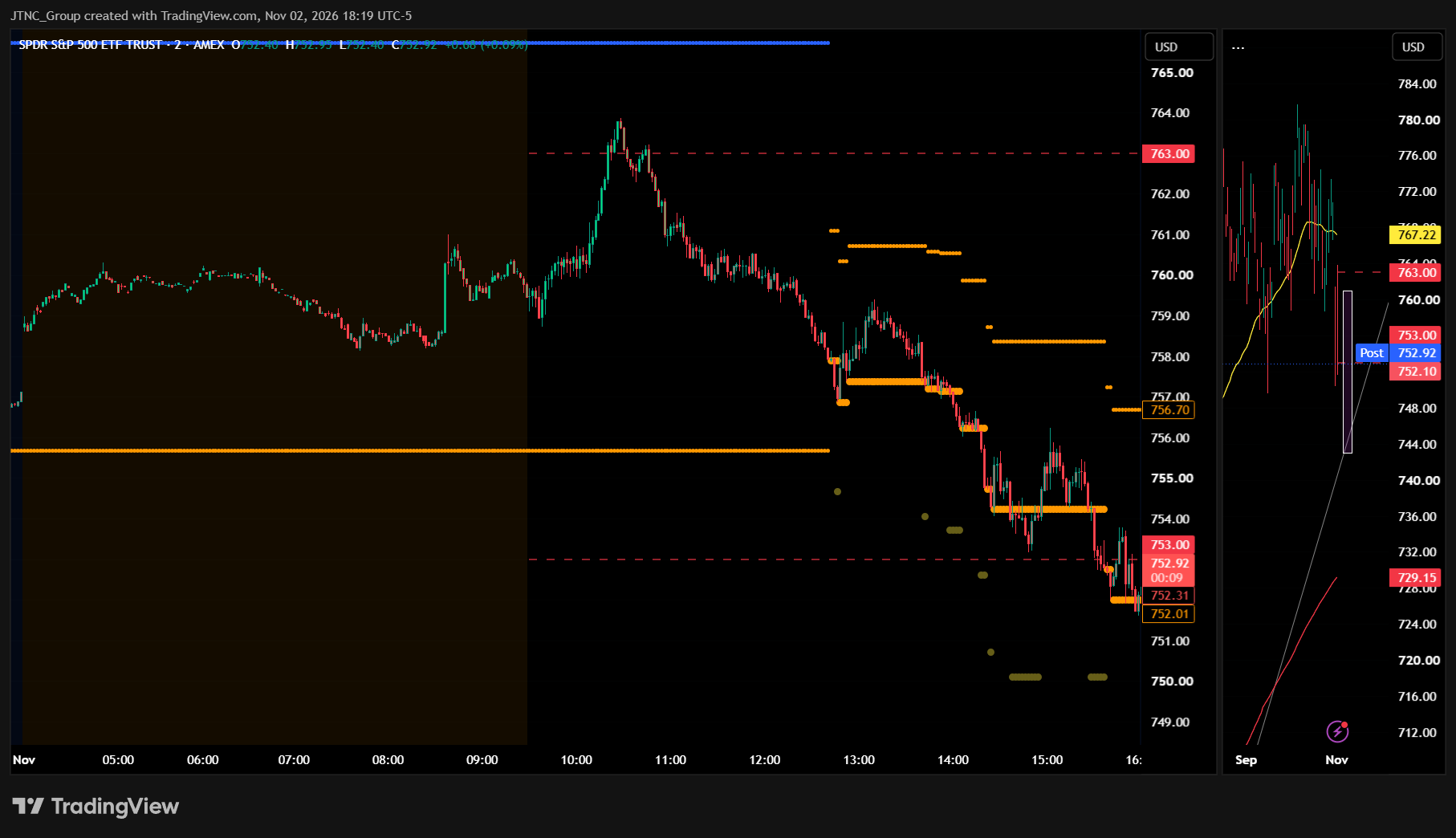
Current Market State Overview:
The MSI ended Monday in a Bearish Trending Market State with SPY closing at $752.15. MSI resistance is $756.70 and MSI support is $752.01 heading into Tuesday's session. The MSI did not rescale overnight and remained in a Ranging state into the open, with no extended targets printing in the premarket. At the open SPY moved higher and continued to $763, where it found major resistance. Early in the afternoon the MSI began a series of rapid rescalings lower, which saw it rescale to a Bearish Trending state with extended targets printing below. That continued into the close, with SPY and QQQ giving up all of the day's earlier gains. By the final bell the extended targets had stopped printing, and the MSI settled into a wide $4.69 bearish state.
For Tuesday the MSI is forecasting that rallies will be sold, and therefore MSI resistance at $756.70 is likely to hold. The wide bearish state says the sellers are in control, while the absence of extended targets at the close says they stopped pressing into the bell rather than chasing price lower. Should extended targets start printing below once again, a test of lower levels is likely.
Key Levels and Market Movements:
Friday we stated, "Bulls want to see overnight price hold $755.68 and build on the late-day reversal," and added, "Bears want to see $755.68 fail, with the MSI rescaling lower and extended targets printing below again," while also noting, "If SPY breaks below $755.68 with extended targets printing below, sell rallies into $755.68 targeting $750.36 and $750."
Both scripts played out, just at different times of the day. The bulls owned the morning. The MSI held its Ranging state overnight, SPY opened at $759.45 well above $755.68, and buyers pushed straight through $760 and Friday's $761.46 high. For a few hours it looked like Friday's $750 low was a real bottom. Then SPY ran into $763 major resistance, topped out at $763.85, and stalled. That was the turning point.
The afternoon belonged to the bears. The MSI began rapid rescalings lower and flipped to a Bearish Trending state with extended targets printing below, and from there it was a steady grind lower. SPY gave back $760, then sliced through $755.68, which was exactly the bear case we laid out. Every bounce was sold, and the MSI kept rescaling lower into the final hour. SPY bottomed at $751.60, just shy of Friday's $750.36 low, and closed at $752.15.
Four trades followed. The first was the failed rally at $763 major resistance. Friday's plan called a rejected rally toward the top of the range an even better short, and once SPY stalled at $763.85 and rolled over, selling the failure targeting $760 and $755.68 paid off. The second came when the MSI first flipped to Bearish Trending. That setup was selling the test of the new MSI resistance and riding it to the new MSI support as extended targets printed below. The third came during the rapid rescalings lower, where each retest of the newly rescaled MSI resistance was a fresh short targeting the lower line. The fourth was the break of $755.68. With extended targets printing below, selling rallies into the final MSI resistance at $756.70 targeting $752.01 worked into the close.
SPY fell 0.47% on volume of 46.22 million shares, near average, so the selling was steady rather than panicked. The VIX rose 9.42% to 21.25, and fear is now sitting above 20, which tells us traders are getting nervous again. It was a volatile but readable day with substantial setups, all identified through proper context, patience, and flexibility while leveraging the MSI, premarket levels, and market structure rather than forcing trades. The MSI continues to prove its reliability as the cornerstone of our trading process.
Trading Strategy Based on MSI:
Tuesday brings JOLTS Job Openings at 10:00 AM ET, and it is Election Day, with the midterm results arriving after the close. Election headlines can create sharp swings in either direction, so let the MSI confirm before pressing. The MSI closed in a wide $4.69 Bearish Trending state with no extended targets printing, which says rallies are likely to be sold and $756.70 is likely to hold as resistance. $756.70 remains MSI resistance and $752.01 remains MSI support.
Bulls want to see overnight price hold $752.01 and stabilize after Monday's reversal. From there they need to reclaim $756.70 with the MSI rescaling higher and extended targets printing above, which would open a push back toward $760 and $763 major resistance. That would turn Monday's selloff into a shakeout instead of a breakdown. Bears want to see $752.01 fail with the MSI rescaling lower and extended targets printing below again. That would press SPY through Monday's $751.60 low and toward Friday's $750.36 low and $750 major support, with $740 the next level of consequence below.
In a wide Bearish Trending state the bears have control, and any rally into $756.70 that fails is the primary short, targeting $752.01. If SPY breaks below $752.01 with extended targets printing below, that level flips to resistance, and traders can sell rallies into it while targeting $751.60, $750.36, and $750. A failed breakdown below $752.01 that quickly reclaims the level could offer a long back toward $756.70, but that is a counter-trend trade, so keep it small. If bulls reclaim and hold $756.70 with the MSI rescaling higher, that would signal a real change in control. Until then, rallies are for selling.
The long-term bull trend remains intact above $640 and failed breakouts and failed breakdowns continue to offer the highest-probability setups. Remain flexible, avoid trading during Ranging Market States unless a clear failed breakout or breakdown presents itself, and ensure all trades are fully aligned with MSI signals. Providing real-time insights into market control, momentum shifts, and actionable levels, the MSI when integrated with our Pre-Market and Post-Market Reports continues to sharpen execution precision and elevate trade quality. If you haven't yet integrated MSI and our model levels into your process, now is the time. Contact your representative to get started as these tools are designed to support consistency and enhance performance.
Dealer Positioning Analysis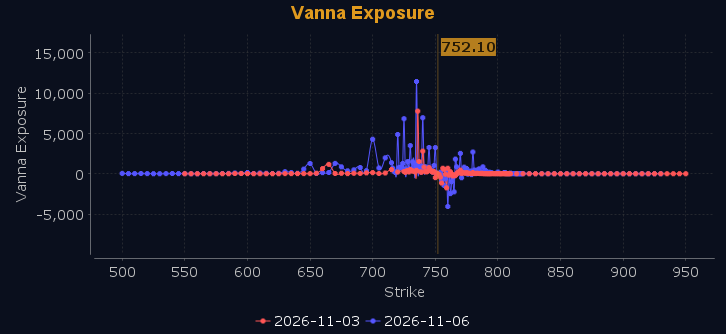
Dealers are selling SPY $756 to $790 and higher strike Calls while buying $755 and $759 Calls, indicating the Dealers' desire to participate in any relief rally on Tuesday should price break $755. They are no longer selling ATM Puts, and while SPY held above the $740 floor, they are not as confident that prices will rally as they were on Friday. The ceiling for Tuesday appears to be $760. To the downside, Dealers are buying $752 to $690 and lower strike Puts in a 4:1 ratio to the Calls they're selling, displaying continued concern that prices could move lower. There is a Call wall below at $750 which will act as temporary support, with a Put wall at $740. With negative gamma, both of these are likely to fail on repeated attempts to break through. Above $763 is bullish and below $760 is bearish, with chop and traps in between. $740 is the lower trend line support from last April as well as the 150 DMA, so it is a logical candidate for an interim low. Dealer positioning has changed to slightly bearish.
Looking Ahead to Next Friday:
Dealers are selling SPY $766 to $805 and higher strike Calls while buying $753 and $765 Calls, indicating the Dealers' desire to participate in any relief rally later this week. Nineteen of the last nineteen midterm elections have been followed by a market rally, so perhaps Dealers are interested in participating should they make it twenty for twenty. The ceiling for the week appears to be $770. To the downside, Dealers are buying $752 to $695 and lower strike Puts in a 4:1 ratio to the Calls they're selling, so they remain heavily hedged against further downside. There is a Call wall at $770 which will provide resistance, with a Put wall at $740 which will provide support. But with heavily negative gamma, these walls are unlikely to hold once price reaches those levels. Below $767 is bearish and above $770 is bullish, with chop and traps in between. Gamma flips positive as price approaches $770, and therefore it's more likely that SPY will mean revert rather than break through that level. A move below $740 could lead to significantly lower prices, possibly as low as the 200 DMA at $729. For the week Dealer positioning is unchanged at bearish. We advise reviewing Dealer positioning daily for directional clues. These positions evolve quickly and tracking them is essential for staying ahead of shifting market sentiment.
Recommendation for Traders
Short rallies near $755, targeting $750 and $745, with stops above $757.
With JOLTS and Congressional Elections on deck, keep size light and review the premarket analysis posted before 9 AM ET for any changes in the model's outlook and Dealer Positioning.
Good luck and good trading!
