
Market Insights: Wednesday, October 7th, 2026
Market Overview
Stocks finally took a breather Wednesday, slipping from record highs as global bond yields climbed and oil pushed back toward $100 a barrel. The Dow dropped 0.6%, while the S&P 500 and Nasdaq each slipped 0.2% after notching fresh records earlier in the week. The 30-year Treasury yield hit its highest level since 2002 before paring gains to close at 5.66%. Brent crude futures hovered near $100 per barrel amid the latest Houthi attacks in the Middle East, a reminder that the forces weighing on markets this year haven't gone away. The afternoon's main event was the release of the Fed's September meeting minutes, which showed officials leaning toward another rate hike before year-end. The minutes noted that "most participants assessed that another increase in the target range for the federal funds rate would likely be appropriate by year end," though no timeline was given, and policymakers "emphasized that they approached each meeting with an open mind and decisions at future meetings would depend on incoming information." Traders priced in roughly 17% odds of a hike at next week's October meeting. Bullish earnings estimates had lifted sentiment this week, but as Yahoo Finance's Brian Sozzi pointed out Tuesday, those records mask a highly concentrated market where Nvidia, Apple, and Microsoft make up roughly a fifth of the S&P 500. AI chip darlings like Nvidia and AMD eased just off their all-time highs, while Bitcoin fell to $83,000 amid a wave of forced liquidations over the past 24 hours. Levi Strauss and Applied Digital are on the earnings docket.
Webull was the day's big loser, plunging 20% for what was shaping up to be its worst daily drop since April 17, 2025, after US lawmakers reportedly flagged the company as "tied in structural ways" to China's government. CNBC reported that a bipartisan House Select Committee on China assessment found the company poses a national security risk, with concerns about its operations having "escalated" over the past year, and the stock has now cratered 40% over the past month. Some well-known names face an even longer road back. Bespoke pointed out that seven S&P 500 stocks with market caps above $20 billion need to gain at least 200% to reclaim their all-time highs: PG&E, PayPal, Ford, Nike, Las Vegas Sands, Zoetis, and Crown Castle. PayPal and Nike best capture the common thread of tough industry conditions, management missteps, underwhelming financial years, and fading investor confidence. On the AI front, Anthropic unveiled Claude Haiku 5.5, the latest in its Claude 5.5 family, calling it the company's best lightweight model yet and saying it beats Haiku 4.5 in coding, computer use, and knowledge work at a lower cost. Haiku is built for quick, low-cost tasks, while Sonnet and Opus handle higher-level coding and enterprise work, and Fable, its most powerful model, is designed for days-long workloads. Meanwhile, SailPoint CEO Mark McClain argued on Sozzi Unleashed that humans need the ability to instantly shut down AI agents that harm a business, saying "the ultimate protection is a kill switch," while warning that "there's a danger in an unsophisticated kill switch."
SPY Performance
SPY opened at $775.77, gapping down below yesterday's close of $779.14 and slipping under the $776.61 level right at the open. That quickly put the gap from the prior session in play, and sellers filled it early. SPY dropped to a session low of $773.61, fully closing the gap and testing the bulls' resolve. They held, though. The low stayed comfortably above the earlier breakout level around $772.65, and buyers stepped in to push SPY back to a session high of $779.10. That rally stalled just shy of yesterday's close, which kept today from turning green. SPY then eased off and finished at $777.26, near the middle of the day's range and back above the $776.61 level.
SPY slipped 0.23%, snapping its four-day winning streak. Volume came in at 26.19 million shares, below average and even lighter than the prior session's already soft participation. That's actually a positive detail here. A small pullback on fading volume looks more like routine profit-taking after a strong run than real distribution. If sellers were serious, you'd expect heavier volume and a close near the lows, and neither happened. The candle tells a similar story. It has a long lower wick showing buyers defended the dip and a small body that reflects indecision rather than panic. The VIX dropped 0.27% to close at 14.97, staying below the 15 level even on a red day. That's encouraging, since a calm volatility reading during a pullback suggests traders aren't rushing to buy protection. The bigger picture remains bullish. SPY filled its gap, found support above the prior breakout, and recovered most of the early losses. Going forward, today's low around $773.61 is the first support level to watch, with $772.65 just below it as the key line of defense. If SPY holds that zone, today was just a healthy breather inside the uptrend. A push back above $779.14 would put the bulls back in control and set up another run at the recent high of $781.62, while a break below $772.65 would signal that a deeper cooling period is underway.
Major Indices Performance
The Nasdaq held up best on a down day, slipping just 0.22% and snapping its three-session winning streak. Mega-cap tech did most of the defending, with the majority of the big names finishing green and keeping the damage small. A few heavyweight laggards were enough to tip the index into the red. Still, a shallow pullback after three straight gains looks more like a breather than a breakdown, and growth continues to show it can hold its ground when the rest of the market wobbles.
The Dow dropped 0.66%, ending its four-session winning streak just one day after finally grabbing the lead. Energy, which gave blue chips a boost last session, couldn't repeat the trick as oil slipped back into the red. That left the old-economy names without their main support. It's a quick reversal of the rotation story. Value buyers stepped back almost as fast as they stepped in, which suggests the move into defensive corners was more of a one-day bounce than a lasting shift.
The Russell 2000 was the clear laggard for a second straight session, tumbling 1.3% and extending its losing streak to two days. Small-caps took the hardest hit as higher borrowing costs weighed on rate-sensitive names that rely heavily on financing to grow. Back-to-back sharp declines in the riskier end of the market show traders aren't ready to bet on smaller companies with Fed uncertainty still hanging overhead. The Nasdaq narrowly edged out the S&P 500 for the best showing of the day. The VIX dipped 0.27% to close at 14.97, a sign that large-cap investors aren't panicking, but the widening small-cap slide shows the broadening rally has stalled with FOMC Member Waller's remarks on deck.
Notable Stock Movements
Amazon took the top spot in the Magnificent Seven for the second straight session, climbing 1.42% to lead the group. Back-to-back leadership from a name that was lagging not long ago shows this isn't a one-day bounce. Buyers are building a position. On a day when most of the market leaned red, Amazon's steady push stood out and gave tech bulls something to point to.
The group finished mostly green, but the cracks were wider this time. NVIDIA, Tesla, and Meta all closed lower, with Meta taking the hardest hit at a 2.38% loss. That's a much deeper slide than its mild dip in the prior session, and two straight red days start to look like real selling pressure rather than a simple breather. Tesla flipping from leader to laggard in just a couple of sessions also shows how quickly money is moving between these names. When NVIDIA, the market's favorite AI trade, sits out too, the group's strength looks more selective than broad.
The wider market told a cautious story. The Nasdaq held up best with a 0.22% decline, while the Dow fell 0.66% and the Russell 2000 dropped 1.3%. Small caps took the worst of it, so investors were clearly shedding risk. Tech's relative resilience shows mega-caps are still acting as a safe harbor when traders get nervous. The VIX slipped 0.27% to 14.97, so fear isn't spiking even with stocks lower. With FOMC Member Waller speaking Thursday, big tech needs more than just Amazon pulling the weight. If Meta and NVIDIA stabilize, bulls keep control. If the weakness spreads, this mixed tape could tilt bearish fast.
Commodity and Cryptocurrency Updates
Crude oil gave back its prior-day bounce, slipping 0.48% to close at $89.01. The pullback was mild, and crude remains well above $70 and far ahead of longer-term model expectations, so this looks more like routine back-and-forth trading than any real shift in direction. The geopolitical tensions and supply disruptions that drove this rally are still very much in play, which continues to put a floor under prices whenever sellers show up. If energy costs hold at these elevated levels for much longer, they will keep adding to inflation pressures and could make the Fed's job on rate policy a lot harder.
Gold couldn't hold onto its rebound, falling 1.41% to close at $4,128. That drop erased the prior session's gains and then some, a disappointing turn after buyers had finally shown some conviction. The move suggests the metal's consolidation phase isn't finished yet, and dip-buyers may need more time before they commit with real size. Still, the bigger picture hasn't changed. Inflation uncertainty, steady central bank buying, and nonstop geopolitical headlines continue to support the long-term case. Gold needs to find its footing and defend recent support to keep the next leg higher on the table.
Bitcoin's slide picked up speed, dropping 2.50% to close above $83,415. That marks four straight down days, and unlike the small losses earlier in the streak, this was a more decisive move lower. Sellers are starting to press harder while buyers remain on the sidelines, which tilts the near-term picture further in the bears' favor. The cryptocurrency is now drifting toward the lower end of its recent range. Until it can put together a series of solid green sessions, Bitcoin looks more vulnerable to further weakness than ready for a meaningful recovery.
Treasury Yield Information
The 10-year Treasury yield edged back up today, rising 0.15% to close at 5.280. That move erased part of yesterday's pullback and confirmed what we suspected: the dip was a pause, not a turn. Bond sellers caught their breath for one session and then went right back to work. The 10-year remains locked in the most dangerous zone on the framework, and the trend in rates still points the wrong way for stocks.
Measured against each threshold, the cushion widened again. The 4.5% level where equity valuations start to feel the squeeze now sits 78 basis points below today's close. The 4.8% mark that usually sparks broader selling is 48 basis points back. The 5% line for serious risk is cleared by 28 basis points. Most importantly, the 10-year sits 8 basis points above 5.2%, the level where the framework calls for a 20% or greater correction. Yesterday's brief narrowing of that gap has already reversed, and the correction signal is flashing a little brighter.
The equity reaction lined up with the framework this time. The Dow fell 0.66% and the Nasdaq slipped 0.22%, but the real damage showed up in small caps, with the Russell 2000 dropping 1.3%. That's the second straight day of small-cap weakness, and it matters. These companies carry more floating-rate debt and depend more on cheap financing, so they feel higher yields first. When they fade whether rates rise or fall, it tells you investors are bracing for borrowing costs to stay elevated. Even so, the VIX dipped 0.27% to 14.97, so options traders still aren't paying up for protection. That calm sits awkwardly next to a 10-year parked above the correction line.
Thursday brings FOMC Member Waller at 4:30 AM ET, and his tone could move the bond market before stocks even open. Hawkish comments about keeping policy tight could push the 10-year back toward the 5.31% high from this run, while anything dovish might give yields a reason to drift lower. Unemployment Claims at 8:30 AM ET shouldn't carry much weight. Watch whether yields break above 5.31% to set a new high or slip back under 5.2% to ease the correction warning. Real relief still requires a sustained move below 5%. Until the bond market cooperates, small caps are the canary, and right now they're struggling.
Previous Day’s Forecast Analysis
Heading into Wednesday, our AI model projected SPY's maximum range at $776 to $784, with the Call side dominating an expanding band. The forecast called for trending price action with intermittent chop, and it flagged the FOMC Meeting Minutes at 2:00 PM ET as the day's major catalyst, likely to produce significant volatility. Because SPY had settled just below the midpoint of the projected range after a third straight push higher, the model assigned a neutral-to-slightly-bearish bias. That lean was offset by the Call-heavy band and a calmer fear gauge, with the VIX dropping 3.61% to 14.96. The forecast also cautioned that the morning would likely drift as traders positioned ahead of the minutes, with the real move expected after 2:00 PM.
On the upside, $782 was identified as the key resistance bulls needed to clear, with $784 as the next target at the top of the range and $786 and $788 as overhead resistance where heavy supply was expected. On the downside, $778 was the line to defend and the preferred dip-buying zone, followed by $775, $772, and $770, with a break of $770 opening the door toward $765. Structural support near $640 kept the broader dip-buying thesis intact.
The trading strategy favored the long side. The cleanest setup was a pullback that held $778 and then drove through $782, targeting $784 first and $786 second, with $788 reserved for runners and stops placed below $775. Shorts were treated as secondary, fading a stall at $782 with targets of $778 and $775 and stops above $784, at roughly half the bull-side size. A break below $772 was shortable at reduced size toward $770. Position sizing was set at 70-80% of normal through the morning, trimming to half size into the 2:00 PM window. A VIX move above 16 called for reducing long exposure and tightening stops, while a jump through 17 meant cutting size toward half.
Market Performance vs. Forecast
Wednesday's session lined up with the forecast's cautious lean. The model entered the day with a neutral-to-slightly-bearish bias, and SPY finished modestly lower, confirming that the directional call was on target. The forecast also warned that price was starting the day sitting right on top of the model's first support and that a clean break below $778 likely sends price sliding toward $775. That is close to how the session opened. SPY started at $775.77, below $778 and right at Monday's breakout level, so sellers had already done that work before the bell. The session low of $773.61 dipped slightly beneath the bottom of the projected $776 to $784 range. The model does not account for unpredictable external events, and positioning around the FOMC Minutes introduced volatility that exceeded the model's base case scenario. Even so, the forecast had already flagged $772 as the next area where bulls should try to make a stand, and the low held above it. Buyers then pushed to a session high of $779.10, reclaiming $778 before stalling well short of $782. SPY closed at $777.26, down 0.23% and back inside the projected range.
On the rising market side, the forecast's emphasis on patience paid off. The cleanest long trigger required a pullback that held $778 and then drove through $782, and that sequence never developed. The $782 ceiling went untested, so the $784, $786 and $788 targets stayed out of reach. The warning not to chase a breakout without a clean retest kept bull-side traders from paying up into a session that never built real momentum. On a Fed day, waiting for confirmation was the right call. The forecast also said to let the post-minutes reaction settle before committing fresh capital, and a tape that drifted back and forth below resistance rewarded that discipline.
The falling market scenario was framed as the secondary setup, and the session explains why. The $782 fade level was never reached, so the short trigger never got the stall and rollover it required. The more aggressive breakdown short below $772 was never triggered either, because buyers defended the zone above it. The $770 floor and the $765 runner target went untested, which supports the forecast's view that a deep selloff was not the base case. Below-average volume showed that sellers lacked the conviction to press beyond the forecast's support structure, and dip-buyers stepped in again just as the playbook expected.
The VIX dropped 0.27% to 14.97, staying under 15 and well below the 16 line the forecast set as the trigger for trimming net long exposure and tightening stops. That kept the 70-80% position sizing guidance in force all session, and the advice to trim toward half size into the 2:00 PM window fit a day when the market chopped without a clean trend. The slightly bearish bias, the $778 pivot, the $775 breakout level, the $772 support and the $782 ceiling all gave traders clear reference points in a choppy, catalyst-driven session. The framework continues to adapt to shifting conditions and gives traders a reliable structure for managing risk and spotting opportunity in the sessions ahead.
Premarket Analysis Summary
The premarket analysis, posted before the opening bell, framed the expected move between $769 and $781, with $783 marked as max upside and $770 as max downside. The tone had flipped overnight to a put-dominated tape, with spot at $776.42 after a gap lower that erased Tuesday's push to new highs and left SPY back under $778, the floor of that breakout. That earned a cautious, bearish-leaning bias. The analysis noted that the expected move priced more room below than above, and that put-dominated tapes tend to see moves pick up speed rather than fade. The defining level was $777, the gate just overhead and by far the heaviest concentration on the board. A clean reclaim and hold would make the gap a shakeout, while failure there would mean the gap-down stuck. Above $777, $778 was where the tape would begin to repair, $780 was the major round number and heaviest resistance bulls really needed, $781 capped the expected move, and $783 stood as max upside. On the downside, $775 was the first level to watch as Monday's breakout level and the floor of the entire run. Losing it was expected to bring a fast trip to $773, the next decision point with heavy interest. Under that, $772 was the point of last hope, and $770 sat at the bottom of the expected move as the old two-week ceiling.
The session played out as the shakeout scenario, though not before the downside script was tested first. SPY opened at $775.77, just above the $775 floor, and sellers quickly pushed it through that level, just as the analysis warned. The drop stopped at a low of $773.61, right on the doorstep of $773, and buyers stepped in before that real fight could begin. That kept $772 and $770 out of play. From there, price reclaimed the $777 gate, cleared $778, and topped out at a high of $779.10. It stalled short of the $780 resistance and never threatened $781 or the $783 max upside. SPY closed at $777.26, down 0.23%, on 26.19M shares of below-average volume. The VIX dropped 0.27% to 14.97, showing little fear despite the early flush. Finishing above the $777 pivot was a quiet win for bulls, but the close sat back under $778. That leaves the breakout floor unrepaired heading into the next session. A hold above $777 keeps $780 in reach, while another loss of $775 would put the $773 to $772 zone squarely back on the table.
Validation of the Analysis
Today's session was a textbook example of the premarket framework mapping out both sides of a volatile tape. The analysis opened with a clear warning that spot was "back under 778" in a "put-dominated tape," and it named $775 as "our first level to watch," the floor of this entire run. The rule was simple: "lose 775 and expect a fast trip to 773, then a real fight there." That is exactly what happened. SPY opened at $775.77, already sitting just above that floor, and sellers quickly pushed it through. The drop ran straight toward $773, the "next decision point with heavy interest," and the session low of $773.61 printed just above it. The fight the analysis promised showed up right on schedule. Buyers stepped in before $772, the "point of last hope," was ever tested, and $770 at the bottom of the expected move stayed untouched.
The upside half of the playbook worked just as well. The morning notes called $777 "the defining level" and "the gate right above us," and said "a clean reclaim and hold makes this a shakeout." After defending $773, SPY climbed back through $777 and pushed past $778, the level where "the tape begins to repair." The rally peaked at a high of $779.10 and stalled before $780, which the analysis had flagged as "the heaviest resistance overhead" and "the level bulls really need." That ceiling did its job. SPY then settled at $777.26, down 0.23% but finishing just above the $777 gate. That close fits the shakeout scenario the analysis described: the gap lower was bought and the key pivot was reclaimed into the bell. The full session also stayed inside the projected 769 to 781 expected move, with $781 and $783 never in play. The VIX dropped 0.27% to 14.97, a sign that the early selling never turned into real fear and that the dip was more of a flush than a breakdown.
The trading opportunities were well defined from start to finish. Traders who respected the "lose 775" signal had a clean short with $773 as the natural target, and the analysis's "real fight there" language told them exactly where to cover. That same zone became the long entry of the day. Buying near $773 gave traders a tight risk point just under $772, and the bounce back to $777 and $778 delivered most of the session's $5.49 low-to-high range. Traders who waited for confirmation had a second chance on the reclaim of $777, with $778 as a first scale-out and $780 as the place to lock in the rest before resistance capped the move. Just as important, the framework kept traders from panicking at the lows or chasing near the highs. With $772 holding and $780 never broken, there was no signal to bet on a deeper unwind or a fresh breakout. The $775 break, the fight at $773, the reclaim of $777, and the stall below $780 all played out in the order the analysis laid out.
Looking Ahead
Thursday's calendar is light on blockbuster data, but it still gives traders two events worth watching. The day kicks off early with FOMC Member Waller speaking at 4:30 AM ET, well before the opening bell. Waller is one of the more closely followed voices on the Fed, and his comments often set the tone for how Wall Street views the rate outlook. If he signals comfort with further easing, futures could get a lift before most traders have finished their coffee. A more cautious message about inflation could put pressure on rate-sensitive areas like tech and small caps. Then at 8:30 AM ET, the weekly Unemployment Claims report hits the tape, giving the market a fresh read on the health of the job market. A jump in claims would strengthen the case that the economy is cooling and could boost hopes for lower rates, while a surprisingly low number would suggest the labor market is still holding firm.
Since neither event is high impact, Thursday's session will likely trade more on positioning and overall sentiment than on one big catalyst. That said, traders shouldn't get complacent, because Fed commentary can move markets quickly when it catches investors off guard. Pay attention to how futures react to Waller's remarks overnight, since that early move often shapes the opening tone. After the claims number drops, give the market a few minutes to digest it before jumping in. Keep positions sized sensibly, stay disciplined with stops, and let the price action confirm your view. On a quieter data day, patience and selectivity tend to pay off more than chasing every headline.
Market Sentiment and Key Levels
The bulls are still holding the bigger picture, but Wednesday handed the bears a small win and exposed some cracks under the surface. SPY slipped modestly and spent most of the session in a tight box, with buyers stepping in each time sellers pushed it toward the lows. That is resilience, but the light participation tells us conviction is thin on both sides. The real story is breadth. The Dow lagged noticeably, and small caps took the hardest hit, while the Nasdaq held up best thanks to support from most of the megacap tech names. When the Russell 2000 falls several times harder than the large-cap indexes, money is retreating into the biggest names and abandoning riskier corners of the market. That kind of narrowing leadership can hold a rally together for a while, but it leaves the market leaning on fewer shoulders. Bitcoin's sharp slide adds to the risk-off undertone. Fear, however, is not showing up. The VIX dropped 0.27% to 14.97, so traders are comfortable holding positions even with Fed commentary on deck, and that calm could leave them flat-footed if a surprise hits.
First resistance sits at $780, just above where sellers capped the session. A clean break through that level should target $782, with $785 and $787 waiting if momentum builds. On the downside, SPY is hovering just above first support at $775 heading into Thursday. Losing $775 opens the door toward $772, followed by $770 and $768. If $768 gives way, there is little to keep price from falling toward $765. For longer-term bulls, the uptrend remains firmly intact well above structural support at $640, so this is still a dip-buying environment as long as those key levels hold. Thursday's projected maximum range runs from $773 to $782, with the Call side dominating in an expanding band that points to trending price action mixed with intermittent chop. The early catalyst is FOMC Member Waller speaking at 4:30 AM ET, which could stir premarket movement if he leans hawkish or dovish, while Unemployment Claims at 8:30 AM ET are unlikely to move the market. Rate expectations remain the key macro driver, and with elevated yields and firm energy prices still hanging over the inflation picture, a hawkish tone from Waller could quickly test $775. A softer message could give buyers the push they need to clear $780. We favor buying dips near $775 rather than chasing strength into resistance. Keep stops disciplined below $772, keep an eye on small-cap weakness spreading, and let price prove it can reclaim $780 before adding size.
Expected Price Action
Thursday's session brings actionable intelligence generated by our AI model, which projects SPY's maximum range at $773 to $782. With the Call side dominating in an expanding band, the model is calling for trending price action with intermittent chop. The calendar starts early. FOMC Member Waller speaks at 4:30 AM ET, and his remarks could stir some premarket movement if he leans hawkish or dovish. Unemployment Claims at 8:30 AM ET are unlikely to move the market. Wednesday's tape cooled off after a three-day push higher, but it was a contained pullback on lighter trading where buyers kept stepping in off the lows. That kind of action looks more like a breather than a breakdown. SPY settled just below the midpoint of the projected range, which gives us a neutral-to-slightly-bearish bias heading into Thursday. That cautious lean is offset by the Call-heavy band and a fear gauge that stayed quiet. VIX dropped 0.27% to 14.97, a sign that traders are comfortable holding positions. The catch is that price is starting the day sitting right on top of the model's first support, so there isn't much cushion if Waller surprises.
The first test for Thursday is $780, the resistance level bulls need to clear to get the trend moving again. It's also a major round number, and it was the heaviest resistance overhead in the premarket setup. If buyers push through $780, the next target is $782 at the top of the projected range, with $785 and $787 waiting as overhead resistance where any extended rally should run into supply. On the downside, $775 is the line buyers need to defend, and it's exactly where we favor buying dips. It's Monday's breakout level and the floor of this entire run, so holding it keeps the uptrend's structure intact. A clean break below $775 likely sends price sliding toward $772, with $770 next. That's the old two-week ceiling that turned into a floor, and bulls should make a real stand there. If the lowest support at $768 gives way, there is little to keep price from falling toward $765. The bigger picture remains healthy, with SPY trading well above structural support near $640, so this is still a dip-buying market on a broader timeframe. In the short run, the playbook is simple. Watch the premarket reaction to Waller, because it may set the tone before the opening bell. A breakout above $780 hands momentum back to the bulls and opens the path toward $782. A hold at $775 keeps the buy-the-dip trade alive. Losing $775 means a trip toward $772 could come quickly, especially if Fed commentary pushes rate expectations in the wrong direction.
Trading Strategy
The VIX dropped 0.27% to 14.97, barely budging but still holding just under the 15 line. That tells us traders aren't scrambling for protection, and the overnight calm looks set to carry into Thursday. The one wildcard comes early. FOMC Member Waller speaks at 4:30 AM ET, and a hawkish or dovish lean could reshape the premarket tape before most traders are even at their desks. Unemployment Claims at 8:30 AM ET are unlikely to move the needle, so the real risk sits with Waller's tone. Keep position sizing in the 80-90% of normal range until the opening auction settles and the Waller reaction is fully priced in. A VIX push back above 16 is the signal to reduce net long exposure and tighten stops to the 0.5-0.75% range from entry, while a jump through 17 means cutting size back toward half. Don't trade the first premarket spike. Let the open confirm direction before committing capital.
In a rising market scenario, $775 is the level to defend, and buying dips there is our preferred setup. A pullback that holds $775 and then drives through $780 is the cleanest long trigger, since clearing that ceiling unlocks the top of the projected range. The first profit target is $782, with a secondary target of $785 if momentum builds and the VIX keeps sliding further below 15. Runners can aim for $787, but treat anything up there as a bonus, since it sits beyond the projected range. Stops on longs belong below $773, the bottom of the projected range, because losing that level would mean the floor is cracking and price is headed toward $772. With the Call side dominating an expanding band, bull-side size can lead. Still, don't chase a breakout straight into $782 without a clean retest of $780. Trending sessions with intermittent chop reward patient pullback entries far more than paying up into resistance.
In a falling market scenario, $780 is the resistance to fade, but treat this as the secondary setup. A bounce that stalls at $780 and rolls over is a valid short trigger, especially if the VIX climbs back toward 16 while price struggles to make headway. The initial profit target is $775, with $772 in play if sellers press through first support. Stops on shorts belong above $782 to guard against a squeeze through the top of the projected range. If Waller sparks a selloff and price breaks $772, that move is shortable at reduced size, targeting $770 and then $768. Should $768 give way, there is little to keep price from falling toward $765, but that is a runner target only, not the base case. With the Call side in control, keep bear-side size at roughly half the bull side. Cover in layers into support and don't overstay. The long-term bull trend remains intact above $640, and dip-buyers keep stepping in on these pullbacks. A VIX that stays below 15 still favors the bulls.
Model’s Projected Range
SPY's projected maximum range for Thursday is $773 to $782, with the Call side dominating in an expanding band that suggests trending price action with intermittent chop. Thursday's economic calendar kicks off with FOMC Member Waller speaking at 4:30 AM ET, which could stir some premarket movement if he leans hawkish or dovish, while Unemployment Claims at 8:30 AM ET are unlikely to move the market. SPY closed at $777.26, down 0.23%, after opening at $775.77, pushing up to a high of $779.10 and dipping to a low of $773.61 on lighter-than-average volume, a fairly contained session where buyers kept stepping in off the lows. SPY is trading near our model's first support at $775, and with Fed commentary on deck, rate expectations remain the key macro driver to watch. If $780 resistance breaks, price should target $782, while a break below $775 support opens the door toward $772, and if the lowest support at $768 gives way, there is little to keep price from falling toward $765. The long-term bull trend remains intact above $640 with SPY well above structural support. As long as price holds above key structural levels, this remains a broader dip-buying environment. Absent a catalyst, resistance sits at $780, $782, $785, $787, while support rests at $775, $772, $770, $768. We favor buying dips at $775. The leadership picture was mixed, with Bitcoin sliding 2.50% to close above $83,415 while the MAG stocks put in a mostly green day led by Amazon up 1.42%, with Meta the clear laggard at down 2.38%, so tech strength is helping offset the crypto weakness for now. The VIX closed at 14.97, down 0.27%, suggesting fear remains subdued with traders comfortable holding positions into Thursday's data. On the bigger picture, SPY continues to hold well above structural support near $640, keeping the broader upward structure firmly in place.
Market State Indicator (MSI) Forecast
Current Market State Overview:
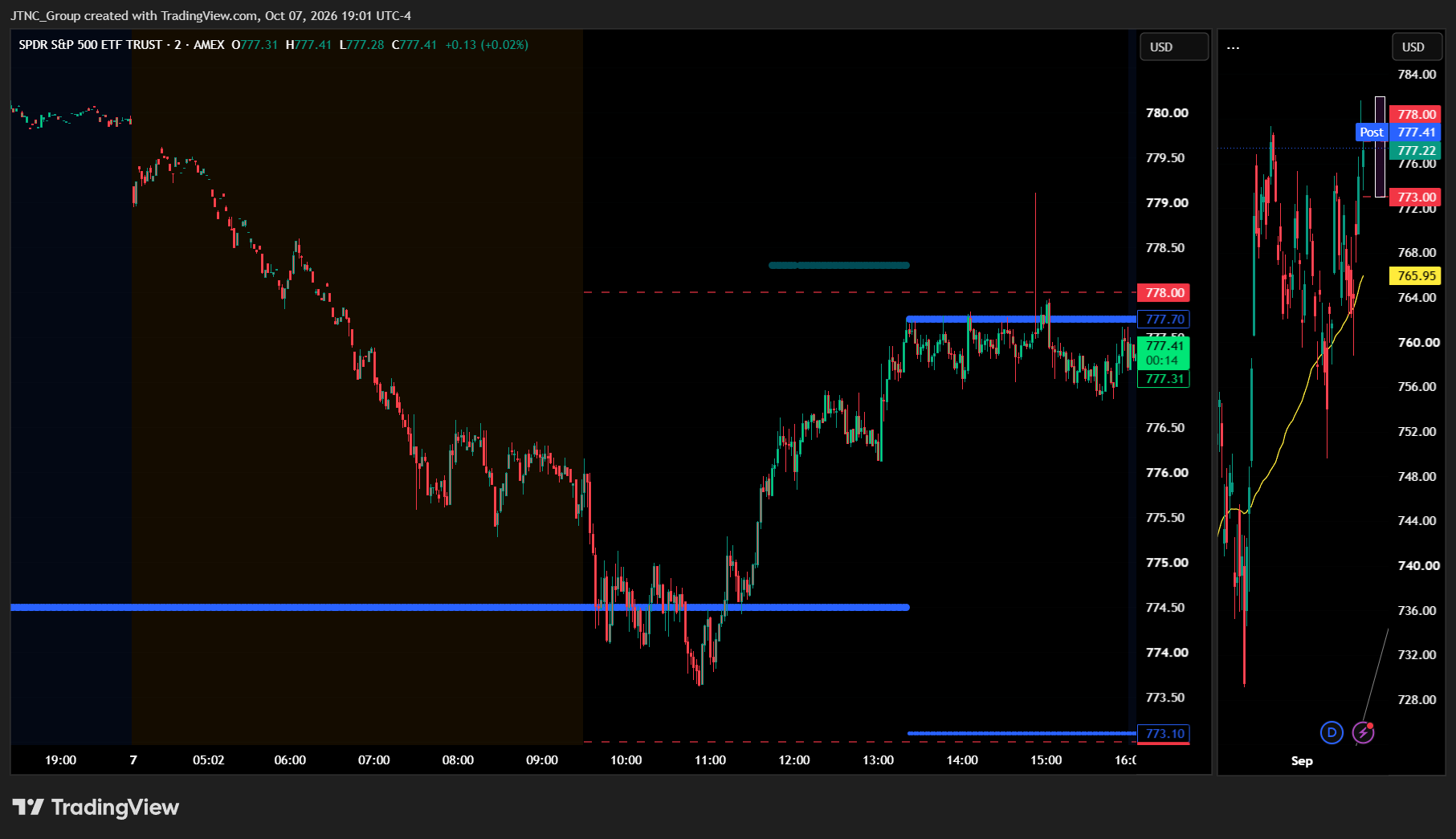
The MSI ended in a Bullish Trending Market State with SPY closing at $777.26. Extended targets were not printing at the close. No extended targets were visible in premarket, as the MSI held its prior level near $774.5 through the overnight and premarket sessions. Extended targets printed above during the AM session near $778.65 as price rallied, and they kept printing into the PM session before fading out. The MSI held Bullish Trending from the open through the close.
The MSI did not rescale overnight or in premarket. It rescaled higher in the PM session to the current $777.7 resistance and $773.1 support. Before that, the setup was simple. SPY sold off at the open into the old $774.5 MSI resistance turned support. The only trade was to buy that level, and it worked well as SPY rallied to MSI resistance before pulling back slightly into the close. On Tuesday we said SPY would likely spend at least a day or two consolidating before another push toward $800, and Wednesday played out exactly that way.
The MSI now sits in a wide $4.60 range, which leaves plenty of room for price to move and points to further gains. For Thursday, the MSI is forecasting a slow grind higher, though without extended targets at the close the move may be modest and is likely to find resistance at key levels above. The rescale higher keeps the bigger picture pointed up, but the lack of extended targets at the bell suggests the bulls won't be in a rush. MSI support is $773.1 with resistance at $777.7.
Key Levels and Market Movements:
Tuesday we stated, "Bulls want to see overnight price hold the $778.30 premarket level and stay well above $774.5, then push back through $780 and take out Tuesday's $781.62 high," and added, "The primary setup for Wednesday is buying a dip to $774.5 support, or buying a failed breakdown back above it, targeting $778.30 and then Tuesday's $781.62 high," while also noting, "If the FOMC Minutes spark a rescale higher with extended targets printing above, stay long and don't fade it." The bulls didn't get the overnight hold. Price slipped below $778.30 overnight, and SPY opened at $775.77, already sitting just above $774.5 MSI resistance turned support.
The open brought a quick selloff. SPY dropped to a session low of $773.61, dipping just under $774.5 before buyers stepped right back in. That was the textbook failed breakdown back above support that Tuesday's plan called for, and it was the only trade of the day. Buy the reclaim of $774.5 and target the $778.30 premarket level above. Price rallied steadily through the AM session, and extended targets printed above near $778.65, which said to stay long and not fade the move. SPY cleared $778.30 and pushed to a session high of $779.10, short of $780 and Tuesday's $781.62 high.
The MSI rescaled higher in the PM session, confirming the bullish move and lifting resistance to $777.7 and support to $773.1. Once the extended targets above stopped printing, the push ran out of steam. SPY drifted off the $779.10 high and settled at $777.26, just under the new MSI resistance. That's the consolidation we expected. The bulls defended support, but they couldn't take out the highs.
SPY slipped 0.23% on volume of 26.19 million shares, below average and lighter than Tuesday. The VIX dropped 0.27% to 14.97, which shows little fear despite the small red close. Light volume and a quiet VIX fit a market that is pausing, not breaking down. At minimum it was a 1-for-1 session for traders following the framework. It was an easy day to read and execute with substantial setups, all identified through proper context, patience, and flexibility while leveraging the MSI, premarket levels, and market structure rather than forcing trades. The MSI continues to prove its reliability as the cornerstone of our trading process.
Trading Strategy Based on MSI:
Thursday has heavy economic data with FOMC Member Waller speaking at 4:30 AM ET and Unemployment Claims at 8:30 AM ET, which can introduce significant volatility, so traders should be ready to trade what they see rather than predict. The MSI closed Bullish Trending with a wide $4.60 width, so the trend still favors the bulls, and the rescale higher adds fuel. Without extended targets at the close, though, Thursday is shaping up as a slow grind higher with a modest move that is likely to find resistance at key levels above. The bulls have control, and any pullback to $773.1 MSI support is a buying opportunity.
Bulls want to see overnight price hold above $774.5 and stay near the $777.26 close, then push through $777.7 MSI resistance and take out Wednesday's $779.10 high. Clearing that opens the door to $780 and Tuesday's $781.62 all-time high, with $800 as the bigger target down the road. Until extended targets return above, expect that climb to be slow and choppy. Bears want to see $774.5 fail, then lose $773.1 MSI support with the MSI rescaling lower and extended targets printing below. That would press price toward $770.7 and $770 major support. Bears have work to do, but two straight stalls near the highs on light volume give them a shot at a deeper pullback.
The primary setup for Thursday is buying a dip toward $774.5 or $773.1 MSI support, or buying a failed breakdown back above $773.1, targeting $777.7 and then Wednesday's $779.10 high. A failed breakout above $779.10 or $780 could offer a quick short back toward $777.7, but the bias favors longs until the MSI shifts. If the data sparks another rescale higher with extended targets printing above, stay long and don't fade it, with $781.62 as the next target. Only if $773.1 breaks with the MSI rescaling lower and extended targets printing below would a short toward $770.7 and $770 make sense.
The long-term bull trend remains intact above $640 and failed breakouts and failed breakdowns continue to offer the highest-probability setups. Remain flexible, avoid trading during Ranging Market States unless a clear failed breakout or breakdown presents itself, and ensure all trades are fully aligned with MSI signals. Providing real-time insights into market control, momentum shifts, and actionable levels, the MSI when integrated with our Pre-Market and Post-Market Reports continues to sharpen execution precision and elevate trade quality. If you haven't yet integrated MSI and our model levels into your process, now is the time. Contact your representative to get started as these tools are designed to support consistency and enhance performance.
Dealer Positioning Analysis
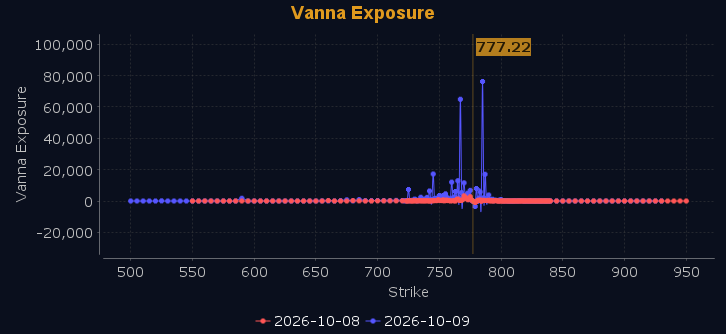
Dealers are selling SPY $781 to $810 and higher strike Calls while buying $778 to $780 Calls, indicating the Dealers' desire to participate in any rally on Thursday. They aren't sitting on the sidelines if the market pushes higher, but they've also added to their hedges after Wednesday's price action, which tells us they're more uneasy about prices at these highs than they were yesterday. The ceiling for Thursday appears to be $783. To the downside, Dealers are buying $777 to $705 and lower strike Puts in a 3:1 ratio to the Calls they're selling, displaying growing concern that prices could move lower. This isn't an outright bearish bet, since Dealers still want a piece of any upside, but the heavier hedging is enough to tip the scales. Dealer positioning shifts to bearish.
Looking Ahead to Next Friday:
Dealers are selling SPY $780 to $810 and higher strike Calls while buying $778 to $779 Calls, indicating the Dealers' desire to participate in any continued new highs, to as high as $785. Unlike Thursday, they have not added to their hedges for the week, which shows they remain comfortable with the broader trend. The ceiling for the week appears to be $785. To the downside, Dealers are buying $777 to $705 and lower strike Puts in a 2:1 ratio to the Calls they're selling, displaying only mild concern that prices could move lower. Above $780 is bullish up to $785, where a massive Call wall will dampen further moves, with Dealers favoring mean reversion over trend continuation. Below $776 is bearish, with major support at $767, though that level is unlikely to hold should SPY reach it. The zone from $775 to $780 is full of chop and traps, so patience is key there. For the week Dealer positioning is unchanged at bullish. We advise reviewing Dealer positioning daily for directional clues. These positions evolve quickly and tracking them is essential for staying ahead of shifting market sentiment.
Recommendation for Traders
Favor buying dips near $775, targeting $780 and $782, with stops below $772, and watch Waller's early remarks for any shift in tone.
Keep size modest and respect your stops. Review the premarket analysis posted before 9 AM ET for any changes in the model's outlook and Dealer Positioning.
Good luck and good trading!
