
Market Insights: Tuesday, October 6th, 2026
Market Overview
Stocks kept the good times rolling Tuesday, with a global bond sell-off and soaring diesel costs doing nothing to cool investors' enthusiasm for upcoming earnings and the AI boom. The Nasdaq rose 0.4% to notch a back-to-back record high, the Dow added 0.5%, and the S&P 500 climbed 0.7% to close at a record of its own after first touching an all-time high just minutes after the opening bell. Treasury yields eased a bit after the 10-year posted its highest close in 24 years, and long-dated yields remain near their highest levels since 2002. Easing oil prices helped take some pressure off. The economic calendar stayed quiet, leaving Constellation Brands' afternoon earnings report as the main event. Tech kept flexing after AMD CEO Lisa Su said demand for compute continues to outrun supply, comments that followed healthy earnings from Taiwanese Nvidia partner Foxconn and pointed to strong global demand for AI infrastructure. Nvidia hit fresh all-time highs as its market cap closes in on $6 trillion, and with AMD and Micron also pushing to records, AI bubble talk is bubbling up again. Pundits love comparing today's Big Tech run to the lead-up to the dot-com crash, but Bank of America strategist Michael Hartnett points out it's also creeping toward the railroad bust of the late 1800s. His data shows peak concentration in most historical asset bubbles has topped out around the 40% level, with the railroad boom as the exception. Concentration is already at an extreme. Per Creative Planning, Nvidia, Apple, and Microsoft now make up over 21% of the S&P 500, the most the index has ever leaned on just three stocks. The closest comparison is IBM, AT&T, and ExxonMobil, which peaked at 13.4% of the index in the mid-1980s.
Marvell Technology surged roughly 8% to its highest level since June after raising its fiscal 2028 revenue guidance above analyst estimates, with CEO Matt Murphy telling the company's investor day, "We expect approximately $20 billion in total company revenue in FY28, representing about 67% year-over-year growth." Constellation Energy rocketed 13% after Alphabet announced a $4.3 billion, 20-year power purchasing agreement to bring 890 megawatts of nuclear energy online. That capacity will come from upgrades at six existing plants in Illinois, New Jersey, and Pennsylvania, including modernized turbines, steam generators, and digital control systems. Google said the deal gives Constellation the revenue certainty to invest in updates to 11 of its reactors while keeping customers from absorbing extra costs tied to the AI boom. Constellation will also use Google's Gemini Enterprise software for site selection, outage management, and infrastructure protection. On the flip side, vaccine stocks gave back Monday's gains after a World Health Organization spokesperson called the risk of a plague epidemic "low." Fears had flared after a 28-year-old woman working at the Irkutsk Anti-Plague Institute of Siberia and the Far East in Russia died last week of "pneumonia of undetermined" origin. Novavax fell around 9% after jumping 20% the day before, Moderna dropped 5% following a 7% gain Monday, and BioNTech and Pfizer were little changed.
SPY Performance
SPY opened at $778.15, gapping up above yesterday's close of $774.83 and even clearing yesterday's session high of $776.61 right out of the gate. That's a confident start, and the bulls defended it all day. SPY dipped to a session low of $777.96 early, which kept the entire day's trading above yesterday's high and left a clean gap underneath. Buyers then pushed to a session high of $781.62, another fresh short-term peak. The afternoon was less impressive, though. SPY faded off the high and finished at $779.14, closing in the lower half of the day's range rather than near the top like yesterday.
SPY gained 0.56%, its fourth straight green close. Volume came in at 30.62 million shares, below average and a noticeable drop from the prior session's healthier participation. That's the main caution flag today. A gap up to new highs on lighter volume suggests the move was driven more by momentum and a lack of sellers than by aggressive new buying. The candle reflects that too. It's a small body sitting on top of a gap, with an upper wick showing that buyers couldn't hold the highs into the close. On the bright side, the VIX resolved yesterday's wrinkle by dropping 3.61% to close at 14.96, slipping back below the 15 level. Fear is fading again as prices rise, which is exactly what you want to see in a healthy uptrend, and it suggests traders feel less need for protection after this four-day run. The bigger picture remains bullish. SPY has now stacked up four green days, made another short-term high, and left a gap below that bulls will want to protect. Going forward, yesterday's high around $776.61 is the first support level to watch, since that's where the gap begins. If SPY holds above it, the uptrend stays intact and the light volume is just a pause rather than a warning. A push above today's high would open the door for more upside, while a slide back below $776.61 would fill the gap and could point to a short-term cooling period, with the earlier breakout level around $772.65 as the next line of defense.
Major Indices Performance
The Dow took the top spot, rising 0.49% for its fourth straight advance and its best showing of the streak. After bringing up the rear for several sessions, blue chips finally stepped into the lead, getting a helping hand from energy as oil turned higher after back-to-back declines. It's a meaningful shift. When the steady, old-economy names start leading, it tells you money is spreading into value and defensive corners instead of chasing only the hottest growth stories.
The Nasdaq added 0.45% for a third straight gain, though the pace cooled noticeably from the prior two sessions. Mega-cap tech still did most of the heavy lifting, but the gains weren't strong enough to keep the index in its usual leadership role. That's not a warning sign by itself. After a run of strong days, a slower grind higher is healthy, and the Nasdaq continuing to finish green shows buyers haven't walked away from growth.
The Russell 2000 was the clear laggard, sliding 0.72% and snapping its three-session winning streak. The timing is curious, since borrowing costs actually eased a bit, which normally gives rate-sensitive small-caps some breathing room. Instead, traders took profits in the riskier end of the market ahead of Wednesday's FOMC minutes, a classic move to trim exposure before a potential volatility event. The S&P 500 edged out both the Dow and Nasdaq. The VIX dropped 3.61% to close at 14.96, which shows the hedging from last session unwound quickly. Large-caps feel comfortable, but the small-cap retreat is a reminder that the broadening story needs the Fed minutes to cooperate.
Notable Stock Movements
Amazon grabbed the top spot in the Magnificent Seven, rising 1.95% to lead the group. That's a sharp turnaround for a name that was one of the laggards in the prior session, and it's exactly the kind of rejoin-the-party move bulls were hoping for. When a mega-cap that was sitting on the sidelines suddenly steps up and leads, it tells us money is rotating within big tech rather than leaving it. That's a healthy sign for a market that has leaned heavily on these names.
The group finished mostly green across the board once again, with Meta the weak spot at a 0.41% loss. That's a mild pullback, not a warning shot. One name taking a breather while the rest keep pushing is normal in a steady uptrend, and the fact that the leadership baton passed from Tesla to Amazon shows the strength isn't hinging on just one stock. Rotating leadership like this usually gives a rally more durability than a single-name surge.
The broader picture was a bit more mixed. The Dow edged out the Nasdaq with a 0.49% gain versus the Nasdaq's 0.45% rise, while the Russell 2000 slipped 0.72%, so investors favored big, established names over riskier small caps. That split hints at a more defensive kind of optimism heading into the Fed minutes. Still, the VIX dropped 3.61% to 14.96, which shows fear is easing, not building. Big tech continues to anchor sentiment, and as long as it holds together, bulls have the upper hand.
Commodity and Cryptocurrency Updates
Crude oil snapped its two-day losing streak, rising 0.41% to close at $89.80. The bounce was modest, but it shows buyers are still willing to step in after the recent profit-taking, and crude remains well above $70 and far ahead of longer-term model expectations. The geopolitical tensions and supply disruptions that fueled this rally haven't gone away, which keeps a firm bid under prices even during pullbacks. If energy prices stay elevated at these levels for an extended stretch, they will keep feeding inflation pressures and could seriously complicate the Fed's path on rate policy.
Gold broke its losing streak with a solid move higher, gaining 0.95% to close at $4,196. After two quiet down sessions, this is the kind of response investors wanted to see, with buyers finally showing some conviction and defending the metal's recent floor. Gold is still working through its consolidation phase, but a strong up day like this suggests the dip-buyers are getting more comfortable stepping back in. The long-term case remains intact, supported by inflation uncertainty, steady central bank buying, and a constant flow of geopolitical headlines. Follow-through in the coming sessions would go a long way toward confirming the next leg higher.
Bitcoin slipped again, falling 0.23% and closing below $85,592. That makes three straight down days, and while the losses have been small, the steady drift lower shows crypto still can't find the momentum to break out of its range. Sellers aren't pressing hard, but buyers continue to sit on their hands, keeping Bitcoin stuck in a cautious, sideways pattern. Until it can string together a run of consistent green sessions, the cryptocurrency looks more likely to keep grinding within its range than to launch a meaningful recovery.
Treasury Yield Information
The 10-year Treasury yield finally took a breather today, falling 0.79% to close at 5.270. That snapped a two-day winning streak and pulled the 10-year back from its fresh high for this run. A one-day dip doesn't change the bigger picture, though. Yields remain parked in the most dangerous zone on the framework, and today's pullback looks more like bond sellers catching their breath than a real change in direction.
Measured against each threshold, the cushion narrowed but is still wide. The 4.5% level where equity valuations start to feel the squeeze sits 77 basis points below today's close. The 4.8% mark that usually sparks broader selling is 47 basis points back. The 5% line for serious risk is cleared by 27 basis points. Most importantly, the 10-year still sits 7 basis points above 5.2%, the level where the framework calls for a 20% or greater correction. The gap shrank, but the correction signal is still flashing.
The equity reaction was mixed in a telling way. The Dow gained 0.49% and the Nasdaq added 0.45%, so large caps welcomed the relief in rates. Small caps told a different story, with the Russell 2000 falling 0.72%. That's a red flag, because rate-sensitive names should be the biggest winners when yields ease. Instead, they lagged, which suggests investors don't trust the dip in yields to last. Meanwhile, the VIX dropped 3.61% to 14.96, erasing yesterday's uptick and showing that traders stopped buying protection. That return to calm feels a bit early given where yields still sit.
Wednesday is a big one, with the FOMC Meeting Minutes due at 2:00 PM ET. Any hawkish language about keeping rates higher for longer could send the 10-year right back toward its recent high, and that would test this calm equity tape fast. Watch whether yields slip below 5.2%, which would ease the correction warning, or bounce back above 5.31% to set another new high. Real relief still requires a sustained move under 5%. Until then, stocks are leaning on a bond market that hasn't given them permission to relax.
Previous Day’s Forecast Analysis
For Tuesday's session, our AI model projected SPY's maximum range at $770 to $779. With the Call side dominating in an expanding band, the model called for trending price action with intermittent chop. No economic news was on the calendar, so we expected the market to trade purely on technicals, with flows and positioning doing the heavy lifting. Monday's breakout above the $770 ceiling that had capped rallies for two weeks set up a modestly bullish bias, supported by the Call-heavy band. We flagged one caution sign: the VIX had risen 1.37% to 15.52, suggesting some traders were quietly buying protection even as stocks climbed.
The key resistance was $777, the level buyers needed to clear to keep the trend running. Above that, the targets were $780, then $782 and $785, where any extended rally was expected to meet heavy supply. On the downside, $773 was the line to defend and our preferred dip-buying zone. Below that, support sat at $771 and then $770, the bottom of the projected range and a former ceiling we expected to act as a floor. Deeper supports were $765 and $760, with $750 in view if those gave way. Structural support near $640 kept the broader dip-buying picture intact.
The trading strategy favored longs. The cleanest trigger was a morning pullback that held $773 and then drove through $777. Profit targets were $779 and $780, with runners aimed at $782 and $785, and stops below $771. Traders were told not to chase a breakout into $779 without a clean retest of $777.
The secondary short setup was fading a stall at $777, targeting $773 and then $771, with stops above $780. A clean break of $771 was shortable at reduced size toward $765 and $760, with $750 as a runner target only. Bear-side size was kept at roughly half the bull side.
Position sizing was set at 70-80% of normal with the VIX below 16. A push through 16 called for trimming net long exposure and tightening stops to 0.5-0.75% from entry. A jump through 17 meant cutting size back toward half.
Market Performance vs. Forecast
Tuesday's session delivered the bullish continuation the forecast anticipated. The model called for trending price action with intermittent chop, a modestly bullish bias and a Call-dominated band, and buyers carried that script through the entire day. SPY opened at $778.15, already above the $777 resistance the forecast named as the first test for bulls, and the overnight strength showed how eagerly buyers were pressing after Monday's breakout. The session low of $777.96 held just above $777, so the level that was resistance coming into the day immediately flipped into support. From there, bulls pushed to a session high of $781.62, slightly above the model's $779 ceiling. The model does not account for unpredictable external events, and even on an empty economic calendar, trending momentum stretched price a bit beyond the base case scenario. Even so, the forecast had already flagged $782 as overhead resistance where any extended rally should run into heavy supply, and SPY topped out just beneath it. SPY closed at $779.14, up 0.56% and right at the top edge of the projected $770 to $779 range.
On the rising market side, the playbook delivered. The forecast said a break above $777 would hand momentum to the bulls and open the path toward $780, and that is exactly how the session unfolded. The $779 first profit target and the $780 secondary target were both reached. The $782 runner target came within a hair of being tagged, and the advice to treat anything up there as a bonus fit a rally that cooled just below that zone. The morning pullback to $773 never came, which showed how firmly buyers controlled the tape. The intraday dip that held just above $777 served as the clean retest the forecast told traders to wait for before getting aggressive. The $771 long stop was never in play, and letting bull-side size lead was rewarded with a steady climb.
The falling market scenario was framed as the secondary setup, and the session showed why. Price opened above $777 and never traded back below it, so the short trigger never got the stall and rollover it required. Any trader who tried to fade strength had a stop defined above $780, so risk management protocols protected capital once buyers pushed through the top of the projected range. Keeping bear-side size at roughly half the bull side also limited exposure on the less likely side of the trade. The $773 and $771 supports, the $770 floor, and the $765, $760 and $750 levels all went untested. The reminder that the long-term bull trend remains intact and that dip-buyers keep stepping in proved to be the defining theme again. Below-average volume showed buyers didn't need heavy participation to keep the advance moving.
The VIX dropped 3.61% to 14.96, staying well below the 16 line the forecast flagged as the signal to trim net long exposure and tighten stops. That kept the 70-80% position sizing guidance in force all session. The fear gauge also slipped below 15, satisfying the condition the forecast tied to the $780 secondary target, and that is right where the rally earned its extension. The $777 breakout line, the $779 and $780 targets, the $782 supply zone and the bullish bias all gave traders clear, actionable guidance on a day driven purely by technicals. The framework continues to adapt to shifting conditions and gives traders a reliable structure for managing risk and spotting opportunity in the sessions ahead.
Premarket Analysis Summary
The premarket analysis, posted before the opening bell, framed the expected move between $770 and $783, with $785 marked as max upside and $770 as max downside. The tone had swung decisively back to the bulls, with the Call side dominating the tape. Spot sat at $778.39 after another gap higher, following Monday's breakout through $770 that ran straight to $775 and left SPY trading above the entire range of the past two weeks. That earned a bullish bias, though the analysis noted that the expected move priced far more room below than above, and that some consolidation after two sharp sessions would be normal. The defining level was $778, the heaviest concentration on the board and the floor of the breakout. Holding above it would let the move extend, while losing it would leave little cushion until $775. Above $778, $780 was the first target and the major round number bulls really needed, $781 was the next decision point, and $783 capped the expected move ahead of the $785 max upside. On the downside, $777 was the first step beneath the pivot, and a clean break there would signal a gap fill. Under that, $775 was flagged as Monday's breakout level turned major support, $772 was the point of last hope and the heaviest battle below, and $770 sat at the bottom of the expected move as the old two-week ceiling turned line in the sand.
The bulls defended the pivot almost perfectly and got the early test of $780 the analysis called for. SPY opened at $778.15, right on top of the $778 floor, and the low of $777.96 barely dipped beneath it before buyers stepped in. That meant $777 held, and $775, $772, and $770 were never in play. From there, price pushed through the $780 round number, cleared $781, and topped out at a high of $781.62, stopping short of the $783 cap and well shy of the $785 max upside. SPY closed at $779.14, up 0.56%, on 30.62M shares of below-average volume. The VIX dropped 3.61% to 14.96, a cleaner confirmation of the rally than Monday's odd pairing. The lighter volume and the fade off the high fit the consolidation the analysis expected, with the gains holding firmly above $778. Price now sits between that pivot and the $780 level, and whichever one gives way first should set the next leg of this breakout.
Validation of the Analysis
Today's session showed how precisely the premarket framework can pin down the level that matters most. The analysis called $778 "the defining level," noting that spot was "sitting right on it" and that it was "the floor of this breakout." It laid out the rule plainly: "hold above it and the move extends." That is exactly how the day unfolded. SPY opened at $778.15, right on the pivot, and the session low of $777.96 came just pennies beneath it. Buyers defended the floor almost to the cent, and the breakout extended from there. The model's next instruction was "Hold 778 and 780 gets an early test," and that is what happened. SPY pushed through $780, the level the analysis described as "a major round number and the level bulls really need to keep this going," and then cleared $781, the "next decision point."
The upside ladder once again worked as a roadmap. SPY tagged a high of $781.62, just past the $781 decision point, and stalled well before $783, the expected move top. It then closed at $779.14, up 0.56%, settling between the $778 pivot and the $780 target. That finish lines up with the morning's view that "after two sharp sessions, some consolidation here would be normal." The day delivered a modest extension followed by a pause, with $785 never in play. The downside framework was just as valuable, because none of its conditions were triggered. The analysis flagged $777 as "the first step beneath the pivot" and warned that "losing it cleanly means the gap is filling." Price never even reached $777, so $775, the $772 "point of last hope," and the $770 max downside all stayed quiet. The VIX dropped 3.61% to 14.96, confirming that traders felt comfortable with the breakout holding. That calmer tone fits the call-dominated tape the morning notes described.
The trading opportunities were clear from the opening bell. With SPY opening right at $778, the playbook gave traders a precise line to lean on. Longs taken against the pivot had a tight, well-defined risk point, and the test of the low just pennies under $778 confirmed that buyers were defending exactly where the analysis said they would. From there, $780 and $781 offered natural spots to scale out, and traders who took profits at those targets captured most of the day's $3.66 range from low to high. Those who respected the model's warning about consolidation had good reason to lock in gains near the highs before price eased back under $780 into the close. Just as important, the framework kept traders out of the wrong trade. With $777 never lost, there was no signal to chase the downside or bet on a gap fill. The $778 pivot held, $780 and $781 fell in sequence, the downside stayed untouched, and the session consolidated just as the analysis laid out.
Looking Ahead
Wednesday's calendar centers on one major event, the release of the FOMC Meeting Minutes at 2:00 PM ET. There's no inflation report or jobs data on the docket, so the morning session will likely trade on positioning and headlines while traders wait for the afternoon catalyst. The minutes give a detailed look at the debate inside the Fed's most recent policy meeting, showing how policymakers are weighing inflation risks against signs of a cooling economy. Wall Street will be combing through the language for clues about the path of interest rates, especially any hints about how many officials lean toward further easing versus holding steady. A dovish tone could spark a rally in rate-sensitive areas like tech and small caps, while hawkish undertones could pressure stocks and send traders scrambling to reprice expectations.
Traders should be careful about loading up on big positions before 2:00 PM ET, since the release can trigger sharp, fast swings in both directions. The first reaction to Fed minutes is often a head fake, with algorithms jumping on headlines before humans have digested the full text, so give the market 15 to 30 minutes to settle before committing. Watch whether buyers defend key levels after the release, because that will show whether the market's recent tone has real staying power. Keep stops disciplined, size positions conservatively, and let the market show its hand. On a day with a single afternoon catalyst, the morning is for planning and the afternoon is for execution.
Market Sentiment and Key Levels
The bulls are still in control, and Tuesday added another quiet but constructive chapter to this rally. SPY opened near its lows, buyers took charge early, and the index held most of its gains into the close. That shows steady demand, but the light participation means this was more of a grind higher than a rush of new money. The Dow and Nasdaq moved nearly in lockstep, while small caps slipped into the red. That split is the wrinkle worth watching. When the Russell 2000 lags while large caps push higher, money is crowding into the biggest, safest names instead of spreading across the market, and narrow leadership like that can leave a rally vulnerable if those leaders stumble. Fear, meanwhile, is fading fast. The VIX dropped 3.61% to 14.96, which tells us investors are comfortable and aren't rushing to buy protection ahead of a major Fed event. That calm can be a strength, but it can also mean the market is underprepared for a surprise.
First resistance sits at $782, right above where buyers ran out of gas. A clean break through that level opens the door to $784, with $786 and $788 waiting if momentum keeps building. On the downside, SPY is sitting right on top of first support at $778 heading into Wednesday. Losing $778 would likely send price toward $775, followed by $772 and $770. If $770 gives way, there's little to keep price from sliding toward $765. For longer-term bulls, the broader uptrend remains intact well above structural support at $640, so this is still a dip-buying environment as long as those key levels hold. Wednesday's projected maximum range runs from $776 to $784, with the Call side dominating in an expanding band that points to trending price action mixed with some intermittent chop. The big event is the FOMC Meeting Minutes at 2:00 PM ET, and that release is likely to produce significant volatility, so expect traders to stay cautious and keep positions light ahead of it. Any hint that the Fed is leaning more hawkish than expected could quickly test support, especially with elevated yields and firm energy prices already hanging over the inflation picture. On the flip side, a softer tone from the minutes could give buyers the fuel to clear $782. With price resting on support and fear at low levels, we favor buying dips near $778 rather than chasing strength into $782. Keep stops disciplined below support, respect the Fed headline risk, and let price prove it can break resistance before adding size.
Expected Price Action
Wednesday's session brings actionable intelligence generated by our AI model, which projects SPY's maximum range at $776 to $784. With the Call side dominating in an expanding band, the model is calling for trending price action with intermittent chop. Unlike Tuesday's empty calendar, Wednesday has a real catalyst. The FOMC Meeting Minutes drop at 2:00 PM ET and are likely to produce significant volatility, so expect traders to stay cautious ahead of the release. Tuesday's tape extended the breakout, with buyers holding control all session on a third straight push higher. SPY settled just below the midpoint of the projected range, which gives us a neutral-to-slightly-bearish bias heading into Wednesday. That cautious lean is offset by the Call-heavy band and a calmer fear gauge. VIX dropped 3.61% to 14.96, a sign that investors are comfortable heading into the Fed minutes. The catch is that comfort can flip fast when Fed policy headlines hit, and price is starting the day sitting right on top of the model's first support.
The first test for Wednesday is $782, the resistance level bulls need to clear to keep the trend running. If buyers push through $782, the next target is $784 at the top of the projected range, with $786 and $788 waiting as overhead resistance where any extended rally should run into heavy supply. On the downside, $778 is the line buyers need to defend, and it's exactly where we favor buying dips. It was the floor of this breakout in the premarket setup, and the Call side is still in control. A clean break below $778 likely sends price sliding toward $775, Monday's breakout level, and below that $772 is the next area where bulls should try to make a stand. If $770 gives way, the old two-week ceiling turned floor, there is little to keep price from falling toward $765. The bigger picture remains healthy, with SPY trading well above structural support near $640, so this is still a dip-buying market on a broader timeframe. In the short run, the playbook comes down to timing. Expect the morning to drift as traders position ahead of the minutes, with the real move likely coming after 2:00 PM. A breakout above $782 hands momentum to the bulls and opens the path toward $784. A hold at $778 keeps the buy-the-dip trade alive. Losing $778 means a trip toward $775 could come in a hurry if the Fed's tone surprises hawkish.
Trading Strategy
The VIX dropped 3.61% to 14.96, slipping back under the 15 line and confirming that traders saw little reason to pay up for protection. That calm is welcome, but Wednesday is not a day to get complacent. The FOMC Meeting Minutes hit at 2:00 PM ET, and that release can flip the tape in minutes. Keep position sizing in the 70-80% of normal range through the morning, and consider trimming to half size into the 2:00 PM window. A VIX push back above 16 is the signal to reduce net long exposure and tighten stops to the 0.5-0.75% range from entry, while a jump through 17 means cutting size back toward half. Let the post-minutes reaction settle before committing fresh capital, because the first move after a Fed release is often a head fake.
In a rising market scenario, $778 is the level to defend, and buying dips there is our preferred setup. A pullback that holds $778 and then drives through $782 is the cleanest long trigger, since clearing that ceiling opens a path toward the top of the projected range. The first profit target is $784, with a secondary target of $786 if momentum builds and the VIX keeps sliding below 15. Runners can aim for $788, but treat anything up there as a bonus on a Fed day. Stops on longs belong below $775, because losing that level would mean the floor is cracking and price is headed toward $772. With the Call side dominating an expanding band, bull-side size can lead. Still, don't chase a breakout straight into $784 without a clean retest of $782. Trending sessions with intermittent chop reward patient pullback entries far more than paying up into resistance, especially with a major catalyst looming in the afternoon.
In a falling market scenario, $782 is the resistance to fade, but treat this as the secondary setup. A bounce that stalls at $782 and rolls over is a valid short trigger, especially if the VIX climbs back toward 16 while price struggles to make headway. The initial profit target is $778, with $775 in play if sellers press through first support. Stops on shorts belong above $784 to guard against a squeeze through the top of the projected range. If the minutes spark a selloff and price breaks $772, that move is shortable at reduced size, targeting $770. Should $770 give way, there is little to keep price from falling toward $765, but that is a runner target only, not the base case. With the Call side in control, keep bear-side size at roughly half the bull side. Cover in layers into support and don't overstay. The long-term bull trend remains intact above $640, and dip-buyers have consistently stepped in on these pullbacks. A VIX that stays below 15 still favors the bulls.
Model’s Projected Range
SPY's projected maximum range for Wednesday is $776 to $784, with the Call side dominating in an expanding band that suggests trending price action with intermittent chop. Wednesday, October 7 brings the FOMC Meeting Minutes at 2:00 PM ET, which are likely to produce significant volatility particularly in the first hour of trading, so expect traders to stay cautious ahead of the release. SPY closed at $779.14, up 0.56%, after opening at $778.15, pushing to a high of $781.62, and finding a floor at $777.96 on lighter-than-average volume, which shows buyers kept control all session. SPY is trading near our model's first support at $778, and the Fed's policy outlook in those FOMC minutes is the macro catalyst most likely to shake things up. If $782 resistance breaks, the next target is $784, but if $778 support gives way, price likely slides toward $775, and if the lowest support at $770 breaks there is little to keep price from falling toward $765. The long-term bull trend remains intact above $640 with SPY well above structural support. As long as price holds above key structural levels, this remains a broader dip-buying environment. Absent a catalyst, resistance sits at $782, $784, $786, $788, while support rests at $778, $775, $772, $770. We favor buying dips at $778. Bitcoin slipped 0.23% to close below $85,592, while the MAG stocks had a mostly green day across the board led by Amazon up 1.95%, with Meta the weak spot at down 0.41%, so leadership in big tech stayed strong even as crypto lagged a bit. The VIX closed at 14.96, down 3.61%, suggesting easing fear as investors stay comfortable heading into the Fed minutes. SPY remains within its broader uptrend channel with structural support near $640.
Market State Indicator (MSI) Forecast
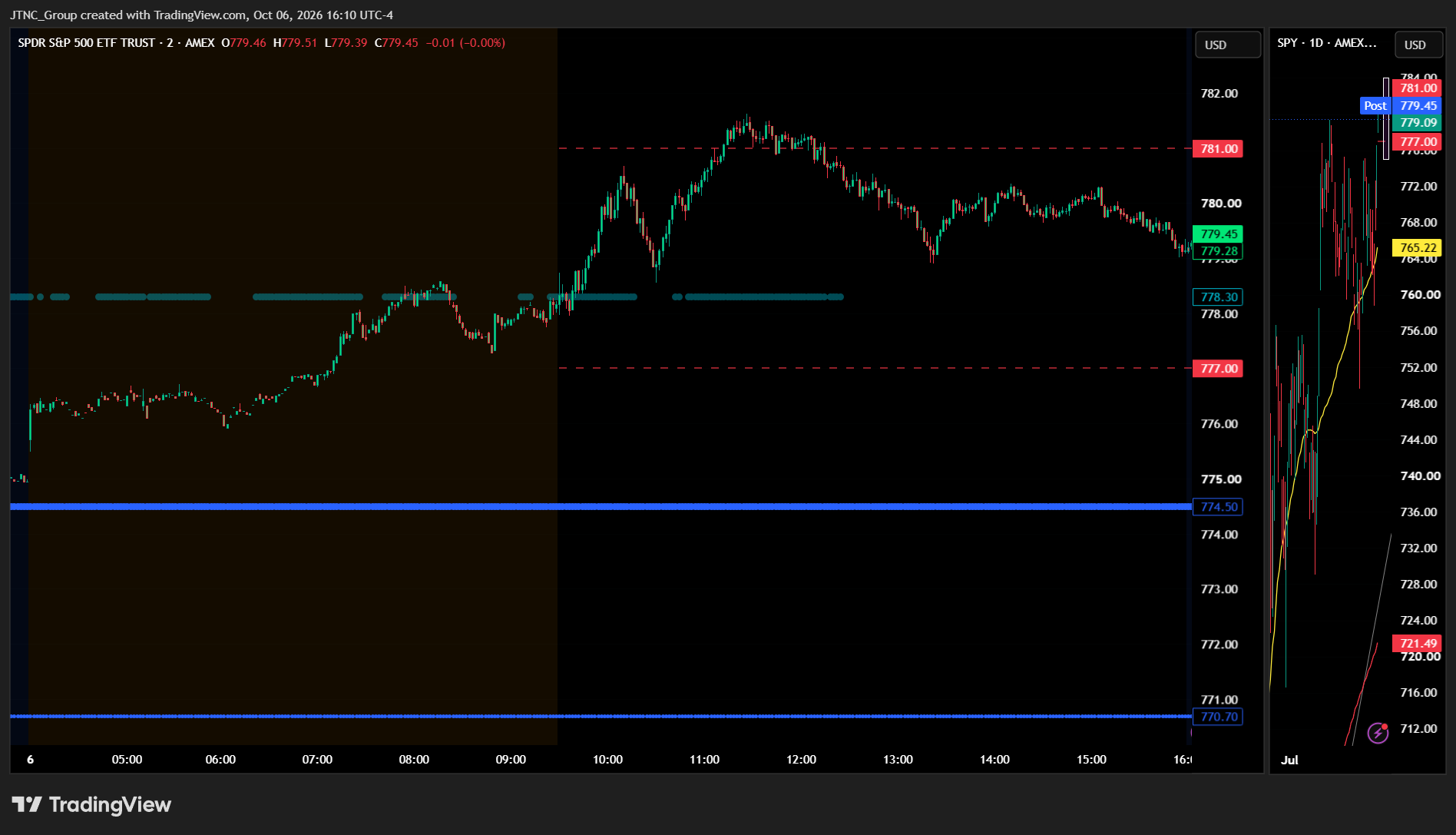
Current Market State Overview:
The MSI ended in a Bullish Trending Market State with SPY closing at $779.14. Because SPY closed above the MSI range, the $774.5 MSI resistance now becomes support heading into Wednesday, with $770.7 serving as the next line of support beneath it. Extended targets were not printing at the close. Earlier, extended targets printed above in premarket near $778.30, which showed the bullish extension was already in place before the bell. They kept printing above through the AM session and stopped early in the PM session. The MSI held Bullish Trending from premarket through the close with no state changes.
There was no rescaling overnight, in premarket, or during the regular session. The MSI held the same levels all day. At the open SPY sat just a smidge off the all-time high, which made it tough to go long into what was sure to be major resistance. But with extended targets above, we never fade the move. The job was to hold until they stopped printing, then take a quick scalp short toward MSI resistance turned support. The fact that the MSI stayed the same as the prior day was the tell that the push to the all-time high would likely be sold.
The MSI now sits in a wide $3.80 range, which leaves plenty of room for price to move. For Wednesday, the MSI is forecasting a slow grind higher, though without extended targets at the close the move may be modest and is likely to find resistance at key levels above. The bigger picture still points higher. But with no extended targets and no rescaling, SPY will likely spend at least a day or two consolidating before another push toward $800. MSI support is $770.7 with resistance at $774.5.
Key Levels and Market Movements:
Monday we stated, "Bulls want to see overnight price hold $774.77, then push back through $775 and take out Monday's $776.61 high," and added, "If $775 flips into support, the next stop is likely $777, followed by a test and possible break of the all-time high," while also noting, "If price clears $776.61 with extended targets above, stay long and take profits into the $777 area and the all-time high rather than fighting the move." The bulls delivered. Overnight price held well above MSI resistance turned support and never came close to testing it. Premarket stayed Bullish Trending with extended targets printing above near $778.30.
SPY opened at $778.15, already through $775, Monday's $776.61 high, and $777. The session low of $777.96 printed right near the open. With price gapping past those levels, there was no pullback to buy, and SPY was pressing straight into the all-time high area. That's a tough spot to chase a long. But with extended targets above through the AM session, fading the move wasn't an option either. Patience was the play. Price pushed to a session high of $781.62, right where Monday's plan called for taking profits into the all-time high rather than fighting the move.
The one trade came early in the PM session. Once the extended targets above stopped printing, the bullish extension was done for the day. That opened the door for a quick scalp short toward $774.5 MSI resistance turned support. Since the MSI never rescaled, the push to the all-time high had no fresh fuel behind it, and sellers leaned on it. SPY faded off the $781.62 high and settled at $779.14, holding comfortably above $774.5 and the $778.30 premarket level.
SPY gained 0.56% on volume of 30.62 million shares, below average and noticeably lighter than Monday. The VIX dropped 3.61% to 14.96, a healthy move lower alongside rising stocks. Still, the light volume at the highs fits the idea of consolidation ahead. At minimum it was a 1-for-1 session for traders following the framework. It was an easy day to read and execute with substantial setups, all identified through proper context, patience, and flexibility while leveraging the MSI, premarket levels, and market structure rather than forcing trades. The MSI continues to prove its reliability as the cornerstone of our trading process.
Trading Strategy Based on MSI:
Wednesday has heavy economic data with the FOMC Meeting Minutes at 2:00 PM ET which can introduce significant volatility, so traders should be ready to trade what they see rather than predict. The MSI closed Bullish Trending with a wide $3.80 width, so the trend still favors the bulls. Without extended targets at the close, though, Wednesday is shaping up as a slow grind higher with a modest move that is likely to find resistance at key levels above. The bulls have control, and any pullback to $774.5 MSI resistance turned support is a buying opportunity.
Bulls want to see overnight price hold the $778.30 premarket level and stay well above $774.5, then push back through $780 and take out Tuesday's $781.62 high. A clean break there would put the all-time high behind them and start the path toward $800. Until the MSI rescales higher or extended targets return above, expect that move to be slow and choppy. Bears want to see $774.5 fail, then lose $770.7 MSI support with the MSI rescaling lower and extended targets printing below. That would press price toward $770 major support and possibly back to $767.99. Bears have work to do, but a stall near the highs on light volume gives them a chance at a pullback.
The primary setup for Wednesday is buying a dip to $774.5 support, or buying a failed breakdown back above it, targeting $778.30 and then Tuesday's $781.62 high. A deeper pullback into the wide range toward $770.7 MSI support would also be a buyable spot as long as the MSI stays Bullish Trending. A failed breakout above $781.62 could offer a quick short back toward $780 and $778.30, much like Tuesday's scalp, but the bias favors longs until the MSI shifts. If the FOMC Minutes spark a rescale higher with extended targets printing above, stay long and don't fade it. Only if $770.7 breaks with the MSI rescaling lower and extended targets printing below would a short toward $767.99 make sense.
The long-term bull trend remains intact above $640 and failed breakouts and failed breakdowns continue to offer the highest-probability setups. Remain flexible, avoid trading during Ranging Market States unless a clear failed breakout or breakdown presents itself, and ensure all trades are fully aligned with MSI signals. Providing real-time insights into market control, momentum shifts, and actionable levels, the MSI when integrated with our Pre-Market and Post-Market Reports continues to sharpen execution precision and elevate trade quality. If you haven't yet integrated MSI and our model levels into your process, now is the time. Contact your representative to get started as these tools are designed to support consistency and enhance performance.
Dealer Positioning Analysis
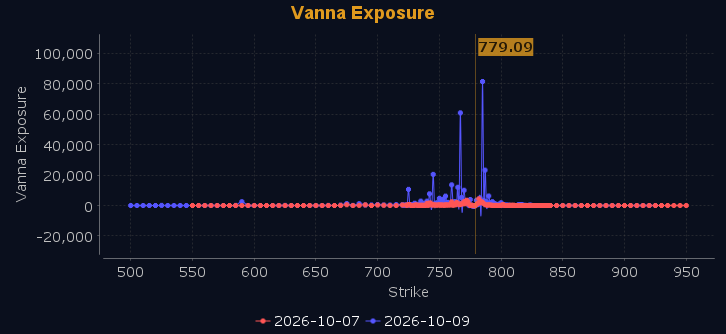
Dealers are selling SPY $780 to $808 and higher strike Calls, and they're no longer selling ATM Puts, though their bet from yesterday certainly paid off handsomely. That shift indicates the Dealers' belief that the market can keep working higher, but they're no longer aggressively forecasting a rally. Instead, Dealers are perfectly balanced, which implies a slow grind higher on Wednesday with periods of consolidation and two-way trading. The ceiling for Wednesday appears to be $782. To the downside, Dealers are buying $779 to $705 and lower strike Puts in a 2:1 ratio to the Calls they're selling, displaying only mild concern that prices could move lower. Dealers are still carrying few hedges, which tells us they remain comfortable with the current trend even if the pace of gains slows. Dealer positioning is unchanged at bullish.
Looking Ahead to Next Friday:
Dealers are selling SPY $780 to $810 and higher strike Calls, and they have not changed their positioning since yesterday. They remain bullish but are positioned for two-way, choppy trading into the end of this week. The ceiling for the week appears to be $785. To the downside, Dealers are buying $779 to $705 and lower strike Puts in a 2:1 ratio to the Calls they're selling, displaying only mild concern that prices could move lower. Above $781 is bullish up to $785, where a massive Call wall sits and Dealers will actively defend against higher prices. Below $774 is bearish, with major support at $767, though that level is unlikely to hold should SPY reach it. In between these levels is nothing but consolidation and chop. For the week Dealer positioning is unchanged at bullish. We advise reviewing Dealer positioning daily for directional clues. These positions evolve quickly and tracking them is essential for staying ahead of shifting market sentiment.
Recommendation for Traders
Favor buying dips near $778, targeting $782 and $784, with stops below $775, and stay nimble ahead of the 2:00 PM ET FOMC minutes.
Keep size modest and respect your stops. Review the premarket analysis posted before 9 AM ET for any changes in the model's outlook and Dealer Positioning.
Good luck and good trading!
