
Market Insights: Tuesday, October 27th, 2026
Market Overview
Stocks kept climbing Tuesday as the AI trade, earnings, and Wednesday's Fed decision stayed front and center. The Nasdaq jumped more than 1.1%, the S&P 500 gained 0.6%, and the Dow inched just above the flat line, with semiconductor stocks doing the heavy lifting. Fresh AI enthusiasm is still running off Anthropic's 407-page IPO prospectus, filed publicly Monday, which laid out both the promise and the risks of artificial intelligence. Odds are you haven't read the whole thing, and Wall Street hasn't either. That AI momentum spread overseas, lifting South Korean chip stocks and the KOSPI. Add in Meta's plan to raise $95 billion through stock offerings to fund its AI build-out, and it's been a busy two days. Oracle also made AI news by signing deals to bring chips from Google, Cerebras, and SambaNova onto its networks as it diversifies beyond Nvidia's processors. This marks the first time Google is selling its Tensor Processing Units for use inside a third-party data center instead of just renting out capacity. Cerebras' massive chips will supply AI inference and agent processing power, while SambaNova's SN50 processor will handle agentic inference. The next big tech catalyst lands Wednesday after the close, when Alphabet and Microsoft report third-quarter results. Policymakers kicked off their two-day meeting Tuesday to weigh whether hotter-than-expected inflation calls for a rate hike, but investors aren't buying it, with CME Group pricing in just 10% odds of a hike and most traders expecting a hold.
Lost in all the AI buzz is that earnings season is in full swing, and it's earnings and earnings expectations that ultimately drive stocks, not Anthropic CEO Dario Amodei, even if his comments have moved markets before. Coca-Cola and SoFi Technologies both topped expectations, while Hilton, UPS, and Whirlpool also reported. JetBlue shares soared despite a wider-than-expected third-quarter loss and a cut to its full-year outlook. The airline now sees an adjusted operating margin of (4.5)% to (6.5)% for 2026, worse than its prior forecast of (2)% to (5)%, with the (5.8)% midpoint missing estimates. Investors focused on demand instead, which has stayed strong and carried into the fourth quarter. CEO Joanna Geraghty said "resilient demand and strong yields drove revenue well ahead of our initial expectations, allowing us to recapture more of the increase in fuel costs than we initially expected." Elsewhere, AT&T customers hit by two 2024 cybersecurity breaches could start getting payments soon after a federal judge granted final approval earlier this month to a $177 million class action settlement. The lawsuit claimed AT&T failed to adequately protect customers' personal information after a data set with customer info surfaced on the dark web on March 30, 2024, followed by a second breach announced July 12, 2024, in which limited data was illegally downloaded from an AT&T workspace on a third-party cloud platform.
SPY Performance
SPY opened at $767.34, gapping up from yesterday's close of $765.29 and starting the session above $766.71, the level we said would truly repair the damage. It also opened just shy of yesterday's high of $767.73, which we flagged as the next big test. The bulls didn't waste much time. SPY pushed through $767.73 and kept climbing to a session high of $771.13, its best level of this recovery so far. Sellers did make one real attempt to knock it back. The session low of $765.21 briefly slipped below $766.71 and just under yesterday's close, but it never threatened $764.44, the first line of support we laid out. Buyers stepped back in from there, and SPY finished at $769.71, closing above both $766.71 and yesterday's high of $767.73.
SPY gained 0.57%, its second straight up day, and it again closed above its open. That matters because buyers are not just relying on the overnight gap. They're adding to gains during regular hours and holding them into the close. The volume, however, is still the weak spot. Turnover came in at just 23.60 million shares, below average and lighter than yesterday's already thin session. That's now two straight rallies on shrinking participation. Prices are grinding higher, but the big money still isn't charging in. Instead, sellers seem to have simply stepped aside, which lets prices drift upward without much resistance. The VIX dropped 4.95% to close at 17.48, extending yesterday's pullback and moving further away from the 20 area. Fear keeps draining out of the market, and traders are clearly getting more comfortable pulling their hedges. That's a supportive backdrop, even if the enthusiasm isn't showing up in the volume numbers.
The bulls checked the box we laid out yesterday by closing above $767.73, which shows they have more staying power than a one-day relief bounce. The next question is whether they can keep stacking gains or whether thin volume eventually leaves this rally vulnerable. On the upside, today's high of $771.13 is the level to beat, and a close above it would extend the recovery into fresh territory. On the downside, $767.73 now becomes the first line of support, followed by $766.71 and then today's low of $765.21. A close back below $764.44 would erase much of this two-day rebound and suggest the bounce is running out of gas, and a drop under $761.17 would hand control back to the bears. For now, the price action is clearly bullish, and the falling VIX backs that up. Even so, the lack of volume keeps us from getting too excited. The trend is pointing higher, but until buyers show up with real conviction, this rally deserves respect with one eye still on the exits.
Major Indices Performance
The Nasdaq led the charge with a 1.18% gain, building on the prior session's rebound and showing that the growth trade has fully regained its footing. Buyers leaned hard into tech and other high-momentum names, and the follow-through had a confident feel to it. Not every big-cap name joined the party, but the leaders that did push higher carried enough weight to drive the index to the top of the leaderboard for a second straight day. With the Fed decision on deck, traders seemed willing to position for a friendly outcome rather than hide on the sidelines.
The Russell 2000 finished a close second with a 1.17% advance, essentially matching the Nasdaq stride for stride. This was a big step up from the small-caps' recent slow-and-steady grind, and it signals that risk appetite is spreading well beyond mega-cap tech. Another pullback in energy prices helped ease the cost pressures that tend to hit smaller companies hardest, and the prospect of a supportive message from the Fed gave rate-sensitive small-caps an extra boost. Their breakout looks even sturdier now, and that kind of broad participation is exactly what you want to see in a healthy rally.
The Dow brought up the rear with a barely-there 0.03% gain, essentially going nowhere while the rest of the market raced ahead. The blue chips just couldn't attract the same enthusiasm, as money continued flowing toward growth and small-caps instead of the value-heavy, old-economy names. Softer crude did little to light a fire under industrials, and the Dow ended up treading water for most of the day. The S&P 500's 0.57% gain landed between the leaders and the laggard, held back a bit by its heavier blue-chip exposure. The VIX dropped 4.95% to close at 17.48, sliding further below the 20 level and showing that fear keeps fading even with a major Fed catalyst just hours away.
Notable Stock Movements
Tesla was the biggest mover in the Magnificent Seven again, climbing 4.04% to lead the group for a second straight session. Back-to-back leadership from Tesla matters, because it shows the prior day's pop wasn't just a one-off short squeeze or a quick bounce that faded. Traders are sticking with the most aggressive name in big tech, and that kind of follow-through usually means risk appetite is real rather than fleeting. Tesla didn't give back its gains. It built on them, and that's exactly what bulls wanted to see heading into a major event.
The group finished with another mostly green session, and the winning side got bigger this time around. Nvidia, Amazon, Apple, and Alphabet all joined Tesla in the green, while Microsoft and Meta were the only exceptions. Meta was the weakest link once again, sliding 1.64% to lead the laggards and extending a rough patch that is starting to look like more than just bad luck. Alphabet finally snapped its losing streak, which is an encouraging sign after it struggled to find its footing over the last couple of sessions. Apple also bounced back into positive territory, recovering from its slip last time out. Microsoft flipping to the red is the new wrinkle, since it was on the winning side just a session ago. The rotation inside the group shows buyers are still active, but they're shuffling their bets rather than buying everything blindly.
The broader market backed up the strength in big tech. The Nasdaq led with a 1.18% gain, and the Russell 2000 nearly matched it with a 1.17% rise, while the Dow barely budged at 0.03%. Small caps keeping pace with tech is a healthy sign, because it means the rally is spreading beyond just the mega-cap names. The VIX dropped 4.95% to 17.48, pushing fear even further below the key 20 level as traders kept leaning into risk. Now everything shifts to Wednesday, when the FOMC Statement and Federal Funds Rate decision hit at 2:00 PM ET, followed by the press conference at 2:30 PM ET. High-growth names like Tesla and Nvidia are the most sensitive to any change in the Fed's tone, so they could swing hard either way. If the Fed sounds calm and Meta and Microsoft find support, big tech could keep powering the market higher. But if the Fed surprises on the hawkish side, the names that ran the hardest could give back their gains the fastest.
Commodity and Cryptocurrency Updates
Crude oil slid for a second straight session, dropping 1.80% to close at $99.93. That move pushed the black gold back below the $100 mark, which is a meaningful psychological line after the recent surge. Even so, crude has rallied well above $70 and far beyond longer-term model expectations, and the geopolitical tensions and supply disruptions fueling this run are still in play. Two days of cooling off looks more like profit-taking than a collapse in the fear premium. With Wednesday's Fed decision on deck, energy traders will be listening closely for any comments on how high fuel costs are feeding into inflation. The bigger risk hasn't changed. A sustained move this far above $70 keeps price pressure alive and could seriously complicate the Fed's rate path if energy prices stay elevated.
Gold built on its rebound, climbing 0.90% to close at $4,075. That's a stronger follow-through than the prior session's bounce, and it pushes the yellow metal further away from the $4,000 level that bulls defended so firmly. Back-to-back gains suggest buyers are regaining confidence, though one more solid push would help confirm the recovery is real. The long-term case remains strong, supported by inflation uncertainty, steady central bank buying, and ongoing geopolitical headlines. If gold can keep holding above $4,000 heading into the Fed, it could set the stage for a steadier climb. A slip back toward that level, however, would test the bulls' resolve all over again.
Bitcoin finally found some footing, rising 0.84% to close above $80,678. That gain did exactly what bulls needed by reclaiming the $80,000 handle it lost in the prior session. The move isn't explosive, but getting back above that line takes some pressure off and shows buyers are willing to step in at these levels. Bitcoin still needs to prove it can build momentum instead of just drifting, especially with a major Fed catalyst ahead that could shake up risk assets. If the crypto can hold above $80,000 and stack a few more green days, it would start to look like a real base. Falling back below that level, though, would hand control right back to the sellers.
Treasury Yield Information
The 10-year Treasury yield edged up 0.14% today to close at 4.990, which puts it right back in the exact spot where it finished the prior session. Bonds saw a little selling pressure, but it wasn't enough to push the yield through the 5% line, and the market ended the day stuck in neutral once again. That's two straight sessions of the 10-year refusing to break in either direction, which tells us traders are waiting on something bigger before they commit. The standoff continues, and the clock is running out on it.
Against each threshold, the picture is identical to yesterday. The 4.5% level where equity valuations start to feel pressure sits 49 basis points below today's close, and the 4.8% mark that usually kicks off broader selling is still 19 basis points back. The 10-year remains just 1 basis point under the 5% line for serious risk, so there's still no real cushion. The buffer under 5.2%, where the framework calls for a 20% or greater correction, holds at 21 basis points. Holding steady beats breaking higher, but the yield is still camped in the most dangerous zone the framework tracks.
Stocks once again ignored the pressure. The Nasdaq jumped 1.18% and the Russell 2000 nearly matched it with a 1.17% gain, while the Dow barely moved at 0.03%. Small caps rallying this hard is notable, because those companies tend to carry more debt and usually get hit first when rates climb. Seeing them lead with the 10-year sitting near 5% suggests investors are betting the Fed will strike a friendly tone. The VIX dropped 4.95% to 17.48, its second straight decline, and another 1.80% slide in crude helped ease some of the inflation worry that would otherwise give bond sellers more ammunition.
Wednesday is the big one, with the FOMC Statement and Federal Funds Rate decision at 2:00 PM ET followed by the press conference at 2:30 PM ET. This is the catalyst that likely breaks the stalemate. A hawkish message that signals rates staying higher for longer could shove the 10-year through 5% and flip the framework's serious-risk flag back on, putting this two-day equity rally to a real test. A softer tone could finally give bond buyers the green light to drive yields back toward 4.8%. The key level is still 5%, and stocks are pricing in a good outcome. If the Fed doesn't deliver, the yield is right there waiting to make equities pay for that optimism.
Previous Day’s Forecast Analysis
Tuesday's forecast called for SPY to trade within a maximum projected range of $760 to $771. The Put side dominated an expanding band, so the model expected trending price action with intermittent chop. The bias was neutral with a slight lean to the upside as long as $762 held, since Monday's rebound had been constructive. Still, the Put-heavy tilt meant sellers held the edge if a directional break came. CB Consumer Confidence at 10:00 AM ET was flagged as the likely spark that could knock price out of the tight $762 to $767 box. The VIX had dropped 5.45% to 18.39 heading into the session, which the newsletter read as a sign of easing fear.
Resistance started at $767, and a clean break above it opened the door to $770, with $772 and $776 as further hurdles beyond the top of the range. On the downside, $762 was the first support and the preferred dip-buying spot. Below that came $760 and $758, then $753 as the last line of defense for bulls. A break there exposed $750. The longer-term picture stayed healthy with SPY well above structural support near $640.
The trading plan called for half to two-thirds normal size and stops of 0.5-0.75% from entry. Traders were told to wait for the first 30 minutes and the 10:00 AM data before committing. The favored trade was buying a dip into $762 that held, targeting $767 and then $770, with stops below $760. A break and hold above $767 would set up a retest long toward $770 and the $771 ceiling. On the short side, a rally into $767 that stalled was the primary trigger, targeting $762, $760, and $758, with $753 as a stretch target and stops above $770. A conviction break of $753 called for shorting a failed retest from underneath, with $750 as the final target. Long and short sizing was to stay roughly equal unless $767 was reclaimed.
Market Performance vs. Forecast
Tuesday's session played out almost entirely inside the model's projected maximum range of $760 to $771, with price pressing just a hair past the top boundary before settling back beneath it. SPY opened at $767.34, dipped to a low of $765.21, climbed to a high of $771.13 and closed at $769.71, up 0.57%. The forecast called for a neutral bias with a slight lean to the upside as long as $762 held, and that is exactly the script the tape followed. The model does not account for unpredictable external events like shifts in sentiment around economic data or positioning changes that build intraday. The CB Consumer Confidence release added just enough fuel for buyers to briefly stretch beyond the base case scenario. Even so, the $771 ceiling marked the session's turning point almost to the penny, and the trending action with intermittent chop matched the model's call for a breakout from the tight box.
The battle at $762 and $767 was the key call of the day, and the forecast said whichever side won it after the 10:00 AM release would likely set the tone. Bulls never let sellers anywhere near $762, which kept the bullish lean firmly in place all session. The open came right at the $767 resistance line, and the early dip below it was the intermittent chop the model anticipated. Buyers then reclaimed $767 and held it, and the forecast's guidance was clear: if bulls broke through $767 and held it, the trend would likely turn up for the day. That is precisely what happened. Price ran through the $770 target and tagged the projected maximum at $771, which the forecast had specifically labeled a hard ceiling for the session. The close just beneath $770 shows how well that zone capped the advance.
On the falling market side, the preferred short required a tag of $767 that stalled and rolled over, ideally with the VIX climbing back above 19. The VIX moved the other way, so the confirming signal never appeared. Any traders who engaged anyway saw risk management protocols protect capital with stops placed above $770. The advice to wait for the 10:00 AM number before committing kept disciplined traders from leaning against a firm tape. On the rising market side, the $762 dip-buy never came into play because sellers couldn't drag price that low. The secondary bull setup was the one that mattered. Buying a retest of $767 as support with $770 and then $771 as targets mapped the session nearly perfectly, and the forecast said longs could take the lead once $767 was reclaimed and held.
The VIX dropped 4.95% to 17.48, sliding right into the 17 area the forecast named as the bullish confirmation signal while price firmed up. Below-average volume points to a steady advance rather than a frantic chase. The hold well above $762, the reclaim of $767 and the stall at the $771 ceiling all played out across levels the forecast had already identified. The framework adapts as conditions shift, and Tuesday showed the value of mapping both scenarios in advance. With the long-term bull trend intact above structural support near $640, it remains a reliable guide for managing risk and capturing opportunity in either direction.
Premarket Analysis Summary
The premarket analysis, posted before the opening bell, set up Tuesday with SPY at $767.44 in a put-dominated tape. Price was sitting flat after Monday's rebound reclaimed $765 and ran straight into $768, parked right on top of the heaviest interest on the board. The bias hinged on $768, the defining level and the gate just half a point overhead. Clearing and holding it would turn the rebound into a trend, while failing there would send price back into the pocket below. The expected move ran from $758 to $772, with far more room priced below than above, and the notes warned that in a put-dominated tape a break tends to run, putting the risk squarely on the downside. Upside targets stepped through $770 as a major round number and the heaviest resistance overhead, the level bulls really needed, then $772 as the cap on the expected move, $773 as the next decision point, and $775 as max upside. On the downside, $766 was the first level to watch, followed by $765 as Monday's gate turned floor and the most important level below, $762 as the point of last hope and the heaviest support on the board, and $760 as max downside, a major round number and Friday's break level.
The session played out on the bullish side of the map, with SPY opening at $767.34, just a dime under the premarket spot. Sellers tested lower early and slipped beneath the $766 first level, but the low printed at $765.21, holding the $765 floor almost to the penny and keeping the rebound intact. Buyers then stepped in, cleared the $768 gate, and pushed through the $770 round number to a high of $771.13. That fell short of the $772 expected move cap, leaving $773 and $775 untouched. SPY closed at $769.71, up 0.57% on 23.60M shares of below-average volume, finishing just under $770. The VIX dropped 4.95% to 17.48, showing that hedging demand kept fading as the rally extended. The key takeaway is that bulls defended $765 and cleared $768, turning the rebound into a trend, but slipping back below $770 into the close means the heaviest resistance still isn't conquered. Bulls need to reclaim $770 and push toward $772, while $768 and $765 remain the levels to defend.
Validation of the Analysis
Tuesday's session played out almost exactly as the premarket map described, and the level the notes called "the defining level" did precisely what it was supposed to do. The notes were written with spot at 767.44, and SPY opened at $767.34, a dime below that mark and parked right under the gate. The whole day came down to one question: could buyers clear $768, "the gate directly above us"? The notes spelled out the stakes: "clear and hold it and yesterday's rebound turns into a trend, fail there and price drops back into the pocket below." Buyers cleared it, held it, and turned Monday's rebound into a second straight day of gains.
The downside levels set the floor with remarkable precision. The session low came in at $765.21, slipping just under $766, "our first level to watch," but stopping a mere 21 cents above $765. The notes called $765 "yesterday's gate turned floor and the most important level below," and it held exactly as a floor should. Because that line never broke, the warning to "expect a fast trip to 762" never came into play, and neither $762, "our point of last hope," nor the $760 max downside was touched. On the upside, buyers worked straight up the ladder. SPY cleared $768, then pushed through $770, the level the notes named "a major round number and the heaviest resistance overhead," and "the level bulls really need." The high printed at $771.13, stopping short of $772, which the notes said "caps the expected move top." Neither $773 nor the $775 max upside came into play. The notes summed up the bullish path in one line: "768 gets taken early with 770 the real test." That is exactly what happened. Price took the gate, tested $770, and finished the day at $769.71, up 0.57%, closing just under that round number after a real fight there. The entire range stayed inside the expected move of 758 to 772. The VIX dropped 4.95% to 17.48, showing that the put-dominated fear kept draining from the tape. With volume below average, the advance was orderly rather than explosive, which helps explain why $770 acted as a magnet instead of a launchpad.
The trading value came from knowing which floor mattered and which level flipped the tone. Traders following the map saw the dip hold just above $765, the most important level below, which offered a clean long setup with a tight stop under the floor and targets already laid out at $768 and $770. Price reached both. The push through $768 gave a second entry for traders who waited for confirmation, with risk defined back under the gate and $770 as the natural target. Sellers had a setup too. The stall above $771 sat just below the $772 expected move cap, giving a well-defined fade with risk above $772 and a target back at $770, and price settled right around that zone into the close. The map also kept traders out of bad trades. With $765 holding firm, there was no reason to press shorts toward $762 or $760. With $772 capping the move, there was no reason to chase longs toward $773 or $775. A session that bottomed just above the key floor, cleared the gate, tested the heaviest resistance, and closed hugging $770 shows how precisely these levels framed the day. Going forward, the battle lines are clear: bulls need to defend $768 and finally close above $770 to open the door toward $772 and $773, while bears need to drag price back under $766 and $765 to put the two-day rebound in question.
Looking Ahead
Wednesday is the big one, with the Federal Reserve taking center stage as its two-day meeting wraps up. The FOMC statement and the federal funds rate decision both hit at 2:00 PM ET, followed by Chair Powell's press conference at 2:30 PM ET. This is about as high-impact as the calendar gets, and it can reset the market's direction in a matter of minutes. Traders will focus on the rate decision itself, but the wording of the statement often matters just as much. Any shift in how the Fed describes inflation, the job market, or the path for future policy can send stocks swinging. A tone that leans toward easier policy ahead would likely fuel a rally in growth and rate-sensitive names, while a more cautious, hawkish message could put pressure on the broader market as investors rethink how long borrowing costs stay elevated. The press conference is where the real fireworks usually happen, since Powell's answers to reporters can either confirm or completely undercut the initial reaction to the statement.
Expect the morning to feel quiet and choppy, with no major data on the docket before the Fed and plenty of traders sitting on their hands until 2:00 PM ET. Don't read too much into early moves, because positioning ahead of a Fed decision rarely carries conviction. Once the statement drops, the first move can be sharp and misleading. It's common to see a quick spike in one direction, a reversal when Powell starts speaking at 2:30 PM ET, and then another shift as the market digests his comments into the close. That's why patience is your best friend here. Avoid jumping in on the first headline, and give the tape at least until the press conference is well underway before committing new capital. If you're carrying open positions into the announcement, consider trimming size or tightening stops so a surprise doesn't do outsized damage. Map out your key levels ahead of time so you're reacting to a plan rather than to emotion. If the post-Fed move holds into the final hour, that's a strong sign the market has accepted the message and the trend could carry forward. If it fades, the reaction was likely noise, and the bigger picture hasn't changed much. Either way, Wednesday afternoon should set the tone for the rest of the week.
Market Sentiment and Key Levels
Tuesday kept the ball firmly in the bulls' hands, and they pushed it further down the field. Buyers absorbed a brief early dip, then steadily ground SPY higher through the session and closed near the top of the day's range. Volume came in light again, so this still looks more like steady accumulation than an all-out buying spree. The breadth picture improved in a meaningful way. The Nasdaq led with a 1.18% gain, and the Russell 2000 nearly matched it with a 1.17% climb, while the Dow barely moved, edging up just 0.03%. When small caps keep pace with tech, it usually means traders are willing to take on risk across the board. The flat Dow shows that blue chips sat this one out. Hedges and risk assets both moved higher, as gold rose 0.90% and Bitcoin added 0.84%. The fear gauge confirmed the improving mood, with the VIX dropping 4.95% to 17.48 and sliding further away from the 20 level that had been hanging over the market. Bulls are in control heading into the week's biggest event, but light volume means they haven't fully proven their conviction yet.
SPY broke out of the tight box that had defined recent trading and finished just above first support at $769. That puts former resistance to work as a new floor. A push through $772 opens the door to $775, followed by $777 and $780 if momentum builds after the Fed. On the downside, losing $769 likely sends SPY back toward $765, then $762 and $760. If $760 gives way, there is little to keep price from falling toward $750. The bigger picture remains solid, with the long-term bull trend intact well above structural support at $640. That keeps this a broader dip-buying environment as long as key levels hold. Wednesday's projected maximum range runs from $763 to $777, with the Call side dominating in an expanding band that points to trending price action mixed with intermittent chop. That's a clear shift from Tuesday's Put-side tilt and gives bulls a modest tailwind. The real test arrives in the afternoon. The FOMC Statement and Federal Funds Rate decision hit at 2:00 PM ET, followed by the press conference at 2:30 PM ET. The morning may drift as traders wait on the sidelines, but expect things to get lively once the Fed speaks, with the first hour after the announcement likely bringing the sharpest swings. Any hint that the Fed is leaning more hawkish could quickly erase Tuesday's gains, while a steady or dovish tone could be the fuel that carries SPY through $772 and toward the top of the projected range. Traders will also want to see whether small caps can keep pace with tech, since that kind of broad participation would make any breakout far more convincing. Elevated yields and high oil prices remain in the background as inflation concerns, and both will color how the market reads the Fed's message. With fear fading and buyers in control, we favor buying dips at $765. Keep stops tight below $760, stay patient through the quiet pre-Fed hours, and wait for a decisive move through $772 after the announcement before chasing the move any higher.
Expected Price Action
Wednesday's session brings actionable intelligence generated by our AI model, which projects SPY's maximum range at $763 to $777. With the Call side dominating in an expanding band, the model is calling for trending price action with intermittent chop. This is the big one on the calendar. The FOMC Statement and Federal Funds Rate decision hit at 2:00 PM ET, followed by the FOMC Press Conference at 2:30 PM ET. Expect the morning to be cautious and positioning-driven, with the afternoon likely to get lively once the Fed speaks. Tuesday's grind higher pushed SPY to finish just shy of the midpoint of Wednesday's projected range. Paired with the Call-heavy tilt of the band, that gives us a bullish bias heading into Wednesday, as long as $765 holds. The VIX dropped 4.95% to 17.48, another solid step down in fear that shows buyers are staying in control right into the decision. An expanding band means a directional move is likely, and the Call side has the edge on which way it breaks. A Fed surprise can flip that in a hurry, though.
The key battleground for Wednesday is the $769 to $772 zone. SPY is sitting right on top of $769, the first support, while $772 is the first real resistance. A clean push through $772 opens the door to $775, with $777 marking the top of the model's range and $780 standing as the stretch target if the Fed lights a fire under buyers. On the downside, losing $769 likely sends price toward $765, which is the spot where we favor buying dips. Below that, $762 and then $760 come into play, with $760 serving as the lowest support and the point of last hope for bulls. If $760 gives way, there is little to keep price from falling toward $750. The bigger picture remains healthy, with SPY well above structural support near $640 and the long-term bull trend intact, so this is still a dip-buying market on a broader timeframe.
In the short run, the playbook is straightforward. A pullback into $765 that holds sets up a long with $772 and $775 as targets. A break above $772 that holds, especially after the 2:00 PM statement, likely turns the day into a trend toward $777. If $765 cracks decisively on a hawkish read, step aside rather than fight it, because $762 and $760 can come quickly. Whichever side wins the fight at $765 or $772 once Powell starts talking likely sets the tone for the rest of the week.
Trading Strategy
The VIX dropped 4.95% to 17.48, sliding further from the 20 line as fear continued to drain out of the market ahead of the Fed. The Call side now dominates an expanding band, which tilts the odds toward the bulls, but Wednesday's FOMC Statement and rate decision at 2:00 PM ET, followed by the Press Conference at 2:30 PM ET, can flip the script in minutes. Keep size at roughly half to two-thirds of normal into the announcement, and keep stops in the 0.5-0.75% range from entry. Morning trades should be quick and light. The real move likely comes after 2:00 PM, so let the initial knee-jerk reaction play out and wait for Powell's tone to settle before committing to anything aggressive. The trending action with intermittent chop the model expects means Fed-day whipsaws will punish anyone who jumps the gun.
In a falling market scenario, shorting a failed push into $772 is the cleanest setup, since that level is the first resistance shelf overhead. A tag of $772 that stalls and rolls over is the primary trigger, especially if a hawkish Fed message sends the VIX back toward the 20 line while price fails to hold gains. The first profit target is $769, with $765 next if sellers keep pressing. Runners can aim for $763, the projected low for the session, while $762 and $760 should be treated as stretch targets on a heavy trend-down day. Stops on shorts belong above $775, and aggressive traders can tighten to just above $773. If price loses $760 with conviction, don't chase the flush. Short a failed retest of $760 from underneath instead, targeting $750 as the final stretch target, since there is little support in between. Scale out in layers into support, because Fed-driven drops can reverse just as violently once the press conference wraps.
In a rising market scenario, buying a dip at $765 is our favored trade and the best risk-reward setup on the board. A pullback that tags $765 and holds is the primary long trigger, particularly if the VIX keeps slipping toward 17 while price firms up. The initial profit target is $769, with $772 in play if buyers seize control. Stops on longs belong below $762, just under the next support shelf. If bulls break through $772 and hold it, buy a clean retest of $772 as support, targeting $775 and then the projected maximum at $777 as a hard ceiling for the session. Anything beyond that toward $780 should be treated as bonus territory for runners only. With the model favoring dip-buys at $765 and calls in charge of the band, longs can carry slightly more size than shorts, but only after the Fed reaction confirms direction. The long-term bull trend remains intact above $640, so deeper pullbacks will likely draw buyers. For now, the bulls have the edge as long as $765 holds.
Model’s Projected Range
SPY's projected maximum range for Wednesday is $763 to $777, with the Call side dominating in an expanding band that suggests trending price action with intermittent chop. Wednesday, October 28 brings the heavy hitters with the FOMC Statement and Federal Funds Rate decision at 2:00 PM ET followed by the FOMC Press Conference at 2:30 PM ET, all of which are likely to produce significant volatility particularly in the first hour of trading, so expect the afternoon to get lively once the Fed speaks. SPY closed at $769.71, up 0.57%, after opening at $767.34, dipping to a low of $765.21 and then grinding up to a high of $771.13 on lighter than average volume. SPY is trading near our model's first support at $769, and with the Fed decision looming as the key macro catalyst, traders will be watching closely for any shift in tone on rates. If SPY can push through $772, the next target is $775, but if $769 gives way, price likely slides toward $765, and if the lowest support at $760 breaks there is little to keep price from falling toward $750. The long-term bull trend remains intact above $640 with SPY well above structural support. As long as price holds above key structural levels, this remains a broader dip-buying environment. Absent a catalyst, resistance sits at $772, $775, $777, $780, while support rests at $769, $765, $762, $760. We favor buying dips at $765. Bitcoin added 0.84% to close above $80,678, and the MAG stocks had a mostly green day led by Tesla up 4.04%, with Meta the notable laggard at -1.64%, so leadership showed solid strength that supports the broader rally. The VIX closed at 17.48, down 4.95%, suggesting easing fear as buyers stayed in control heading into the Fed. SPY closed well above structural support near $640, keeping the broader trend structure firmly intact.
Market State Indicator (MSI) Forecast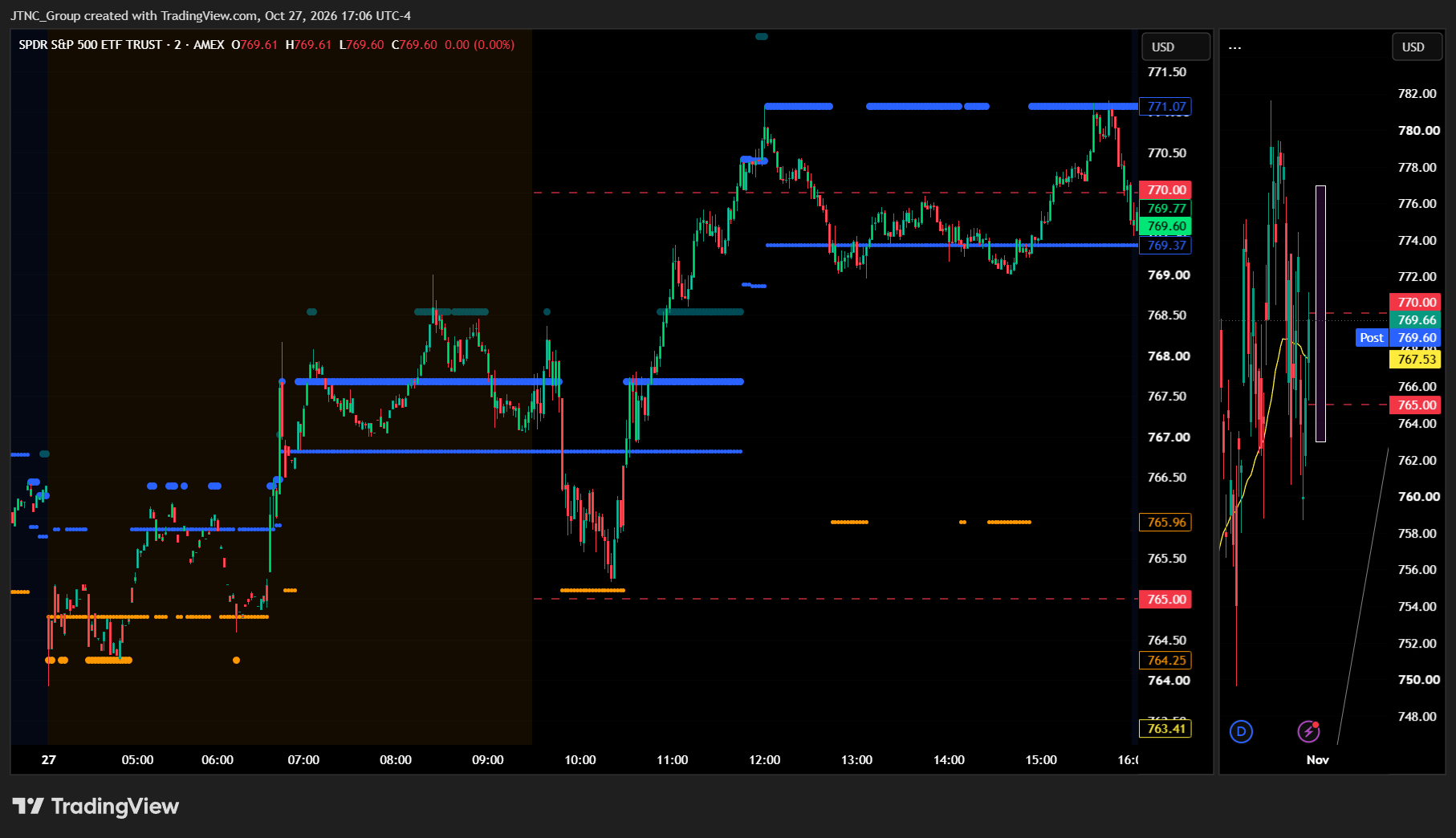
Current Market State Overview:
The MSI ended Tuesday in a Bullish Trending Market State with SPY closing at $769.71. No extended targets were printing at the close. The MSI rescaled lower overnight to a very narrow bearish state, but no extended targets printed below, so sellers never had the green light. In the premarket the MSI rescaled to a Ranging state and then to a bullish state, with SPY finding support at $765. Extended targets were visible above the range in premarket, with some scattered marks below. At the open SPY tried to break out above MSI resistance, but the move failed quickly. The MSI rescaled to a Ranging state, and SPY retested $765. That base held again, and SPY climbed back up through MSI support that had been acting as resistance, which is our favorite setup, and easily reached MSI resistance. A second breakout attempt came with extended targets printing above during the AM session, and this time SPY was off to the races. Extended targets also printed briefly below during the morning dip, and some extended marks showed up below the range in the PM session. The MSI rescaled higher several times through midday and settled into a moderate $1.70 Bullish Trending state into the close.
For Wednesday the MSI forecast is a slow grind higher, though without extended targets at the close the move may be modest and is likely to find resistance at key levels above. With the FOMC decision Wednesday afternoon and heavyweight tech earnings after the close, expect a muted morning that picks up steam once the Fed speaks. MSI support is $769.37 with resistance at $771.07.
Key Levels and Market Movements:
Monday we stated, "Bulls want to see overnight price hold above $763.80 and stay near the $765.29 close," and added, "From there they need to reclaim $766.35 with the MSI rescaling to a bullish state and extended targets printing above, which would open another push through $767.73 and the 50 DMA toward $770," while also noting, "A clean break of the 50 DMA would be the first real sign the squeeze has more fuel." The bulls followed that script closely. The MSI slipped into a narrow bearish state overnight, but with no extended targets below, sellers couldn't press, and SPY based at $765, well above $763.80. The MSI turned bullish ahead of the bell with extended targets printing above, and SPY opened at $767.34, just under the 50 DMA near $767.73. The first breakout attempt failed fast, the MSI rescaled to a Ranging state, and SPY slid back to a session low of $765.21 to retest the $765 base. That level held again, and buyers drove price back up through MSI support and into MSI resistance. The second breakout came with extended targets printing above, and this one stuck. SPY cleared the 50 DMA, pushed through $770, and tagged a session high of $771.13 as the MSI rescaled higher several times. Price eased off in the PM session and settled at $769.71, just above the new $769.37 support.
Three trades followed. The first was selling the failed breakout at the open once extended targets stopped printing above, targeting a move back to the $765 base, which was reached at the $765.21 low. The second was buying the $765 retest once SPY reclaimed MSI support from below, targeting MSI resistance, which was reached easily. The third was buying the second breakout and the dips into rescaled MSI support with extended targets printing above, targeting the upper line, which carried SPY through the 50 DMA and $770 to the $771.13 high. At minimum it was a 3-for-3 session for traders following the framework.
SPY gained 0.57% on volume of 23.60 million shares, below average again, so the buying still lacked heavy participation ahead of the Fed. The VIX dropped 4.95% to 17.48, another step down in fear. It was an easy day to read and execute with substantial setups, all identified through proper context, patience, and flexibility while leveraging the MSI, premarket levels, and market structure rather than forcing trades. The MSI continues to prove its reliability as the cornerstone of our trading process.
Trading Strategy Based on MSI:
Wednesday has heavy economic data with the FOMC Statement and Federal Funds Rate decision at 2:00 PM ET and the FOMC Press Conference at 2:30 PM ET, which can introduce significant volatility, so traders should be ready to trade what they see rather than predict. Heavyweight tech earnings also land after the close, so expect a muted morning with positioning ahead of the Fed and the real move coming after 2:00 PM ET. The MSI closed in a moderate $1.70 Bullish Trending state with no extended targets printing, which points to a slow grind higher on Wednesday. Without extended targets at the close the move may be modest and is likely to find resistance at key levels above. MSI support is $769.37 and MSI resistance is $771.07, with Tuesday's $771.13 high sitting right on top.
Bulls want to see overnight price hold above $769.37 and stay near the $769.71 close. From there they need to push through $771.07 and Tuesday's $771.13 high with the MSI rescaling higher and extended targets printing above, which would open the door to fresh highs once the Fed is out of the way. Bears want to see $769.37 fail with the MSI rescaling to a bearish state and extended targets printing below. That would press SPY back toward the 50 DMA near $767.73, Tuesday's $767.34 open, and the $765 base beneath it.
In a Bullish Trending state with moderate width, bulls have control and any pullback to MSI support at $769.37 is a buying opportunity targeting $771.07. A failed breakout above $771.07 or the $771.13 high that slips back under could offer a short back toward $769.37, but the bias favors longs until the MSI shifts. If the MSI rescales higher with extended targets printing above, buy dips into the new support while targeting the upper line. If $769.37 breaks with extended targets printing below, step aside on longs and look to sell rallies toward $767.73 and $765. Keep size light into the 2:00 PM ET statement and let the post-FOMC reaction and the MSI confirm direction before pressing.
The long-term bull trend remains intact above $640 and failed breakouts and failed breakdowns continue to offer the highest-probability setups. Remain flexible, avoid trading during Ranging Market States unless a clear failed breakout or breakdown presents itself, and ensure all trades are fully aligned with MSI signals. Providing real-time insights into market control, momentum shifts, and actionable levels, the MSI when integrated with our Pre-Market and Post-Market Reports continues to sharpen execution precision and elevate trade quality. If you haven't yet integrated MSI and our model levels into your process, now is the time. Contact your representative to get started as these tools are designed to support consistency and enhance performance.
Dealer Positioning Analysis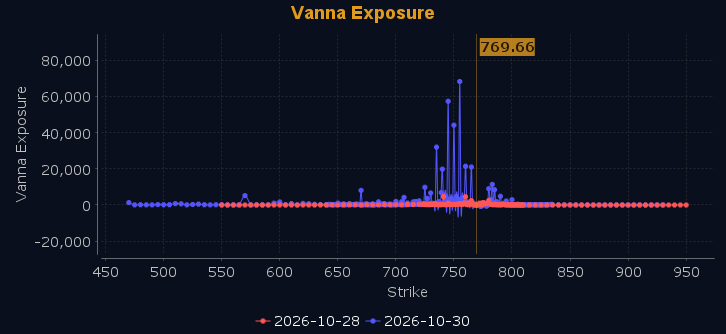
Dealers are selling SPY $770 to $795 and higher strike Calls, indicating the Dealers' belief that the market is balanced for now and waiting on an external catalyst to move price. They are no longer selling ATM Calls, nor are they buying ATM Puts, which is a clear sign they see no edge in either direction at the moment. Dealers bought a large quantity of Calls on Monday, and that bet paid off handsomely on Tuesday. The ceiling for Wednesday appears to be $780. To the downside, Dealers are buying $769 to $710 and lower strike Puts in a 3:1 ratio to the Calls they're selling, displaying continued concern that prices could move lower. There is a Call wall overhead at $772 which will provide resistance, with a Put wall below at $758 that is unlikely to hold as support should price reach that level. Below $767 is bearish and above $772 is bullish, with chop and traps in between. Gamma is positive, so rallies are likely to be sold, while pullbacks below $767 may pick up steam and head significantly lower. Dealer positioning is unchanged at neutral/slightly bullish.
Looking Ahead to Next Friday:
Dealers are selling SPY $770 to $805 and higher strike Calls, indicating the Dealers' belief that the market is balanced and awaiting an external catalyst to move price this week. They are no longer selling ATM Calls, nor are they buying ATM Puts, so the smart money is sitting on its hands until something forces the issue. The ceiling for the week appears to be $783. To the downside, Dealers are buying $769 to $685 and lower strike Puts in a 4:1 ratio to the Calls they're selling, showing they remain heavily hedged and are still guarding against a deeper pullback. Into the end of the week, there is a Call wall overhead at $770 which will provide resistance, with a Put wall below at $755 that is unlikely to hold as support should price reach that level. Below $766 is bearish and above $770 is bullish, with chop and traps in between. Gamma is positive, so rallies are likely to be sold, while pullbacks below $766 may pick up steam and head significantly lower. For the week Dealer positioning is unchanged at bearish. We advise reviewing Dealer positioning daily for directional clues. These positions evolve quickly and tracking them is essential for staying ahead of shifting market sentiment.
Recommendation for Traders
Buy dips near $765, targeting $772 and $775, with stops below $760.
With the FOMC decision at 2:00 PM ET and the press conference at 2:30 PM ET, keep size light and review the premarket analysis posted before 9 AM ET for any changes in the model's outlook and Dealer Positioning.
Good luck and good trading!
