
Market Insights: Monday, October 26th, 2026
Market Overview
Stocks started the week higher as Anthropic's IPO filing reignited the AI trade ahead of a packed stretch of tech earnings. The Dow added 146 points, or roughly 0.3%, while the S&P 500 rose 0.7% and the Nasdaq gained about 0.8%, bouncing after a second straight losing week for both the S&P 500 and the Nasdaq. Tech led the way, with chip names Nvidia, Broadcom, and Micron all higher, and neocloud CoreWeave turned positive after weeks of pressure tied to AI financing worries. The catalyst was Anthropic's public S-1, filed under the ticker ANT, which showed revenue of $16.3 billion for the six months ended June versus $4.6 billion for all of 2025, with AI infrastructure spending of $9 billion already topping last year's total. The filing also disclosed that Anthropic agreed to spend up to $120.5 billion with SpaceXAI through 2029, roughly $3.1 billion per month once capacity comes online in December, which gave SpaceX shares a lift. Not to be outdone, Meta plans to raise up to $95 billion for AI infrastructure, starting with $35 billion in common and preferred stock, and Nvidia, AMD, and Broadcom signaled they could buy up to $5 billion of it. Tesla was the standout, jumping more than 5% for its best day since early July after Barclays upgraded the stock to Overweight with a $450 price target, with analyst Dan Levy citing a possible takeout premium from a SpaceX combination. Apple slipped, while Alphabet and Meta barely moved. Oil eased, with Brent falling to $110 and WTI to $101 after Saudi Arabia's defense minister visited Tehran, though AAA's national average for gasoline still sits at $4.28 a gallon and diesel at $5.34, about $3.28 more than a year ago.
Beneath the rally there were reasons for caution. RBC's Lori Calvasina noted that the 10 largest S&P 500 stocks have been faltering and dragging on the index, and Goldman Sachs' Ben Snider said retail trading volumes have fallen about 20% since mid-summer and more than 40% since late 2025, with retail now just 9% of US equity volume versus 15% late last year. Overseas, Brazilian stocks plunged after Lula's reelection, with the iShares MSCI Brazil ETF down 26% in the premarket, which would be its biggest one-day drop since 2000. Microsoft edged higher after offering voluntary buyouts to roughly 60,000 employees, and Lumentum jumped 10% after StoneX initiated coverage with a Buy rating and a $1,200 target, lifting Coherent and Applied Optoelectronics along with it. The week's real tests are still ahead. The Fed begins its two-day meeting Tuesday with a decision Wednesday afternoon, and while markets widely expect a hold, Alan Blinder is looking for a "hawkish pause" and Chair Warsh is not expected to telegraph the next move. Alphabet and Microsoft report Wednesday after the close, and the ECB, Bank of Canada, and Bank of Japan all meet this week as well.
SPY Performance
SPY opened at $762.25, gapping up from yesterday's close of $759.96 and starting the session above the $761.17 level we flagged as the first hurdle to reclaim. After two straight gap downs, the bulls finally got the overnight edge, and they built on it once the bell rang. SPY pushed through yesterday's high of $763.47 and cleared the $764.44 level we said needed to be recaptured first, then kept climbing to a session high of $767.73. That briefly took it above $766.71, the line we said would truly repair the damage. Sellers did show up near the highs and pulled SPY back, but the dip never got close to threatening the morning gains. The session low of $761.64 held above $761.17, and SPY finished at $765.29, closing back above $764.44 but just shy of $766.71.
SPY gained 0.70%, more than erasing yesterday's loss and closing well above its open. That's the key difference from the last two sessions. Instead of the gap doing all the work, buyers kept pressing during regular hours and held most of their ground into the close. The volume tells a more cautious story, though. Turnover came in at 27.87 million shares, below average and even lighter than yesterday's already quiet session. That means this bounce happened without much conviction behind it. A rally on thin participation can happen simply because sellers step aside, not because buyers are rushing in, and that's exactly what this looks like. The bears clearly lost their urgency, but the bulls haven't brought out the heavy money yet either. The VIX dropped 5.45% to close at 18.39, pulling back from the 20 area where it had stalled for two straight sessions. That's a meaningful cooling in fear. Traders are starting to take some of their protection off the table, which tells us the worry that drove the recent selloff is easing, at least for now.
The big question now is whether this is the start of a real recovery or just a relief bounce that fades once sellers regroup. Reclaiming $764.44 on a closing basis is a solid step, and holding above $761.17 all session shows that the old resistance may be turning back into support. On the upside, $766.71 is the level to watch, since SPY poked above it today but couldn't hold it into the close. Beyond that, today's high of $767.73 is the next test, and a close above it would show buyers have real staying power. On the downside, $764.44 is now the first line of support, followed by today's low of $761.64 and then $761.17. A close back below $761.17 would put the bears right back in charge and bring yesterday's low of $758.68 back into focus. Today the bulls did what they needed to do on price, but they did it without much volume behind them. Until SPY can close above $766.71 with stronger participation, this rally deserves respect but not blind trust. The sellers' grip has clearly loosened, yet the buyers still have to prove they can take full control.
Major Indices Performance
The Nasdaq led the way with a 0.82% gain, a solid rebound after a couple of sessions spent licking its wounds from the recent tech selloff. Growth stocks finally got the bounce that had been missing, as buyers stepped back into the high-octane corners of the market with real conviction. Strength wasn't perfectly uniform across the biggest tech names, but enough heavyweights pushed higher to lift the whole index and put it firmly back in charge. After the stabilization we saw last session, this follow-through shows the growth trade still has plenty of fans willing to buy weakness.
The Russell 2000 came in second with a 0.33% advance, extending its streak of steady, reliable behavior. Small-caps didn't explode higher, but they didn't need to. They've been one of the most dependable groups through all the recent rotation chaos, and today they simply kept grinding along with the broader market. Cooling energy prices helped ease some of the inflation pressure that weighs on smaller companies, which tend to feel rising costs more sharply than their larger peers. Their breakout remains intact, and that continued resilience keeps the risk-on case alive.
The Dow brought up the rear with a modest 0.28% gain, a mild recovery after getting hammered in the prior session. The blue chips managed to claw back a slice of their losses, but they clearly weren't where the money wanted to be today. With crude pulling back, the industrials and old-economy names that got squeezed by the energy spike caught a little relief, though not enough to keep pace with tech's charge. The rotation swung back toward growth, leaving the value-heavy Dow trailing the pack. The S&P 500 landed between the Nasdaq and the small-caps, supported by broad participation from the growth side. The VIX dropped 5.45% to close at 18.39, pulling further away from the 20 level and signaling that the nervousness hanging over the market eased noticeably as buyers regained control.
Notable Stock Movements
Tesla was the biggest mover in the Magnificent Seven, ripping 5.21% higher to lead the group. That's the kind of move that grabs attention after a couple of rough sessions for big tech, and it shows traders are still willing to chase high-beta names when the mood improves. Tesla is usually the first stock buyers reach for when they want to take on more risk, so a jump this size suggests sentiment flipped quickly from defensive to aggressive. If Tesla can build on this pop instead of giving it back, it could become the spark that pulls the rest of the group out of its recent funk.
The group finished with a mostly green session, a welcome change after the red streak that had been dragging on mega-cap growth. Microsoft, Nvidia, and Amazon joined Tesla on the winning side, while Alphabet, Apple, and Meta were the exceptions. Meta was the weakest link again, sliding 1.88% to lead the laggards and adding to the heavy damage it took earlier in this stretch. Alphabet stayed in the red for a second straight session, which means it still hasn't found its footing after leading the group lower last time out. Apple slipping is a notable twist, since it had been one of the safe harbors inside big tech just a couple of sessions ago. The split shows that buyers came back, but they're still being selective and aren't willing to forgive every name.
The broader market lined up with the bounce in big tech. The Nasdaq led the way with a 0.82% gain, while the Russell 2000 added 0.33% and the Dow rose 0.28%. That's a reversal of last session, when the blue chips took the biggest hit, and it puts tech back in the driver's seat. The VIX dropped 5.45% to 18.39, pulling fear further away from the key 20 level and confirming that traders felt a lot more comfortable stepping back in. Tuesday brings CB Consumer Confidence at 10:00 AM ET, which could shake things up early since a weak read on the consumer would hit names like Amazon and Tesla especially hard. If Tesla keeps its momentum and Meta and Alphabet find support, the Nasdaq could extend its leadership and give the whole market a stronger push. But if the laggards keep sliding and the consumer data disappoints, this bounce could turn out to be just a short break in the selling rather than a true turnaround.
Commodity and Cryptocurrency Updates
Crude oil cooled off after its big surge, slipping 1.74% to close at $101.47. The pullback looks more like traders catching their breath than a real change in direction, since the black gold is still holding above the $100 mark. Crude has rallied well above $70 and far beyond longer-term model expectations, and the geopolitical tensions and supply disruptions behind this run haven't gone away. A one-day dip doesn't erase the fear premium built into prices. With Tuesday's consumer confidence report on deck, energy traders will be watching for any sign that high fuel costs are starting to weigh on household spending. The bigger concern stays the same. A sustained move this far above $70 keeps inflation pressure alive and could seriously complicate the Fed's path on rate policy if energy prices stay this high.
Gold finally snapped its losing streak, rising 0.49% to close at $4,028. That bounce came right off the doorstep of the $4,000 level, which suggests bulls were ready to defend that big psychological line. The gain was modest, so it's too early to call a full recovery, but stopping the bleeding is an important first step. The long-term story remains solid, backed by inflation uncertainty, steady central bank buying, and ongoing geopolitical headlines. If gold can build on this move and hold above $4,000, it could set the stage for a steadier climb. A drop back below that level, however, would reopen the door to more selling.
Bitcoin drifted lower again, slipping 0.27% to close at $79,807. The losses are small, but the crypto has now lost the $80,000 handle, which is a level bulls would have liked to keep. Bitcoin still isn't showing real strength and continues to trade like a high-risk asset that isn't getting much love even when the broader mood improves. Buyers need to step in and build a base here before any breakout talk makes sense. If Bitcoin can reclaim $80,000 quickly, it would ease some of the pressure. Continued slippage below recent lows, though, would keep sellers firmly in control.
Treasury Yield Information
The 10-year Treasury yield slipped just 0.04% today to close at 4.990, which is basically a flat finish right on the doorstep of the 5% line. After Friday's bounce, bonds didn't extend the selling, but they didn't mount a real rally either. Buyers and sellers fought to a standstill, and the yield ended the session parked in the same spot. That's better than another leg higher, but it isn't the clean rejection of 5% that would tell us the pressure is easing. For now the bond market is holding its breath.
Against each threshold, nothing changed. The 4.5% level where equity valuations start to feel pressure still sits 49 basis points below today's close, and the 4.8% mark that usually triggers broader selling remains 19 basis points back. The 10-year is still just 1 basis point under the 5% line for serious risk, so the cushion that disappeared last week hasn't come back. The buffer under 5.2%, where the framework calls for a 20% or greater correction, holds at 21 basis points. Stalling in place beats moving the wrong way, but this is still the most dangerous zone the framework tracks.
Stocks shrugged it off and rallied across the board. The Nasdaq led with a 0.82% gain, the Russell 2000 added 0.33%, and the Dow bounced 0.28% after taking the brunt of Friday's damage. Growth names doing the heavy lifting with yields hovering near 5% shows investors were willing to look past rates for at least one session. The VIX dropped 5.45% to 18.39, cooling off after two straight days of rising fear. A 1.74% pullback in crude also took a little heat off inflation worries, which gave bond sellers less reason to press.
Tuesday brings CB Consumer Confidence at 10:00 AM ET, and that's the first real test for yields this week. A strong read could revive inflation and growth worries and push the 10-year through 5%, which would flip the framework's serious-risk flag back on and test whether today's equity rally can hold. A soft number could give bond buyers the excuse they need to drive the yield back toward 4.95% or lower. The key level is still 5%, and the 10-year hasn't moved off it. Until it makes a real run at 4.8%, stocks are rallying into a headwind rather than away from one.
Previous Day’s Forecast Analysis
Heading into Monday, our AI model projected SPY's maximum range at $753 to $769, with the Put side dominating in an expanding band. The model called for trending price action with intermittent chop. With an empty economic calendar, the forecast leaned entirely on technicals and positioning. Friday's fade left SPY tucked just beneath $760 and slightly below the midpoint of the projected range, and that placement, combined with the Put-heavy tilt, gave us a bearish bias. The VIX had risen 3.57% to 19.71, sitting right under the 20 line and signaling that traders were still paying up for protection.
The key battleground was $760, the round number sitting right on top of Friday's finish, and it was flagged as the spot to short rallies. Resistance above that stood at $765, $767, and $770. On the downside, $757 was the first support, followed by $755, $753, and $750, which was called the point of last hope for bulls. A break below $750 opened the door to $745.
The preferred trade was shorting a failed rally into $760. Targets were $757, $755, and $753, with $750 as a stretch target and stops above $763. On the bull side, the plan was to buy a dip at $757 that held, targeting $760 and $765, with stops below $755. Traders were told to keep size at half to two-thirds of normal, keep stops at 0.5-0.75% from entry, wait out the first 30 minutes, and avoid the choppy $757 to $760 zone.
Market Performance vs. Forecast
Monday's session stayed entirely inside the model's projected maximum range of $753 to $769, another clean confirmation of the day's outer boundaries. SPY opened at $762.25, dipped to a low of $761.64, climbed to a high of $767.73 and closed at $765.29, up 0.70%. The forecast leaned bearish based on the Put-heavy tilt, but it also laid out a detailed bull roadmap for a decisive break above $760, and that is the script the tape followed. The model does not account for unpredictable external events like weekend sentiment shifts or positioning changes that build before the opening bell. With an empty economic calendar, buyers found enough conviction to push the tape in the opposite direction from the base case. Even so, the projected ceiling at $769 held firm, and the session's trending character matched the model's call for directional movement out of the recent tight channel.
The battle at $760 was the key call of the day, and the forecast said whichever side won it would likely set the trend. Bulls settled that fight before the opening bell, and price never returned to test $760 from above. That turned the level into a floor all session long. The forecast's guidance was clear: if buyers pushed firmly through $760 and held it, traders should step aside and let $765 prove itself. That is exactly what happened. Price broke through $765, reached the $767 stretch target and stalled just short of the $769 hard ceiling. The close above $765 confirmed that level as fresh support. The $770 resistance stayed out of reach, which fits the forecast's view that pushing that high would take more than a quiet, catalyst-free tape.
On the falling market side, the preferred short required a tag of $760 that stalled and rolled over. Price never pulled back to $760, so the trigger never fired and no capital was put at risk. The advice to let the first 30 minutes play out before committing kept traders from forcing a bearish view onto a firm tape. On the rising market side, the $757 dip-buy never came into play because sellers couldn't drag price anywhere near it. The secondary bull setup was the one that mattered. A hold above $760 with $765 and then $767 as targets mapped the session almost perfectly, and the forecast specifically said longs could take the lead once $760 was reclaimed and held. The $769 ceiling marked the right place to lock in gains.
The VIX dropped 5.45% to 18.39, moving away from the 20 line and matching the forecast's bullish condition of volatility backing off while price firmed up. Below-average volume suggests the advance was a steady grind higher rather than a frenzied squeeze. The hold above $760, the push through $765 and the stall beneath $769 all played out across levels the forecast had already named. The framework adapts as conditions shift, and Monday showed the value of mapping both scenarios in advance. With the long-term bull trend intact above structural support near $640, it remains a reliable guide for managing risk and capturing opportunity in either direction.
Premarket Analysis Summary
The premarket analysis, posted before the opening bell, set up Monday with SPY at $762.40 in a put-dominated tape. Price was bouncing back above $760 after Friday's slide closed just under it, but only barely. The bias hinged on $765, the defining level and the gate above, where the tape would begin to repair and the heaviest resistance on the board sat. Reclaiming and holding it would mark Friday's break as a false one, while failing there would keep sellers in control of the week's open. The expected move ran from $753 to $769, about seven points, and the notes warned that moves in a put-dominated tape tend to accelerate rather than fade, making the first hour critical. Upside targets stepped through $764 as the first level, the step into the band beneath the gate, then $766 as a battleground where price should stall, $768 as the next decision point, and $770 as max upside, a major round number just past the top of the expected move. On the downside, $761 was the first level to watch, followed by $760 as the line in the sand and Friday's break level, $758 as the point of last hope, and $755 as max downside and the heaviest support on the board by a wide margin.
The session leaned firmly to the bullish side of the map, with SPY opening at $762.25, just a touch under the premarket spot. Sellers made only a brief attempt lower, and the low printed at $761.64, holding above the $761 first level and never threatening the $760 line in the sand. Buyers then took over, clearing $764, punching through the $765 gate, and pushing past the $766 battleground to a high of $767.73. That fell just short of the $768 decision point, leaving $770 untouched. SPY closed at $765.29, up 0.70% on 27.87M shares of below-average volume, finishing right above the gate. The VIX dropped 5.45% to 18.39, showing that hedging demand eased as the bounce held. The key takeaway is that bulls reclaimed $765 and closed above it, which marked Friday's break as a false one, but the light volume means the repair still needs confirmation. Bulls need to hold $765 and then take out $768, while $761 and $760 remain the levels to defend.
Validation of the Analysis
Monday's session followed the bullish branch of the premarket map almost step by step, and the most important level on the board did exactly what the notes said it would. The notes were written with spot at 762.40, and SPY opened at $762.25, just a hair below that mark and right in the zone between $761 and $764. The notes framed the day around one question: could buyers reclaim $765, "the gate above us, where the tape begins to repair"? The notes were blunt about what a win would mean: "reclaim and hold it and Friday's break was a false one." That is exactly what played out. Buyers took the gate, held it, and turned Friday's slide under $760 into a false break.
The downside levels set the floor right away. The session low came in at $761.64, holding just above $761, the level the notes called "our first level to watch." Price never came close to retesting $760, the "line in the sand," so the warning of a "fast trip to 758" never came into play, and neither $758 nor the $755 max downside was touched. From there, buyers worked through the upside ladder in order. SPY cleared $764, "the step into the band beneath the gate," then pushed through $765 and $766. The high printed at $767.73, stalling just under $768, the level the notes named "the next decision point." The notes said "reclaim 765 and 768 comes quickly," and price got within pennies of it before the decision went to the sellers for the afternoon. The pullback from the high then landed right where the map pointed. The notes described $766 as "a battleground where price should want to stall," and SPY gave back ground through that zone before finishing at $765.29, up 0.70%, closing just above the $765 gate it had fought to reclaim. The entire range stayed inside the expected move of 753 to 769, and the $769 top and the $770 max upside were never reached. The VIX dropped 5.45% to 18.39, confirming that the put-heavy fear from Friday eased as the tape repaired. With volume below average, the rally was steady rather than explosive, which helps explain why $768 capped the move.
The trading value came from knowing where the floor was and which level flipped the tone. Traders following the map saw the early low hold above $761 with $760 sitting just below it, which offered a clean long setup with a tight stop under the line in the sand. The targets were laid out in advance: $764 first, the $765 gate next, and $766 after that. Price reached all three. The breakout through $765 gave a second entry for traders who waited for confirmation, with risk defined back under the gate and $768 as the natural target. Sellers had a setup too. The stall just under $768 was a textbook fade at a named decision point, with risk clearly defined above $770 and profit targets at $766 and $765. Price hit both zones before settling on the gate. The map also kept traders out of bad trades. With $761 holding firm, there was no reason to press shorts toward $758 or $755. With $768 rejecting, there was no reason to chase longs toward $770. A session that bottomed just above the first level below, topped just under the decision point, and closed on top of the gate shows how precisely these levels framed the start of the week. Going forward, the battle lines are clear: bulls need to keep $765 as support and finally push through $768, while bears need to drag price back under $764 and $761 to reopen the door to $760.
Looking Ahead
Tuesday brings one notable release to the calendar, with the Conference Board's Consumer Confidence report hitting the wires at 10:00 AM ET. It's rated medium impact, so it's not the kind of number that usually flips the market on its head, but it still matters. Consumer spending drives a huge chunk of the U.S. economy, and this survey gives a read on how households feel about their jobs, their income, and the months ahead. A strong reading would suggest shoppers are still confident enough to keep opening their wallets, which tends to support retail and consumer discretionary names. A weak print could raise worries that the consumer is starting to pull back, and that can weigh on growth-sensitive stocks. The report's expectations component is worth watching closely, since it often hints at where spending is headed before the hard data catches up.
With nothing scheduled at 8:30 AM ET, the opening move will mostly reflect overnight futures and any early earnings headlines, so the first half hour may feel like a warm-up. The real test comes at 10:00 AM ET, when the confidence number can spark a quick burst of buying or selling. Don't chase that first reaction. Knee-jerk moves on medium-impact data often fade once traders digest the details, so give the market time to settle before you act. If the initial move holds into the afternoon, that tells you the number actually shifted sentiment. If it reverses, the report likely didn't change the bigger picture. This is also a good session to stay disciplined with position sizes and keep stops tight on existing trades. Map out the key levels you care about ahead of time so you're reacting to a plan rather than to the headline. Let the tape confirm the direction before adding new risk, and remember that a single data point rarely defines a trend on its own. Keep the bigger picture in mind too. The Fed's two-day meeting begins Tuesday with the decision and statement due Wednesday afternoon, and Alphabet and Microsoft report Wednesday after the close, so Tuesday's tape is likely to be about positioning ahead of those events rather than conviction.
Market Sentiment and Key Levels
Monday handed the ball back to the bulls, and they ran with it more cleanly than they have in days. Buyers stepped in almost from the opening bell, shook off a shallow early dip, and pressed SPY toward the top of its recent range before easing off slightly into the close. Volume was light, so this wasn't a wave of conviction buying. It was more of a relief rally as sellers backed off after two rough sessions. The breadth story looked healthier than Friday's. The Nasdaq led with a 0.82% gain, while the Russell 2000 added 0.33% and the Dow tacked on 0.28%. Growth took the lead again, but small caps and blue chips joined in, which tells us buyers weren't hiding in one corner of the market. That's a constructive shift after Friday's rotation-driven selling, though the modest gains in the Dow and small caps show the enthusiasm wasn't evenly spread. Hedges sent mixed signals, as gold rose 0.49% while Bitcoin slipped 0.27%. The biggest tell came from the fear gauge, with the VIX dropping 5.45% to 18.39 and pulling well back from the 20 mark it had been pressing against. Bulls have reclaimed a slight edge, but light volume means they still need to prove this bounce has staying power.
SPY finished in the upper half of the $762 to $767 range that has defined recent trading, just shy of first resistance at $767. A clean break above $767 opens the door to $770, followed by $772 and $776 if buyers can build momentum. On the downside, losing $762 likely sends SPY toward $760, then $758 and $753. If $753 gives way, there is little to keep price from falling toward $750. The bigger picture remains solid, with the long-term bull trend intact well above structural support at $640. That keeps this a broader dip-buying environment as long as key levels hold, and Monday's drop in fear supports that view. Tuesday's projected maximum range runs from $760 to $771, with the Put side dominating in an expanding band that points to trending price action mixed with intermittent chop. That Put-side tilt is worth respecting, since it suggests the upside may not come easily even after a strong session. The main catalyst arrives at 10:00 AM ET with CB Consumer Confidence, a medium-impact release that could stir things up shortly after the open as traders gauge how the consumer is holding up. A solid read could be the spark that finally pushes SPY out of this tight box to the upside, while a soft number could send price right back toward the bottom of the range. Traders will also want to see whether tech leadership holds or fades, and whether small caps and blue chips can add to Monday's modest gains. Elevated yields and stubborn oil prices remain in the background as inflation worries, and either one could hand sellers fresh ammunition. With fear easing and SPY holding firm inside its range, we favor buying dips near $762. Keep stops tight below $758, watch how price reacts to the consumer confidence data in the first hour, and look for a decisive push through $767 before chasing the move any higher.
Expected Price Action
Tuesday's session brings actionable intelligence generated by our AI model, which projects SPY's maximum range at $760 to $771. With the Put side dominating in an expanding band, the model is calling for trending price action with intermittent chop. Unlike Monday's empty calendar, Tuesday has a real catalyst, with CB Consumer Confidence hitting at 10:00 AM ET. It's a medium-impact release, but it lands right after the open and could be the spark that finally knocks price out of the tight box it has been stuck in. Monday was a solid rebound that repaired some of Friday's damage, and SPY finished almost exactly at the midpoint of Tuesday's projected range. That central position, set against the Put-heavy tilt of the band, leaves us with a neutral bias heading into Tuesday and a slight lean to the upside as long as $762 holds, since the bounce itself was constructive. The VIX dropped 5.45% to 18.39, a meaningful drop in fear that shows buyers are getting more comfortable. Still, an expanding band means a directional move is likely, and the Put side has the edge on which way it breaks.
The key zone for Tuesday is the $762 to $767 box that has defined recent trading. Resistance starts at $767, and a clean break above it opens the door to $770, with $772 and $776 standing as further hurdles beyond the top of the model's range. On the downside, $762 is the first support and the spot where we favor buying dips. Losing it likely sends price toward $760, the bottom of the projected range, followed by $758. Below that, $753 is the lowest support and the point of last hope for bulls. If $753 gives way, there is little to keep price from falling toward $750. The bigger picture remains healthy, with SPY well above structural support near $640 and the long-term bull trend intact, so this is still a dip-buying market on a broader timeframe. In the short run, the playbook is straightforward. A pullback into $762 that holds sets up a long with $767 and $770 as targets. A decisive break of $762 after the consumer confidence data flips the script and puts $760 and $758 in play quickly, so step aside rather than fight it. If buyers punch through $767 and hold it, the trend likely turns up for the day. Whichever side wins the battle at $762 or $767 after the 10:00 AM release likely sets the tone for Tuesday's session.
Trading Strategy
The VIX dropped 5.45% to 18.39, pulling back from the 20 line as fear eased and buyers stepped in with more confidence. Even so, the Put side still dominates an expanding band, so keep size at roughly half to two-thirds of normal until price breaks out of its box. Keep stops in the 0.5-0.75% range from entry. Tuesday brings CB Consumer Confidence at 10:00 AM ET, and that release could be the spark that finally breaks the tight $762 to $767 zone. Let the first 30 minutes play out, then wait for the 10:00 AM number to land before committing to anything aggressive. The trending action with intermittent chop the model expects means jumping in early is how traders get whipsawed.
In a falling market scenario, shorting a rally into $767 is the cleanest setup, since that level has capped recent upside and sits at the top of the range. A tag of $767 that stalls and rolls over is the primary trigger, especially if a soft consumer confidence read sends the VIX back above 19 while price fails to push higher. The first profit target is $762, with $760 next if sellers keep pressing. Runners can aim for $758, and $753 should be treated as a stretch target on a heavy trend-down day. Stops on shorts belong above $770, and aggressive traders can give it room up to just below $772. If price loses $753 with conviction, don't chase the flush. Short a failed retest of $753 from underneath instead, targeting $750 as the final stretch target. Scale out in layers into support, because quick drops in this environment can snap back just as fast.
In a rising market scenario, buying a dip at $762 is our favored trade and the best risk-reward setup on the board. A pullback that tags $762 and holds is the primary long trigger, particularly if the VIX keeps sliding toward the 17 area while price firms up. The initial profit target is $767, with $770 in play if buyers seize control. Stops on longs belong below $760, just under the next support shelf. If bulls break through $767 and hold it, buy a clean retest of $767 as support, targeting $770 and then the projected maximum at $771 as a hard ceiling for the session. Anything beyond that toward $772 and $776 should be treated as bonus territory for runners only. With the model favoring dip-buys at $762 but puts still in charge of the band, keep long and short size roughly equal, and let longs take the lead only if $767 is reclaimed and held. The long-term bull trend remains intact above $640, so deeper pullbacks will likely draw buyers. For now, the bulls have a slight edge as long as $762 holds.
Model’s Projected Range
SPY's projected maximum range for Tuesday is $760 to $771, with the Put side dominating in an expanding band that suggests trending price action with intermittent chop. Tuesday, October 27 brings CB Consumer Confidence at 10:00 AM ET, a medium-impact release that could stir some movement shortly after the open as traders gauge how the consumer is holding up. SPY closed at $765.29, up 0.70%, after opening at $762.25, dipping to a low of $761.64, and then pushing to a high of $767.73 before settling back a bit into the close on lighter-than-average volume. SPY remains in the $762 to $767 range that has defined recent trading, and the consumer confidence read is the main macro catalyst on deck that could finally push price out of this tight box. If SPY breaks above $767, look for a move toward $770, while a break below $762 opens the door to $760, and if the lowest support at $753 gives way, there is little to keep price from falling toward $750. The long-term bull trend remains intact above $640 with SPY well above structural support. As long as price holds above key structural levels, this remains a broader dip-buying environment. Absent a catalyst, resistance sits at $767, $770, $772, $776, while support rests at $762, $760, $758, $753. We favor buying dips at $762. Leadership was mixed, as Bitcoin slipped 0.27% to close at $79,807 while the MAG stocks put in a mostly green day led by Tesla up 5.21%, with Meta the notable laggard down 1.88%. The VIX closed at 18.39, down 5.45%, suggesting a significant reduction in fear as buyers stepped in and SPY pressed toward the top of its range. SPY closed in the upper half of its recent sideways channel with structural support near $640.
Market State Indicator (MSI) Forecast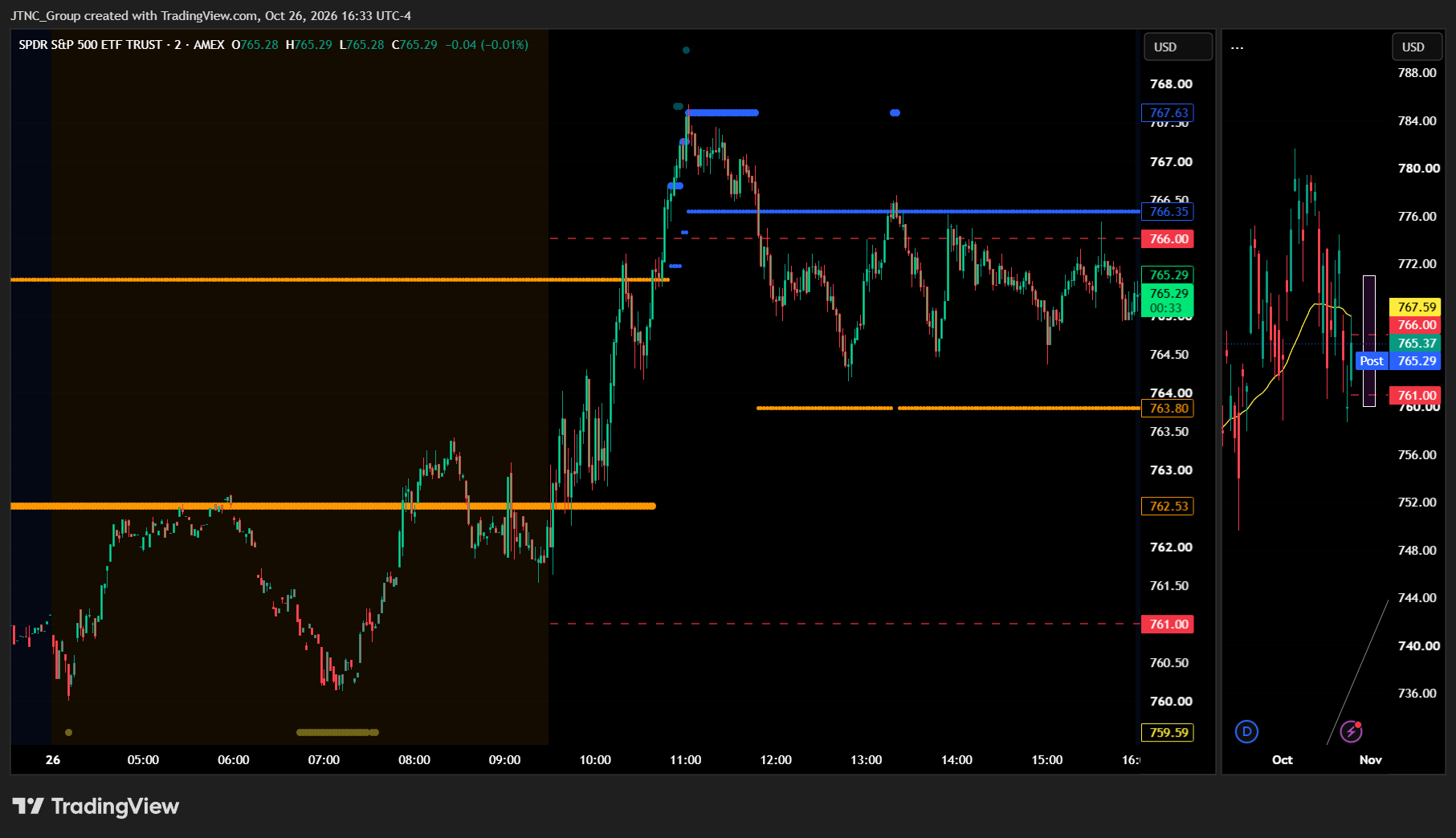
Current Market State Overview:
The MSI ended Monday in a Ranging Market State with SPY closing at $765.29. MSI support is $763.80 and MSI resistance is $766.35 heading into Tuesday's session. The MSI did not rescale overnight and remained in a wide bearish state into the open. Extended targets printed below briefly in the premarket, but SPY found a base at $760, and with no extended targets below by the open, SPY was able to move back into the MSI from below and mean revert. With the short squeeze on, the MSI rescaled higher three times in quick succession late in the morning to narrow bullish states, with a few moments of extended targets printing above. That brought SPY right to the 50 DMA, where it failed, and the MSI rescaled to a moderate $2.55 Ranging state, where it remained until the end of the day with no extended targets printing.
For Tuesday that implies more sideways to perhaps slightly higher prices. The failure at the 50 DMA and the shift to a Ranging state say the squeeze ran out of fuel for now, and it's also quite likely the market is waiting on the major earnings due this week as well as Wednesday's FOMC statement before committing to a direction.
Key Levels and Market Movements:
Friday we stated, "Bulls want to see overnight price hold above Friday's $758.68 low and stay near the $759.96 close," and added, "From there they need to reclaim $762.53 with the MSI rescaling higher and extended targets printing above, which would open a push toward Friday's $763.47 high and $765.47," while also noting, "If $762.53 is reclaimed with the MSI rescaling higher and extended targets printing above, it flips back to support, and traders can buy dips into it while targeting $763.47 and $765.47." The bulls got exactly that script. Sellers pressed SPY lower in the premarket, but price based at $760 and never threatened Friday's $758.68 low. SPY opened at $762.25, just under $762.53, and dipped to a session low of $761.64. That breakdown failed, and price climbed back into the range. Shorts were caught leaning the wrong way, and buyers pushed through $765.47 MSI resistance. The MSI rescaled higher three times in quick succession, extended targets printed above for a few moments, and the rally peaked at a session high of $767.73 right at the 50 DMA, where it stalled. The MSI then rescaled to the Ranging state with $766.35 on top and $763.80 below, and SPY chopped sideways inside that band for the rest of the day before settling at $765.29.
Three trades followed. The first was buying the failed breakdown below $762.53 once SPY reclaimed it after the $761.64 low, targeting $765.47 MSI resistance, which was reached and exceeded. The second was buying the dip into the newly rescaled MSI support as the state turned bullish with extended targets printing above, targeting the upper line and the push into $767.73. The third was selling the failed breakout at the 50 DMA near $767.73 once extended targets stopped printing, targeting a move back into the new range toward $765.
SPY gained 0.70% on volume of 27.87 million shares, below average again, so the squeeze lacked heavy participation from the herd. The VIX dropped 5.45% to 18.39, easing some of the fear that built last week. It was an easy day to read, though not an easy day to trade once the afternoon settled into a tight, choppy range. Still, substantial setups were present, all identified through proper context, patience, and flexibility while leveraging the MSI, premarket levels, and market structure rather than forcing trades. The MSI continues to prove its reliability as the cornerstone of our trading process.
Trading Strategy Based on MSI:
Tuesday has light economic news, with CB Consumer Confidence at 10:00 AM ET the only release, and it carries medium impact. The bigger catalysts are the mega-cap earnings landing through the week and Wednesday's FOMC statement, so expect positioning rather than conviction. The MSI closed in a moderate $2.55 Ranging state with no extended targets printing, which points to sideways to slightly higher prices on Tuesday. MSI support is $763.80 and MSI resistance is $766.35, with the 50 DMA near Monday's $767.73 high the first real test above.
Bulls want to see overnight price hold above $763.80 and stay near the $765.29 close. From there they need to reclaim $766.35 with the MSI rescaling to a bullish state and extended targets printing above, which would open another push through $767.73 and the 50 DMA toward $770. A clean break of the 50 DMA would be the first real sign the squeeze has more fuel. Bears want to see $763.80 fail with the MSI rescaling to a bearish state and extended targets printing below. That would press SPY back toward $762.53, Monday's $761.64 low, and the $760 base beneath it.
In a Ranging state the best setups are at the edges of the range, so be patient and let price come to the levels. A failed breakdown below $763.80 that quickly reclaims the level offers a long back toward the $765.29 close and $766.35. A failed breakout above $766.35 or at the 50 DMA near $767.73 that slips back under offers a short back toward $763.80. If the MSI rescales to a trending state, trade with it: above $766.35 with extended targets printing above, buy dips into that level while targeting $767.73 and $770; below $763.80 with extended targets printing below, that level flips to resistance, and traders can sell rallies into it while targeting $762.53 and $761.64. Inside the range, stay small and avoid chasing.
The long-term bull trend remains intact above $640 and failed breakouts and failed breakdowns continue to offer the highest-probability setups. Remain flexible, avoid trading during Ranging Market States unless a clear failed breakout or breakdown presents itself, and ensure all trades are fully aligned with MSI signals. Providing real-time insights into market control, momentum shifts, and actionable levels, the MSI when integrated with our Pre-Market and Post-Market Reports continues to sharpen execution precision and elevate trade quality. If you haven't yet integrated MSI and our model levels into your process, now is the time. Contact your representative to get started as these tools are designed to support consistency and enhance performance.
Dealer Positioning Analysis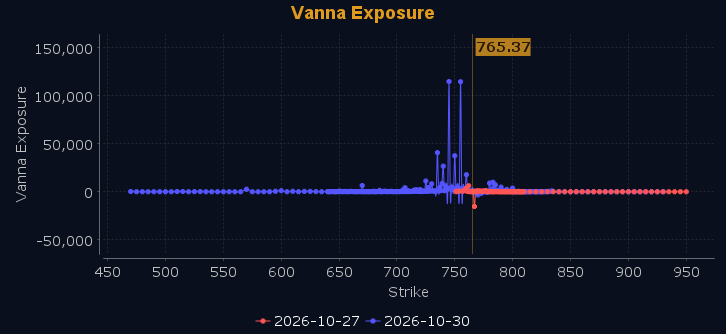
Dealers are selling SPY $768 to $785 and higher strike Calls while buying $766 to $768 Calls, indicating the Dealers' desire to participate in any rally on Tuesday. They are buying large quantities of these ATM Calls to stay positioned for the upside. The ceiling for Tuesday appears to be $777. To the downside, Dealers are buying $765 to $700 and lower strike Puts in a 3:1 ratio to the Calls they're selling, displaying continued concern that prices could move lower. Dealers sold a large quantity of Puts on Friday, and that bet paid off handsomely on Monday. There is a wall overhead at $767 which will slow any ascent, with support at $765. But SPY does not turn bullish until $770 is reclaimed, and a failure of $765 opens the door to $760. Expect chop between $763 and $767, with just a slight bull drift above and a bear drift below those levels. Gamma is strongly negative, so support and resistance are less apt to hold, and the market may fail to respect these levels on repeated attempts to break through. Dealer positioning is unchanged at neutral/slightly bullish.
Looking Ahead to Next Friday:
Dealers are selling SPY $770 to $800 and higher strike Calls while buying $766 to $769 Calls, indicating the Dealers' desire to participate in any rally this week. They are buying ATM Calls to stay positioned for that upside. The ceiling for the week appears to be $780. To the downside, Dealers are buying $765 to $700 and lower strike Puts in a 4:1 ratio to the Calls they're selling. Dealers reduced their protection on Monday, but they remain heavily hedged, so the smart money is still guarding against a deeper pullback. For the week, below $763 is bearish and above $770 is bullish, with the range in between being choppy and trap filled. SPY will find major resistance at $770, while $755 is a major Put wall below. Gamma is negative, which favors trending behavior, with support and resistance giving way as price pushes through. For the week Dealer positioning is unchanged at bearish, though a bit less so. We advise reviewing Dealer positioning daily for directional clues. These positions evolve quickly and tracking them is essential for staying ahead of shifting market sentiment.
Recommendation for Traders
Buy dips near $762, targeting $767 and $770, with stops below $758.
With CB Consumer Confidence at 10:00 AM ET, keep size light and review the premarket analysis posted before 9 AM ET for any changes in the model's outlook and Dealer Positioning.
Good luck and good trading!
