
Market Insights: Thursday, October 15th, 2026
Market Overview
Stocks bounced back Thursday as investors rotated out of tech and into defensive plays, piling into bonds and sending long-dated Treasury yields tumbling. The Dow jumped nearly 600 points, or 1.1%, the S&P 500 erased early losses to finish up 0.3%, and the Nasdaq clawed back from a drop of more than 1% to edge slightly higher. The comeback followed a two-day AI-driven sell-off fueled by worries over how the industry is financing its massive build-out. Chip stocks trimmed their losses after South Korea's KOSPI sank 7% overnight, though Taiwan Semiconductor still fell 2% despite posting a record profit and beating estimates on global AI chip demand. Inflation worries also crept back in after September's wholesale inflation index rose at its fastest pace since 2022, raising fresh questions about the Fed's next move. The biggest drama centered on CoreWeave, which staged its biggest intraday comeback since Aug. 3, erasing an early decline of roughly 10% to turn positive after Wednesday's 15% plunge, its worst day since February. Nvidia CEO Jensen Huang, a key backer of the neocloud provider, sparked the reversal at a Bloomberg event in Stockholm, saying "CoreWeave's strength is improving every day. I'm optimistic. Their cost of capital is actually decreasing." The bond market isn't buying it yet, though. The cost of insuring CoreWeave against default hit a record, with pricing implying roughly 60% odds of default within five years, underscoring concerns about its debt-heavy balance sheet and whether it can grow fast enough to cover rising interest costs. Watch whether its debt starts recovering alongside its shares, since that would be stronger proof that financing fears are easing.
The AI trade split down the middle. Hyperscalers like Microsoft, Amazon, and Alphabet held steady to higher, but the companies supplying the physical build-out got hammered. Vertiv fell over 6%, while Comfort Systems and Quanta Services posted sizable losses. Together with GE Vernova, Eaton, and EMCOR, those six names have shed roughly $94 billion since Oct. 6, including over $23 billion Thursday alone. Their businesses reach beyond AI, but data center spending drives demand for their cooling, electrical equipment, power systems, and construction services, so a rebound alongside their customers would signal confidence that the spending is still flowing to the builders. Other big-promise stocks in space and quantum computing also got slammed early before finding buyers. Rocket Lab bounced off its lows but stayed down double digits after pushing its Neutron rocket debut into 2027, while quantum names IonQ and Rigetti turned substantially higher after early declines. These companies face different hurdles, but funding expensive infrastructure and getting ambitious technology into service can both delay the profits investors are counting on.
SPY Performance
SPY opened at $766.25, gapping down below yesterday's close of $769.67 and, just as important, slipping under yesterday's low of $766.71. That was the line we said needed to hold, and early on it looked like sellers were going to pick up right where they left off. SPY extended the slide to a session low of $764.44, but that's where the selling dried up. Buyers stepped in, pushed SPY back above $766.71, and then kept pressing. The rally carried all the way to a session high of $772.87 before cooling off slightly, and SPY finished at $771.77, near the top of the day's range rather than the bottom.
SPY gained 0.28%, a modest move on paper, but the shape of the session matters more than the size of the gain. Volume came in at 37.30 million shares, below average and well short of yesterday's heavy turnover. That tells two stories at once. On one hand, the sellers who drove yesterday's breakdown didn't show up with the same force, which is encouraging. On the other hand, the bounce didn't attract enough buyers to signal real conviction. This looks more like sellers stepping back than bulls charging in. The early undercut of yesterday's low followed by a quick recovery is a classic shakeout pattern, the kind that flushes out weak hands before a stabilization. Whether it's the start of a real recovery or just a pause in the decline will depend on what happens next. The VIX dropped 2.43% to close at 16.46, easing back after yesterday's spike but still sitting well above the 15 area where it had been comfortable. Fear cooled off a bit, but traders haven't fully let go of their protection, and that's a sign the market is still on edge. The bigger picture hasn't changed dramatically. SPY bounced, but it's still trading well below the broken support zone that gave way yesterday. On the upside, today's high of $772.87 is the first hurdle, and above that the $775.95 to $776.30 area remains the key ceiling, with $776.61 and $777.26 stacked just overhead. SPY needs to reclaim that cluster to convince anyone the breakdown was a false alarm, and until it does, rallies into that zone are likely to run into selling. On the downside, today's low of $764.44 is now the most important level on the chart, with yesterday's low of $766.71 serving as the first line of support above it. If SPY holds above $764.44, today's reversal could mark a short-term bottom and set up a test of resistance. A close below it, though, would erase today's recovery and suggest the selling pressure from yesterday is far from over. The bulls won this round, but on light participation, they haven't won the argument yet.
Major Indices Performance
The Russell 2000 led the charge, jumping 1.28% and snapping a three-day losing streak in convincing fashion. After getting dumped hardest in the prior session, small-caps flipped from the market's biggest laggard to its top performer. That kind of reversal usually means traders are getting less defensive, and a pullback in Treasury yields gave the most rate-sensitive corner of the market some much-needed breathing room. One good day doesn't repair a stalled recovery, but it shows buyers are still willing to step into beaten-down names when the pressure lets up. If small-caps can string together a few more sessions like this, the recent breakdown could start to look more like a shakeout than the start of something worse.
The Dow followed close behind, climbing 1.08% to end its two-day slide. The blue-chip index already proved it was the market's safe harbor during the selloff, and today it turned that steadiness into real gains. Value and old-economy names kept drawing money, which keeps the rotation story very much alive. The gap between the Dow and the tech-heavy Nasdaq tells you investors are still favoring industrials, financials and other cyclical plays over high-multiple growth. This wasn't just a defensive hiding spot anymore. It was money actively chasing the parts of the market that have been holding up best.
The Nasdaq barely made it into positive territory, inching up just 0.08%. That technically ends a three-day losing streak, but it's hardly a victory lap. Mega-cap tech was split, with weakness in the chip space offsetting gains elsewhere and leaving the index stuck in neutral while the rest of the market rallied. The fact that growth stocks couldn't join a broad-based bounce is a warning sign that the rotation away from tech hasn't finished yet. The S&P 500 landed in between with a modest gain, lifted by strength in cyclicals but held back by sluggish tech. The VIX dropped 2.43% to close at 16.46, breaking its three-day climb and showing that nerves cooled somewhat as buyers returned to the riskier parts of the market.
Notable Stock Movements
NVIDIA took the hardest hit in the Magnificent Seven, dropping 1.84% to lead the group lower. The chip giant has been the face of the AI trade, so a slide like this stands out on a day when the broader market found its footing. It doesn't necessarily signal a breakdown, but it does show that traders were willing to take profits in the group's biggest momentum name rather than chase it higher. When the leader of the AI story is lagging, it's a sign that money is getting more selective about where it wants exposure.
The group as a whole put up another mostly red session, but the mix shifted from yesterday. Microsoft was the clear standout, gaining 1.08%, with Alphabet and Amazon also finishing green. Apple, yesterday's lone bright spot, slipped back into the red, and Meta failed to bounce after its rough prior session. That split suggests this wasn't the broad tech dump of the last session. It was more of a rotation within big tech, with investors favoring the cloud and software heavyweights over chips and consumer-facing names. Three winners is an improvement, but it's far from a convincing recovery for the group.
The broader market tells a different story than the Mag Seven did. The Nasdaq barely moved with a 0.08% gain, while the Dow jumped 1.08% and the Russell 2000 led the way at 1.28%. That's a sharp reversal from the prior session, when small caps got hammered, and it shows buyers stepping back into beaten-down areas instead of piling into mega-cap tech. The VIX dropped 2.43% to 16.46, a modest easing of fear after yesterday's spike. Friday brings no economic news, so big tech will trade on technicals and positioning alone. If Microsoft can keep its momentum and NVIDIA finds support, the Nasdaq could start catching up to the Dow and small caps, but continued weakness in chips would keep the tech-heavy index stuck while the rest of the market does the heavy lifting.
Commodity and Cryptocurrency Updates
Crude oil extended its climb, rising 1.21% to close at $96.24. That's another fresh high for this run, and the steady march higher shows no sign of losing steam. Crude has rallied well above $70 and far beyond longer-term model expectations, and the geopolitical tensions and supply disruptions fueling the move remain firmly in place. Buyers keep stepping in on every session, and with no economic data on Friday's calendar, oil will likely keep trading on headlines and momentum. The bigger concern is what happens if crude stays this elevated, because sustained energy costs at these levels will keep feeding inflationary pressure and could seriously complicate the Fed's path on rate policy.
Gold came roaring back, jumping 2.10% to close at $4,194. That move more than erased the prior session's pullback and sent a clear message that dip buyers are still very much in control. The quick rebound shows that demand for the metal remains deep, and sellers couldn't build on their brief moment of traction. The long-term drivers haven't changed: inflation uncertainty, steady central bank buying, and nonstop geopolitical headlines all continue to underpin the bid. With momentum swinging back in the bulls' favor, gold looks poised to take another run at its highs, and holding above these levels will be key to keeping that push alive.
Bitcoin bounced back, gaining 0.90% to close above $82,299. That recovered the prior session's losses and put crypto back on firmer footing, even as big tech struggled to find its footing. Bitcoin showing relative strength on a day when growth leadership wobbled is an encouraging sign for bulls. Still, the recent pattern of one step forward and one step back has made it tough to trust any single up day. Buyers need to string together consecutive gains to prove momentum is truly shifting, and until that happens, the broader trend remains under pressure, with a break below recent lows still opening the door to more downside.
Treasury Yield Information
The 10-year Treasury yield fell 1.95% today to close at 5.090. That's the fourth straight pullback and by far the largest of the streak, nearly four times the size of yesterday's drop. Bond buyers didn't just defend the break below 5.2%, they pressed the advantage and pushed yields toward the next major line in the framework. The rate surge that had equities on edge is now clearly losing steam, but the 10-year still sits in territory that has historically spelled trouble for stocks.
Measured against each threshold, the setup keeps getting better while staying far from comfortable. The 4.5% level where equity valuations start to feel the squeeze is 59 basis points below today's close. The 4.8% mark that usually triggers broader selling is 29 basis points back. The 5% line for serious risk is now cleared by just 9 basis points, the thinnest margin we've seen in this pullback. The 10-year has also built a real cushion of 11 basis points under 5.2%, the level where the framework calls for a 20% or greater correction. Yesterday that cushion was a single basis point, so today's move turns a fragile break into something more convincing.
This time stocks reacted the way you'd expect when rates ease. The Russell 2000 jumped 1.28% and the Dow gained 1.08%, with small caps finally getting the relief that falling yields usually deliver. Rate-sensitive smaller companies carry more debt and depend more on cheap financing, so they tend to benefit most when borrowing costs back off. The Nasdaq lagged with a 0.08% gain as weakness in big tech held it back, but the broader message is that the disconnect from yesterday has started to heal. The VIX dropped 2.43% to 16.46, a sign that some of the nervousness is draining out of the market.
Friday brings no economic news, so the 10-year will trade on momentum and positioning rather than fresh data. The big question is whether yields can break below 5% and stay there. A close under that line would remove the framework's serious-risk warning and give equities their most meaningful relief since the rate surge began. A failure there, especially with energy prices still elevated and feeding inflation worries, could send yields bouncing back toward 5.2%. The trend is finally working in the market's favor, but lasting relief for stocks still depends on a sustained move under 5%.
Previous Day’s Forecast Analysis
Thursday's forecast called for SPY to trade within a maximum projected range of $761 to $775, with our AI model expecting trending price action mixed with intermittent chop. The Put side dominated an expanding band, so even though SPY's position slightly above the midpoint of the range gave a modestly bullish lean, the overall tilt favored sellers. The VIX jump of 10.61% to 16.89 backed up that caution and showed traders reaching for protection. The heavy 8:30 AM ET data stack of Core PPI m/m, PPI m/m, Core Retail Sales m/m, Retail Sales m/m, the Philly Fed Manufacturing Index, and Unemployment Claims was flagged as a likely source of first-hour volatility. Warsh's 11:30 PM ET remarks were labeled a wildcard for Friday rather than a factor during the session. With price still working inside the $766 to $770 zone that had defined recent trading, a decisive breakout in one direction looked likely.
The key levels were clearly mapped. Resistance started at $770, followed by $772, $775, and final overhead resistance at $778. On the downside, $766 served as the pivot, with support at $764, $762, and $760, the last hope for bulls. A break of $760 opened the door to $750. Structural support near $640 kept the long-term bull trend intact.
The strategy called for cutting size to about half of normal, using stops of 0.5-0.75%, and waiting out the first 30 minutes before committing. The preferred trade was shorting rallies that stalled near $770, targeting $766, then $764, $762, and $760, with $750 as a stretch target and stops above $772 or $775 for aggressive traders. If an early headline knifed price below $766, the plan was to short a failed retest rather than chase. Longs were the secondary setup at roughly half the bear-side size. The plan was to buy a flush into $762 that held, targeting $766 and $770, with stops below $760. A clean retest of $770 as support after a breakout was a long for $772 and $775. The burden of proof sat squarely on the bulls.
Market Performance vs. Forecast
Thursday's session stayed entirely inside the model's projected range, and the level structure mapped the day with impressive accuracy. The forecast called for a maximum range of $761 to $775, and SPY respected both boundaries, trading between a session low of $764.44 and a high of $772.87 before closing at $771.77, up 0.28%. The model entered the day with a modestly bullish bias by position, noting that SPY had settled above the midpoint of the projected range, and that lean proved correct by the closing bell. The model does not account for unpredictable external events, and the 8:30 AM ET stack of Core PPI m/m, PPI m/m, Core Retail Sales m/m, Retail Sales m/m, the Philly Fed Manufacturing Index and Unemployment Claims was always going to inject early volatility. Still, the market's reaction unfolded within the framework's boundaries. The forecast named $766 as the pivot, and price opened at $766.25, right on top of it. The forecast also said whichever side won the battle at $766 or $770 would likely set the trend for the session, and that is exactly how it played out.
The early dip tested the downside levels just as the playbook outlined. Price slipped below the $766 pivot and pushed toward the $764 target, with the session low at $764.44 stopping just shy of that level. Buyers stepped in right where the forecast's support structure said they should, and the $762 and $760 levels were never threatened. From there, the battle shifted to $770. Bulls cleared the top of the recent range with conviction, which matched the forecast's guidance that a firm hold above $770 would neutralize the bearish tilt and open a run at $772. The $772 target was hit as the session high reached $772.87, and price stalled well below the $775 top of the projected range, confirming that the upper boundary held firm.
On the falling market side, the short setup near $770 required a stall and rollover at that level. Instead, buyers pushed through, and the forecast had already accounted for that outcome by placing stops above $772. Those stops did their job, and risk management protocols protected capital as the tape shifted in favor of the bulls. The guidance to let the first 30 minutes shake out before committing proved valuable, since the opening reaction to the data initially leaned bearish before reversing. On the rising market side, the forecast laid out a clear alternate path: if bulls cleared $770 with conviction, buy a clean retest of $770 as support, targeting $772 and then $775. That roadmap captured the afternoon's strength, with the first target reached as price pressed higher into the close. The flush-to-$762 long trigger never lined up, since buyers defended price well above that zone.
The VIX dropped 2.43% to 16.46, easing from the prior session's spike but still holding above the 16 line that the forecast set for cutting size toward half. That kept the reduced sizing and tight 0.5-0.75% stop guidance fully relevant on a day that whipsawed early before settling into a trend. Volume came in below average, suggesting the advance lacked broad participation even as price worked higher. The $766 pivot, the $764 support test, the $770 breakout line and the $772 upside target all gave traders clear reference points throughout a data-heavy session. The framework continues to adapt to shifting conditions, and with the bigger picture still healthy above structural support near $640, it remains a reliable guide for managing risk and positioning ahead of Warsh's late-night remarks and whatever Friday brings.
Premarket Analysis Summary
The premarket analysis, posted before the opening bell, framed Thursday's projected maximum range between $761 and $775, with the Put side dominating in an expanding band that pointed to trending price action mixed with intermittent chop. The bias was split. SPY had settled slightly above the midpoint of the projected range, which gave a modestly bullish lean by position, but the Put-heavy band said sellers held the upper hand after Wednesday's sharp rejection. The analysis warned that the 8:30 AM ET stack of Core PPI m/m, PPI m/m, Core Retail Sales m/m, Retail Sales m/m, the Philly Fed Manufacturing Index, and Unemployment Claims could whipsaw the first hour, and it urged traders to let the opening reaction settle. The first test was $770, sitting right overhead at the top of the recent $766 to $770 range and flagged as the spot to short rallies. A firm hold above it would neutralize the bearish tilt and open a run at $772, with $775 at the top of the projected range and $778 as final resistance. On the downside, $766 was the pivot, with $764 and $762 below, $760 as the point of last hope, and $750 in play if that level gave way.
The session played out as a battle at the exact levels the analysis named, and the bulls won it. SPY opened at $766.25, sitting right on the $766 pivot, and the early data-driven chop briefly cracked that level. Sellers pushed to a low of $764.44, stopping just short of the $764 target, but the breakdown never accelerated the way a true Put-dominated trend day would. Buyers stepped in, reclaimed $770, and delivered the scenario the notes described as a firm hold that opens a run at $772. SPY tagged a high of $772.87 and stalled well before $775, keeping the entire session inside the projected range. It closed at $771.77, up 0.28%, on 37.30M shares of below-average volume. The VIX dropped 2.43% to 16.46, confirming that some of Wednesday's fear unwound. Shorts taken near $770 were stopped out on the push above $772, which is exactly why the notes required bulls to prove they could reclaim $770 before anyone changed course. Once they did, the modestly bullish positional bias won out over the bearish tilt. With price now holding above $770, that level becomes the floor to defend, and a clean break of $772 puts $775 back in play.
Validation of the Analysis
Thursday tested both sides of the map, and the premarket levels handled every turn. The notes set up the session as a battle between two lines, warning that "whichever side wins the battle at $766 or $770 likely sets the trend for the session." SPY opened at $766.25, sitting right on the $766 pivot the analysis had named as the key downside level. The notes also cautioned that "the first hour could whipsaw hard in both directions" after the 8:30 AM ET data stack, and that is how the morning played out. Early selling pushed price through $766, and the analysis had already mapped the next stop: "a failure at $766 could mean a quick trip to $764." SPY found its low at $764.44, holding just above that $764 support. The deeper levels at $762, $760, and the $750 flush scenario stayed untouched, and the session never came close to the $761 bottom of the projected range.
From there, buyers took the other path the notes had laid out. The analysis said "a firm hold above $770 would neutralize the bearish tilt and open a run at $772," and that is what happened next. SPY reclaimed $770, pushed to a high of $772.87, and stalled right around that $772 target. The $775 top of the projected range and the $778 heavy-supply zone were never challenged, which means the whole session stayed inside the $761 to $775 band the model drew up the night before. SPY closed at $771.77, up 0.28%, sitting comfortably between the $770 and $772 markers. That finish also lined up with the "modestly bullish bias by position" the notes flagged after Wednesday's close above the midpoint of the projected range. The VIX dropped 2.43% to 16.46, giving back part of the prior day's spike and confirming that the fear premium built into the data slate faded as the numbers were absorbed.
The playbook gave traders a clear way to handle a two-sided tape. The instruction to "let the opening reaction settle" kept disciplined traders from getting chopped up in the early whipsaw. The dip toward $764 offered a clean spot to take profits on any early downside move, since the notes had named it as the first target below $766. Once SPY pushed back above $770, the framework told traders exactly how to adjust. The notes said to "make the bulls prove they can reclaim $770 before changing course," and when they did, the long setup came into play: "buy a clean retest of $770 as support, targeting $772 and then $775." That trade worked, with $772 delivering right on schedule. Just as important, the risk rules kept losses small for anyone who leaned short. Shorts were supposed to trigger only if $770 "stalls and rolls over," and when it held instead, stops above $772 provided a defined exit. The framework was just as valuable for what it told traders to avoid. There was no reason to panic-sell below $764, and no reason to chase upside toward $775 once $772 started capping the move. The test of $766, the hold above $764, the reclaim of $770, and the stall at $772 all matched levels published before the bell. With price now sitting between those two upper markers, the map is ready for Friday.
Looking Ahead
Friday's economic calendar is completely clear, with no high-impact releases on the schedule. After a stretch packed with inflation and consumer spending data, that is a welcome change of pace. Without a fresh report to react to at 8:30 AM ET, the market will have to stand on its own and decide what to make of everything it has absorbed this week. Quiet sessions like this often reveal where conviction really sits. If buyers keep stepping in with no new catalyst to push them, that tells you the recent moves have real support behind them. If the market drifts or fades, it suggests traders were leaning on headlines more than on genuine confidence. Either way, Friday works as an honest read on sentiment heading into next week.
Traders can use the session to position thoughtfully rather than chase reactions to data. This is a good time to review open trades, tighten stops on winners, and trim anything that no longer fits the setup. Keep in mind that a light calendar can still produce sharp moves. Overnight headlines, corporate news, and end-of-week profit-taking can all shake things up, especially in the final hour as traders decide whether to hold positions over the weekend. Lower volume can also exaggerate swings in both directions, so a sudden spike may not carry the weight it would on a busier day. Stay patient, let price action confirm a direction before committing, and treat Friday as a chance to set up cleanly rather than force trades that aren't there.
Market Sentiment and Key Levels
Thursday gave the bulls a modest win, and the way it came together tells a more interesting story than the headline gain. Sellers tested the tape early, but buyers absorbed the pressure and ground prices higher through the session to finish near the top of the day. The breadth beneath the surface was the real headline. The Russell 2000 jumped 1.28% and the Dow climbed 1.08%, while the Nasdaq barely moved at 0.08%. When small caps and blue chips lead while growth stalls, it signals rotation rather than a broad risk-on rush. Mega-cap tech offered little help, so leadership came from the rest of the market, and Bitcoin's 0.90% gain showed speculative appetite holding up well. Fear eased, too. The VIX dropped 2.43% to 16.46, unwinding part of Wednesday's spike as the early dip was bought. The bulls have reclaimed some ground, but with the Put side still dominating the projected range and participation light, this looks more like a cautious recovery than a decisive shift in control.
SPY finished inside the $770 to $773 range that has defined recent trading, putting $773 squarely in focus as resistance. A push through it opens the door to $775, with $778 and $780 in play if buyers keep pressing. On the downside, $770 is the first line of support. Losing it targets $768, followed by $765 and $760. If $760 gives way, there is little to keep price from falling toward $750. The bigger picture still favors the bulls, with the long-term trend firmly intact well above structural support at $640, so this remains a broader dip-buying environment as long as key levels hold. Friday's projected maximum range runs from $766 to $778, with the Put side dominating in an expanding band that points to trending price action mixed with intermittent chop. There is no economic news on the calendar, which means the market will trade almost entirely on technicals and the levels above will carry extra weight. Without a data catalyst, traders will watch whether the rotation into small caps and blue chips can continue or whether weakness in big tech finally drags the broader tape lower. Softer yields gave equities some breathing room on Thursday, but firm energy prices and a sharp move in gold suggest inflation and hedging concerns have not gone away. Those background forces could resurface quickly heading into the weekend, especially if buyers can't clear resistance early. We favor shorting rallies near $773 rather than chasing strength into resistance. Keep stops disciplined above $775, watch how price behaves around $770, and make the bulls prove they can break out of the recent range before changing course.
Expected Price Action
Friday's session brings actionable intelligence generated by our AI model, which projects SPY's maximum range at $766 to $778. With the Put side dominating in an expanding band, the model is calling for trending price action with intermittent chop. The economic calendar is empty, so there is no scheduled data to jolt the tape, and the market will trade on technicals. The one wildcard is Fed Chairman Warsh's late-night remarks Thursday, which could color the open before the levels take over. Thursday's session was a steady recovery from early weakness, with buyers grinding price back toward the top of the recent channel. SPY settled just below the midpoint of the projected range, which gives us a modestly bearish bias by position heading into Friday. That lean lines up with the Put-heavy band, so sellers still hold the edge even after the bounce. The VIX dropped 2.43% to 16.46, a modest easing of fear that shows traders are not scrambling for protection, but it is not the kind of collapse that signals a full-blown risk-on shift. Price is still working inside the $770 to $773 range that has defined recent trading, and with an expanding band and no headlines to hide behind, a decisive move out of this tight zone looks likely.
The first test for Friday is $773, sitting right overhead at the top of the recent range. In a Put-dominated tape, this is exactly where we favor shorting rallies. If buyers can push through and hold it, SPY targets $775 next, with $778 at the top of the projected range and $780 standing as the final overhead resistance where any squeeze should run into heavy supply. On the downside, $770 is the pivot, and a clean break there likely sends price toward $768, followed by $765 near the bottom of the projected range. Below that, $760 is the lowest support and the point of last hope for bulls. If $760 gives way, there is little to keep price from falling toward $750. The bigger picture remains healthy, with SPY trading well above structural support near $640 and the long-term bull trend intact, so this is still a dip-buying market on a broader timeframe. In the short run, the playbook is straightforward. With no data on the calendar, the opening reaction to Warsh's comments is the only early catalyst, so let any overnight move settle before committing. Rallies that stall near $773 are selling opportunities, while a firm hold above $773 would neutralize the bearish tilt and open a run at $775. A failure at $770 could mean a quick trip to $768, and with the Put side in control, breakdowns below support are more likely to accelerate than to get bought. Whichever side wins the battle at $770 or $773 likely sets the trend into the weekend.
Trading Strategy
The VIX dropped 2.43% to 16.46, a modest easing of fear as buyers absorbed the early weakness. That's still above the 16 line, though, so don't get comfortable. Keep size at roughly half to three-quarters of normal and hold stops in the 0.5-0.75% range from entry. Friday has no economic news on the calendar, which means there's no data spike to dodge at the open. The tape will trade purely on technicals. Expect trending moves broken up by intermittent chop. Let the first 30 minutes establish direction before committing, and don't force trades in the middle of the range where the chop will eat you alive.
In a falling market scenario, shorting rallies near $773 is our preferred setup, with the Put side dominating an expanding band. A push into $773 that stalls and rolls over is the primary short trigger, especially if the VIX starts to firm while price fails to break through. The first profit target is $770, with $768 next if sellers crack first support. Runners can aim for $766 near the bottom of the projected range, then $765 and $760. If $760 gives way, $750 comes into play, but treat that as a stretch target reserved for a strong trend day. Stops on shorts belong above $775, and aggressive traders can give it room above $778 at the top of the projected range. If price slices below $770 early, don't chase. Short a failed retest of $770 from underneath instead. With puts in control, bear-side size can lead.
In a rising market scenario, longs are the secondary setup and should be traded lighter. A flush into $766 or $765 that holds and bounces is the cleanest long trigger, particularly if the VIX keeps fading while price stabilizes. The initial profit target is $768, with $770 and then $773 in play if buyers regain control of the channel. Stops on longs belong below $760, because losing that level opens a fast slide toward $750. If bulls clear $773 with conviction, buy a clean retest of $773 as support, targeting $775 and then $778. Treat $780 as a stretch target only on a strong breakout day. Keep bull-side size at roughly half the bear side and take profits in layers into resistance. The long-term bull trend remains intact above $640, so dip-buyers will likely defend pullbacks. For now, though, the burden of proof is on the bulls to break out of this range.
Model’s Projected Range
SPY's projected maximum range for Friday is $766 to $778, with the Put side dominating in an expanding band that suggests trending price action with intermittent chop. Friday brings no economic news due out so the market will trade on technicals. SPY closed at $771.77, up 0.28%, after opening at $766.25, dipping to a low of $764.44 early, and then grinding higher to tag a high of $772.87 before settling just off the top of the day. SPY remains in the $770 to $773 range that has defined recent trading, and with no fresh macro headline driving the tape, price action continues to be dictated by the levels. If SPY can push through $773, the next target is $775, but if $770 gives way, look for a slide toward $768, and if the lowest support at $760 breaks there is little to keep price from falling toward $750. The long-term bull trend remains intact above $640 with SPY well above structural support. As long as price holds above key structural levels, this remains a broader dip-buying environment. Absent a catalyst, resistance sits at $773, $775, $778, $780, while support rests at $770, $768, $765, $760. With SPY closing in the upper half of its range and the Put side in control, we favor shorting rallies near $773. Bitcoin showed strength, closing above $82,299 with a 0.90% gain, while the MAG stocks had a mostly red day led lower by NVIDIA down 1.84%, with Microsoft the standout to the upside at 1.08%, so leadership was clearly split between crypto strength and big tech weakness. The VIX closed at 16.46, down 2.43%, suggesting a modest easing of fear as SPY recovered from its early lows. SPY closed near the top of its recent trading channel with long-term structural support well below at $640.
Market State Indicator (MSI) Forecast
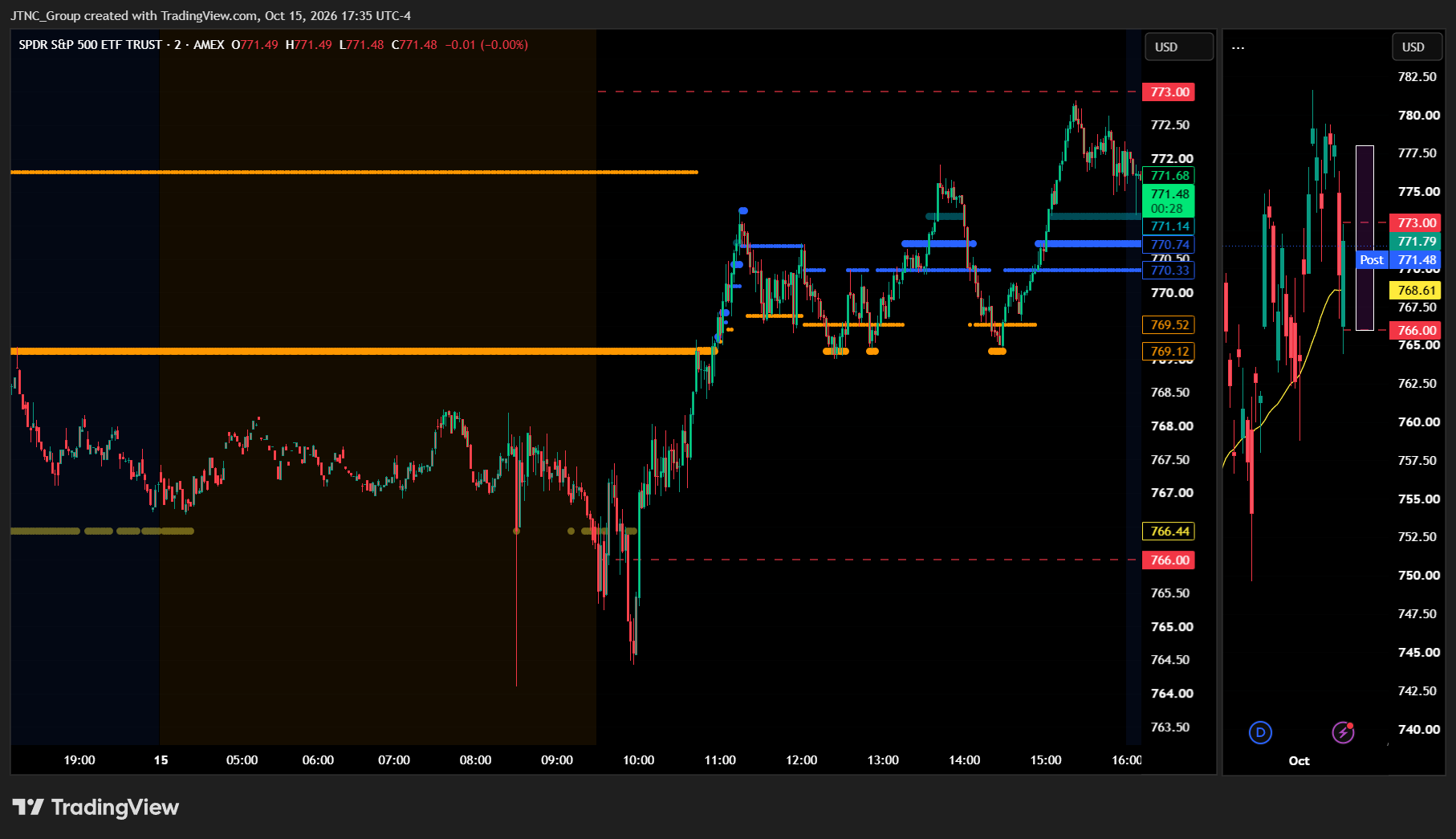
Current Market State Overview:
The MSI ended Thursday in a Bullish Trending Market State with SPY closing at $771.77. That close sits above the MSI range, so we have a flip. MSI resistance at $770.74 now becomes support for Friday, giving the bulls a fresh floor to defend. Extended targets were printing above at the close. The MSI did not rescale overnight, and as we suggested Wednesday, SPY retested the prior day's lows and then some. Extended targets printed below in premarket and into the open while the MSI held a Bearish Trending state, and for a while it looked like SPY was headed significantly lower. Then SPY reached $765 major support and reversed hard. Extended targets stopped printing below, a clear sign the herd was no longer pushing prices lower.
From there the MSI rescaled several times higher. It moved into a Ranging state during the AM session and held there through midday as SPY climbed back above the 50 DMA. In the PM session it turned Bullish Trending, and extended targets printed above, pushing SPY right up to $773. A pullback into the close with extended targets still printing above kept SPY in positive territory. At the close the MSI range is a narrow $0.41, which signals tight consolidation rather than a market ready to sprint. For Friday the MSI is forecasting a likely sideways to possibly higher session, as the narrow bullish MSI suggests consolidation rather than strong trending. That said, the bulls are likely to maintain pressure to the upside, and a push that holds above $772 would put higher prices in play. Any failure of MSI support is likely to see SPY retest the day's lows. MSI support is $770.33 with resistance at $770.74.
Key Levels and Market Movements:
Wednesday we stated, "Bulls want to see overnight price hold above $769.12 and stay near the $769.67 close," and added, "Bears want to see $769.12 fail and press SPY back toward Wednesday's $766.71 low and the $766.44 extended target area," while also noting, "If a hot PPI print breaks that zone with the MSI rescaling lower and extended targets still printing below, the 50 DMA that held Wednesday may give way and open the door to a deeper slide." The bears got their move early. With the MSI Bearish Trending in premarket and extended targets printing below into the open, SPY opened at $766.25, already under $766.71 and $766.44. It then slipped below the 50 DMA, just as we flagged it might.
The deeper slide never got going, though. SPY tagged $765 major support, made a session low of $764.44, and snapped back hard. Extended targets stopped printing below, which told us sellers were running out of gas. A perfectly acceptable trade there was the failed breakdown at $765. Traders could buy the reclaim of that major support and target $766.71 and the 50 DMA overhead, and that was the first winner of the day. The MSI then rescaled higher into a Ranging state in the AM session and held there through midday. That is not the place to force trades, and patience was rewarded as SPY worked its way back above the 50 DMA.
In the PM session the MSI rescaled again into Bullish Trending, with support at $770.33 and resistance at $770.74, and extended targets printed above. Once SPY pushed through $770.74, that resistance flipped to support. Buying the dip into that old resistance-turned-support and targeting the premarket levels above was the second trade, as SPY ran to a session high of $772.87. A pullback into the close trimmed some of the gains, but SPY held above the MSI range to finish at $771.77. At minimum it was a 2-for-2 session for traders following the framework.
SPY gained 0.28% on volume of 37.30 million shares, which is below average and well under Wednesday's turnover. The VIX dropped 2.43% to 16.46, a sign that some of the fear from the inflation scare is easing. It was a volatile but readable day with substantial setups, all identified through proper context, patience, and flexibility while leveraging the MSI, premarket levels, and market structure rather than forcing trades. The MSI continues to prove its reliability as the cornerstone of our trading process.
Trading Strategy Based on MSI:
Friday has light economic news so the market is likely to move more sideways to up than trend given the Bullish Trending at close. The MSI closed Bullish Trending with a narrow $0.41 width and extended targets printing above. That points to a sideways to possibly higher session, with the narrow bullish MSI suggesting consolidation rather than strong trending. The bulls are still likely to keep pressure to the upside. SPY closed above the range, so $770.74 flips from MSI resistance to support, with $770.33 MSI support just beneath it.
Bulls want to see overnight price hold above $770.74 and stay near the $771.77 close. From there they need to push and hold above $772 and take out Thursday's $772.87 high. If the MSI rescales higher with extended targets still printing above, that opens the door to a grind higher. Bears want to see $770.74 and $770.33 fail. A break there would press SPY back toward the 50 DMA and $766.71, with $765 major support and Thursday's $764.44 low in play if extended targets flip to printing below. Because the range is so narrow, the MSI may rescale overnight, so respect both boundaries and be ready for a breakout in either direction.
With bulls holding the edge, the primary setup for Friday is buying a dip into $770.74 resistance-turned-support, using $770.33 as the line in the sand and targeting $772 and $772.87. A failed breakout above $772.87 that quickly slips back under offers a short back toward $770.74, but the bias favors longs while the MSI stays bullish. If $770.33 breaks with the MSI rescaling lower and extended targets printing below, that level flips to resistance. Traders can then sell rallies into it while targeting $766.71, $765, and the $764.44 low. A failed breakdown below $770.33 that quickly reclaims the level offers a long back toward $772.
The long-term bull trend remains intact above $640 and failed breakouts and failed breakdowns continue to offer the highest-probability setups. Remain flexible, avoid trading during Ranging Market States unless a clear failed breakout or breakdown presents itself, and ensure all trades are fully aligned with MSI signals. Providing real-time insights into market control, momentum shifts, and actionable levels, the MSI when integrated with our Pre-Market and Post-Market Reports continues to sharpen execution precision and elevate trade quality. If you haven't yet integrated MSI and our model levels into your process, now is the time. Contact your representative to get started as these tools are designed to support consistency and enhance performance.
Dealer Positioning Analysis
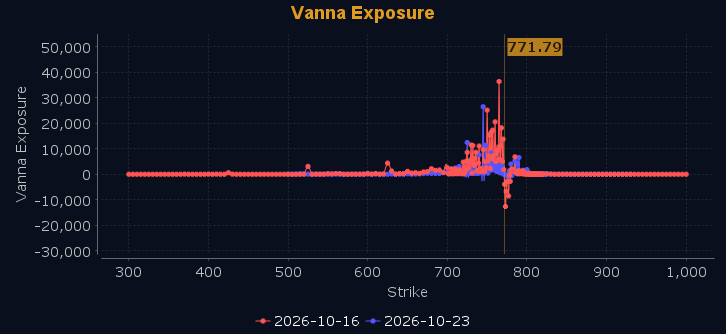
Dealers are selling SPY $780 to $805 and higher strike Calls while buying $772 to $779 Calls, indicating the Dealers' desire to participate in any rally on Friday. They are buying ATM Calls, looking to take part in any continuation rally on Friday, and their positioning and hedging remain unchanged. The ceiling for Friday appears to be $785. To the downside, Dealers are buying $771 to $700 and lower strike Puts in a 3:1 ratio to the Calls they're selling, displaying continued concern that prices could move lower. Below $772 is bearish and above $775 is bullish, with everything in between being choppy and trap filled. Should SPY fail to stay above $772, expect weakness on Friday. Above $772 the market will attempt to clear $775, where it returns to solidly bullish. Gamma is negative, so SPY is likely to trend and push through support and resistance levels. A move to $775 will likely be met with initial resistance that should ultimately give way, and the same goes for support at $772. Should that support fail, SPY can easily revisit $765. We continue to favor trades with the trend on Friday and will restrict mean reversion trade opportunities. Dealer positioning is unchanged at neutral/slightly bullish.
Looking Ahead to Next Friday:
Dealers are selling SPY $780 to $810 and higher strike Calls while buying $772 to $779 Calls, indicating the Dealers' desire to participate in any continuation of Thursday's short squeeze rally into next week. The ceiling for the week appears to be $790. To the downside, Dealers are buying $771 to $700 and lower strike Puts in a 4:1 ratio to the Calls they're selling, displaying ongoing concern that prices could move lower. They materially reduced their hedges, suggesting some belief that prices may not have much further to fall, but they remain positioned for a sell off should one develop. Below $770 is bearish and above $777 is bullish, with the range in between being choppy and trap filled. There is major support at $765 with major resistance at $775. Gamma is negative, and as such we expect more trending opportunities into the end of next week. For the week Dealer positioning is unchanged at bearish. We advise reviewing Dealer positioning daily for directional clues. These positions evolve quickly and tracking them is essential for staying ahead of shifting market sentiment.
Recommendation for Traders
Short rallies near $773, targeting $770 and $768, with stops above $775. A break under $760 opens the door to $750.
With no economic news Friday, technicals rule, so keep size light and review the premarket analysis posted before 9 AM ET for any changes in the model's outlook and Dealer Positioning.
Good luck and good trading!
