
Market Insights: Wednesday, September 9th, 2026
Market Overview
US stocks fell for a third straight session Wednesday as oil topping $100 a barrel and a sharp jump in Treasury yields gave investors plenty to worry about. The Dow dropped roughly 0.8%, the S&P 500 slipped 0.5%, and the Nasdaq fell 0.6%, with inflation anxiety front and center as earnings reports took a back seat. The 10-year Treasury yield climbed 3 basis points to 4.83%, its highest level since October 2023, after Treasury Secretary Scott Bessent announced plans to triple the next bond buyback program in an attempt to rein in rising borrowing costs — a move the market clearly didn't love. Fed rate hike odds ticked up to 60% for the meeting next week, per CME Group, as energy supply disruptions from escalating US-Iran tensions continued to fuel inflation fears.
On the oil front, Brent crude crossed $101 per barrel and WTI hit $96 after the US struck five Iranian oil tankers, marking crude's first triple-digit print in over a month. Diesel stole the spotlight though, with the EIA warning that US stockpiles could fall below 100 million barrels for the first time since 2003, while retail prices averaged $5.94 per gallon and GasBuddy's Patrick de Haan said a cross above $6 per gallon could be days away. On the corporate side, Apple shares dipped as CEO John Ternus unveiled the foldable iPhone Duo, updated Apple Watch Series 11 and Ultra 4, AirPods 5, and improved Apple Intelligence software — a "sell the news" reaction that's historically not unusual for the stock. Meta surged over 6% on strong analyst reception to its new AI assistant Muse, Chewy posted in-line quarterly results, and Fox and Roku each sank roughly 2% after the DOJ requested additional information on Fox's proposed Roku acquisition.
SPY Performance
SPY opened at $764.08 and wasted no time signaling that the bears were still firmly in control, with the high of $764.47 tagged almost immediately before the session deteriorated into another slow, painful slide. The low of $760.94 captured the worst of the day's damage, and while buyers managed a modest bounce off those levels, the close of $762.40 still landed well within the lower half of the day's range. That's now four consecutive closes near session lows — a pattern that makes it increasingly difficult to argue this is just a temporary pause rather than a real breakdown in progress.
SPY finished down 0.46% on the day, a slightly smaller loss than yesterday's decline but damaging in its own right because it extends a losing streak that is showing no meaningful signs of exhaustion. Volume came in at 32.77 million shares, below average and nearly identical to the prior session — once again, this isn't panic selling, it's quiet, methodical distribution where sellers don't need to rush because buyers simply aren't showing up to contest the tape. The VIX surged 4.71% to close at 16.46, a significantly larger move than yesterday's uptick and a clear signal that fear is accelerating, not stabilizing. Four straight down closes on SPY combined with a VIX that is now trending sharply higher is the kind of setup where bulls genuinely need to make a stand, because the longer this drags on without a credible bounce, the more likely it becomes that the market revisits meaningfully lower support levels.
Major Indices Performance
The Russell 2000 was the clear laggard on the day, dropping 1.32% in a session where small-caps bore the brunt of the selling pressure. That kind of underperformance from smaller companies typically signals risk aversion at the institutional level — when money managers get defensive, small-caps are usually the first thing they trim. It's a meaningful divergence from the larger averages and worth watching if it continues.
The Dow came in as the second-worst performer, sliding 0.77% on the session. Blue chips didn't get the same extreme punishment as yesterday's session, but the selling was consistent enough to keep any recovery attempt from gaining traction. The S&P 500 also finished in the red, adding to a cautious tape that gave buyers very little reason to step in aggressively.
The Nasdaq dropped 0.64%, weighed down by broad weakness across the growth space. With the 10-year yield still parked in uncomfortable territory, rate-sensitive tech names had a tough time finding sponsorship. The VIX jumped 4.71% to close at 16.46, which is a notably larger move than the prior session's modest uptick — and it confirms that traders are still actively repricing risk rather than stabilizing. Three straight sessions of VIX expansion is the kind of pattern that keeps institutional buyers cautious and keeps dip-buyers from committing with any real size.
Notable Stock Movements
Alphabet took the crown as the biggest drag inside the Magnificent Seven today, sliding -2.28% to lead the group lower. That's a meaningful move for a name that carries enormous index weight, and when one of the heaviest hitters in the complex sells off by that magnitude, it doesn't stay contained — it bleeds into sentiment across the whole group and puts pressure on the broader tape.
The overall Magnificent Seven picture was mostly red again, making this yet another session where the group couldn't muster any real collective strength. Meta was the lone exception, finishing the day in the green, which mirrors the dynamic from the prior session where one name managed to hold up while the rest struggled. One green close in a sea of red is not the kind of broad participation that suggests a meaningful floor has been put in. The group continues to move in fits and starts, unable to get most of its members pushing higher at the same time.
The read from mega-cap tech today is still bearish, and it aligns cleanly with what the rest of the market was showing. The Nasdaq led the major indices lower among large-cap benchmarks, down -0.64%, which is consistent with Alphabet dragging on growth names. Until the Magnificent Seven can string together a session where the majority of its members close green simultaneously, it's difficult to build a constructive case for the group reclaiming its role as a market leader. Right now, it remains a source of drag, not a source of lift.
Commodity and Cryptocurrency Updates
Crude oil isn't showing any signs of slowing down, tacking on another 3.43% today and closing at $96.22. Black gold continues to defy gravity here, and the combination of tight supply and persistent geopolitical tensions is keeping buyers firmly in control. At these levels, the inflationary implications are hard to ignore — energy prices this elevated feed directly into the data the Fed is watching most closely, and a sustained presence above $70 makes any talk of policy easing increasingly difficult to justify.
Gold bounced back in a big way today, climbing 1.59% to close at $4,464. After yesterday's minor pullback, the metal wasted no time reasserting its uptrend, and that kind of resilience tells you something about the underlying demand. Central bank buying remains a consistent backstop, and with macro uncertainty running high across markets, gold continues to attract capital looking for safety. The dip buyers who stepped in yesterday are already being rewarded.
Bitcoin quietly snapped its recent losing streak, though just barely — the crypto edged down only 0.17% and closed below $78,307. After three straight sessions of more meaningful declines, the near-flat finish is a mild step in the right direction, but it's far from the kind of conviction buying the bulls need to see. The burden of proof still sits with the buyers here, and until Bitcoin can string together a clean recovery with real follow-through, this market remains in a show-me phase.
Treasury Yield Information
The 10-year Treasury yield pushed higher again today, climbing another 0.65% to close at 4.840%. That's not a pause — that's continuation. After yesterday's clean break above the 4.800% threshold, today's print confirms that yields aren't reversing course anytime soon. The bond market is firmly in control of the narrative right now, and equity bulls are being forced to play on its terms.
The framework keeps getting darker. Above 4.5% the discount rate headwind is real — that's been the baseline reality for a while now. Crossing 4.800% shifted the conversation from pressure to deterioration, and today's 4.840% close means yields are now 4 basis points deeper into that danger zone than they were yesterday. Any rally attempt in equities is swimming upstream against this current, and history shows that sustained closes above 4.800% tend to make those rallies short-lived and worth fading.
The 5% level now sits just 16 basis points away, and that gap is uncomfortably thin. One hot inflation report, one hawkish Fed comment, one strong jobs number — any of those could punch yields through that ceiling in a single session. Beyond 5%, the pressure on valuations becomes genuinely severe. And the 5.2% level, where a 20% or greater correction becomes the base-case expectation, is no longer a fringe scenario worth dismissing. What to watch is simple — yields need to close back below 4.800% to give equity markets any meaningful breathing room. Until that happens, the burden of proof is entirely on the bulls.
Previous Day’s Forecast Analysis
Wednesday's forecast called for SPY to trade within a fourteen-point range bounded by $761 on the downside and $775 as the max upside target, with a bearish near-term bias heading into the open given Tuesday's close at $766 in the lower half of that projected window. The model flagged $765 as the most critical battleground below spot, warning that a clean break there could accelerate toward $763 before hitting the $761 range floor. On the upside, $769 was identified as the first hurdle buyers needed to clear, with $772 serving as the real gate — sellers were expected to maintain the upper hand until that level was reclaimed. The $773 level was flagged as heavy overhead concentration where bulls would need to prove themselves, with $774 capping the expected move and $775 representing max upside.
The trading strategy leaned cautious, recommending position sizing in the 50-60% range with stop-losses kept in the 0.75-1.0% band from entry given the vol environment. For a bullish scenario, the preferred long entry was a clean stabilization around $766-$767 with improving volume, targeting $772-$773 initially and $775-$776 on confirmed follow-through, with stops below $764.50. Chasing any early gap-up above $770 on thin tape was explicitly discouraged. On the bearish side, a decisive break below $765 on expanding volume was the short trigger, with primary targets at $761-$762 and secondary targets at $758-$759 if sellers built real conviction. Stops on shorts were set above $768.50, and the strategy emphasized covering into support methodically rather than letting a winning short overstay its welcome.
Market Performance vs. Forecast
Wednesday's session delivered a clean bearish outcome that tracked the forecast's directional bias with impressive precision. The model had flagged a bearish tilt heading into the day, identified $765 as the critical structural level to watch, and mapped out a falling market scenario with a breakdown trigger and primary profit target of $761-$762. SPY opened at $764.08, immediately confirming that sellers were in control from the jump, and the tape never offered any meaningful upside — price ran from a high of just $764.47 to a low of $760.94 before settling at $762.40, a -0.46% decline that landed right inside the downside scenario the forecast had constructed in detail.
What the model got right was the breakdown structure and the directional conviction. Wednesday's Expected Price Action explicitly identified $765 as the level where a decisive break would get ugly fast, with $763 as the only meaningful floor before $761 marked the bottom of the expected move. That framework proved out almost exactly — the session low of $760.94 tagged right at the projected downside target zone, and the close at $762.40 sat comfortably within the $761-$762 primary profit target range for the short scenario. The short trigger was clean, the target zone absorbed the move, and risk management protocols with stops above $768.50 on short positions were never engaged, as price never threatened any meaningful reversal. That's disciplined framework execution working exactly as designed.
Volume at 32.77M shares came in below average, which the model had specifically called out as a warning sign for a low-volume rollover surrendering $765 — and that's precisely what unfolded. The VIX added another 4.71% to close at 16.46, continuing and accelerating the vol expansion the model had been tracking. The model does not account for macro or geopolitical developments that can amplify selling pressure beyond the base case, but Wednesday's move stayed within the projected range, which means the framework's position sizing recommendations and disciplined stop placement kept traders appropriately calibrated for what the session delivered. A day where the breakdown trigger, the structural levels, the directional bias, and the profit target zone all confirmed is the kind of outcome that reinforces confidence in the model's core architecture — and it sets up well-defined levels to work from heading into Thursday.
Premarket Analysis Summary
The premarket analysis posted at market open set SPY's projected range for the session between $757 as max downside and $770 as max upside, with the defining gate level at $768 — the line buyers needed to reclaim before the tape could begin to repair. Spot entered the session at $763.80 in a put-dominated tape, with upside targets stacked at $765, $767, $769, and $770, and $770 flagged as the heaviest concentration overhead and the level bulls truly needed. The expected move spanned six points, and the analysis was explicit that the burden sat squarely on buyers — with spot pinned on a heavy pocket and $768 well overhead, losing $763 early would open the door for a quick test of $762, with the heaviest battle below expected at $760, identified as the line in the sand holding the pullback together. A clean break of $760 was flagged as the scenario that could get ugly fast.
The session unfolded almost entirely within the downside framework the premarket had outlined. SPY opened at $764.08, briefly holding near spot before sellers asserted control, capping the high at $764.47 and never allowing any meaningful push toward $765, let alone $768 or the upside stack above. Price pressed lower through the session, tagging a low of $760.94 — testing the critical $760 battleground nearly to the tick, exactly as the premarket identified as the most important level of the day. The session closed at $762.40, a loss of 0.46% on below-average volume of 32.77 million shares. The VIX rose 4.71% to 16.46, reinforcing the defensive tone that dominated the tape. The entire upside stack went untested, and $760 held just barely, proving to be precisely the fight the premarket said it would be.
Validation of the Analysis
Today's session was another clean confirmation of the premarket framework, and traders who had those levels in front of them coming into the open had a precise, actionable roadmap from the first print. SPY opened at $764.08, essentially pinned right on top of the 763 level the premarket identified as the first critical floor — the line where losing it cleanly opens the door for acceleration. The analysis was clear: spot was sitting on a heavy pocket with the burden squarely on buyers, and that framing proved out immediately. Price never made a meaningful push toward 765, the key reclaim level the premarket identified as the first thing buyers needed to take back, stalling at a high of just $764.47 — well short of the 765 resistance that capped the session from the jump. That rejection confirmed sellers were maintaining control exactly as described.
From there, the downside sequence the premarket laid out played out with real precision. The analysis flagged 762 as the next decision point below 763, and 760 as the most important level of the day — the line in the sand holding the pullback together where the heaviest battle sits. SPY pressed steadily lower, tagging a session low of $760.94, which drove right into that 760 battleground zone almost to the penny. That level held, confirming it as a live floor rather than a theoretical construct, and price bounced off it to close at $762.40 — right between the 762 and 763 levels the premarket outlined as the core decision zone. The VIX surging 4.71% to 16.46 validated the cautionary, put-dominated tone the analysis established heading into the session. From the 765 cap overhead to the 763 trigger level to the 760 battlefield low, the premarket framework mapped today's entire range with exceptional accuracy.
Looking Ahead
With the economic calendar showing no high-impact releases scheduled for Thursday, traders head into the session without a major macro catalyst on the docket. No inflation print, no labor data, no Fed speak — just another day where price action and market internals carry the full weight of the narrative. That kind of setup keeps the focus squarely on how the market digests whatever momentum, or lack thereof, carries over from Wednesday's session.
On a quiet tape like this, breadth trends and sector rotation become the most reliable signals for gauging real directional conviction. Any unscheduled commentary from a Fed official or unexpected headline risk will land with more force than usual given the absence of scheduled catalysts, so staying nimble and letting price confirm before committing to a direction is the smart play. Discipline matters more on low-catalyst days, not less.
Market Sentiment and Key Levels
The directional bias today leans bearish, with bears holding a clear edge after SPY dropped 0.46% on below-average volume of 32.77M shares. The VIX rising 4.71% to 16.46 is a more aggressive fear print than yesterday's modest uptick — volatility is climbing with conviction now, and that's a meaningful warning sign for anyone trying to make a bullish case in the near term. The broad index picture reinforces the cautious tone across the board, with the Russell 2000 taking the sharpest hit at -1.32%, followed by the Dow at -0.77% and the Nasdaq at -0.64%. Small-cap weakness of that magnitude is typically a signal that risk appetite is fading fast — when traders get nervous, they sell the more speculative, rate-sensitive names first, and today's Russell performance suggests that process is well underway.
Key resistance sits at $764.47, the intraday high from today's session. A reclaim of that level on expanding volume would give bulls something to work with and could signal at least a short-term stabilization attempt. On the downside, $760.94 — the session low — is the critical line to watch. A decisive close below that level would give bears a technical green light and likely accelerate selling pressure into the next leg lower. Gold surging 1.59% to $4,464 signals that defensive positioning is intensifying, not fading, which keeps the risk-off tone very much alive. Bitcoin's slight dip to close below $78,307 adds to that picture. Rising oil prices add an inflationary wrinkle to an already complicated macro backdrop, and with the 10-year yield sitting at 4.840, the pressure on equity valuations isn't letting up. Bears hold the edge here, and unlike yesterday's drift, this tape is starting to show signs of something more purposeful.
Expected Price Action
Thursday's session brings actionable intelligence generated by our AI model, with SPY projected to trade within a range defined by $757 on the downside and $770 as the max upside target. That thirteen-point window puts this squarely in trending territory, meaning traders should be positioned for a directional move rather than sideways chop. Wednesday's close at $762.40 sits in the lower half of the projected range, which keeps the near-term bias firmly tilted bearish heading into Thursday's open — buyers have not demonstrated the kind of conviction needed to suggest this tape is ready to stabilize, let alone reverse.
The defining level to watch on Thursday is $760, which the premarket analysis flags as the most critical floor holding this pullback together. A clean break there opens the door to a quick and potentially ugly slide toward $757, the bottom of the expected move and max downside. Above current spot, the first thing buyers need to reclaim is $763, and losing that level cleanly early in the session is a serious warning sign that should accelerate selling into $762 before the real battle begins at $760. On the upside, $765 is the first meaningful recovery level — that's the price that gave way Wednesday and the first thing bulls need to take back to shift the tone. Beyond that, $767 is the next decision point, and the true gate for any tape repair sits at $768. Until $768 is reclaimed, sellers control the session. The $770 level caps the expected move top and represents the heaviest overhead concentration — that's where bulls really need to prove themselves if this market is going to have any chance at a near-term recovery. With VIX climbing 4.71% to 16.46 and a put-dominated tape sitting on a heavy pocket at the lows, the burden remains squarely on buyers. Watch volume conviction carefully — any high-volume reclaim of $768 and above is constructive, while a low-volume rollover that surrenders $763 early is a clear signal to step aside.
Trading Strategy
The VIX rising 4.71% to 16.46 is a more forceful uptick than recent sessions have delivered, and it deserves real attention. We're still not in panic territory, but 16.46 represents a meaningful acceleration in vol expansion, and the fact that it jumped nearly 5% on a day with below-average volume tells you anxiety is building faster than participation. Hedgers are getting more active, and when vol rises at this pace without a broad volume surge to justify it, it usually means institutional players are quietly loading up on protection. Keep position sizing in the 50-60% range and run stop-losses in the 0.75-1.0% band from entry. This is not an environment that rewards oversized bets — measured size and disciplined exits are the playbook until the market finds a clearer footing.
In a rising market scenario, the bulls need to reclaim and hold the $765-$766 zone with conviction to suggest yesterday's moderate selling was contained and not the start of something bigger. The preferred long entry is a firm stabilization around $762-$763 — right near where price closed — with buyers stepping in on volume that signals genuine demand rather than just a dead-cat bounce. If that level holds cleanly, the initial profit target is $768-$769, with a stretch target of $772-$773 on confirmed follow-through and broadening market participation. Stops on longs belong below $760.50 to protect against a deeper flush through the session's low. Don't chase any gap-up open above $766 on light tape — let price prove it can hold before committing to size.
In a falling market scenario, $760.50-$761 is the structural level to watch closely. A decisive breakdown through that zone on expanding selling pressure is your short trigger, and it opens the door to $757-$758 as the primary profit target, with $754-$755 in play if sellers build real momentum. Stops on shorts belong above $764 to guard against a sharp reversal back through the prior close area. If the market opens soft and immediately knifes through $760.50 without any credible buyer response, that's a high-conviction short entry at measured size. With VIX at 16.46 and accelerating, the risk of a vol-driven downside move is elevated — respect your targets, cover into support levels methodically, and don't let a winning short run past its welcome.
Model’s Projected Range
SPY's projected maximum range for Thursday is $756 to $769, with the Put side dominating in an expanding band that suggests trending price action with intermittent chop. Thursday brings Unemployment Claims data, which is unlikely to move the market. SPY closed at $762.40, down 0.46%, after opening at $764.08, tagging a high of $764.47, and selling off to a low of $760.94 before settling mid-range — a relatively contained session on lower-than-average volume that kept traders cautious. SPY is trading near our model's first support at $760, and ongoing trade policy uncertainty continues to weigh on sentiment as the market searches for direction. If price can reclaim and hold above our model's first resistance at $765, the next target becomes $767, while a clean break of $760 opens the door to $756 — and if that level fails to hold, there is little to keep price from falling toward $750. The long-term bull trend remains intact above $640 with SPY well above structural support. As long as price holds above key structural levels, this remains a broader dip-buying environment. Absent a catalyst, resistance sits at $765, $767, $769, $770, while support rests at $760, $756, $755, $750. Given the close at $762.40 and proximity to support, we favor buying dips at $760 with confirmation rather than chasing strength into resistance. Bitcoin slipped a modest 0.17% to close below $78,307, while MAG stocks were mostly red across the board led lower by Alphabet, which fell 2.28% — though Meta was a notable bright spot surging 6.55%, making for a split picture within the leadership group where sustained weakness across both would be required to signal a deeper pullback. The VIX closed at 16.46, up 4.71%, suggesting elevated fear given the soft close and continued macro uncertainty hanging over the tape. SPY closed just above the lower line of the trend channel, with structural support near $760 keeping the broader uptrend technically intact for now.
Market State Indicator (MSI) Forecast
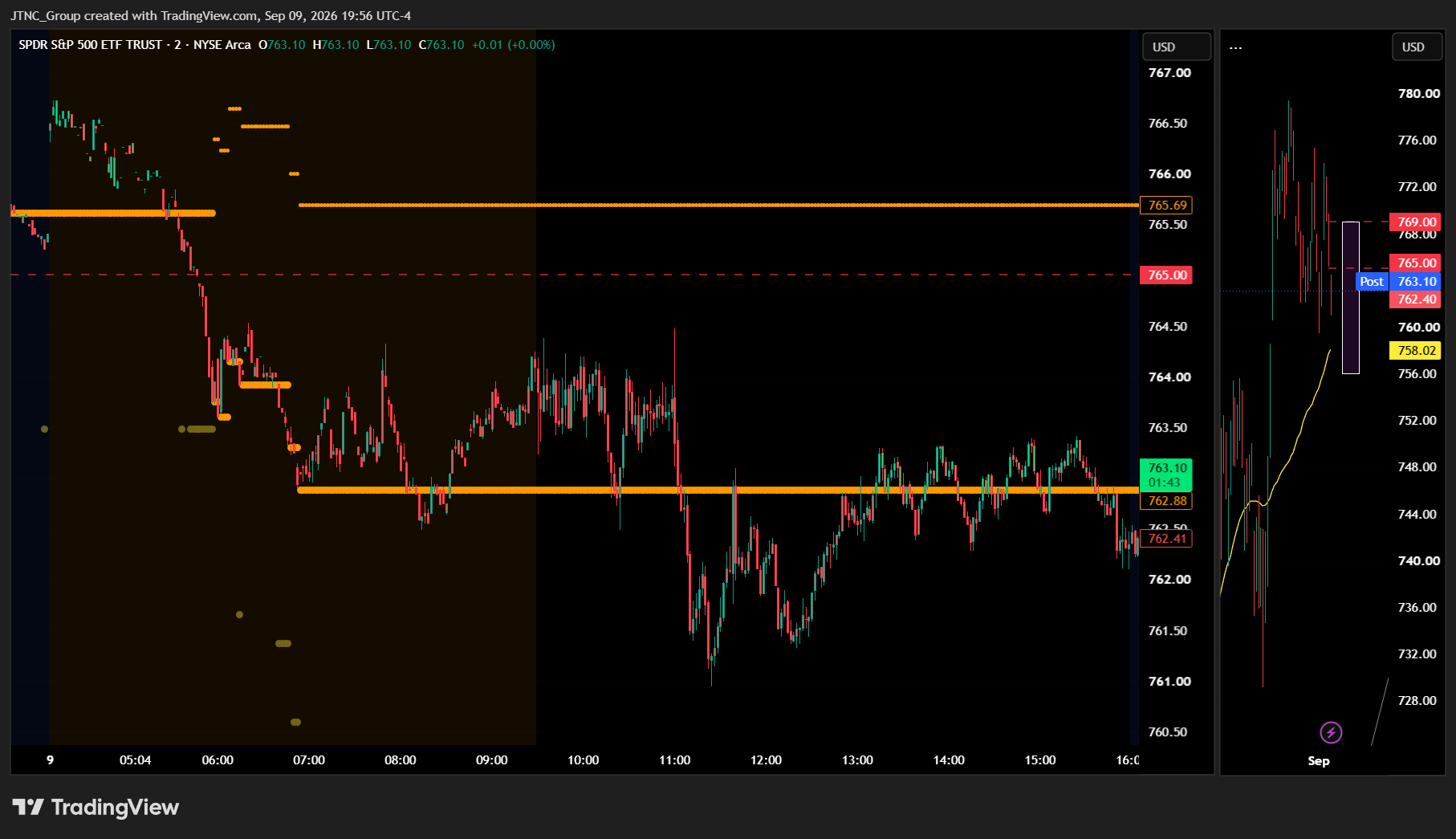
Current Market State Overview:
The MSI ended in a Bearish Trending Market State with SPY closing at $762.40. With SPY finishing below MSI support, that $762.88 level has now flipped and becomes resistance heading into Thursday, with $765.69 acting as the next layer of resistance above. Extended targets were not printing at the close, though they were active during the premarket and again during the AM session, printing below, which confirmed the bearish directional bias early and gave traders following the framework the confidence to press the short side from the open. The session told a clear story from the start, with the MSI rescaling lower overnight and by the open the market had already broken the prior day's lows. Once the rescale settled, the session spent much of its time grinding sideways with limited trading opportunities as the market continued to feel the weight of the summer slump, lacking a meaningful external catalyst to push it decisively in either direction. The MSI width is moderate at a $2.81 spread, wide enough to give bears room to operate but not signaling full capitulation mode just yet. With the MSI closing in a Bearish Trending state, SPY finishing below MSI support turned resistance, and extended targets absent at the close, the forecast for Thursday is a slow grind lower, though without extended targets at the close the downside may be limited and price is likely to find support at key levels below, absent an external catalyst. A bounce that carries SPY back toward $762.88 is also a reasonable scenario given the lack of extended target confirmation. MSI support is $762.88 with resistance at $765.69.
Key Levels and Market Movements:
Tuesday we stated, "Bulls want to see overnight price stabilize above $765.73 and begin pushing back toward $767.83, ideally with the MSI rescaling to a more constructive state and extended targets fading from the picture entirely," and added, "Bears want to see $765.73 fail to hold and selling pressure push SPY toward a test of Tuesday's session low and potentially lower," while also noting, "Avoid pressing a directional bias ahead of the open and instead let the MSI settle and dictate which side has control before committing to a position." Wednesday delivered firmly in the bears' favor once again, with $765.73 failing to hold overnight and price following through to the downside, ultimately settling well below that key level by the close and one again validating the framework's read heading into the session.
SPY opened at $764.08, briefly reached a session high of $764.47, and that ceiling held for the entire day. The MSI had rescaled lower overnight and entered Wednesday already in a Bearish Trending state, which immediately put the burden of proof squarely on the bulls. Extended targets had printed below during the premarket and into the AM session, giving traders an early and reliable signal that the bears were in control and that any strength was a selling opportunity rather than a reason to look for longs. Once that information was in hand, selling any rally toward $762.88, which had acted as MSI support but quickly revealed itself as resistance with SPY trading below it, was the framework-aligned approach with no clean MSI target below and premarket levels serving as the natural objective. Price walked steadily lower through the session, finding its low of $760.94 before settling at $762.40 into the close. The session offered limited opportunities overall given the sideways grind that developed after the early breakdown, with the market lacking the follow-through energy that extended targets would have fueled. At minimum it was a one-for-one session for traders following the framework. It was an easy day to read albeit not an easy day to trade given the tight choppy range. But substantial setups were present, all identified through proper context, patience, and flexibility while leveraging the MSI, premarket levels, and market structure rather than forcing trades. The MSI continues to prove its reliability as the cornerstone of our trading process.
Trading Strategy Based on MSI:
Thursday has light economic news so the market is likely to grind lower given the Bearish Trending state at the close, though the move may be modest. The MSI closed in a moderate Bearish Trending state with a $2.81 spread, which gives bears enough room to apply pressure, but the absence of extended targets at the close tempers expectations for a sharp or accelerated move lower. Without that extended target confirmation, the downside is likely to be measured and price should find support at key levels below rather than seeing a sudden leg down. The session is more likely to see a methodical drift lower than a hard selloff, and traders should remain open to a brief relief bounce if the bears cannot sustain selling pressure at current levels. The VIX ticking higher to 16.46 is worth noting as it reflects a modest increase in anxiety, but it is not yet at levels that signal a panic-driven move.
Bulls want to see overnight price stabilize and begin pushing back toward $762.88, ideally with the MSI rescaling to a less bearish state and extended targets fading from the picture entirely. If the MSI transitions out of its bearish state overnight or early Thursday and price reclaims $762.88 with conviction, buying any pullback toward that level would be the preferred approach, targeting a move back through $762.88 and toward $765.69 above. A failed breakdown at current levels, where price briefly dips but quickly recovers, is also a high-probability long setup worth watching as it would signal the bears are losing their grip. Bears want to see $762.88 continue to act as resistance and selling pressure push SPY toward a test of Wednesday's session low at $760.94 and potentially lower. If the MSI holds its bearish state into the open Thursday and extended targets resume printing below, selling any rally toward $762.88 resistance would be the preferred approach, targeting the session low and below. Given the moderate MSI width and the lack of extended targets at the close, the highest-probability path for Thursday is a slow grind lower that finds support at key levels, with the overall bias favoring the bears until the MSI shifts. Avoid pressing a directional bias ahead of the open and instead let the MSI settle and dictate which side has control before committing to a position.
The long-term bull trend remains intact above $640 and failed breakouts and failed breakdowns continue to offer the highest-probability setups. Remain flexible, avoid trading during Ranging Market States unless a clear failed breakout or breakdown presents itself, and ensure all trades are fully aligned with MSI signals. Providing real-time insights into market control, momentum shifts, and actionable levels, the MSI when integrated with our Pre-Market and Post-Market Reports continues to sharpen execution precision and elevate trade quality. If you haven't yet integrated MSI and our model levels into your process, now is the time. Contact your representative to get started as these tools are designed to support consistency and enhance performance.
Dealer Positioning Analysis
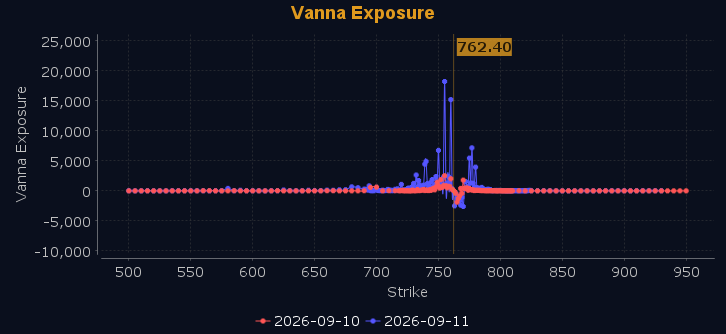
Dealers are selling SPY $770 to $800 and higher strike Calls, while buying $763 to $769 Calls, indicating the Dealers' desire to participate in any rally on Thursday. The ceiling for Thursday appears to be $770. To the downside, Dealers are buying $762 to $710 and lower strike Puts in a 2:1 ratio to the Calls they're selling, displaying moderate concern that prices could move lower. Dealers have not increased their hedges, which implies some confidence that price may find a bottom in the current range, though the absence of ATM Put selling tells us their conviction is only partial. The $760 to $770 range may be where the market gets stuck for some time. Below $766 is bearish and above $767 is bullish with everything in between being chop and trap filled. Should SPY fail to hold $766, $760 comes into play. A move above $768 may find little resistance until $773, where prices should stall or reverse. Dealer positioning is unchanged at bullish.
Looking Ahead to Next Friday:
Dealers are selling SPY $771 to $810 and higher strike Calls, while buying $763 to $770 Calls, indicating the Dealers' desire to participate in any rally into Friday. The ceiling for the week appears to be $777. To the downside, Dealers are buying $762 to $695 and lower strike Puts in a 3:1 ratio to the Calls they're selling, displaying moderate concern that prices could move lower. Dealers have not increased or reduced their hedges, which implies they expect SPY to trade more sideways than move strongly higher or lower. We remain bullish above $767 but below $766 we are bearish, which implies selling rallies below $767. For the week Dealer positioning is unchanged at neutral/slightly bearish. We advise reviewing Dealer positioning daily for directional clues. These positions evolve quickly and tracking them is essential for staying ahead of shifting market sentiment.
Recommendation for Traders
With SPY closing at $762.40 and the 10-year yield at 4.840, the bias remains cautious to bearish. Favor shorts on any failed bounce toward $764, with stops above $764.47. A continued breakdown opens the door toward $760 and lower.
Keep size disciplined — VIX rising 4.71% to 16.46 signals growing nervousness, and yields above 4.8% remain a headwind for equities. Always review the premarket analysis posted before 9 AM ET for any changes in the model's outlook and Dealer Positioning.
Good luck and good trading!
