
Market Insights: Tuesday, September 8th, 2026
Market Overview
Stocks kicked off the week in the red Tuesday as a combination of trade war escalation, rising oil prices, and inflation anxiety weighed on all three major indices. The Dow dropped 1.1%, the S&P 500 slipped 0.5%, and the Nasdaq fell 0.3%, with some semiconductor strength limiting the tech index's losses. Canada turned up the heat on the US-Canada trade dispute by slapping 50% tariffs on roughly $20 billion worth of American goods, targeting dairy, steel, wood products, and certain copper products. That move rattled markets already on edge heading into Friday's Consumer Price Index report, which could influence whether the Fed pulls the trigger on another rate hike at its meeting next week — odds of which hit 58% according to CME FedWatch.
Oil prices added to the pressure, with WTI climbing above $93 per barrel and Brent creeping toward $100 after Iran signaled it was close to a deal with Oman over Strait of Hormuz traffic, stoking fresh inflation fears. Copper stole the commodity spotlight, with Comex futures trading near $6.85 a pound and London Metal Exchange copper touching $14,617 a metric ton for a second straight intraday record — putting copper up roughly 21% year to date. Gold, meanwhile, slipped as rising yields and rate hike expectations offset August's solid 10% rally, though UBS's CIO Americas Ulrike Hoffmann-Burchardi called any weakness a buying opportunity for long-term investors. On the corporate side, Intel jumped 9% on reports of planned price hikes, Oracle gained ahead of its earnings report later this week, and GE Aerospace climbed after announcing a $11.75 billion deal to acquire jet engine component maker Consolidated Precision Products from Warburg Pincus and Berkshire Partners.
SPY Performance
SPY opened at $769.07 and never really gave bulls anything to work with, spending the entire session in a slow, grinding decline that left the high of $769.70 in the rearview mirror almost immediately. The low of $765.15 marked the worst of the damage before a minor bounce into the close, but the close of $766 still landed near the bottom of the day's range — not the kind of finish that inspires confidence heading into the next session. Three consecutive closes near session lows is a pattern that's hard to dismiss, and the buyers who were supposed to step in and defend this level simply haven't shown up.
SPY finished down 0.54% on the day, the steepest single-day decline in this recent losing streak and a sign that selling pressure is building rather than fading. Volume came in at 33.18 million shares, below average and roughly in line with yesterday's session — so this wasn't a panic flush, just steady, persistent distribution with no meaningful buying response. The VIX ticked up another 1.31% to close at 15.50, a smaller move than yesterday's spike but notable because it confirms the fear gauge is now in a multi-day uptrend rather than a one-day overreaction. Back-to-back VIX closes at rising levels combined with back-to-back lower closes on SPY is the kind of environment where bulls need to show a decisive stand soon, or the recovery that looked so promising earlier in the week risks turning into something far more damaging.
Major Indices Performance
The Nasdaq and Russell 2000 were essentially tied for the least-bad performance on the day, with the Nasdaq slipping 0.32% and the Russell 2000 close behind at -0.31%. Neither index could find any real buying conviction, but relative to the broader damage being done elsewhere, growth stocks and small-caps at least avoided the worst of it. The Nasdaq's modest decline came despite meaningful pressure from the mega-cap tech space, which tells you the rest of the index held up reasonably well underneath the surface noise.
The S&P 500 also finished in the red, adding to the cautious tone that defined the session from open to close. With macro headwinds keeping institutional buyers selective, there wasn't much appetite for risk across any corner of the market.
The Dow was the clear laggard on the day, shedding 1.18% in a session where blue chips got hit the hardest. That's a significant underperformance relative to the other major averages, and it suggests the selling was concentrated in some of the index's heavier-weighted names rather than being a broad, uniform decline. When the Dow drops more than three times what the Nasdaq loses in the same session, you're looking at stock-specific or sector-specific pain rather than a pure risk-off flush. The VIX edged up another 1.31% to close at 15.50, a smaller move than the prior session's spike but still trending in the wrong direction — confirming that traders aren't done repricing risk just yet.
Notable Stock Movements
NVIDIA flipped the script today, going from a relative bright spot in recent sessions to the headline loser inside the Magnificent Seven, dropping -2.01% to lead the group lower. That's a notable shift in character for a name that had been holding up better than most of its mega-cap peers, and when NVIDIA starts cracking, it tends to put pressure on the entire complex given how much index weight and sentiment it carries.
The broader Magnificent Seven picture was mostly red again, making this another session where the group failed to show up with any real conviction. The one exception was Tesla, which managed to close green — a welcome reversal after the beating it took in recent sessions. But one green name in an otherwise red group isn't the kind of broad participation that signals the heavy selling is behind us. The group continues to struggle to get all, or even most, of its members moving in the same direction on the upside.
The overall read from the Magnificent Seven today is still bearish, and it fits neatly with the broader tape. Mega-cap growth remains a source of drag rather than leadership, and with NVIDIA now joining the rotation toward the downside, there's less of a safety net within the group. The fact that every major index finished in the red today — the Dow taking the hardest hit — confirms that this isn't a story of isolated weakness. It's broad. Until the Magnificent Seven can get most of its members posting green closes simultaneously, it's hard to make a constructive case for mega-cap growth as a driver of market momentum.
Commodity and Cryptocurrency Updates
Crude oil surged 2.35% today, closing at $93.63, extending its rally well above recent expectations. Black gold has no interest in cooling off, and at these levels the supply-demand picture combined with persistent geopolitical tensions is keeping the bid firmly in place. A sustained presence this far above $70 creates a real headache for the Fed — energy prices at these levels feed directly into the inflation data policymakers are desperately trying to tame, and every day crude holds here makes a dovish pivot that much harder to defend.
Gold gave back a little ground today, slipping 0.47% to close at $4,409. After the impressive follow-through we've seen in recent sessions, a minor cooling-off day is perfectly healthy price action. The broader trend remains intact, central bank demand hasn't gone anywhere, and macro uncertainty continues to provide a solid floor. Dip buyers have been consistently rewarded in this market, and there's no reason yet to think this pullback is anything more than the market taking a breath before the next leg higher.
Bitcoin extended its losing streak, sliding another 0.83% and closing below $78,456. Three down sessions is the kind of string that shifts the burden of proof firmly back onto the bulls. The crypto thesis isn't shattered, but the market needs to see buyers show up with real conviction here — not just a brief bounce, but sustained defense of these levels. If that buying doesn't materialize soon, the door opens wider for a deeper consolidation that could test patience across the crypto space.
Treasury Yield Information
The 10-year Treasury yield climbed another 0.46% today, closing at 4.810%. That's not a near-miss — that's a clean break above the 4.800% threshold, and the market now has to reckon with what that means. For weeks, 4.800% has served as the line in the sand where selling pressure historically starts to intensify, and today's close confirms yields aren't just flirting with danger anymore. The bond market has officially crossed into uncomfortable territory for equity bulls.
The framework is now flashing a more serious warning. Above 4.5% the discount rate headwind bites — that's been the reality for some time. But crossing 4.800% shifts the conversation from "elevated pressure" to "deteriorating conditions." History shows that once yields establish themselves above this level, equities struggle to sustain any meaningful rally, and any pop tends to get sold into quickly. Today's close isn't a one-day fluke — it confirms the move that yesterday's 4.780% reading was telegraphing.
The 5% danger zone now sits just 19 basis points away, and that gap can evaporate fast with a single hot inflation print or a hawkish surprise from the Fed. Beyond that, the 5.2% level — where this framework calls for a 20% or greater correction — starts to feel less hypothetical and more like a scenario worth actively preparing for. What to watch next is a sustained close back below 4.800%, which would offer some relief, but until that happens the presumption should be that yields are in control here and equities are playing defense.
Previous Day’s Forecast Analysis
Yesterday's forecast projected SPY would trade within a range of $768 on the downside and $781 as the max upside target, a thirteen-point window that the model flagged as trending territory, calling for a directional move rather than sideways chop. With Monday's close at $770.19 sitting near the lower end of that range, the near-term bias heading into Tuesday was tilted bearish, with bulls needing to do more work before the tape could be called healthy.
The most critical floor identified was $770, described as the key structural level holding the week's setup together. A clean breakdown below it pointed to $768 as the next meaningful stop. To the upside, $773 was the first hurdle needed to make any bullish case credible, followed by $775 as the gate level with the heaviest call concentration. Reclaiming $775 was the trigger that would shift sentiment meaningfully bullish and open the door toward $778, with $780 capping the expected move and $781 as max upside.
On the strategy side, the VIX rising 5.30% to 15.30 was the key risk management signal, calling for tighter parameters — position sizing in the 50-60% range and stop-losses in the 0.75-1.0% band. For longs, the preferred entry was a pullback and hold near $770-$770.19 with initial targets at $774-$775 and a stretch target of $777-$778, stops below $768.50. For shorts, a decisive break below $769 on expanding volume was the trigger, targeting $765-$766 initially and $762-$763 on follow-through, with stops above $772.
Market Performance vs. Forecast
Tuesday's session played out with a distinctly bearish tone that aligned tightly with the framework's directional bias heading into the day. The forecast had flagged a bearish tilt from the open given Monday's close near the bottom of the projected range, and that read proved correct — SPY opened at $769.07, immediately below the $770 structural floor the model had identified as the most critical level holding the week's architecture together. That floor gave way early, and the tape never looked back, with sellers pressing the session to a low of $765.15 before price settled at $766, a -0.54% decline that landed squarely within the downside scenario the forecast had laid out in detail.
What the model got right was the breakdown trigger and the directional conviction behind it. Tuesday's Expected Price Action explicitly called out a decisive break below $769 on expanding selling pressure as the short trigger, with a primary profit target of $765-$766 — and that's almost exactly where the session closed. Price opened soft, sliced through the $769 level without meaningful buyer response, and delivered the move the falling market scenario had mapped in advance. The $765-$766 target zone absorbed the session low and held as the closing anchor, which is a precise outcome for a framework working from premarket analysis. Risk management protocols with stops above $772 on short positions were never engaged, as price never threatened a reversal back through that level.
The one area where external conditions shaped the result was volume — at 33.18M shares, participation came in below average, which the model had specifically flagged as a warning sign worth respecting. The VIX added another 1.31% to close at 15.50, continuing its measured grind higher. The model does not account for macro or geopolitical developments that can suppress or redirect institutional participation in ways that alter intraday dynamics, but the framework's recommended position sizing in the 50-60% range and disciplined stop placement ensured exposure was appropriately calibrated for the environment. A session where the breakdown trigger was called in advance, the profit target zone was hit almost to the dollar, and the directional bias held throughout is exactly the kind of outcome that demonstrates this model's structural edge — and it sets up well-defined levels to work from heading into Wednesday.
Premarket Analysis Summary
The premarket analysis posted at market open set SPY's projected range for the session between $761 as max downside and $775 as max upside, with the defining gate level at $772 — the line buyers needed to reclaim before the tape could begin to repair. Spot entered the session at $767.81 in a put-dominated tape, with upside targets stacked at $769, $773, $774, and $775, and $773 flagged as the heaviest concentration overhead and the level bulls truly needed. The expected move spanned six points, and the analysis was explicit that the burden sat squarely on buyers — with spot sitting on a heavy pocket and $772 well overhead, losing $767 early would open the door for a quick test of $765, where the heaviest battle below was expected to play out. The bias leaned bearish, and the premarket warned that a clean break of $765 could get ugly fast.
That cautionary scenario is almost exactly what played out. SPY opened at $769.07, briefly clearing the first upside target before sellers moved in immediately, capping the high at $769.70 and never allowing any serious push toward $772 or beyond. Price rolled over and pressed lower through the session, tagging a low of $765.15 — testing the critical $765 level almost to the tick, just as the premarket identified as the most important battleground below. The session closed at $766, a loss of 0.54% on below-average volume of 33.18 million shares. The VIX rose 1.31% to 15.50, confirming the defensive tone. The entire upside stack above $769.70 went untested, and the session resolved firmly within the downside warning the premarket had laid out, with $765 once again proving to be exactly the fight the analysis said it would be.
Validation of the Analysis
Today's session delivered another textbook confirmation of the premarket framework, and traders who came in prepared with those levels had a clear, profitable roadmap from the first print. SPY opened at $769.07, punching right through the 769 target the premarket identified as the first step buyers needed to clear. The analysis was direct: 769 was the minimum buyers needed to show early, and the open did exactly that — but the follow-through immediately told the real story. Price stalled at $769.70, a high that barely nudged past 769 and fell well short of the 772 defining level the premarket called the gate where the tape begins to repair. That failure at the gate was precisely the signal the analysis was built around — without 772, sellers keep the upper hand, and that's exactly what happened.
From there, the downside sequence the premarket outlined took over with surgical precision. The analysis warned that losing 767 cleanly opens the door for acceleration, and SPY did exactly that, pressing down toward 765 — the level the premarket flagged as the most important battlefield below and where the heaviest fight sits. The low of $765.15 tagged that 765 zone almost to the tick, confirming it as a live, contested level rather than background noise. The close at $766 landed just above 765, proving that level held as the real session floor — exactly the kind of last-stand defense the premarket described. The VIX climbing 1.31% to 15.50 reinforced the cautionary, put-dominated tone the analysis set heading into the session. From 769 as the opening resistance cap to 767 as the acceleration trigger to 765 as the primary battlefield, every level the premarket outlined did precisely what it was supposed to do.
Looking Ahead
With the economic calendar showing no high-impact releases scheduled for Wednesday, traders head into the session without a major macro catalyst on the docket. No Fed speak, no labor data, no inflation print — just price action doing the talking on what figures to be another positioning day. That kind of quiet setup cuts both ways, either giving bulls room to build on any momentum or leaving the market vulnerable to slow, methodical selling if conviction stays thin.
Without a scheduled catalyst, Wednesday becomes a session where internals take center stage. Breadth readings, sector rotation, and volume trends will carry more weight than any headline, and any surprise commentary from a Fed official or unexpected geopolitical development will hit harder than usual on a low-catalyst tape. The key is staying disciplined, letting price confirm direction before adding exposure, and not overreacting to noise in the absence of a clear fundamental driver.
Market Sentiment and Key Levels
The directional bias today leans bearish, with bears maintaining a modest edge after SPY shed 0.54% on below-average volume of 33.18M shares. The VIX rising 1.31% to 15.50 is a quieter uptick than yesterday's fear spike, but it still represents continued anxiety accumulating beneath the surface — the trend in volatility remains pointed in the wrong direction for bulls. The broad index picture tells a similarly cautious story — the Dow took the hardest hit at -1.18%, while the Nasdaq and Russell 2000 held up relatively better at -0.32% and -0.31% respectively. That divergence between the Dow's sharp decline and the relative steadiness elsewhere suggests large-cap industrial and blue-chip names are absorbing the most pressure right now, while tech and small-caps are showing a bit more resilience. Volume staying below average keeps this from looking like a full-blown breakdown, but the lack of any meaningful buying conviction is itself a problem — the bulls aren't defending territory, they're just not getting overrun yet.
Key resistance sits at $769.70, the intraday high from today's session. A reclaim of that level on expanding volume would give bulls a credible shot at reversing the near-term downtrend and stabilizing price action. On the downside, $765.15 — the session low — is the line that matters most. A decisive close below that level would hand bears a clear technical victory and open the door to a more meaningful flush lower. Gold pulling back 0.47% to $4,409 suggests some of yesterday's defensive rotation may be unwinding, while Bitcoin slipping 0.83% to close below $78,456 keeps the risk-off undertone intact. The 10-year yield edging up to 4.810 and oil jumping 2.35% to $93.63 both add macro weight to an already strained tape. Bears hold the edge here, but without a volume-backed break below today's low, this market is still drifting rather than collapsing outright.
Expected Price Action
Wednesday's session brings actionable intelligence generated by our AI model, with SPY projected to trade within a range defined by $761 on the downside and $775 as the max upside target. That fourteen-point window puts this squarely in trending territory, meaning traders should be positioned for a directional move rather than sideways chop. Tuesday's close at $766 sits in the lower half of the projected range, which keeps the near-term bias tilted bearish heading into Wednesday's open — buyers have not shown enough conviction to suggest this tape is ready to reverse.
The defining level to watch on Wednesday is $765, which the premarket analysis flags as the most important battleground below current spot. A clean break there could get ugly fast, with $763 as the only meaningful floor before $761 marks the bottom of the expected move. On the upside, $769 is the first level buyers need to clear early to show any life, but the real gate is $772 — until that level is reclaimed, sellers keep the upper hand. Above $772, the heaviest overhead concentration sits at $773, where price should want to stall and where bulls truly need to prove themselves. Beyond there, $774 caps the expected move top and $775 stands as max upside, the same ceiling that rejected the tape in the prior session. With VIX rising 1.31% to 15.50 and the 10-year yield firmly parked in dangerous territory for equities, this is not an environment to be aggressively buying dips without clear confirmation. Watch for volume conviction on any directional move — a high-volume reclaim of $772 and above is constructive, while a low-volume rollover that surrenders $765 cleanly is a serious warning sign that should not be ignored.
Trading Strategy
The VIX rising 1.31% to 15.50 is a modest but meaningful continuation of the vol expansion we've seen building in recent sessions. At 15.50 we're still well below panic territory, but the fact that volatility is grinding higher even on a day with below-average volume tells you the market is carrying a low-grade unease beneath the surface. The options market isn't screaming yet, but hedgers are staying active, and that incremental drift higher in VIX from an already-elevated recent baseline is worth respecting. Keep position sizing in the 50-60% range and maintain stop-losses in the 0.75-1.0% band from entry. The vol environment doesn't justify aggressive directional bets in either direction right now — measured size and disciplined execution are the game plan until the market shows its hand more clearly.
In a rising market scenario, the bulls need to reclaim and hold the $769-$770 zone to restore any near-term confidence. The preferred long entry is a clean stabilization and hold around $766-$767 — that's right in line with where price settled after the day's moderate selling, and it gives buyers a well-defined base to defend. If price firms up there with improving volume participation, the initial profit target is $772-$773, with a stretch target of $775-$776 on confirmed institutional follow-through. Stops on longs belong below $764.50 to give the trade enough room without letting a manageable loss become a problem. Don't chase any early morning gap-up above $770 on thin tape — wait for a clean retest and successful hold before committing to size.
In a falling market scenario, $765 is the critical structural level to watch — a decisive break below it on expanding selling pressure is your short trigger. The primary profit target on a breakdown is $761-$762, with a secondary target of $758-$759 if sellers build real conviction and volume picks up meaningfully. Stops on shorts belong above $768.50 to protect against a quick reversal back through the prior close area. If the market opens soft and immediately slices through $765 without any meaningful buyer response, that's a high-conviction short entry at measured size. With VIX at 15.50 and continuing to drift higher, the risk of a vol-driven acceleration to the downside remains real, so respect your targets, cover into support methodically, and don't let a winning short overstay its welcome.
Model’s Projected Range
SPY's projected maximum range for Wednesday is $760 to $771, with the Put side dominating in an expanding band that suggests trending price action with intermittent chop. Wednesday brings no economic news due out so the market will trade on technicals. SPY opened at $769.07, tagged a high of $769.70, slid to a low of $765.15, and closed at $766, finishing down 0.54% on the session with volume coming in below average — a modest but notable pullback that found buyers near the lows. SPY is trading near our model's first support at $765, and ongoing tariff uncertainty and global trade tension narratives continue to weigh on sentiment at the margin. On the upside, if $770 gives way, price targets $771 next, while a break below $765 opens the door to $762, and if that level fails to hold there is little to keep price from falling toward $755. The long-term bull trend remains intact above $640 with SPY well above structural support. As long as price holds above key structural levels, this remains a broader dip-buying environment. Absent a catalyst, resistance sits at $770, $771, $772, $773, while support rests at $765, $762, $760, $755. We favor buying dips at $765 given SPY closed right at that first model support with the range floor sitting at $760. Bitcoin dropped 0.83% to close below $78,456, while MAG stocks were mostly red on the day led lower by NVIDIA which fell 2.01%, though Tesla bucked the trend in a big way surging 3.98% — the mix of crypto weakness and tech selling pressure alongside an isolated Tesla spike suggests the leadership group is not yet aligned in either direction, and sustained weakness across both leadership groups would be required to signal a deeper pullback. The VIX closed at 15.50, up 1.31%, suggesting elevated fear given the broad tech selloff and cautious tone heading into a technical-only trading session. SPY closed just above the lower line of its trend channel with structural support near $765, keeping the broader uptrend structure intact for now but putting bulls on notice that a clean break below that level changes the near-term picture.
Market State Indicator (MSI) Forecast
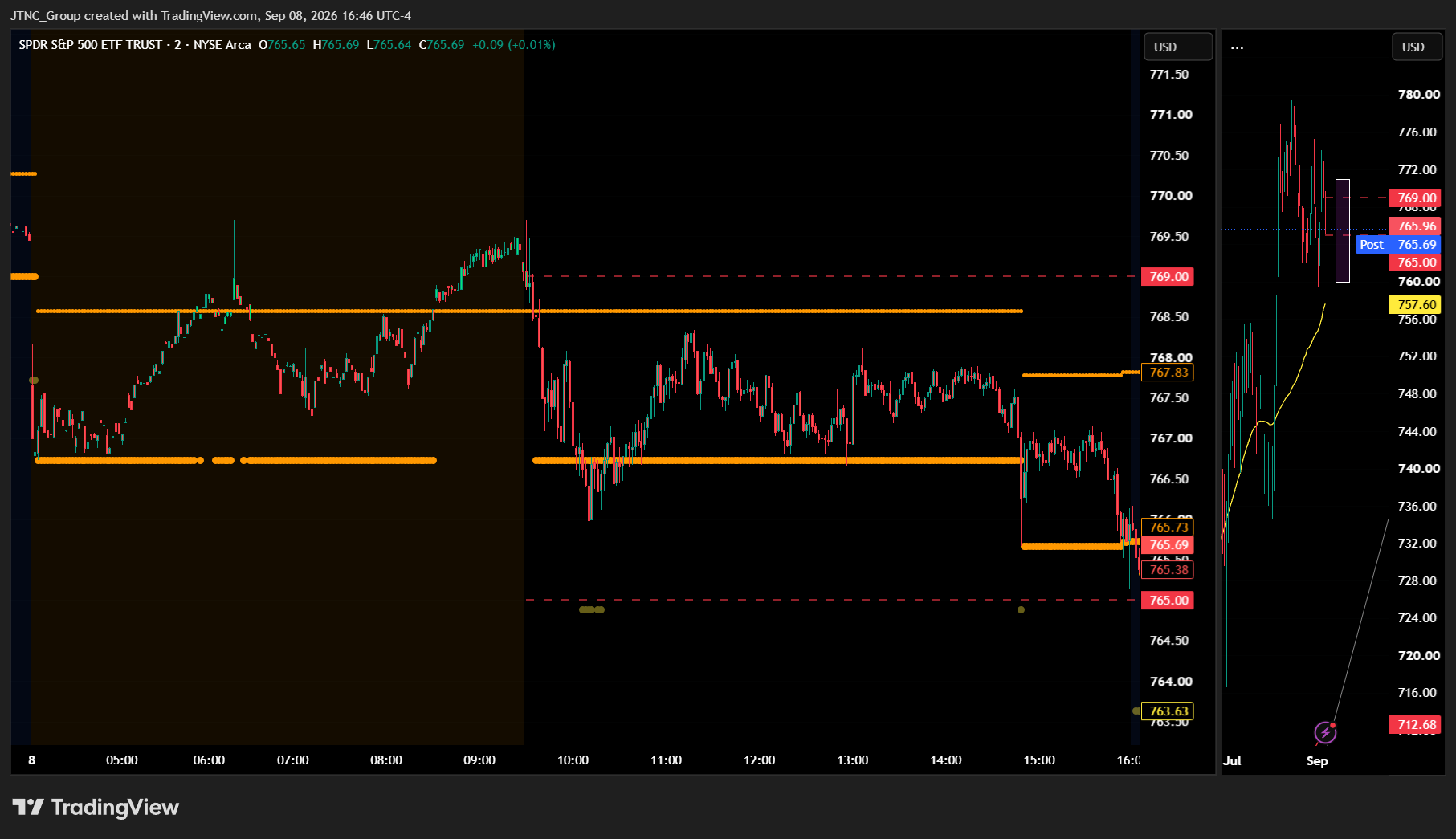
Current Market State Overview:
The MSI ended in a Bearish Trending Market State with SPY closing at $766. Support remains support and resistance remains resistance heading into Wednesday, with $765.73 holding as support and $767.83 as the level to clear. Extended targets were not printing at the close, though they were active during both the AM and PM sessions printing below, which reflected consistent bearish momentum throughout the day and helped confirm the directional bias for traders watching the framework in real time. No extended targets were visible in the premarket. The session unfolded as a gradual breakdown, with the MSI rescaling lower overnight as traders returned after the long weekend and remaining in a bearish state into the open where SPY tested $770 major resistance. That level held firm and price spent time bouncing between MSI support and resistance before the final hour brought a fresh rescale lower with a brief burst of extended targets that pushed SPY down into the close. The MSI width is moderate at a $2.10 spread, reflecting a market that has room to move within the range but is not yet in full capitulation mode. With bears in control and the MSI closing in a Bearish Trending state following a session that saw progressive rescaling lower, the forecast for Wednesday is a slow grind lower, though without extended targets printing at the close the downside may be limited and price is likely to find support at key levels below, absent an external catalyst. MSI support is $765.73 with resistance at $767.83.
Key Levels and Market Movements:
Monday we stated, "Bulls want to see overnight price hold above $769 and push toward $770.28 and ultimately through it, ideally with the MSI rescaling to a more constructive state and extended targets beginning to print above to confirm real upside momentum," and added, "Bears want to see $769 fail and selling pressure continue to push SPY toward a retest of today's lows and potentially lower," while also noting, "Avoid pressing a directional bias ahead of the open and instead let the MSI settle and dictate which side has control before committing to a position." Tuesday delivered firmly in the bears' favor, with $769 failing to hold and price grinding lower through most of the session before settling well below that key level by the close.
SPY opened at $769.07, briefly tagged a session high of $769.70, and that was essentially the ceiling for the entire day. The MSI had rescaled lower overnight and entered Tuesday already in a bearish state, which immediately told traders that the burden of proof rested on the bulls and that any early strength should be treated as a selling opportunity rather than a reason to chase upside. The session opened in a mildly ranging to slightly constructive tone near the $768.50 to $769 area, but that window closed quickly as price began to break down and the MSI transitioned into a sustained Bearish Trending state. Once that transition was confirmed and price was inside a bearish MSI, selling any rally toward MSI resistance was the play, targeting MSI support below, and the framework delivered cleanly on that setup. The MSI rescaled lower several times through the PM session, each rescale creating a fresh resistance level to sell against with the trend fully intact and extended targets printing below during both the AM and PM sessions to reinforce directional confidence. Price walked steadily lower throughout the afternoon, finding its session low of $765.15 before settling at $766 by the close. There was no meaningful bounce to speak of, no failed breakdown setup that tempted longs with conviction, just a methodical grind lower that rewarded traders who stayed disciplined and sold strength rather than buying into the weakness. At minimum it was a three-for-three session for traders following the framework. It was an easy day to read and execute with substantial setups, all identified through proper context, patience, and flexibility while leveraging the MSI, premarket levels, and market structure rather than forcing trades. The MSI continues to prove its reliability as the cornerstone of our trading process.
Trading Strategy Based on MSI:
Wednesday has light economic news so the market is likely to grind lower given the Bearish Trending state at the close, though the move may be modest. The MSI closed in a moderate Bearish Trending state with a $2.10 spread, which is wide enough to give bears room to press but the absence of extended targets at the close does temper expectations for a sharp continuation move. Without that extended target confirmation, the downside is likely to be measured and price should find support at key levels below rather than seeing an accelerated leg lower. Bears are in control but may not have enough fuel to push hard without a fresh catalyst or a new burst of extended targets to confirm momentum. The session is more likely to see a methodical drift lower than a sharp selloff, and traders should be prepared for potential consolidation or even a brief relief bounce if MSI support holds and the bears cannot sustain selling pressure.
Bulls want to see overnight price stabilize above $765.73 and begin pushing back toward $767.83, ideally with the MSI rescaling to a more constructive state and extended targets fading from the picture entirely. If the MSI transitions out of the bearish state overnight or early Wednesday and price reclaims $767.83 with conviction, buying any pullback to MSI support at $765.73 would be the preferred approach, targeting a move back through $767.83 and toward higher levels. A failed breakdown at $765.73, where price briefly dips below but quickly reclaims it, is also a high-probability long setup worth watching as that level now becomes the line in the sand for bulls heading into the session. Bears want to see $765.73 fail to hold and selling pressure push SPY toward a test of Tuesday's session low and potentially lower. If the MSI holds its bearish state into the open on Wednesday and extended targets resume printing below, selling any rally to $767.83 would be the preferred approach, targeting $765.73 and below. Given the moderate MSI width and the lack of extended targets at the close, the highest-probability path for Wednesday is a slow grind lower that finds support at key levels, with the overall bias favoring the bears until the MSI shifts. Avoid pressing a directional bias ahead of the open and instead let the MSI settle and dictate which side has control before committing to a position.
The long-term bull trend remains intact above $640 and failed breakouts and failed breakdowns continue to offer the highest-probability setups. Remain flexible, avoid trading during Ranging Market States unless a clear failed breakout or breakdown presents itself, and ensure all trades are fully aligned with MSI signals. Providing real-time insights into market control, momentum shifts, and actionable levels, the MSI when integrated with our Pre-Market and Post-Market Reports continues to sharpen execution precision and elevate trade quality. If you haven't yet integrated MSI and our model levels into your process, now is the time. Contact your representative to get started as these tools are designed to support consistency and enhance performance.
Dealer Positioning Analysis
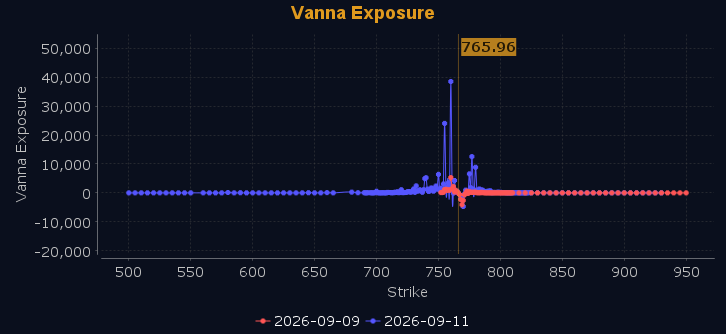
Dealers are selling SPY $772 to $800 and higher strike Calls, while buying $766 to $771 Calls, indicating the Dealers' desire to participate in any rally on Wednesday. The ceiling for Wednesday appears to be $773. To the downside, Dealers are buying $765 to $710 and lower strike Puts in a 2:1 ratio to the Calls they're selling, displaying moderate concern that prices could move lower. Dealers have not increased their hedges for Wednesday, which implies some confidence that price may find a bottom in the current range, though the absence of ATM Put selling tells us their conviction is only partial. Below $762 is bearish and above $771 is bullish with everything in between being chop and trap filled — this wide choppy range should contain price on Wednesday. Should SPY fail to hold $762, $760 comes into play. A move above $769 may find little resistance until $773, where prices should stall or reverse. Dealer positioning is unchanged at bullish.
Looking Ahead to Next Friday:
Dealers are selling SPY $771 to $810 and higher strike Calls, while buying $766 to $770 Calls, indicating the Dealers' desire to participate in any rally into Friday. The ceiling for the week appears to be $777. To the downside, Dealers are buying $765 to $695 and lower strike Puts in a 3:1 ratio to the Calls they're selling, displaying moderate concern that prices could move lower. Dealers have not increased or reduced their hedges, which implies they expect SPY to trade more sideways than move strongly higher or lower. We remain bullish above $771 but below $770 we are bearish, which implies selling rallies below $771. For the week Dealer positioning is unchanged at neutral/slightly bearish. We advise reviewing Dealer positioning daily for directional clues. These positions evolve quickly and tracking them is essential for staying ahead of shifting market sentiment.
Recommendation for Traders
With SPY closing at $766 and the 10-year yield pressing 4.810, the bias stays cautious to bearish. Favor shorts on any failed bounce toward $769, with stops above $770. A continued breakdown targets $763 and below.
Keep size tight here — yields above 4.8% are a headwind and VIX at 15.50 leaves room for more volatility. Always review the premarket analysis posted before 9 AM ET for any changes in the model's outlook and Dealer Positioning.
Good luck and good trading!
