
Market Insights: Friday, September 4th, 2026
Market Overview
Stocks pulled back Friday as a blowout August jobs report flipped the rate narrative on its head. The economy added 162,000 jobs last month — nearly triple the 55,000 economists expected — while June and July payrolls were revised up a combined 55,000 and the unemployment rate held at 4.1%. That was enough to send Fed rate-hike odds for September back up to roughly 60%, according to CME Group, essentially reversing Thursday's optimism in a single data print. The Dow fell 0.6%, the S&P 500 dropped 0.5%, and the Nasdaq slipped 0.4%. UBS economist Andrew Dubinsky now expects two 25-basis-point hikes — September and December — while Macquarie's David Doyle also moved his baseline to September, though both noted cooler inflation readings could delay the second move.
The hot jobs number rippled across markets and headlines fast. Bitcoin came tantalizingly close to the key $80,000 resistance level Friday morning before reversing lower alongside gold and other risk-on Thursday winners as the dollar and short-term yields climbed. Lululemon was the biggest individual stock casualty of the day, cratering 16% after slashing revenue and profit guidance alongside a second-quarter revenue decline. Tesla also dropped about 6% after news broke that the NHTSA has opened a formal investigation into whether its new Cybercab — which lacks a steering wheel and brakes — actually meets federal safety standards, even as Tesla launched customer rides in Austin the same day. Adding to the noise, Trump posted on Truth Social demanding the Fed cut rates or face trade embargoes on countries running deficits with the US, while diesel prices hit a record high as Middle East and Russia conflicts continued squeezing global energy flows.
SPY Performance
SPY opened at $772.01 and struggled to find its footing from the start, with the high of $772.87 coming early before sellers stepped in and pushed prices lower throughout the session. The low of $769 was reached as the afternoon wore on, and the close of $770.24 landed closer to the bottom of the range than the top — not the kind of finish that inspires confidence after two straight days of recovery. It's the mirror image of what bulls want to see: buyers showed up briefly, got nowhere, and sellers quietly reasserted themselves.
SPY closed down 0.38% on the day, a modest but meaningful pullback that interrupted the momentum built over the prior two sessions. Volume came in at 28.90 million shares, well below average and actually lighter than the prior day's already-subdued participation — and that's the concerning part. Falling prices on thin volume isn't necessarily a disaster, but it does suggest the buyers who drove the recovery simply stepped aside rather than defending their gains with conviction. The VIX nudging higher by 0.49% to 14.39 isn't an alarming move, but it does chip away at the two-day volatility unwind that had been encouraging. The bulls haven't lost the narrative entirely, but today's session was a reminder that this recovery still hasn't earned full credibility, and follow-through remains the missing ingredient.
Major Indices Performance
The Russell 2000 was the lone bright spot on the day, eking out a 0.21% gain in an otherwise soft session. Small-caps managed to hold their ground while larger-cap indices struggled, which is a bit of a reversal from the prior session's dynamic where big tech and blue chips were doing the heavy lifting. It wasn't a barnburner by any means, but in a red tape kind of day, staying green counts for something.
The Nasdaq slipped 0.29%, weighed down by weakness across much of the growth trade. Tech names faced real headwinds, and the index couldn't generate enough buying interest to overcome the drag. The S&P 500 also finished modestly lower, consistent with the cautious tone that defined the session from open to close.
The Dow was the biggest laggard of the bunch, dropping 0.51%. Blue-chip names that had participated so broadly in the prior day's rally gave some of those gains back, and with sentiment shifting toward defense, the index had nowhere to hide. The declines across the major averages weren't catastrophic, but the session had a distinctly risk-off feel to it. The VIX ticked up 0.49% to close at 14.39, a small move but one that confirmed traders were quietly adding a bit of hedging back into the mix after the previous session had squeezed a good deal of fear out of the market.
Notable Stock Movements
Tesla flipped the script today, this time leading the Magnificent Seven to the downside with a sharp -5.92% decline. That's a brutal reversal from the momentum it was carrying in the prior session, and it set a negative tone for the group right out of the gate. Tesla is always the most reactive name in this cohort, and when it swings hard to the downside like this, it tends to drag sentiment with it across the entire mega-cap growth space.
The broader Magnificent Seven picture was mostly red today, with Meta and NVIDIA standing out as the lone bright spots in an otherwise difficult session for the group. The contrast with yesterday's near-unanimous green day is hard to ignore — that kind of reversal from broad participation to broad selling tells you the risk-on conviction didn't have much staying power. When the largest, most influential names in the market struggle to hold their gains from one session to the next, it reflects a market that's still searching for a clear directional catalyst.
The overall read from the Magnificent Seven today is cautiously bearish, and it fits the tape. The group's weakness aligned neatly with modest losses across the major indices, and the Russell 2000's slight outperformance suggests rotation away from mega-cap growth and toward smaller-cap names — not exactly a ringing endorsement of the bull case. With VIX ticking up 0.49% to 14.39, fear isn't spiking dramatically, but it is creeping higher, and that subtle shift in the volatility picture is worth watching. The Magnificent Seven stumbled today, and until Tesla and the broader group can string together back-to-back constructive sessions, the path of least resistance remains uncertain.
Commodity and Cryptocurrency Updates
Crude oil went nowhere today, posting a flat 0.00% session to hold at $91.30. After yesterday's grind higher, the bulls took a breather, but there's no sign of meaningful selling pressure either. Black gold remains well above $70 and continues to be a thorn in the Fed's side — the longer energy prices camp out at these levels, the harder it becomes to make a credible case for rate cuts. Geopolitical tensions and supply dynamics are still very much in control of this market, and until something fundamentally shifts on that front, crude isn't going to hand the bears a gift anytime soon.
Gold slipped a modest 0.19% today to close at $4,483, which is really nothing more than a pause after yesterday's explosive 3.64% surge. When gold runs like it did in the prior session, a little consolidation is completely normal and arguably healthy. The macro backdrop that's been fueling this rally — central bank demand and persistent uncertainty — hasn't changed, so there's no reason to read too much into a minor one-day pullback. Dip buyers have been rewarded consistently throughout this run, and nothing about today changes that picture.
Bitcoin gave back some of yesterday's sharp gains, sliding 1.75% to close below $79,853. After that big 5.59% pop, a pullback isn't surprising — crypto rarely moves in a straight line, and one strong session followed by a down day is a reminder that confirmation still matters here. The bulls needed to see follow-through after yesterday's move, and they didn't get it today. That doesn't kill the thesis, but it does put the burden back on buyers to prove they can string together consecutive sessions of meaningful upside.
Treasury Yield Information
The 10-year Treasury yield reversed course today, climbing 0.46% to close at 4.780%. That move erases most of yesterday's progress in a single session and puts yields right back at the doorstep of that critical 4.800% level. One day of relief, one day of retreat — that's exactly the kind of whipsaw action that makes it hard to trust any single yield move in either direction. Yesterday's pullback to 4.760% looked like the beginning of something. Today's bounce back to 4.780% is a reminder that the pressure on equities hasn't gone anywhere.
The framework is fully engaged here. Above 4.5% the discount rate headwind is real, and at 4.780% stocks are carrying that weight every single day. More concerning is how little separation there is between today's close and the 4.800% threshold where selling momentum historically starts to build. We're talking about 2 basis points — essentially sitting on the line. Any upside surprise in economic data, any hawkish Fed commentary, or any fresh inflation concern could push yields cleanly above 4.800% before the market even has time to react. That's not a comfortable position for bulls to be in.
The 5% danger zone sits 22 basis points away, and the 5.2% correction threshold — where this framework expects a 20% or greater drawdown — remains a real possibility if the macro narrative deteriorates. What to watch next is simple: a close above 4.800% puts the market back on high alert, and a sustained push toward 4.900% would almost certainly bring renewed selling pressure across the major indices. The bond market is not giving equities a clean runway right now, and until yields make a convincing move back below 4.700%, the ceiling on any equity rally remains low.
Previous Day’s Forecast Analysis
Friday's forecast called for SPY to trade within a projected range of $759 on the downside and $771 as the max upside target, a twelve-point window that the model flagged as consolidation territory — choppy, back-and-forth action rather than a clean directional move. Notably, Thursday's close at $773.15 already sat above that max upside target heading into the session, which the forecast interpreted as a bullish signal suggesting the prior session had run hotter than the model anticipated. That dynamic flipped $771 from a ceiling into a support reference, making it the defining level to defend on Friday.
The forecast identified $774 as the immediate resistance zone given Thursday's high, with $764 flagged as a critical line in the sand on the downside — a break there, the newsletter warned, could invite a quick flush toward $762 and ultimately $759. The bias heading into Friday was firmly bullish, supported by the VIX dropping 5.59% to 14.35, which the forecast cited as evidence that the options market was comfortable shedding fear premium. However, the model tempered that optimism by noting Thursday's advance came on below-average volume, cautioning that bulls would need to defend key levels convincingly or risk giving back the week's gains in a hurry.
On the strategy side, the recommended position sizing was 65-75% with stop-losses kept tight in the 0.75-1.0% band from entry. The preferred long entry was a pullback and hold in the $769-$770 area, with an initial profit target of $778-$779 and a stretch target of $782-$784 on volume expansion. For the bearish scenario, a clean break below $767.45 on expanding selling pressure was the short trigger, targeting $764-$765 first and $761-$762 as a secondary objective. The overall message was constructive but measured — use the low-VIX environment as a tailwind, don't chase extended moves on thin volume, and stay disciplined with exits in either direction.
Market Performance vs. Forecast
Friday's session played out as a measured pullback inside the projected range, with the model's level structure proving highly relevant throughout the day. SPY opened at $772.01, right in line with the prior close at $773.15, and traded within a contained zone that never threatened the critical downside levels the forecast had flagged as meaningful. The session's low of $769 held comfortably above the $767.45 structural level identified as the key short trigger — meaning the bears never got the clean breakdown signal that would have warranted serious short exposure. That's a notable win for the framework: the level that mattered most held, and disciplined traders who required confirmation below $767.45 before initiating shorts were never given the green light.
What the model got right was the identification of $771 as the defining pivot. The forecast explicitly stated that losing $771 cleanly would shift momentum and bring $768 into focus quickly — and Friday's close at $770.24 confirmed that dynamic in real time, with price slipping just below that level and settling into the $769-$771 consolidation zone the strategy had already mapped out. The preferred long entry on intraday softness in the $769-$770 area, highlighted in the rising market scenario, turned out to be exactly where Friday's low found support, giving patient buyers a well-defined entry point that the framework identified the prior session. The VIX ticking only 0.49% higher to 14.39 confirmed the options market remained largely unconcerned about downside acceleration — consistent with the forecast's assessment that vol-driven waterfall selling was unlikely in this environment. Risk management protocols with stops below $767 on long positions were never engaged. The framework's level architecture continues to define the right zones in advance, and Friday's contained, range-bound session is precisely the kind of tape where disciplined, level-based trading maintains a meaningful structural edge.
Premarket Analysis Summary
The premarket analysis posted at market open set SPY's projected range for Friday between $768 on the downside and $781 as max upside, with the defining gate level sitting at $775 — the line buyers needed to clear and hold before Thursday's sharp recovery could extend further into the week's close. Spot entered the session at $773.89 in a call-dominated tape with upside targets layered at $776, $778, $780, and $781, with $778 flagged as the stall zone and where bulls really needed to plant a flag. The expected move was six points wide, and the analysis warned that Friday sessions following a run as sharp as Thursday's tend to invite profit-taking, making the first hour critical. The bias leaned constructive above $773, but the analysis was clear that losing that first support level cleanly would stall the move before it could extend.
On the downside, $773 was the immediate line of defense, $772 the next decision point, $770 the most important battle level holding the week's turn together, and $768 the bottom of the expected move. That downside structure ended up being the story of the session. SPY opened at $772.01, already beneath the first line of defense, and never made a serious attempt at reclaiming $775 or testing any upside target. Price drifted lower through the session, tagging a low of $769 before settling at $770.24, a loss of 0.38% on below-average volume of 28.90 million shares. The entire upside target stack went untested, and the session played out almost entirely within the downside framework the analysis laid out as the cautionary scenario — with $770 ultimately serving as the closing battleground just as the premarket had warned it would.
Validation of the Analysis
Today's session tested the premarket framework from the downside, and the analysis delivered exactly the roadmap traders needed to navigate it. SPY opened at $772.01, right beneath the critical 773 support level the premarket flagged as the first line of defense — and that positioning immediately told the story. The analysis was explicit: losing 773 cleanly stalls the move before it can extend, and that's precisely what happened. The open beneath 773 was the early warning signal baked right into the premarket, and traders who respected that level as their line in the sand had every reason to stay cautious from the first tick.
What followed confirmed the downside framework with impressive specificity. The premarket identified 772 as the next decision point below 773, and SPY's high of $772.87 tested that level from beneath without ever reclaiming it — a textbook rejection that validated the analysis's characterization of 772 as a key area. From there, price worked its way down toward 770, which the premarket called the most important level below and the floor holding this week's turn together. SPY's low of $769.00 pierced 770 briefly, triggering exactly the kind of fight the analysis warned about — a clean break that opened the door toward 768, the stated max downside. The close at $770.24 landed right on top of that 770 battleground, confirming the premarket had the right level mapped for where sellers and buyers would wage their most significant battle of the session. The VIX rising 0.49% to 14.39 reinforced the cautious tone the analysis implied when it flagged the risk of profit-taking on a Friday after a sharp run. Traders who used 773 as their pivot had a clearly defined, high-confidence framework from the open to the close.
Looking Ahead
With the economic calendar showing no high-impact releases scheduled for Monday, traders kick off the new week without a hard macro catalyst to drive direction. No GDP revision, no PMI print, no Fed speak on the docket — the session is essentially a clean slate, which puts the burden squarely on price action and whatever sentiment carried over from Friday's close. That kind of quiet open can cut both ways, giving bulls room to build on any momentum or leaving the tape vulnerable to drift if conviction is thin coming in.
In the absence of a scheduled catalyst, Monday becomes a positioning session more than anything else. Traders will be watching internals closely — breadth, volume, and sector rotation will tell the real story about where institutional money wants to be headed into the meat of the week. Any surprise headline out of the weekend, whether geopolitical, Fed-related, or macro in nature, could carry outsized weight on a quiet tape. Don't let the blank calendar breed complacency. Stay flexible, respect the levels, and let price action set the tone before getting too aggressive in either direction.
Market Sentiment and Key Levels
The directional bias today leans bearish, though not in a panicked way — this looks more like a market quietly losing footing than one in full retreat. SPY slipped 0.38% while the VIX rose 0.49% to 14.39, a modest uptick in fear that confirms sellers had a slight edge without triggering any real alarm bells. The broad index picture echoes that same cautious tone — the Dow underperformed at -0.51%, the Nasdaq held up a bit better at -0.29%, and the Russell 2000 was the lone bright spot with a 0.21% gain. That small-cap outperformance is a curious split worth watching — it occasionally signals a rotation away from mega-cap names, especially on a day when heavyweight tech stocks were dragging on sentiment. Volume came in at 28.90M shares, which is below average, so the bears aren't exactly stampeding — this is more of a drift lower than a decisive breakdown, and that matters when reading how much conviction sits behind today's move.
Key resistance is at $772.87, today's intraday high. A push back above that level on meaningful volume would flip the short-term script and put bulls back in the driver's seat, potentially setting up a test of higher ground. On the downside, $769 is the immediate support to defend — that's where buyers showed up today, and a clean break below it on heavier volume would invite more selling and shift momentum firmly to the bears. Gold pulling back 0.19% to $4,483 and Bitcoin sliding 1.75% to close below $79,853 suggest broad risk-off pressure across asset classes, though neither move was dramatic enough to signal a major sentiment shift. The 10-year yield nudging higher remains a quiet headwind for equities, and oil holding flat at $91.30 keeps energy-driven inflation concerns parked in the background. Bears have a slight edge here, but until SPY breaks below support with real conviction, the bulls still have room to answer.
Expected Price Action
Monday's session brings actionable intelligence generated by our AI model, with SPY projected to trade within a range defined by $768 on the downside and $781 as the max upside target. That thirteen-point window puts this squarely in trending territory, meaning traders should be positioned for a directional move rather than sideways chop. Friday's close at $770.24 sits near the lower end of the projected range, which tilts the near-term bias bearish heading into Monday's open — bulls have work to do before this tape can be considered healthy again.
The defining level to watch on Monday is $770, which the premarket analysis flags as the most important floor holding this week's structure together. Bulls absolutely need to defend that level — a clean break below it opens the door to $768 fast, and there's little cushion between those two prices if selling accelerates. Above current levels, $773 is the first hurdle that needs to clear before any upside story gets credible, followed by $775, the gate level where the heaviest call concentration sits. Clearing and holding $775 would shift the tone meaningfully bullish and put $778 in play, with $780 representing the top of the expected move and $781 standing as max upside. The VIX ticking up 0.49% to 14.39 isn't alarming on its own, but it does confirm some anxiety is creeping back into the market after Friday's mild selling. With volume running below average Friday, the conviction behind any Monday move — up or down — needs to be watched carefully. A high-volume reclaim of $773 and above is constructive. A low-volume drift lower that loses $770 is a warning sign that should not be ignored.
Trading Strategy
The VIX rising 0.49% to 14.39 is a modest uptick in fear premium, but at that level we're still firmly in complacency territory. The options market isn't flashing any serious alarm bells here — 14.39 on the VIX tells you hedgers aren't aggressively protecting downside, even after a session of soft selling across the major indices. That said, any vol expansion from a low base deserves attention. When VIX starts creeping higher from compressed levels, it can build momentum quickly if sellers find a catalyst. With VIX at 14.39, keep position sizing in the 60-70% range and maintain stop-losses in the 0.75-1.0% band from entry. The vol environment isn't screaming danger, but the slight uptick in fear combined with below-average participation means you shouldn't be pressing size aggressively in either direction.
In a rising market scenario, the bulls need to reclaim and hold the $772-$773 zone to reestablish any near-term momentum. The preferred long entry is a clean pullback and hold around the $769-$770 area — that level served as intraday support and gives buyers a defined floor to defend. If the tape stabilizes there and volume picks up, the initial profit target is $775-$776, with a stretch target of $778-$780 on confirmed institutional follow-through. Stops on longs belong below $767.50 to give the trade room to breathe without letting a manageable loss turn into a damaging one. Don't chase any pop above $773 on thin tape — wait for a clean base and successful retest before adding to the position.
In a falling market scenario, $769 is the structural level to watch — that was today's session low, and a decisive break below it on expanding selling pressure is your short trigger. The primary profit target on a breakdown is $765-$766, with a secondary target of $762-$763 if sellers build conviction and volume firms up to the downside. Stops on shorts belong above $772.50 to guard against a swift reversal back through the prior close. If the market opens soft and immediately slices through $769 without any meaningful buyer response, that's a high-conviction short entry at measured size. With VIX at 14.39, vol-driven waterfall selling remains unlikely, so cover into support levels methodically and resist the temptation to hold shorts for maximum extension.
Model’s Projected Range
SPY's projected maximum range for Monday is $764 to $775, with the Call side dominating in an expanding band that suggests trending price action with intermittent chop. Monday brings no economic news due out so the market will trade on technicals. Friday's session saw SPY open at $772.01, tag a high of $772.87, slip to a low of $769, and close at $770.24, finishing down 0.38% on below-average volume — a relatively contained session that left price hovering near the lower end of the day's range. SPY is trading near our model's first support at $770, and with trade policy uncertainty continuing to weigh on sentiment, the tape remains cautious heading into the new week. On the upside, a clean break above $775 opens the door toward $777 next, while a loss of $770 to the downside puts $765 in play — and if that level gives way, there is little to keep price from falling toward $764. The long-term bull trend remains intact above $640 with SPY well above structural support. As long as price holds above key structural levels, this remains a broader dip-buying environment. Absent a catalyst, resistance sits at $775, $777, $780, while support rests at $770, $765, $764, $763. We favor buying dips at $770 given SPY closed right at that first model support level. Bitcoin dropped 1.75% to close below $79,853, and the MAG complex was mostly red led lower by Tesla which shed 5.92%, with Meta being the lone standout gaining 1.00% — sustained weakness across both leadership groups would be required to signal a deeper pullback. The VIX closed at 14.39, up 0.49%, suggesting elevated fear given the soft close and ongoing macro uncertainty keeping hedgers modestly active. SPY closed just above the lower line of its trend channel, with structural support near $770 keeping the short-term uptrend technically intact for now.
Market State Indicator (MSI) Forecast
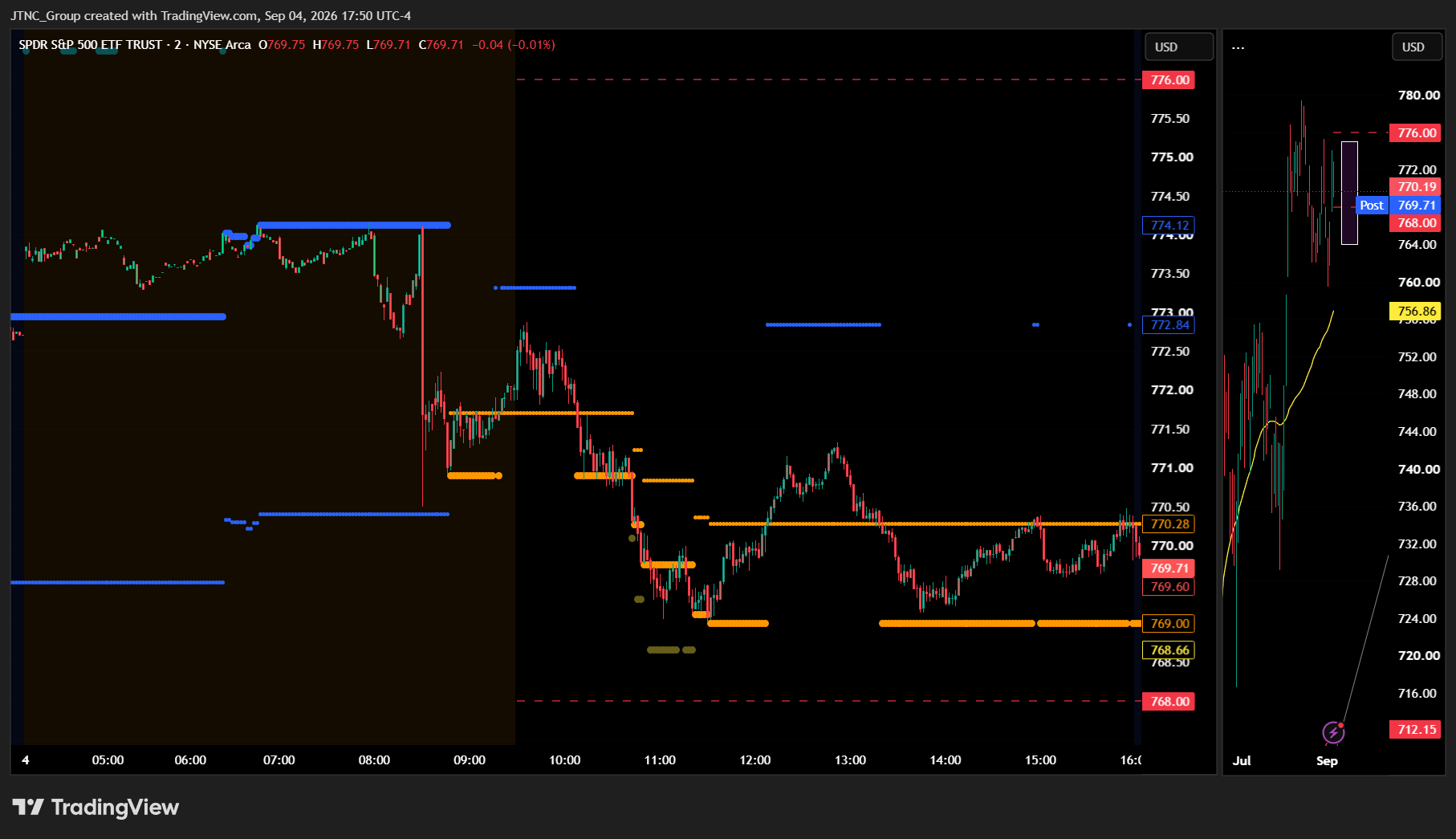
Current Market State Overview:
The MSI ended in a Bearish Trending Market State with SPY closing at $770.24. Since SPY closed inside the MSI range, support remains support and resistance remains resistance heading into Monday, with $769 holding as support and $770.28 as the level to clear. Extended targets were not printing at the close, though they were active during both the AM and PM sessions printing below, confirming sustained bearish pressure throughout the day. The session itself was a textbook example of the MSI guiding traders through a trending move with precision. The MSI rescaled higher overnight while awaiting the jobs report, but immediately after the report was released in the premarket, it rescaled sharply to a very narrow bearish state, then by the open had transitioned briefly to a ranging state. That ranging environment did not last long. Once price came in from above into a bearish state, the odds of reaching MSI support climbed to near 70%, and sure enough price dropped to $769 quickly. The MSI then rescaled lower several more times throughout the session, each rescale offering a fresh opportunity to trade in the direction of the trend. Extended targets printed below during both the AM and PM sessions, adding confirmation to each leg lower. Price eventually bounced from $769 when extended targets stopped printing, recovering to $771 briefly, but that rally was short-lived as SPY fell again and the MSI rescaled back to a bearish state for another round of downside follow-through. The current MSI width is narrow at just $1.28, reflecting a market that is coiling rather than trending aggressively, and that narrow spread suggests Monday could see some continued softness but likely without much extension below today's lows. The narrow bearish state forecasts some possible weakness on Monday but perhaps not much lower than today's session lows, and the overall bias remains sideways to possibly up given the tight consolidation. MSI support is $769 with resistance at $770.28.
Key Levels and Market Movements:
Thursday we stated, "buying any pullback to $769.53 support after the jobs report settles is the preferred approach, with confirmation from the MSI state and extended targets required before pressing into a position," and added, "if the jobs report disappoints and the MSI rescales to a Ranging or Bearish Trending state with extended targets printing below, the bullish case fades quickly and caution is warranted," while also noting, "avoid chasing the open print and let the MSI dictate direction before committing to either side." Friday delivered exactly that scenario, as the jobs report triggered an immediate bearish shift in the MSI and the entire session played out under bear control. SPY opened at $772.01, briefly touching a session high of $772.87, before sellers stepped in quickly and the MSI transitioned first to a narrow bearish state in the premarket and then briefly to ranging at the open. That ranging environment was a signal to wait, not act, and traders who followed the framework avoided getting caught in a false long at the open. Once price came from above the MSI range into the bearish state, the probability of reaching MSI support at $769 was high and price reached it without much hesitation. The setup was to sell any rally toward MSI resistance and target the support level below, and that played out cleanly on the first leg down. The MSI then rescaled lower several more times during both the AM and PM sessions, each providing a fresh resistance level to sell against with extended targets printing below to confirm the move. When extended targets finally stopped printing, price bounced from $769 up toward $771, which offered a brief relief but no real reversal, as bears reasserted control and the MSI rescaled back to a bearish state for yet another tradeable leg lower. By the close, SPY had settled at $770.24 with the MSI sitting in a narrow bearish state, no extended targets, and a VIX reading of 14.39 reflecting a modest but real uptick in caution. At minimum it was a four-for-four session for traders following the framework. It was an easy day to read and execute with substantial setups, all identified through proper context, patience, and flexibility while leveraging the MSI, premarket levels, and market structure rather than forcing trades. The MSI continues to prove its reliability as the cornerstone of our trading process.
Trading Strategy Based on MSI:
Monday has light economic news so the market is likely to move more sideways than trend given the Bearish Trending state at the close. But with such a narrow range it is also likely the MSI rescales overnight and a short squeeze ensues which will push price back to test higher levels. The narrow $1.28 spread reflects a market that is coiling rather than breaking, and while bears are likely to maintain some pressure to the downside, the narrow bearish state suggests less conviction than a wide trending environment. Monday may see continued softness but is equally capable of producing a relief rally, particularly if the MSI rescales higher overnight. Traders should lean on the MSI state at the open and not assume continuation in either direction without confirmation from the levels and extended targets.
Bulls want to see overnight price hold above $769 and push toward $770.28 and ultimately through it, ideally with the MSI rescaling higher to confirm the move has real legs. If the MSI transitions out of the bearish state overnight or early Monday and extended targets begin printing above, buying any pullback to MSI support at $769 would be the preferred approach targeting a move back through $770.28 and toward higher levels. A failed breakdown at $769, where price briefly dips below but quickly reclaims it, is also a high-probability long setup worth watching as that level has already served as strong intraday support. Bears want to see $769 fail to hold selling pressure and push price toward a retest of today's lows and potentially lower. If the MSI holds its bearish state into the open and extended targets return printing below, selling any rally to $770.28 would be the preferred approach targeting $769 and below. Given the current setup, the highest-probability path Monday is sideways action between these two levels with a potential short squeeze giving bulls a chance to reclaim the range. Avoid pressing a directional bias ahead of the open and instead let the MSI settle and dictate which side has control before committing to a position.
The long-term bull trend remains intact above $640 and failed breakouts and failed breakdowns continue to offer the highest-probability setups. Remain flexible, avoid trading during Ranging Market States unless a clear failed breakout or breakdown presents itself, and ensure all trades are fully aligned with MSI signals. Providing real-time insights into market control, momentum shifts, and actionable levels, the MSI when integrated with our Pre-Market and Post-Market Reports continues to sharpen execution precision and elevate trade quality. If you haven't yet integrated MSI and our model levels into your process, now is the time. Contact your representative to get started as these tools are designed to support consistency and enhance performance.
Dealer Positioning Analysis
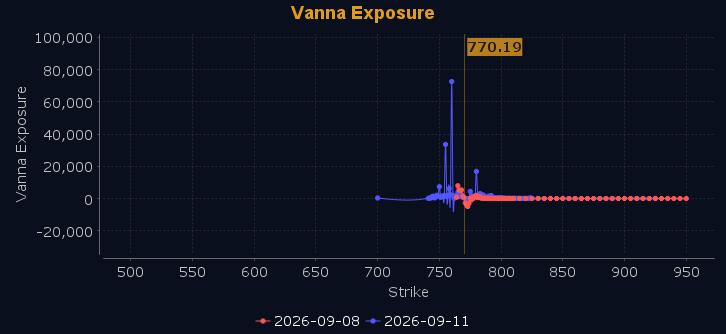
Dealers are selling SPY $775 to $800 and higher strike Calls, while buying $771 to $774 Calls, indicating the Dealers' desire to participate in any rally on Monday. The ceiling for Monday appears to be $779. To the downside, Dealers are buying $770 to $710 and lower strike Puts in a 2:1 ratio to the Calls they're selling, displaying moderate concern that prices could move lower. Dealers have not increased or reduced their hedges, indicating more of a wait and see view heading into Monday. Below $763 is bearish and above $769 is bullish with everything in between being chop and trap filled. Should SPY fail to hold $761, there is a wall of support to $755 which should slow any descent. Above $770 there is a wall all the way to $783 which is likely to contain price in this range, meaning chop and two way trading on Monday absent an external catalyst. Dealer positioning is unchanged at bullish.
Looking Ahead to Next Friday:
Dealers are selling SPY $771 to $810 and higher strike Calls, indicating the Dealers' belief that the market is likely to stall next week and trade more sideways than move strongly higher or lower. The ceiling for the week appears to be $780. To the downside, Dealers are buying $770 to $695 and lower strike Puts in a 3:1 ratio to the Calls they're selling, displaying moderate concern that prices could move lower. The absence of ATM Put selling or ATM Call buying confirms that Dealers are in wait and see mode, and this is likely still tied to the long weekend — we expect to see this picture shift by the end of Tuesday's session. We remain bullish above $773 but below $762 we are bearish with the large zone in between being nothing but chop and full of traps. For the week Dealer positioning is unchanged at neutral/slightly bearish. We advise reviewing Dealer positioning daily for directional clues. These positions evolve quickly and tracking them is essential for staying ahead of shifting market sentiment.
Recommendation for Traders
With SPY closing at $770.24 and VIX rising 0.49% to 14.39, the bias leans cautious. Favor longs only on a reclaim of $772 with stops below $769. If $769 fails to hold, shorts become attractive toward $767.
Keep position sizes tight — the 10-year yield at 4.780 is deep in danger territory, and below-average volume means moves can be deceptive. Always review the premarket analysis posted before 9 AM ET for any changes in the model's outlook and Dealer Positioning.
Good luck and good trading!
