
Market Insights: Thursday, September 24th, 2026
Market Overview
Thursday was a tug-of-war on Wall Street, but investors ultimately bought the dip as renewed hopes for a Strait of Hormuz deal outweighed sticky inflation fears and a brutal bond sell-off that pushed the 10-year yield to its highest level since 2007 and the 30-year to its highest since 2004. The Dow fell 0.3%, the S&P 500 closed just below the flat line, and the Nasdaq clawed back from its lows to finish in the green. Stocks turned around after Reuters reported that US and Iranian negotiators are working on a phased plan in which Iran would allow shipping through the Strait in exchange for Washington lifting its economic blockade, though plenty of obstacles remain. The Strait has become a critical chokepoint in the Middle East conflict, choking off oil flows and driving up energy costs, and crude still rose over 2% with Brent trading above $105 per barrel. Meta gained another 4% after Mark Zuckerberg laid out his plan to monetize the wildly popular Muse AI agent, and Eli Lilly also popped. On the other side, Oracle tumbled and dragged other AI names with it after Bloomberg reported that the company issued a force majeure notice to limit its financial exposure to a New Mexico data center project, raising fresh questions about the AI buildout. Darden Restaurants slid after first-quarter results missed expectations, and Costco reports after the bell.
The Trump-Xi summit got underway in earnest, with both sides signaling that importers can count on some stability for the next few months. Treasury Secretary Scott Bessent said the US and China agreed to extend their trade truce by two months and set a new early 2027 deadline for continued talks, leaving AI competition, the war in Iran, and critical minerals as the main topics. Beijing hasn't confirmed the extension yet, but Xi opened with notably conciliatory remarks, backing "a constructive China-US relationship of strategic stability" and more flights "to facilitate two-way travel and trade," and top US tech CEOs are set to join both leaders for dinner Thursday. Meanwhile, Argentine President Javier Milei pitched investors at New York's Economic Club, touting the country's energy and minerals, the massive Vaca Muerta gas reserves as a potential AI power source, and "hospitable land" for data centers. He promised Argentina is "not going to regulate" AI, pointed to falling interest rates, and vowed that "today's rules will be the same tomorrow," declaring that "the time to bet on Argentina is now." Peter Thiel has already established a foothold there, and Tesla has plans to launch in the country as well.
SPY Performance
SPY opened at $764.07, gapping lower after yesterday's weak finish, and briefly extended the damage to a low of $763.25 early in the session. But this time the bears didn't get the one-way ride they enjoyed the day before. Buyers stepped in off that low and pushed SPY all the way up to a high of $768.95, briefly climbing back above the prior session's close before giving a little back. The close at $767.18 settled in the upper portion of the range, a much healthier look than yesterday's finish near the lows.
SPY finished down just 0.08%, essentially flat, but the real story was the intraday recovery from the gap down. Volume came in at 43.89 million shares, near average and a clear step up from the prior session. That means the dip-buying had real participation behind it and wasn't just a thin bounce. Still, the VIX rose 3.23% to close at 15.67, so traders kept paying up for protection even as prices recovered. That tension is worth watching. Buyers defended the lows convincingly, but the market isn't fully buying the rebound yet. Yesterday looked like the bears finally showed up, and today's action shows the bulls aren't ready to hand over control without a fight.
Major Indices Performance
The Nasdaq was the lone index to finish in positive territory, but only barely, eking out a 0.01% gain in what can only be described as a stalemate session. Tech buyers and sellers fought to a draw, with strength in some mega-cap names offsetting weakness elsewhere in the index. A flat finish after the prior session's slide isn't exactly a victory lap, but it does suggest the aggressive selling in growth names cooled off for at least a day. Holding the line counts for something when the macro backdrop remains this uneasy.
The Russell 2000 slipped 0.11%, a much milder decline than the heavy losses small-caps posted in the previous session. That's a modest improvement, but it's not a reversal. Small-caps are still struggling to regain the relative strength they had been showing before the recent pullback, and the lack of a meaningful bounce tells you buyers aren't rushing back into the riskier end of the market just yet. The S&P 500 also closed fractionally lower, keeping the broader market in a holding pattern.
The Dow was the weakest performer of the group, falling 0.31% as blue-chip names extended their recent losing streak. The persistent pressure on industrials and financials points to continued caution from institutional money in the more rate-sensitive, traditionally valued corners of the market. The fact that the Dow lagged again while tech held flat shows that investors are still being selective rather than broadly adding risk. The VIX rose 3.23% to close at 15.67, its second straight gain, signaling that nervousness continues to build beneath the surface even on a relatively quiet day for the indices.
Notable Stock Movements
Tesla led the Magnificent Seven lower today, but this was a far cry from the kind of damage we saw in the prior session. A -0.57% loss made Tesla the group's biggest decliner, yet the move was more of a shrug than a statement. Tesla is known for dramatic swings in both directions, so a sub-one-percent slip barely registers by its standards. Still, being at the bottom of the mega-cap leaderboard keeps the spotlight on a stock that has struggled to hold a consistent bid, and it shows the selling pressure in this group hasn't fully cleared out.
The broader Magnificent Seven picture was mostly red again, stretching the fractured pattern that has defined this group for a while now. The bright spots were Meta, Alphabet, and Amazon, all of which closed in the green. Alphabet's bounce is especially worth noting after it absorbed such a heavy hit in the prior session, and it suggests at least some dip-buying appetite is still out there for the beaten-down names. But three winners against a red majority is the same split decision we keep getting. The rotation among these names is constant, and the unified push higher that powers real rallies is still missing.
This muted, splintered showing from the mega-cap core matches the market's cautious, directionless mood. The losses were small and the gains were modest, which points to hesitation rather than panic. Traders aren't bailing on big tech, but they aren't rushing to pile in either. Until the Magnificent Seven can line up behind a common direction, the market will stay stuck in this holding pattern, waiting for leadership from the names that have historically carried the load.
Commodity and Cryptocurrency Updates
Crude oil bounced 1.00% today to close at $93.08, clawing back some of yesterday's losses and reminding everyone that black gold isn't ready to give up its gains. Prices remain well above $70, still defying longer-term model expectations by a wide margin. The geopolitical tensions and supply concerns that fueled this rally haven't gone anywhere, and buyers seem quick to step in on dips. If energy prices hold at these elevated levels, they'll keep feeding into inflationary pressures, and that's a real complication for a Fed trying to fine-tune rate policy without reigniting price growth.
Gold barely moved today, inching up 0.01% to close at $4,319. After yesterday's pullback, a flat session like this suggests the metal is finding its footing rather than extending the slide. That's a constructive sign for the bulls. The same forces that drove gold to these historically lofty levels are still in place, including inflation uncertainty, steady central bank buying, and a steady stream of geopolitical headlines. Consolidation near the highs is healthy, and nothing in today's action suggests the longer-term uptrend is in jeopardy.
Bitcoin slipped 0.21% today, closing above $84,203, a much milder decline than yesterday's pullback. With equities drifting in a mixed, indecisive session, crypto followed suit with a quiet, low-drama day. The selling pressure appears to be easing, which is encouraging for anyone hoping this dip is just a pause. The next test is whether buyers can defend current levels and rebuild momentum, or whether Bitcoin needs more time to consolidate before its next leg. For now, the crypto trade is catching its breath.
Treasury Yield Information
The 10-year Treasury yield kept grinding higher today, rising 0.94% to close at 5.160. It wasn't the explosive jump of the prior session, but it didn't need to be. Yields added another 5 basis points on top of yesterday's breakout above 5%, and that kind of follow-through tells you the move wasn't a one-day fluke. Bond sellers are still in control, and the market is now sitting uncomfortably close to the level the framework treats as the breaking point.
The math is getting tight. The 4.5% line where equity multiples start to feel the squeeze is now 66 basis points behind us. The 4.8% level that signals broader selling pressure is 36 basis points in the rearview. The 5% threshold for serious risk has been cleared by 16 basis points. That leaves just 4 basis points between today's close and 5.2%, the level where the framework calls for a 20% or greater correction. One more session like today would put that trigger squarely in play.
What stands out is how quietly stocks handled it. After yesterday's broad-based selling seemed to confirm that equities were finally respecting the rate reality, today's session slipped back into that uneasy calm. The major indices barely moved, and the damage stayed contained. That's not necessarily good news. When yields climb deeper into danger territory and stocks don't react, it often means the adjustment is being delayed rather than avoided. The framework doesn't care how calm the tape looks on any given day. Sustained yields above 5% eventually catch up with valuations.
The watch level is now crystal clear. A close at or above 5.2% would be the most significant signal the framework can give, and the market is right on its doorstep. On the flip side, any real relief would require yields retreating back under 5%, which would take a meaningful shift in the inflation or Fed outlook. Until one of those happens, every uptick in the 10-year deserves close attention.
Previous Day’s Forecast Analysis
Heading into Thursday, our AI model projected SPY to trade within a range bounded by $768 on the downside and $780 as the max upside target. That twelve-point window put the session in trending territory, and the forecast called for a directional move rather than a sideways grind. With Wednesday's close at $767.83 sitting near the lower end of that range, the bias tilted bearish, and the burden was on bulls to reclaim lost ground before any upside could develop.
The forecast named $772 as the defining level, the first gate above price where buyers needed to show up in force. A reclaim of $772 with conviction was expected to put $774 and then $775 in play, with $775 flagged as the real battleground since that's where Wednesday's early rally stalled. Above that, $778 and then $780 were the next targets, with sellers expected to press at the $780 round number. On the downside, $768 was the immediate floor with very little cushion, and a clean breach was expected to open the door to an accelerated move lower.
The trading strategy leaned on the VIX rising 2.02% to 15.17. It was described as a contained fear reading, but one that was moving the wrong way for bulls. The plan recommended 55-65% position sizing. If vol pushed above 17 on a red tape, traders were told to cut net long exposure and tighten stops to 0.5-0.75% from entry. On the long side, the preferred trigger was a bounce off $769-$770 that pushed back above $772, targeting $773 first and then $775-$776, with stops below $766.50. Chasing an open above $772 without a clean retest was specifically discouraged. On the short side, the $772-$773 band was the resistance zone to fade, targeting $769-$770 and then $767, with stops above $773.50. A weak open breaking below $767.83 without a credible bounce was considered shortable at reduced size, targeting $764-$765. The strategy stressed covering in layers and respecting the risk of a fast headline-driven reversal.
Market Performance vs. Forecast
Thursday's session played out along the bearish tilt the forecast established, with the model's directional read and key pivot levels proving their value throughout the day. SPY opened at $764.07, below the $768 max downside. Overnight developments and external catalysts drove the open beyond the projected range, a reminder that the model's base case does not account for unpredictable events that hit the tape before the bell. What the forecast did get right was the core message: the burden was squarely on bulls, and they never came close to meeting it. Price never approached $772, the "first gate above current price," and the $774-$775 battle zone was never tested. The bearish bias heading into Thursday proved correct from the opening print.
The standout call was the falling market scenario's continuation setup. The forecast stated that if the tape opened weak and broke below the prior close of $767.83 without a credible bounce attempt, that break was shortable at reduced size targeting $764-$765. That is essentially the session's script. Price traded right into that target zone and pressed just beneath it to a low of $763.25, giving short-side traders a clean opportunity to cover into support in layers exactly as the framework advised. The $768 level also functioned as the pivot the model identified. Once lost at the open, it capped the recovery attempt, with the session high of $768.95 barely poking above it before sellers leaned in again. The model's long trigger required a push back above $772, and that trigger never activated, which kept disciplined traders out of long entries on a tape that couldn't generate real upside conviction. The instruction not to chase strength on a tape that had just sold off kept capital protected.
The late-session recovery toward $767.18 aligned with the forecast's warning to cover shorts into support rather than overstay. The model specifically cautioned that a fast reversal could materialize, and the rebound off the lows showed why layered profit-taking was the right call. Volume came in near average, suggesting that the lower open reflected orderly repricing rather than panic liquidation.
The VIX rising 3.23% to 15.67 continued the exact trend the forecast highlighted, a volatility gauge grinding higher on a soft tape as the market quietly prices in additional risk. Vol remains below the 17 threshold the model flagged as the trigger for cutting net long exposure, which means the recommended 55-65% position sizing remained the appropriate posture all session. The bearish bias, the continuation short target, the $768 pivot, and the rising volatility warning all delivered actionable guidance. The framework continues to adapt to shifting conditions and gives traders a reliable structure for managing risk and spotting opportunity heading into the next session.
Premarket Analysis Summary
The premarket analysis posted at market open set SPY's projected range for the session between $754 as max downside and $772 as max upside, with spot entering at $762.96 in a put-dominated tape. That was ten points lower after the prior day's break of $770 gave way to a slide through the entire downside stack. The expected move had widened to nine points, signaling that participants were bracing for larger swings with one session left in the week. The defining level was $768, identified as the gate bulls really needed to reclaim to take back control of the week. On the way there, $764 was the first step out of the hole, and $765 was the heaviest battle above and the point where the tape would begin to repair. Above $768, $770 was flagged as the prior day's floor turned resistance and a major round number, with $772 capping the expected move as max upside. On the downside, $762 sat right beneath spot as the first watch level. $760 was the most important floor below, a major round number and the line in the sand where the heaviest battle sat. $758 was the point of last hope, and $754 was max downside at the bottom of the expected move. The analysis framed it as a fragile setup: reclaim $765 and $768 gets tested, but lose $762 and expect a fast trip to $760.
Bulls took the repair path the analysis laid out. SPY opened at $764.07, already above the first upside level, and never threatened the downside stack, with a session low of $763.25 that stayed above $762. Price pushed through $765 and did exactly what the analysis projected, testing the $768 gate with a high of $768.95. Bulls couldn't hold above it, though, and SPY closed at $767.18, just beneath the defining level. That left $770 and $772 untouched and the question of who controls the week unresolved heading into Friday. The VIX rising 3.23% to 15.67 even as price recovered showed that participants weren't fully convinced the damage had been repaired.
Validation of the Analysis
Today's session was a textbook example of how the premarket framework maps out both sides of the tape and then lets price tell you which script is in play. SPY opened at $764.07, right on top of the 764 level flagged before the bell as "the first step out of this hole." The downside never came into play. The session low printed at $763.25, holding above 762, which the analysis named as the first level to watch beneath spot. Because 762 never gave way, the feared "fast trip to 760" never started. That line in the sand at 760 was never even challenged, and neither were 758 or 754. Buyers defended the exact zone the framework said mattered, and that told traders early which direction had the edge.
From there, the upside road map played out almost word for word. The analysis spelled out the conditional clearly: "reclaim 765 and 768 gets tested." SPY cleared 765, the heaviest battle above and the spot where the tape "begins to repair," and then drove straight into the 768 gate. It pushed to a high of $768.95 before stalling. The framework called 768 "the level bulls really need" and said that until it was reclaimed, sellers kept control of the week. Price poked through intraday but couldn't hold it, closing at $767.18, just beneath the gate. The 770 level, flagged as yesterday's floor turned resistance, was never reached, and 772 stayed well out of range. The trading opportunities were clean and clearly defined. Longs taken on the hold above 762 and the reclaim of 764 and 765 had a precise target at 768, which is where the move ran out of steam. Anyone watching the 768 gate had a high-probability spot to lock in gains or lean short into the close as price faded back under it. Every major call held. The key support stayed intact, the 765 reclaim triggered the exact test the analysis predicted, and 768 acted as the ceiling it was billed to be.
Looking Ahead
The economic calendar for Friday shows no confirmed high-impact releases, so there's no GDP revision, PCE report, or jobs data waiting to jolt the market into the weekend. Without a macro headline to react to, the final session of the week will run on positioning and price action. Traders will be watching whether Thursday's tone carries into Friday's close or whether end-of-week profit-taking and position squaring take over.
Quiet Fridays can still produce meaningful moves, especially when traders decide whether they want to hold exposure over the weekend. That makes the late-day tape worth watching closely, because conviction or hesitation tends to show up in the final hour. The playbook stays the same. Respect key technical levels, wait for price to confirm direction, and keep position sizes sensible heading into two days of headline risk with no ability to react. Treat Friday as a positioning session and set up cleanly for whatever next week's calendar brings.
Market Sentiment and Key Levels
The directional bias today is neutral with a slight bearish tilt, and neither side landed a decisive blow. A -0.08% close is essentially a stalemate, but how SPY got there matters. After opening under pressure, buyers stepped in and pushed the index back toward the upper end of its range, which shows dip buyers haven't abandoned ship after yesterday's selling. Still, the VIX rising 3.23% to 15.67 marks a second straight day of climbing fear, and that is hard to ignore even with a relatively calm tape. Average participation suggests this was more of a pause than a conviction move in either direction. The split among the major indices, with tech holding flat while the Dow lagged, points to rotation and hesitation rather than a unified push. Bulls earned a small moral victory by defending lower levels, but they haven't regained control.
Key resistance now sits at $768.95, today's session high, where buyers ran out of steam late in the day. A clean break above that level on stronger volume would be a constructive signal and could open a path back toward $773.02, yesterday's high, where sellers took control and are likely to reappear. On the downside, $763.25 is the line in the sand. It was today's intraday low and sits right in the zone bulls needed to defend after yesterday's decline. A decisive break below that floor would suggest the morning bounce was a one-off and could invite a slide toward the psychologically important $760 area, where support would need to hold to prevent a deeper pullback. The biggest wild cards remain elevated rates and firm energy prices, both of which keep inflation worries alive and limit how much room the Fed has to help. If rates cool and fear gauges settle down, bulls have a real shot at testing resistance, but until SPY clears the session high with conviction, caution is the smarter posture.
Expected Price Action
Friday's session brings actionable intelligence generated by our AI model, though the model's projected range for Friday was not included in today's data, so we are not publishing a range figure. Instead, the focus is on the key levels from the model's most recent framework, which run from $754 as max downside to $772 as max upside. Thursday's tape held up well against those levels. SPY recovered from the morning's put-dominated open and finished in the upper half of the framework, just shy of the $768 gate. That leaves a cautiously bullish lean heading into Friday, but it is a lean and not a green light. Bulls still have to prove they can take back the level that has capped them all week.
The defining level for Friday remains $768, the gate the model flagged as the one bulls really need. A reclaim of $768 with conviction puts $770 in play. That level is Wednesday's broken floor turned resistance and a major round number, so sellers should be expected to defend it hard. Above $770, $772 is the max upside and the last target in the stack. On the downside, $765 is the first line bulls need to hold. It was the heaviest battle above spot on Thursday morning and is now the level that keeps the repair job intact. Below that, $762 and then $760 come back into focus, and $760 is the true line in the sand. A clean break there leaves little cushion, with $758 as the point of last hope and $754 as the max downside. With VIX rising 3.23% to 15.67 and the expected move having widened, traders should be ready for bigger swings into the weekend. Reclaim $768 and the path toward $770 and $772 opens up. Lose $765 and the slide back toward $760 can happen in a hurry.
Note: Section 3 in the data provided ends at line "i." and does not include the "j." Model's Projected Range line. Because that range was missing, I have not stated a projected range, a range width, or a trend-versus-chop call for Friday. The levels above come from Thursday's premarket notes. Please send the "j." line and I will revise the section to use the official projected range.
Trading Strategy
The VIX rising 3.23% to 15.67 deserves attention because it came on a session where the broad tape barely moved. When implied volatility climbs even as prices stay close to flat, it usually means options traders are quietly buying protection beneath the surface. At 15.67, fear is still contained and nowhere near panic territory, but this is the second straight session of vol drifting higher, and that persistence matters more than the absolute level. The 17 threshold remains the line in the sand. A break above that level on a red tape is the signal to cut net long exposure and tighten stops to the 0.5-0.75% range from entry. Until then, 50-60% position sizing is appropriate. That is slightly more conservative than a session ago, reflecting a volatility backdrop that keeps inching the wrong way for bulls.
In a rising market scenario, the key level to defend is $767, where price settled into the close. An early dip that holds $766-$767 and then pushes back through $769 is the preferred long trigger, since clearing that ceiling would mean buyers finally broke out of the tight range that capped the session. The first profit target is $771, with a secondary target of $772-$773 back into the zone where sellers took control earlier in the week. Stops on longs belong below $765, because losing that level on renewed selling would signal the dip-buyers have lost their grip. Do not chase a gap above $769 without a clean retest. Breakouts from a quiet, indecisive tape have a habit of fading fast when conviction is thin.
In a falling market scenario, $768.50-$769 is the resistance band to fade. That ceiling rejected every push higher during the session, and a morning bounce that stalls there is a clean short trigger. The initial profit target is $765-$766, with $764 available if sellers press their advantage back toward the opening zone. Stops on shorts belong above $770 to guard against a squeeze through the recent ceiling. If the tape opens weak and slices below $763.25 without a meaningful bounce attempt, that continuation break is shortable at reduced size, targeting $760-$761. With the VIX at 15.67 and climbing for a second session, shorts have a modestly friendlier backdrop, but this market has shown a stubborn refusal to break down. Cover in layers into support and do not get greedy, because a single upbeat headline can flip a sleepy tape into a sharp reversal in minutes.
Model’s Projected Range
SPY's projected maximum range for Friday is $761 to $773, with the Call side dominating in an expanding band that suggests trending price action with intermittent chop. Traders should check Friday's economic calendar before the open, since any high-impact release would likely produce significant volatility particularly in the first hour of trading, while a quiet calendar would leave the market trading on technicals. SPY closed at $767.18, down 0.08%, after opening at $764.07, dipping to a low of $763.25 and then grinding up to a high of $768.95 before settling just below the top of the day's range. SPY is trading near our model's first support at $766, and with no major new macro headlines driving the tape, positioning into the weekend is doing most of the talking. If buyers push through $770, the next target is $772, but if $766 gives way, price likely slides toward $762, and if the lowest support at $755 breaks, there is little to keep price from falling toward $750. The long-term bull trend remains intact above $640 with SPY well above structural support. As long as price holds above key structural levels, this remains a broader dip-buying environment. Absent a catalyst, resistance sits at $770, $772, $775, $780, while support rests at $766, $762, $760, $755. We favor buying dips at $766. Bitcoin slipped 0.21% but held above $84,203, while the MAG stocks had a mostly red day led lower by Tesla, down 0.57%, with Meta the standout exception, jumping 4.50%, so leadership was soft but not broken, and sustained weakness across both leadership groups would be required to signal a deeper pullback. The VIX closed at 15.67, up 3.23%, suggesting elevated fear given traders are adding some protection heading into the weekend even as price held near the highs. SPY remains in an uptrend channel, holding comfortably above structural support near $640.
Market State Indicator (MSI) Forecast
Current Market State Overview:
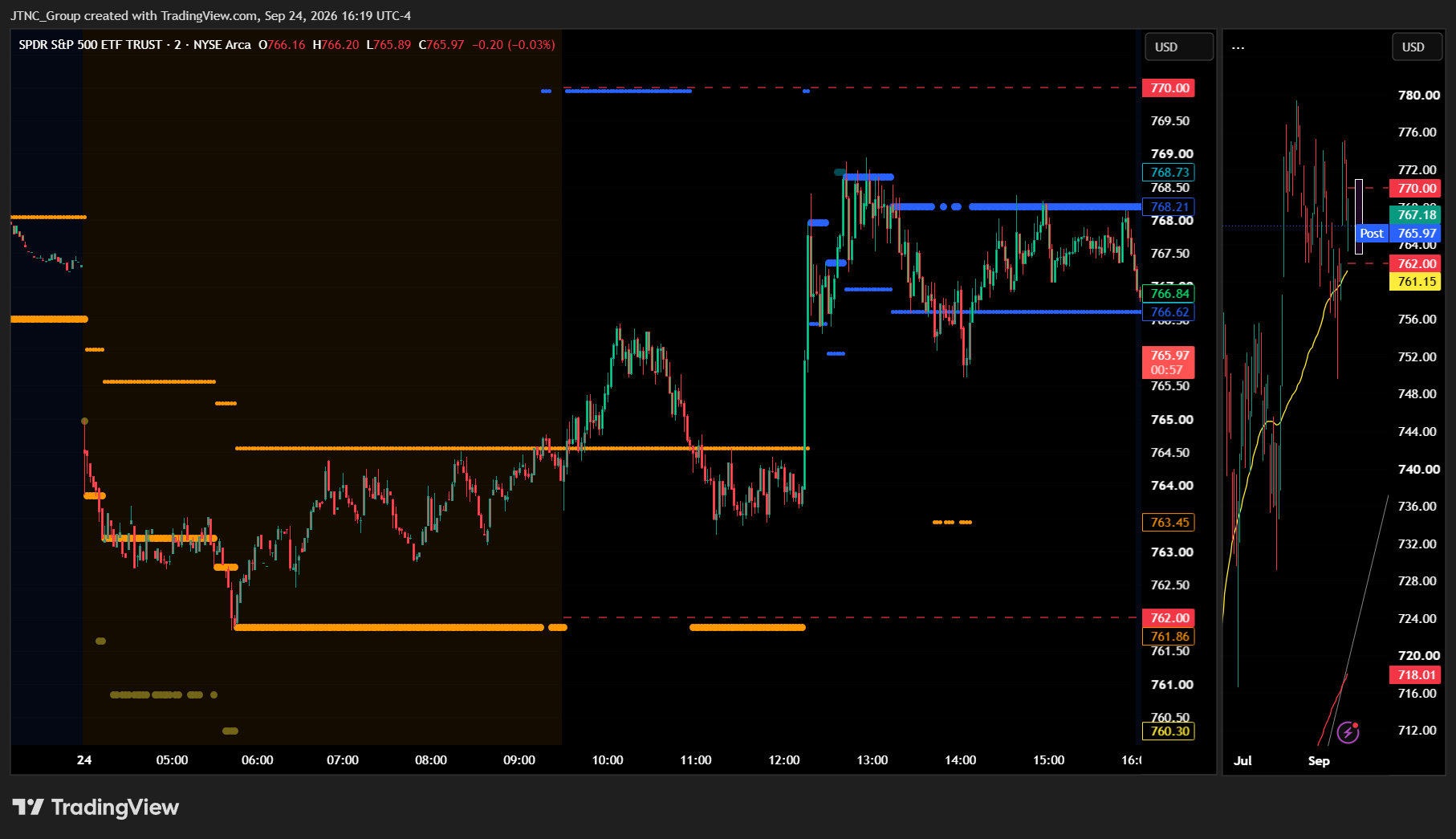
The MSI ended in a Bullish Trending Market State with SPY closing at $767.18. With SPY closing inside the MSI range, support remains support at $766.62 and resistance remains resistance at $768.21 heading into Friday. Extended targets were not printing at the close. Extended targets were visible below in premarket, reaching down toward the 761 and 760.30 area, and printed below again briefly in the PM session before the news-driven reversal wiped them out. The MSI rescaled lower overnight as SPY broke the prior day's lows and closed the gap from Friday. With extended targets printing, it looked like SPY might break major support at $760 and cascade lower. But $760 held, extended targets stopped printing in premarket, and by the open SPY was back near $765 with the MSI in a Ranging state. Late in the AM session the MSI rescaled into a Bearish Trending state. Around noon, headlines about US talks with Iran to end the war reversed SPY hard, and the MSI rescaled several times higher into a Bullish Trending state that held through the close. The MSI range settled at a moderate $1.59 spread, which is tight enough to signal consolidation but gives price some room to rotate between the lines. With no extended targets above during the rally and none at the close, the bulls won the day without building much upside momentum. The MSI is forecasting a slow grind higher for Friday, though without extended targets at the close the move may be modest and is likely to find resistance at key levels above. Choppy, rangebound trade between $766 and $770 is the most likely path, with upside capped near $772 and $760 still serving as the line in the sand for major support. MSI support is $766.62 with resistance at $768.21.
Key Levels and Market Movements:
Wednesday we stated, "Bears want to see $768.54 fail to hold as resistance on any overnight push and for sellers to press price back toward the session low of $766.50 and ultimately toward $760, which remains the key structural support level," and added, "Bulls, on the other hand, want to see overnight price reclaim $768.54 and hold it as support rather than resistance," while also noting, "If the MSI rescales higher overnight and extended targets begin printing above, traders should be willing to flip their bias and participate in the squeeze rather than stubbornly staying short into a shift." Thursday managed to deliver both scenarios in a single session. The bears got the first move overnight. SPY broke Wednesday's lows, closed the gap from Friday, and printed extended targets below toward the 761 and 760.30 area. For a while it looked like $760 would give way, but that key structural support held. Extended targets faded in premarket, and SPY opened at $764.07 before drifting back toward $765 with the MSI in a Ranging state. We do not favor trading in a Ranging state, so the right move was to sit on our hands through most of the AM session. Late in the morning the MSI rescaled into a Bearish Trending state, and the short from MSI resistance looked good as sellers tried to press toward the session low of $763.25. Around noon, headlines about US talks with Iran to end the war hit the tape. SPY reversed hard and stopped that short out, which is exactly the kind of shift the framework warned traders to respect rather than fight. From there the MSI rescaled higher several times in rapid succession, and each rescale created a fresh support level to buy. The first long came on the initial Bullish Trending rescale, buying the new support as it was tested and riding it to the new resistance. The second came on the next rescale higher, buying the redefined support and trading up to resistance as SPY pressed toward the session high of $768.95, just shy of major resistance near $769. With no extended targets printing above, the MSI then settled into a narrow bullish band for the bulk of the PM session. That set up two more clean rotations as SPY moved from $766.62 support to $768.21 resistance and back again. SPY closed at $767.18, down 0.08%, on volume of 43.89 million shares, near average, while the VIX rose 3.23% to 15.67 as headline risk kept some hedging demand in place. The four long setups more than recouped the early short, and at minimum it was a four-for-four session for traders following the framework. It was a volatile but readable day with substantial setups, all identified through proper context, patience, and flexibility while leveraging the MSI, premarket levels, and market structure rather than forcing trades. The MSI continues to prove its reliability as the cornerstone of our trading process.
Trading Strategy Based on MSI:
Friday has light economic news so the market is likely to grind higher given the Bullish Trending at the close, though the move may be modest. The bulls took control on Thursday's headline reversal and the MSI finished in a Bullish Trending state with a moderate $1.59 spread. That setup favors continuation higher, but the absence of extended targets both during the rally and at the close says buyers lack the urgency for a runaway move. Expect a stair-step grind rather than a breakout, with price most likely rotating between $766 and $770 and meeting heavier selling as it approaches $772.
Bulls want to see overnight price hold above $766.62 MSI support and push through $768.21 MSI resistance toward $770. If they can do that, a test of $772 becomes possible. If the MSI rescales higher overnight and extended targets begin printing above, it would confirm that buyers have more in the tank than the close suggested, and traders should lean into strength. Bears want to see $766.62 fail and press price back toward the session low of $763.25 and ultimately toward $760, which remains the key structural support level. A failure of MSI support alone would not be enough, though. Bears would need the MSI to rescale into a Ranging or Bearish state before shorts carry real conviction.
The primary setup for Friday is to buy pullbacks to $766.62 MSI support and target $768.21 MSI resistance, repeating that rotation as long as the MSI holds its Bullish Trending state. A failed breakout above $768.21 that stalls near $769 without extended targets printing above could offer a tactical short back toward support. Even so, the bias favors longs until the MSI shifts. Keep targets realistic, since resistance near $770 and $772 is likely to slow any advance, and headline risk around the Iran talks can move price quickly in either direction. As long as SPY stays above $766.62 with the MSI in a Bullish Trending state, dips should be treated as buying opportunities, and the MSI will be the first signal if that changes.
The long-term bull trend remains intact above $640 and failed breakouts and failed breakdowns continue to offer the highest-probability setups. Remain flexible, avoid trading during Ranging Market States unless a clear failed breakout or breakdown presents itself, and ensure all trades are fully aligned with MSI signals. Providing real-time insights into market control, momentum shifts, and actionable levels, the MSI when integrated with our Pre-Market and Post-Market Reports continues to sharpen execution precision and elevate trade quality. If you haven't yet integrated MSI and our model levels into your process, now is the time. Contact your representative to get started as these tools are designed to support consistency and enhance performance.
Dealer Positioning Analysis
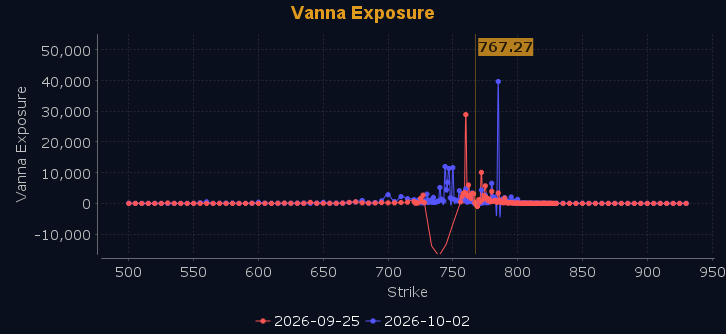
Dealers are selling SPY $770 to $805 and higher strike Calls while buying $768 to $769 Calls, indicating the Dealers' desire to participate in any rally on Friday. The ceiling for Friday appears to be $772. Dealers are buying those ATM Calls in very small size, though, so their conviction is not very strong. To the downside, Dealers are buying $767 to $710 and lower strike Puts in a 4:1 ratio to the Calls they're selling, displaying meaningful concern that prices could move lower. They have also increased their hedges, which further confirms that their appetite for a rally is cautious at best. Below $766 is bearish and above $768 is bullish, with everything in between acting as high-noise chop. Should SPY fail to reclaim and break above $770, expect the rally to be sold with a likely test of $765, with $760 in play. Should $760 fail, Dealers will press shorts and push SPY back to last week's lows. A break above the heavy Call wall at $770 could lead SPY as high as $772, where it is unlikely to push through on the first few attempts. Dealer positioning is unchanged at bearish.
Looking Ahead to Next Friday:
Dealers are selling SPY $768 to $805 and higher strike Calls, and they are no longer buying ATM Calls or selling ATM Puts. That points to a relatively balanced market that may move more sideways than trend. The ceiling for the week appears to be $785, but $772 is major resistance and needs to break for price to work back toward the all-time highs. To the downside, Dealers are buying $767 to $715 and lower strike Puts in a 4:1 ratio to the Calls they're selling, reflecting meaningful concern that prices could move lower if key levels fail to hold. Dealers are positioned to sell the rallies rather than push to new highs this week. A break of $765 will see SPY reach $760, where there is major support. Any failure at $760 will be met with heavy Dealer selling, which would bring SPY back to last week's lows at $750. For the week Dealer positioning is unchanged at neutral/slightly bearish. We advise reviewing Dealer positioning daily for directional clues. These positions evolve quickly and tracking them is essential for staying ahead of shifting market sentiment.
Recommendation for Traders
Favor shorts below $770 and fade any pops toward the session highs with tight stops. Keep longs on the sidelines until rising yields cool off.
Size down and stay disciplined. Review the premarket analysis posted before 9 AM ET for any changes in the model's outlook and Dealer Positioning.
Good luck and good trading!
