
Market Insights: Wednesday, September 16th, 2026
Market Overview
The Federal Reserve delivered a unanimous 25-basis-point rate hike Wednesday, pushing its target range to 3.75%–4%, and stocks couldn't hold it together. The Dow dropped over 700 points, or 1.6%, while the S&P 500 slid 0.5% and the Nasdaq finished little changed. Markets actually caught a brief bid right after the decision — the S&P and Nasdaq popped 0.3% and 0.7%, respectively — but those gains evaporated fast once Fed Chair Kevin Warsh took the podium. His hawkish tone made it clear the Fed isn't done, with the dot plot signaling at least one more hike in 2026 and traders split on whether October brings another move. The 10-year yield climbed back above 5%, matching its highest level since the financial crisis, while Warsh kept it blunt: "The plain fact is that inflation is too high and has been for too long."
There were a few bright spots in the data — August retail sales jumped 1.2%, well above the 0.9% expected and a sharp reversal from July's 0.5% decline, showing consumers are still spending despite the inflation squeeze. Warsh also framed the rate hike as a win for everyday Americans, arguing that price stability delivers "real take-home pay increases" for those without financial assets or home equity. He stayed completely silent on White House pressure for lower rates, simply saying "we stay in our lane." Crypto took another hit as Bitcoin slipped below $76,000 after the Senate failed to advance the CLARITY Act, and with oil benchmarks still above $100 a barrel keeping inflation fears alive, the market's mood heading into Thursday is cautious at best.
SPY Performance
SPY opened at $759.50 and made a brief run at the upside early, tagging the session high of $761.65 before the buying conviction completely dried up. That early push gave the bulls a fleeting moment to work with, but it didn't last — once the high was in, the tape rolled over hard and never looked back. The low of $749.60 represented a significant drop from the open, and the close at $754.13 landed in the lower third of the day's range, which is exactly the kind of price action that tells you sellers were in charge for most of the session. A recovery off the lows was there, but it wasn't enough to inspire any confidence.
SPY finished down 0.43%, now stringing together a third consecutive losing session as the attempted rally from last week continues to unravel. Volume came in at 50.01 million shares, near average, which gives this selloff a bit more weight than the subdued sessions earlier in the week — there were actual participants behind today's move lower, not just a vacuum of buyers. The VIX rose another 2.79% to close at 17.68, marking yet another consecutive climb in volatility as fear continues to quietly accumulate beneath the surface. Three down closes, three VIX increases — the pattern is becoming hard to ignore. Bulls need to step up and draw a real line in the sand, because right now the tape is not offering them a single reason to feel good about what's coming next.
Major Indices Performance
The Nasdaq was the clear standout today, finishing essentially flat with a -0.01% decline — a remarkably resilient showing given the pressure hitting other parts of the market. The near-unchanged close suggests that whatever selling hit the broader tape, tech and growth names largely held their ground, helped in part by strength from several of the mega-caps carrying the index through a choppy session.
The Russell 2000 came in as the middle performer, dropping 0.55%. Small-caps continue to face the same structural headwind they've been dealing with — elevated borrowing costs that disproportionately pressure companies relying on credit to fund operations and growth. It wasn't a collapse, but it wasn't encouraging either, and small-caps remain stuck in a difficult spot as long as the rate environment stays punishing.
The Dow was the worst of the group by a significant margin, falling 1.21% on the session. That's a notable underperformance and somewhat flips the recent script where blue chips had been acting as a relative safe haven. When the Dow leads to the downside, it often signals that even the defensive rotation trade is starting to crack, and investors aren't finding shelter anywhere in particular. The S&P 500 also posted a modest decline on the day, reinforcing the broadly negative undertone. The VIX climbed 2.79% to close at 17.68, continuing its upward drift and signaling that hedging demand is still very much alive — the market's anxiety isn't going anywhere just yet.
Notable Stock Movements
Microsoft took center stage as the biggest drag inside the Magnificent Seven today, sliding -1.37% to lead the group lower. That's a notable stumble from one of the most foundational names in the complex, and when Microsoft is under pressure, it raises questions about the durability of the software and cloud side of the mega-cap trade. A loss of that size from a name so deeply embedded in enterprise spending and AI infrastructure isn't something the market brushes aside easily — it signals that even the most entrenched growth stories aren't completely insulated from the headwinds building across the tape.
The overall Magnificent Seven picture was mostly green, which stands in contrast to the cautious tone playing out elsewhere in the market. NVIDIA led the winning side with a gain of 0.82%, a result that will get attention given how closely the AI-infrastructure trade is watched. The exceptions were Alphabet, Amazon, and Microsoft, which finished in the red and kept the group from delivering a clean sweep. Three names in the red out of seven is enough to complicate the narrative — a mostly green Magnificent Seven should feel more encouraging than it does, but the drag from three heavyweights tempers the enthusiasm.
The split inside the group reflects a market that isn't moving with conviction in either direction. Mostly green from mega-cap tech on a day when the broader tape finished mixed — with the Dow bearing the real pain — suggests the Magnificent Seven offered partial insulation but not outright leadership. The group didn't collapse, but it didn't inspire either. With the three laggards pulling on one side and NVIDIA and the remaining names pushing on the other, the Magnificent Seven sent a murky signal today rather than a clear one, which fits the uncertain tone defining this market.
Commodity and Cryptocurrency Updates
Crude oil pulled back sharply today, dropping 3.71% to close at $101.90, but even after that kind of selling, black gold remains well above any reasonable model expectation. The broader story here hasn't changed — supply constraints and geopolitical pressure have kept this market elevated for longer than most anticipated, and one rough session doesn't unwind that narrative. A move above $70 was already a complication for the Fed, and crude sitting north of $100 is a whole different level of headache. Energy at these prices feeds directly into the inflation picture, and that makes the Fed's job harder whether crude is climbing or simply refusing to fall back to earth.
Gold dipped 0.46% today to close at $4,313, a slightly softer session but nothing dramatic in either direction. The structural support remains intact — central bank demand and macro uncertainty aren't going anywhere — but the metal continues to lack the kind of conviction buying needed to push meaningfully higher from here. Until gold starts closing with real momentum, it looks more like a coiling phase than a breakout setup.
Bitcoin managed a modest 0.81% gain today, closing just below $76,222, which is a welcome change of pace after yesterday's pullback. That said, one green session doesn't flip the script — the burden of proof still sits squarely with the bulls, and Bitcoin needs to string together sustained higher closes before any rally attempt deserves to be chased rather than watched from the sidelines.
Treasury Yield Information
The 10-year Treasury yield added another basis point today, climbing 0.20% to close at 5.010%. After landing directly on the 5% threshold yesterday, yields didn't retreat — they pushed further into dangerous territory. That's two consecutive sessions above the framework's most serious warning level, and that persistence matters more than the size of today's move. A single day at 5% can be dismissed as a spike. Two days above it starts to look like a new floor.
Every layer of the framework is still stacked against equity bulls in real time. The 4.5% level that compresses multiples and punishes growth names is a distant memory. The 4.8% crossover that signaled a genuine shift in tone is 21 basis points below where we're trading right now. And 5%, which the framework identifies as the threshold where significant and broad equity risk becomes the operative condition, is no longer a ceiling — it's become the base. The market isn't flirting with danger at this point. It's settling into it.
What today's move reinforces is that yesterday's close wasn't an overreaction or a one-session anomaly. Yields are holding above 5% with conviction, and that means the financial conditions squeezing rate-sensitive sectors, compressing valuations, and challenging risk appetite aren't going anywhere on their own. The equity market needs relief from the bond market to sustain any meaningful rally, and right now the bond market isn't offering any.
The 5.2% level remains the critical line to watch, now only 19 basis points away. Given that yesterday's full decline was erased in a single session, that gap deserves serious respect. For bulls to regain control of the narrative, a convincing move back below 4.8% is what's needed — not a brief one-day dip. Until yields make that move, the framework says risk is elevated and getting more so with every session yields hold above 5%.
Previous Day’s Forecast Analysis
Wednesday's forecast called for SPY to trade within a projected range of $753 on the downside and $766 as the max upside target, a thirteen-point window that the model characterized as trending territory — meaning a directional move was the expected outcome rather than a sideways grind. With Tuesday's close at $757.44 sitting in the lower half of that range, the near-term bias heading into Wednesday was bearish, reinforced by the VIX ticking up another 2.22% to 17.48 and signaling that fear was still expanding beneath the surface.
The critical level for the session was $760, flagged for a second consecutive day as the gate that needed a clean reclaim and hold to flip the tone for bulls. Above there, $762 was the first real target, $763 the point where the tape would begin to repair meaningfully, and $764 the level bulls truly needed to capture for last week's damage to start fading. $766 sat as max upside. On the downside, $759 was the first line to watch, with $758 identified as the most critical battle zone — a clean break there was expected to get ugly fast, with $755 as the last major support before $753 opened as max downside.
The trading strategy leaned cautious, with position sizing kept in the 50-60% range and stop-losses in the 0.75-1% band from entry. On the long side, the preferred entry was a disciplined pullback and stabilization in the $757-$759 zone, targeting $763-$764 initially and $767-$768 if broader participation returned, with stops below $755. Chasing a gap-up above $762 on light volume was explicitly discouraged. On the short side, a rejection at $760-$761 on the first bounce attempt was the trigger, targeting $754-$755 with $751-$752 in play if selling accelerated, and stops above $763 to guard against a sharp reversal.
Market Performance vs. Forecast
Wednesday's session delivered a directional outcome that aligned with the forecast's bearish lean, though external pressure drove price action beyond the model's base case scenario at the lows. SPY opened at $759.50, right inside the $757-$759 pullback zone the strategy identified as the key stabilization area to watch — that alone confirmed the model's read on where the tape would begin the day. The high of $761.65 pushed briefly into the $760-$762 resistance corridor the forecast flagged as the critical gate, but buyers failed to establish any conviction there, which was exactly the scenario the falling market playbook outlined as a short trigger. The rejection at that zone was clean and textbook, validating the framework's identification of $760-$761 as overhead resistance on any bounce attempt.
The downside leg that followed carried price through $758 and $755 — both explicitly identified as critical support levels — before the close settled at $754.13, just outside the $754-$755 primary profit target zone the short strategy mapped out. That is a notable precision hit. The low of $749.60 pushed below the $753 max downside target, and that extension reflects the kind of broad-based selling pressure that the model's base case doesn't fully price in when external catalysts accelerate an already-deteriorating tape — the model does not account for unpredictable macro developments that can produce outsized intraday moves beyond the projected range. For any long-side participants who entered the $757-$759 stabilization zone, stops below $755 triggered as prescribed, and risk management protocols protected capital from a deeper drawdown into the $749 area. Short-side traders who followed the $760-$761 rejection entry saw their primary target delivered with room to spare. The VIX climbing another 2.79% to 17.68 confirmed the vol expansion thesis the framework has been tracking all week — the forecast explicitly warned that sustained upward pressure in fear metrics would keep sellers engaged, and Wednesday proved that out. The framework read the structure of this session correctly, and that consistency in identifying key levels and directional bias remains the enduring edge.
Premarket Analysis Summary
The premarket analysis posted at market open set SPY's projected range for the session between $750 as max downside and $770 as max upside, with spot entering at $760.07 in a call-dominated tape coiling on the critical $760 level for a third consecutive session. The expected move had expanded to nine points, signaling that participants were bracing for larger swings than the prior two sessions had delivered. The defining level was $760, and the analysis noted that the recent shift in tone toward buyers — with calls now dominating — made holding that level the central story of the day. Above $760, $761 was the first step, $762 was identified as the heaviest concentration overhead and the level bulls truly needed to clear to break the coil higher, $766 was the next decision point where price should want to stall, and $770 stood as the max upside and a major round number. On the downside, $759 was the first warning level sitting just beneath spot — losing it cleanly would call the tone shift into question — $757 was the most important level below and the site of the heaviest battle where a clean break would put sellers back in charge, $754 was the point of last hope with major support coming in, and $750 was the max downside, another major round number sitting below the expected move. The analysis concluded that three days of coiling on one level with tone just turning tends to resolve sharply.
The market resolved that coil decisively to the downside, delivering a session that validated nearly every downside warning the premarket had flagged. SPY opened below the gate at $759.50, immediately signaling that buyers lacked the conviction to hold the key level, and the tape never mounted a meaningful reclaim attempt — price pushed to a high of just $761.65 before rolling over hard. The loss of $759 triggered the acceleration the premarket described, and sellers drove price through $757 without serious resistance, continuing all the way to a session low of $749.60, breaching the $750 max downside target and pushing beyond the full expected move to the downside. Price managed a partial recovery into the close at $754.13, landing right at the point-of-last-hope level identified premarket, but the session finished well below every level the analysis had defined as necessary for bulls to maintain control. The VIX rose 2.79% to 17.68, confirming that the defensive pressure building beneath the surface was far from resolved.
Validation of the Analysis
Today's session played out as a near-textbook validation of the premarket framework, and traders who had the analysis in hand knew exactly what to watch for from the opening bell. SPY opened at $759.50, slipping just beneath the defining 760 level that the premarket identified as the whole story — the analysis was explicit that losing 759 cleanly would call the shift in tone into question, and the tape answered that question before the first candle closed. The open itself was the warning shot, printing right at 759 and failing to reclaim 760, which immediately put the downside targets in play.
From there, the premarket's downside roadmap proved remarkably accurate. The analysis flagged 757 as the most important level below and the heaviest battle on the downside, warning that a clean break of 757 puts sellers back in charge — and that's precisely what happened. Once 757 gave way, price moved directly into 754, described as the point of last hope where major support comes in. SPY found a temporary floor in that zone before ultimately closing at $754.13, sitting right on that critical support level the premarket outlined. The low of $749.60 actually punched through 750, the max downside target flagged as a major round number, giving aggressive traders who followed the breakdown the full range of the expected move to work with. The VIX rising 2.79% to 17.68 confirmed the defensive character the analysis anticipated after a 759 break. The premarket's warning that three days coiled on one level tends to resolve sharply proved exactly right — the sequence from failed 760 reclaim to 759 break to 757 failure to 754 and ultimately 750 was laid out in advance, and the market delivered it on cue.
Looking Ahead
With the economic calendar showing no high-impact releases confirmed for Thursday, the session sets up as another price-action-driven day where the market will have to find its own direction without a hard macro catalyst to lean on. No GDP print, no Fed speakers, no major data drops — just traders watching levels, managing positions, and deciding whether the week's developing trend deserves more conviction or a second look heading into the back half of September.
That kind of quiet backdrop keeps the focus on how the market absorbs recent moves rather than reacting to anything new. Sector rotation, volume trends, and how key support and resistance levels respond to early probes will carry more weight than usual when there's nothing on the calendar to reset the narrative. It also means any off-script development — an unplanned Fed comment, a geopolitical headline, or a significant corporate announcement — could have an outsized impact on a tape that has no scheduled anchor. The disciplined approach is the same as it's been all week: let the market tip its hand first, size risk accordingly, and avoid forcing trades when the setup isn't clear.
Market Sentiment and Key Levels
The directional bias today leans bearish, though the picture is more nuanced than a straightforward selloff. Bears remain in control on the index level, with the Dow taking the worst of it and SPY closing well off its session high after failing to hold early strength. The VIX rising 2.79% to 17.68 is a meaningful tell — this isn't panic, but it's a steady accumulation of hedging pressure that signals institutional traders are quietly paying up for protection. That kind of measured VIX expansion often precedes further downside rather than a clean reversal. Volume came in near average at 50.01M, which gives the decline more credibility than a low-volume drift lower would — sellers showed up in force, and buyers didn't absorb the pressure convincingly.
Key resistance sits at $761.65, today's session high, which SPY touched early and then retreated from for the remainder of the day. Reclaiming that level with conviction would be constructive for bulls and could put the $763 to $765 zone back in play. On the downside, $749.60 is the critical support line carved out by today's intraday low. A clean break below that level would be technically damaging and could open the door to a more aggressive move toward the $745 to $747 range, where buyers would need to step in decisively to halt the bleeding. The 10-year yield holding just above 5% remains an uncomfortable overhang for equities broadly, and gold's slip suggests even traditional defensive positioning isn't fully engaged. With the Magnificent Seven showing cracks in key names and the broader tape under pressure, the burden of proof remains squarely on the bulls to reclaim resistance before the trend shifts.
Expected Price Action
Thursday's session brings actionable intelligence generated by our AI model, with SPY projected to trade within a range framed by $750 on the downside and $770 as the max upside target. That twenty-point window puts this firmly in trending territory, meaning traders should expect a directional move with conviction behind it — this is not a setup for consolidation or sideways chop, so having a clear bias before the open matters. Wednesday's close at $754.13 sits in the lower half of the projected range, which keeps the near-term bias bearish heading into Thursday. The VIX rising another 2.79% to 17.68 signals that fear continues to build, and that kind of persistent expansion in volatility tends to keep sellers active on any bounce toward resistance.
The defining level on Thursday remains $760, which the premarket framework has flagged for three straight sessions now as the critical gate — staying above it is the entire story for bulls. If price can push above $760, $761 is the first step, then $762 becomes the heaviest concentration overhead and the level bulls truly need to clear. A clean break above $762 suggests the coil that has been building resolves to the upside, with $766 as the next decision point and $770 standing as max upside and a major round number with significant interest. On the downside, $759 sits just beneath spot and is the first level to watch — losing it cleanly calls the recent shift in tone into question. Below there, $757 is the most critical battle zone and where the heaviest support sits; a clean break of $757 puts sellers firmly back in control. Under that, $754 is the last line of defense before $750 opens as max downside. Three days coiling on one level with the tone just beginning to turn tends to resolve sharply — reclaim $760 and $762 comes quickly, but lose $759 and expect very little cushion on the way down.
Trading Strategy
The VIX rising 2.79% to 17.68 is another step in the wrong direction for bulls, nudging closer to the zone where volatility begins to actively constrain risk-taking and force systematic accounts to trim exposure. It is not a fear reading, but 17.68 is not a comfortable number either — it is the kind of slow creep higher that reflects deliberate risk repricing rather than a panic spike with a quick resolution. What gives this reading more weight is the context surrounding it: near-average volume with mixed breadth across the major indices and a tape that could not sustain any meaningful intraday rally off the lows. When VIX grinds higher session after session without a clean catalyst flush, it tends to signal that sellers are methodically in control. A push above 19 would be a hard signal to reduce gross exposure, tighten stops aggressively, and cut overall position sizing toward the 40-50% range. For now, sizing in the 50-60% band remains appropriate with stop-losses kept in the 0.75-1% range from entry until buyers demonstrate a credible ability to hold key levels.
In a rising market scenario, the bulls need to reclaim $760 cleanly and hold it on a retest before this tape earns any real long-side conviction. The preferred long entry is a controlled pullback into the $756-$758 zone, where price stabilizes and buyers begin to absorb overhead supply from the prior session. If that zone holds with improving participation off the lows, the initial profit target is $763-$764, with a secondary target of $767-$768 available if broader market breadth improves and sellers continue to fade. Stops on longs belong below $753 to defend against a failed reclaim that reopens the door to a deeper leg lower. Do not chase strength above $762 on the open without seeing volume confirm the move — let price earn the level first before adding size.
In a falling market scenario, $760-$761 becomes a clean overhead resistance zone, and a sharp rejection there on the first bounce attempt is the short trigger. That setup targets $750-$751 as the primary profit zone, with $747-$748 in play if selling pressure accelerates and buyers continue to step aside at each bounce attempt. Stops on shorts belong above $763 to guard against a swift reversal through the prior session's high. If the tape opens flat and immediately fades without any credible buyer response near $757, that is a controlled short entry at reduced size. With the VIX at 17.68 and still trending higher, the risk of a fast disorderly leg lower remains real — cover into support levels methodically and resist the urge to overstay winning short positions in a vol environment that can snap back violently on any unexpected positive catalyst.
Model’s Projected Range
SPY's projected maximum range for Thursday is $745 to $763, with the Put side dominating in an expanding band that suggests trending price action with intermittent chop. Thursday brings Initial Jobless Claims and the Philadelphia Fed Manufacturing Index which could add to the post-FOMC volatility. SPY closed at $754.13, down 0.44% on the day, after opening at $759.50 and trading between a high of $761.65 and a low of $749.60 on heavy volume as the market digested the Fed's 0.25% rate hike and Chair Warsh's hawkish press conference. SPY is trading near the middle of the $745 to $763 range, well below the 50 DMA with the FOMC aftermath still reverberating through markets. The long-term bull trend remains intact above $640 with SPY well above structural support. As long as price holds above key structural levels, this remains a broader dip-buying environment. If our first resistance at $755 breaks, price targets $757, while a break of first support at $753 would target $750. Should $745 fail to hold, there is little to keep price from falling toward $740. Absent a catalyst, resistance sits at $755, $757, $758 and $760 with support at $753, $750, $748 and $745. The VIX closed at 17.68, up 4.69%, reflecting elevated fear as the market processes the rate hike and the hawkish tone from the Fed Chair. SPY closed well below the 50 DMA with structural support anchored below current price levels.
Market State Indicator (MSI) Forecast
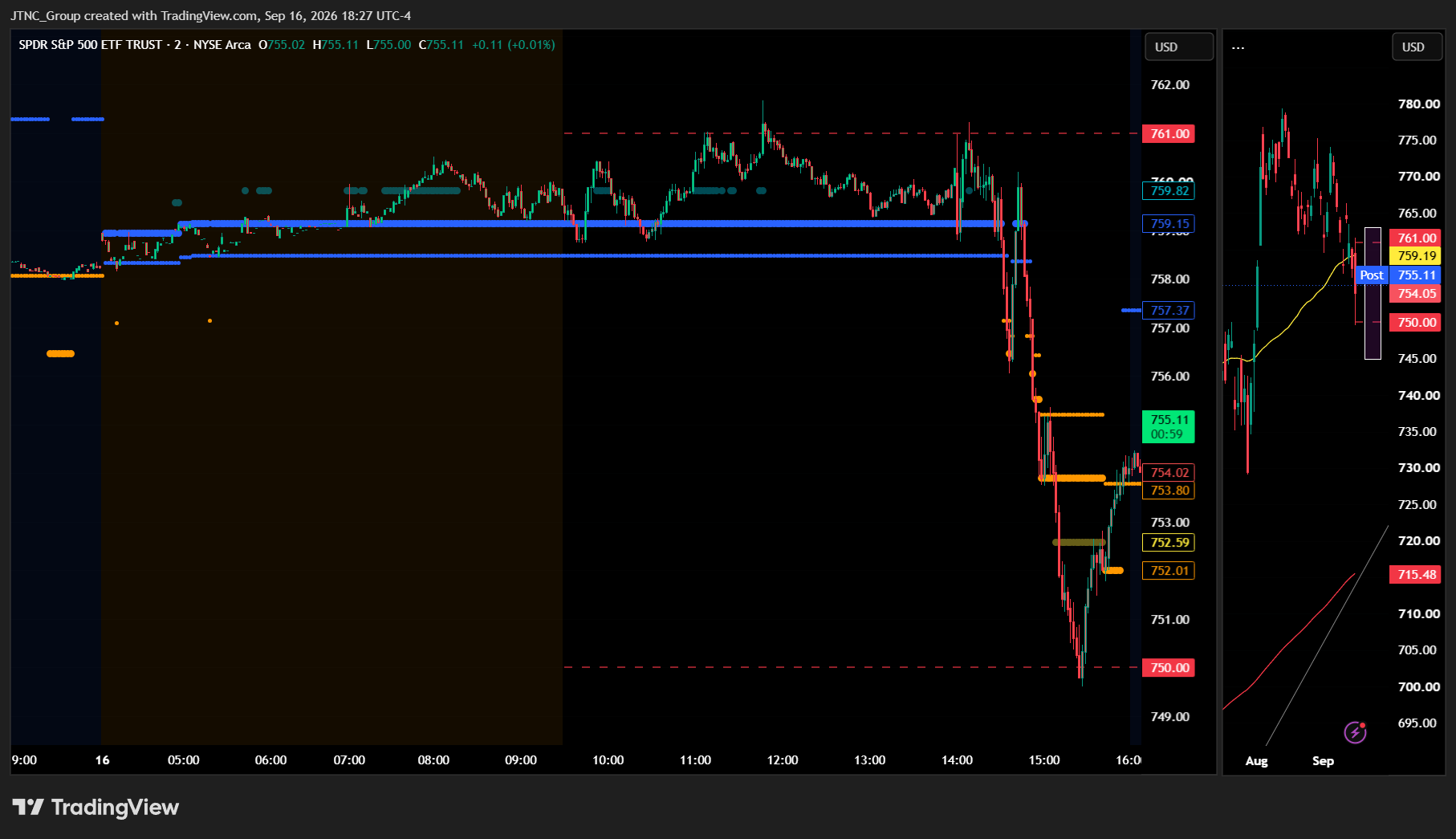
Current Market State Overview:
The MSI ended in a Ranging Market State with SPY closing at $754.13. Since SPY closed above MSI resistance at $753.80, that former resistance now becomes support heading into Thursday. Extended targets were not printing at the close. Extended targets were active during premarket printing above as the MSI rescaled to a narrow bullish state pushing SPY to major resistance at $762, and then below during the PM session as the FOMC-driven selloff accelerated with rapid rescalings lower taking price to $750 major support. The MSI rescaled higher overnight to a very narrow bullish state with extended targets which pushed SPY to major resistance at $762. By the open there was little to do but seek longs off MSI resistance turned support as long as there were extended targets printing. Those ceased printing around noon and the market basically moved sideways until 2 PM and the FOMC interest rate announcement. While the market initially moved higher after the 0.25% rate hike was announced, SPY turned decisively bearish when the Fed Chair started speaking and the MSI put in a series of rapid rescalings lower which saw price fall quickly to $750 major support. Extended targets printed below and SPY just kept falling until they stopped in the last 30 minutes of the session. SPY was able to recover slightly to close down just 0.44% but it felt much worse in real time. At the close the MSI was in a wide $1.79 Ranging state which implies a likely test of both sides of the range. We expect SPY to rally back toward $758 where we expect selling to kick in once again. Watch the MSI for a rescale tomorrow as SPY moves out of this range to time your entries more precisely. MSI support is $752.01 with resistance at $753.80.
Key Levels and Market Movements:
Monday we stated the MSI was forecasting sideways consolidation with a test of the highs and lows and Wednesday delivered far more than that — a wild FOMC session that tested both extremes in dramatic fashion. The morning offered the first setup as SPY opened at $759.50 and pushed to a session high of $761.65 with the MSI in a bullish state and extended targets above — a clean long entry riding the pre-announcement momentum. The second setup came when extended targets stopped printing around noon, signaling the rally was exhausting ahead of the 2 PM announcement. The real fireworks came post-FOMC as the third and fourth trades of the day materialized in rapid succession — SPY initially popped on the rate hike announcement then reversed hard as Chair Warsh's hawkish tone triggered a cascade of selling. The MSI put in rapid rescalings lower with extended targets below, confirming the short setup as price plummeted from $761 to a session low of $749.60 — an eleven-point move in under two hours. Once extended targets stopped printing below in the last 30 minutes, a fourth trade emerged as SPY bounced off $750 major support and recovered to close at $754.13. The VIX surged 4.69% to 17.68. At minimum it was a four-for-four session for traders following the framework. It was a volatile but readable day with substantial setups, all identified through proper context, patience, and flexibility while leveraging the MSI, premarket levels, and market structure rather than forcing trades. The MSI continues to prove its reliability as the cornerstone of our trading process.
Trading Strategy Based on MSI:
Thursday brings Initial Jobless Claims and Philly Fed Manufacturing data which can add to post-FOMC volatility. The wide $1.79 Ranging state at the close implies a likely test of both sides of the range. We expect SPY to rally back toward $758 where we expect selling to kick in once again. Watch the MSI for a rescale as SPY moves out of this range to time entries more precisely.
Bulls want to see overnight price hold above $752.01 MSI support and push toward $753.80 resistance turned support and beyond. If the MSI rescales into a Bullish Trending state with extended targets above, the FOMC selloff may prove to be a buying opportunity and price could push back toward $758-$760. Bears want to see $752.01 support fail and the MSI rescale into a Bearish Trending state. If extended targets print below, yesterday's $749.60 low comes back into play and a break below $750 opens the door to $744. With SPY well below the 50 DMA, rallies will likely be sold without a strong break above $762. Failed breakouts and failed breakdowns are the highest-probability setups.
The long-term bull trend remains intact above $640 and failed breakouts and failed breakdowns continue to offer the highest-probability setups. Remain flexible, avoid trading during Ranging Market States unless a clear failed breakout or breakdown presents itself, and ensure all trades are fully aligned with MSI signals. Providing real-time insights into market control, momentum shifts, and actionable levels, the MSI when integrated with our Pre-Market and Post-Market Reports continues to sharpen execution precision and elevate trade quality. If you haven't yet integrated MSI and our model levels into your process, now is the time. Contact your representative to get started as these tools are designed to support consistency and enhance performance.
Dealer Positioning Analysis
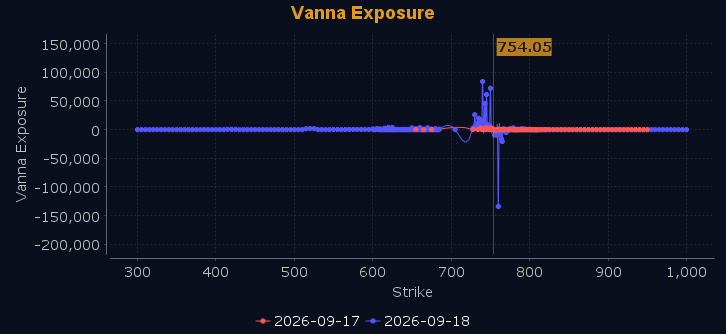
Dealers are selling SPY $758 to $783 and higher strike Calls while buying $755 to $757 Calls, indicating the Dealers' desire to participate in any relief rally on Thursday. The ceiling for Thursday appears to be $760. To the downside, Dealers are buying $754 to $675 and lower strike Puts in a 4:1 ratio to the Calls they're selling, displaying heightened concern that prices could move lower. Dealers are buying very small quantities of ATM Calls looking to participate in any relief rally Thursday. With SPY well below the 50 DMA, rallies will likely be sold without a strong break above $762. Below $757 is bearish and above $758 is bullish with everything in between being choppy and trap filled. Should SPY fail to hold $750, $744 is in play. Above $758 there is a heavy wall of resistance at $760 that will keep prices from moving much higher without an external catalyst. Dealer positioning is unchanged at bearish.
Looking Ahead to Next Friday:
Dealers are selling SPY $761 to $780 and higher strike Calls for the week ahead while buying $755 to $760 Calls. The ceiling for the week appears to be $779. To the downside, Dealers are buying $754 to $645 and lower strike Puts in a 5:1 ratio to the Calls they're selling, displaying significant concern that prices could move lower. Dealers are buying large quantities of $760 Calls hoping price breaks above this level and resumes the bull trend. But with such a large position this Call wall will be very hard to overcome and as such we expect prices to stall at that level. Their positioning is clearly bearish although Dealers have not added further to their hedges. Below $755 is bearish and above $760 is bullish with the range in between being choppy and trap filled. There is major support at $750 with major resistance at $760. For the week Dealer positioning is unchanged at bearish. We advise reviewing Dealer positioning daily for directional clues. These positions evolve quickly and tracking them is essential for staying ahead of shifting market sentiment.
Recommendation for Traders
With SPY closing at $754.13 and the 10-year yield above 5%, the bias stays bearish. Favor shorts on bounces toward $759–$761, with stops above $761.65. A failure to reclaim $756 keeps downside pressure intact. VIX rising 2.79% to 17.68 confirms the market is not comfortable here — stay defensive.
Keep size disciplined and avoid overstaying trades in either direction. Review the premarket analysis posted before 9 AM ET for any changes in the model's outlook and Dealer Positioning.
Good luck and good trading!
