
Market Insights: Tuesday, September 15th, 2026
Market Overview
US stocks fell for a second straight session Tuesday as investors kept one eye on the Fed's Wednesday rate decision and the other on the ongoing AI safety debate sparked by Anthropic's Dario Amodei. The Nasdaq dropped 0.8%, the Dow slid 0.7%, and the S&P 500 fell more than 0.4%, with elevated oil prices and rising bond yields doing the market no favors. Brent crude climbed to $108 a barrel and WTI hit $105, staying hot after Saudi Arabia's East-West pipeline shutdown and fresh Houthi attacks in the Middle East kept supply fears alive. The 10-year Treasury yield hovered around 5%, just off its highest intraday level since 2007, keeping borrowing cost concerns front and center.
Not everyone is panicking about AI spending, though. BofA analyst Vivek Arya pushed back on the slowdown narrative, raising his 2030 chip market estimate from $2.7 trillion to $3.2 trillion — an 18% annual growth rate — citing overwhelming demand for data center capacity, advanced logic, and memory. Meanwhile, Bitcoin dropped 4% to just above $75,000 after the CLARITY Act failed to clear its Senate cloture vote, with Polymarket odds of it becoming law this year collapsing to just 5%. On the policy front, Treasury Secretary Scott Bessent told the House Financial Services Committee he's been developing a plan to deliver a $5,000 dividend to Americans without adding to the deficit — though he offered zero specifics — while traders priced in a 93% chance the Fed hikes 25 basis points Wednesday, a move one CIO warned would hit the bottom half of America's K-shaped economy hardest.
SPY Performance
SPY opened at $760.12 and struggled to gain any traction right out of the gate, with the high of $760.34 coming almost immediately before the bid simply evaporated. That razor-thin range between the open and the high told the story early — there was no real attempt by bulls to push higher, and once that ceiling was established, the tape drifted steadily lower throughout the session. The low of $756.15 was tagged as sellers maintained quiet but persistent control, and the close at $757.44 showed only a minor recovery off the lows, landing in the bottom third of the day's range. That's not the kind of close that gives the bull case any momentum heading into tomorrow.
SPY finished down 0.45%, extending what is now a two-day losing streak following last week's bounce attempt. Volume came in at 38.03 million shares, again below average, which means the selling pressure wasn't panic-driven — but as with yesterday, the absence of aggressive selling doesn't tell a bullish story either. Buyers simply aren't materializing with enough conviction to absorb even modest distribution. The VIX climbed another 2.22% to close at 17.48, continuing to creep higher and signaling that anxiety is quietly building back into the market. Two consecutive down closes, two consecutive VIX increases — the rally attempt that looked promising just days ago is losing credibility fast, and the bulls are going to need to show up with something real before this tape gives anyone a reason to get excited.
Major Indices Performance
The Nasdaq, Dow, and Russell 2000 all finished in the red today, with the rankings flipped from what we saw recently — this time small-caps were the laggard rather than showing any relative strength. The Russell 2000 dropped 0.85%, making it the worst performer of the session as rate-sensitive small-cap names struggled under the weight of the current yield environment. Smaller companies tend to carry more floating-rate debt and depend heavily on credit markets to grow, so when the cost of capital stays elevated, these names feel the squeeze more acutely than their large-cap counterparts.
The Nasdaq fell 0.78%, not far behind the Russell, as growth and tech names continued to face headwinds. The index couldn't find footing even with a couple of the Magnificent Seven holding up, which tells you the broader tech universe beyond the mega-caps was under real pressure. High-multiple stocks remain a tough sell in this environment, and when sentiment turns cautious, growth names are typically the first to get trimmed.
The Dow slipped 0.63%, making it the relative outperformer of a bad bunch, which echoes the defensive rotation we've been seeing — investors gravitating toward more established, dividend-paying blue chips when the tape gets ugly. The S&P 500 also closed lower on the session, reinforcing the broadly negative tone. The VIX rose 2.22% to close at 17.48, a more moderate uptick than yesterday's spike but still a signal that hedging demand remains elevated and the market's anxiety level hasn't cooled off.
Notable Stock Movements
Amazon took center stage as the biggest drag inside the Magnificent Seven today, sliding -2.02% to lead the group lower. That's a meaningful pullback from one of the most influential names in the complex, and when Amazon is stumbling, it puts real pressure on the broader mega-cap narrative. A drop of that size from a name that touches everything from e-commerce to cloud infrastructure is hard to shrug off — it signals that even the most diversified growth stories aren't immune to the selling pressure hanging over this market.
The overall Magnificent Seven picture was mostly red, which aligns with the cautious tone playing out across the broader market. The two exceptions were Meta and NVIDIA, which managed to finish green and at least prevented a complete washout from the group. NVIDIA holding in positive territory is worth noting given how much attention the AI-infrastructure trade commands, but two green names out of seven isn't exactly a confidence builder. When the majority of the group is under pressure, the handful of winners can soften the blow but can't really change the story.
The split inside the group reflects exactly the kind of uncertainty that's been building across the tape. Mostly red from mega-cap tech on a day when every major index finished lower paints a consistent picture — this wasn't a case where growth stocks bucked the trend. Instead, the Magnificent Seven moved in sync with the broader selloff, offering no real safe harbor for investors looking to the biggest names for leadership. The group, taken as a whole today, reinforced rather than challenged the cautious sentiment driving the market.
Commodity and Cryptocurrency Updates
Crude oil refuses to slow down, tacking on another 4.36% today to close at $105.81, and at this point black gold has moved so far above any model expectation that the conversation has fully shifted to what's driving it rather than when it cools. Supply tightness and geopolitical pressure remain the dominant forces keeping this market elevated, and the longer crude holds above $70, the harder it becomes for policymakers to talk about easing with a straight face. Energy at these levels seeps into nearly every corner of the inflation picture, and that's a complication the Fed simply cannot ignore.
Gold slipped a modest 0.38% today to close at $4,335, which is actually a relatively calm session compared to yesterday's sharper pullback. The structural story hasn't changed — central bank demand and macro uncertainty still provide a solid floor — but the metal is struggling to find momentum either direction right now. It needs buyers to step up with conviction before the next leg higher becomes a real conversation.
Bitcoin gave back 2.79% today, closing just below $75,979, and the back-to-back green days from earlier in the week feel like a distant memory. This kind of reversal is exactly why the burden of proof remains firmly on the bulls — one or two encouraging sessions don't erase the broader pattern of pressure, and today's move reinforces that patience continues to outweigh aggression here. Until Bitcoin strings together sustained higher closes with real volume, any rally attempt should be treated as something to watch rather than something to chase.
Treasury Yield Information
The 10-year Treasury yield pushed higher today, climbing 0.71% to close right at 5.000%. That's not a near-miss or a close call — that's a direct hit on the threshold the framework identifies as signaling significant and broad equity risk. After yesterday's brief four-basis-point reprieve, yields wasted no time erasing that relief and landing exactly where the damage gets real.
Every level in the framework is now working against equity bulls simultaneously. Above 4.5% compresses multiples and punishes growth names through relentless discount rate pressure — that's been true for a while. The 4.8% crossover already confirmed that the tone had shifted from uncomfortable to genuinely dangerous. And now, with the 10-year sitting at exactly 5%, the framework's most serious warning is no longer a forward-looking concern — it's the current condition. Stocks aren't approaching significant risk. They're in it.
What makes today's close especially important is that 5% isn't just a psychological round number — it's a structural line that historically coincides with real multiple compression, tighter financial conditions, and increasing stress in rate-sensitive corners of the market. The selling across major indices today reflects that reality directly. With yields holding here, every equity rally faces an enormous headwind that fundamentals alone can't overcome.
The next level to watch is 5.2%, where the framework calls for a correction of 20% or greater. That's only 20 basis points away, and given that today's move erased yesterday's entire decline in a single session, that gap can close faster than most expect. For the equity market to stabilize, yields need to retreat convincingly back below 4.8% — not just dip for a day. Until that happens, 5% is the ceiling on confidence and the floor on risk.
Previous Day’s Forecast Analysis
Yesterday's forecast set up Tuesday's session with a projected trading range of $751 on the downside and $768 as the max upside target, a seventeen-point window that the model classified as trending territory — meaning the expectation was for a directional move, not a sideways chop fest. With Monday's close at $760.81 sitting in the lower half of that range, the bias heading into Tuesday was bearish, and the VIX surging 6.63% to 16.89 was flagged as a key warning sign that sellers remained engaged and volatility was moving in the wrong direction for bulls.
The critical level identified for Tuesday was $760, described as the gate that held all last week and the line bulls needed to defend convincingly on the open. A push through $762 was required to build any real momentum, with $764 as the next decision point and $766 as the level that would fully flip the tone bullish. The $768 level sat as max upside. On the downside, $759 was the first defense line, $757 was flagged as the most important level below where a clean break could accelerate selling quickly, and $755 was the final line of hope before $751 opened up as max downside.
The trading strategy called for position sizing in the 50-60% range with stop-losses in the 0.75-1% band, reflecting a cautious stance given the vol expansion. On the long side, the preferred entry was a controlled pullback and hold around $760-$761 in the first hour, targeting $765-$766 with a stretch to $769-$770, and stops below $758. On the short side, a rejection at $762-$763 was the trigger, targeting $757-$758 with $754-$755 as an extended target if volume accelerated, and stops above $765.
Market Performance vs. Forecast
Tuesday's session validated the forecast's directional bias from the opening bell. SPY opened at $760.12, essentially right on top of the critical $760 level the model flagged as the defining gate for the entire day — and what followed confirmed everything the framework warned about when that level fails to generate conviction. Price spent virtually no time above the open, with the high of $760.34 barely registering before sellers took control and drove the tape lower throughout the session. The close at $757.44 landed squarely within the downside scenario the forecast mapped out, with $757 explicitly identified as a critical level and $755 as the final line of hope — price found its footing right in that corridor, exactly where the model said buyers would need to show up.
The falling market scenario outlined in Tuesday's strategy proved to be the playbook the session followed. The forecast identified a flat open that fades without a credible buyer response near $761 as a measured short entry, and that is precisely how the tape behaved — $760.34 as the high tells you buyers had no answer at the open, and the subsequent slide to $756.15 at the low hit the primary downside target zone with precision. The $757-$758 profit target identified for short positions was reached and delivered. Position sizing at 50-60% with stops in the 0.75-1% band kept risk controlled, and risk management protocols protected capital for any long-side participants who were stopped out below $758 as the model prescribed. The VIX continuing its climb to 17.48, a gain of 2.22% on the session, confirmed the vol expansion narrative the framework had been tracking — the forecast explicitly flagged 17.50-18 as the zone where exposure reduction was warranted, and Tuesday's close at 17.48 puts that threshold right at the doorstep heading into Wednesday. The model's emphasis on vol direction over absolute readings proved its value again, as the sustained upward pressure in fear metrics kept sellers engaged all session long. The framework read this environment correctly, and that discipline continues to be the edge.
Premarket Analysis Summary
The premarket analysis posted at market open set SPY's projected range for the session between $753 as max downside and $766 as max upside, with spot entering at $759.66 in a put-dominated tape pinned for a second straight day right on the critical $760 line. The expected move had tightened to just six points, signaling that the range should stay contained unless one side forced a decisive break. The defining gate level remained $760, now carrying even more weight after two consecutive sessions of coiling on it — a clean reclaim and hold was the only thing that would flip the tone toward buyers, while failure to hold left the downside stack fully exposed. Above $760, $762 was the first target, $763 the point where the tape would begin to repair, $764 the heaviest concentration overhead and the level bulls truly needed, and $766 the max upside cap. On the downside, $759 was the first warning level sitting just beneath spot, $758 was identified as the most important level below and the site of the heaviest battle — a clean break there could get ugly fast — $755 was the point of last hope, and $753 was the max downside at the bottom of the expected move. The analysis noted that two days of coiling on a level this heavy tends to resolve sharply in one direction.
The market resolved that coil to the downside, delivering exactly the kind of sharp drop the premarket warned was possible if sellers forced the issue. SPY opened at $760.12, barely clearing the gate, but the reclaim had no conviction — price stalled at a high of just $760.34 before rolling over and losing $759 cleanly, triggering the acceleration the premarket flagged. The tape fell through $758 without meaningful support and pushed to a low of $756.15, slicing through the $755 point-of-last-hope level and confirming a genuine breakdown. Price managed a partial recovery into the close at $757.44, but the session finished well below every key level the analysis had identified as necessary for bulls to maintain control. The VIX rose 2.22% to 17.48, reinforcing that the defensive tone the premarket had flagged in the put-dominated tape was fully justified.
Validation of the Analysis
Today's session validated the premarket framework with surgical precision, and traders who followed the structure had a clear roadmap from the opening bell to the close. SPY opened at $760.12, essentially kissing the defining 760 level the analysis flagged as the most critical gate in the market — the premarket was explicit that a clean reclaim and hold of 760 was the only thing that flipped the tone bullish, and the tape answered that question immediately. The open failed to hold above it, which was exactly the warning the analysis provided: two days coiled on a heavy level tends to resolve sharply, and the downside resolution came fast.
From there, price slid directly into the framework's downside targets in sequence. The premarket identified 759 as the first level beneath spot and warned that losing it cleanly opens the door for acceleration — that acceleration came, and SPY moved straight toward 758, described as the most important level below and where the heaviest battle sits. The low of $756.15 actually punched through 758 cleanly, which the analysis explicitly warned could get ugly fast, and it did. That break triggered the next target of 755, flagged as the point of last hope where major support comes in. Price found its footing in that zone, bouncing off the breakdown and settling at $757.44 into the close — right in the contested territory between 755 and 758 that the premarket outlined as the critical battleground. The VIX rising 2.22% to 17.48 confirmed the defensive, put-dominated character the analysis described. From the failed 760 reclaim to the 759 break and the waterfall into the 755 to 758 zone, the framework delivered precise, actionable structure at every level that mattered.
Looking Ahead
With the economic calendar showing no high-impact releases confirmed for Wednesday, traders head into the midweek session in a similar position to where they started this week — no major macro catalyst to anchor direction, no Fed speakers locked in, and no data prints demanding a repositioning of expectations. That kind of setup keeps the focus squarely on price action and whether the market can build on or push back against whatever momentum Tuesday establishes heading into the close.
Without a scheduled catalyst to force the hand of either buyers or sellers, Wednesday becomes a session about confirmation. How key levels hold under pressure, whether sector leadership rotates or stays consistent, and how volume behaves relative to recent sessions will do more to reveal the market's true intentions than any single headline could. The absence of hard data also keeps traders on alert for anything off-script — an unplanned Fed comment, a geopolitical development, or a surprise corporate disclosure could punch well above its weight in a quiet tape. Staying patient, sizing risk appropriately, and letting the market show its hand before committing to a direction remains the disciplined approach heading into Wednesday's session.
Market Sentiment and Key Levels
The directional bias today leans bearish, with sellers in control across every major index and the VIX rising 2.22% to 17.48 — a continued buildup in hedging demand that suggests traders aren't ready to step in and buy this dip with confidence. Unlike a sharp fear spike, this kind of steady VIX creep is actually more telling — it reflects a market slowly pricing in more downside risk rather than reacting emotionally to a single catalyst. The below-average volume of 38.03M softens the conviction behind today's move, but that doesn't mean the bears are losing ground. Low-volume declines that close near the lows of the session leave the chart in a vulnerable spot heading into the next session.
Key resistance sits at $760.34, today's session high, which SPY tagged almost immediately at the open and then walked away from for the rest of the day. Reclaiming that level on expanding volume would be an encouraging sign for bulls and could open the door back toward the $763 area. On the downside, $756.15 is the line in the sand — today's session low. A decisive break below that level would be technically damaging and could accelerate selling toward the $753 to $755 zone, where buyers would need to show up in size to prevent further deterioration. The 10-year yield closing right at 5.000 is an uncomfortable reality for equity bulls, and that psychological ceiling on rates continues to weigh on risk appetite broadly. Gold's modest slip and Bitcoin's nearly 2.79% decline both remove potential safe-haven and risk-on offsets that the market could have leaned on. Until SPY reclaims resistance on meaningful volume, the path of least resistance remains with the sellers.
Expected Price Action
Wednesday's session brings actionable intelligence generated by our AI model, with SPY projected to trade within a range framed by $753 on the downside and $766 as the max upside target. That thirteen-point window puts this in trending territory, meaning traders should expect a directional move rather than a slow grind — this is not a setup for sideways chop, so positioning matters. Tuesday's close at $757.44 sits in the lower half of the projected range, which keeps the near-term bias bearish heading into Wednesday's open. The VIX ticking up another 2.22% to 17.48 confirms that fear is still expanding, and that kind of persistent volatility buildup tends to keep sellers leaning on any rip toward resistance.
The defining level on Wednesday remains $760, which the premarket analysis flags as the critical gate for a second consecutive session — a clean reclaim and hold there is the only thing that flips the tone for bulls. If price pushes above $760, $762 is the first real target, then $763 is where the tape begins to repair meaningfully. Beyond that, $764 is where the heaviest overhead concentration sits and the level bulls truly need to capture — hold there and last week's damage starts fading in the rearview. $766 sits as max upside at the top of the expected move. On the downside, $759 is the first line to watch and losing it cleanly opens the door for acceleration. Below there, $758 is the most critical battle zone — a clean break of $758 could get ugly fast, with $755 serving as the last major support before $753 opens as max downside. Two days coiled under a level this important tends to resolve sharply in one direction, so watch the first hour closely — reclaim $760 and $762 comes quickly, but lose $759 and expect very little cushion on the way down.
Trading Strategy
The VIX rising 2.22% to 17.48 is a quiet but persistent warning signal that the risk environment continues to deteriorate beneath the surface. It is not a panic reading by any stretch, but 17.48 is now pressing toward the threshold where volatility begins to actively suppress risk appetite and force position unwinds from momentum-oriented accounts. What makes this reading more meaningful is the context — below-average participation combined with continued broad-based selling across every major index tells you this is not just noise. When vol grinds higher on low-volume sessions rather than spiking on a catalyst, it often reflects a slow, deliberate repricing of risk rather than a reactionary flush that resolves quickly. Any push above 18.50-19 would be a clear signal to step back from aggressive long exposure, tighten stops materially, and reduce overall position sizing. For now, keep sizing in the 50-60% range and maintain stop-losses in the 0.75-1% band from entry until the tape demonstrates a credible ability to attract buyers at key support levels.
In a rising market scenario, the bulls need to reclaim and hold $760 with conviction before this tape is worth pressing on the long side. The preferred long entry is a disciplined pullback and stabilization in the $757-$759 zone, where price consolidates Thursday's close and buyers begin to absorb the recent selling pressure. If that level holds and volume improves off the lows in a meaningful way, the initial profit target is $763-$764, with a secondary target of $767-$768 if broader participation returns and sellers fail to show up on the retest of the prior session open. Stops on longs belong below $755 to protect against a failed reclaim that opens the door to deeper downside. Do not chase a gap-up open above $762 on light participation — let price confirm the level before adding size.
In a falling market scenario, $760-$761 flips to overhead resistance, and a clean rejection at that zone on the first bounce attempt is your short trigger. That setup targets $754-$755 as the primary profit zone, with $751-$752 in play if selling accelerates and buyers continue to step aside. Stops on shorts belong above $763 to guard against a sharp reversal through the prior session's highs. If the market opens flat and immediately fades without any credible buyer response near $758, that is a controlled short entry at reduced size. With the VIX at 17.48 and continuing to trend in the wrong direction for bulls, the risk of a fast disorderly leg lower remains elevated — cover into support levels methodically and do not overstay winning short positions in a vol environment that can reverse violently on any unexpected positive catalyst.
Model’s Projected Range
SPY's projected maximum range for Wednesday is $749 to $767, with the Put side dominating in an expanding band that suggests trending price action with intermittent chop. Wednesday brings no economic news due out so the market will trade on technicals. SPY closed at $757.44, down 0.45%, after opening at $760.12 and trading in a tight range between a high of $760.34 and a low of $756.15, reflecting a relatively controlled session with selling pressure throughout the day on lower than average volume. SPY is trading near our model's first support at $755, with ongoing trade policy uncertainty continuing to weigh on sentiment and keeping buyers cautious near current levels. If price can reclaim and hold above resistance at $760, it opens the door toward $764 next, while a break below $755 puts $750 in play quickly and if that gives way there is little to keep price from falling toward $745. The long-term bull trend remains intact above $640 with SPY well above structural support. As long as price holds above key structural levels, this remains a broader dip-buying environment. Absent a catalyst, resistance sits at $760, $764, $765, $766, while support rests at $755, $750, $749, $745. We favor shorting rallies near $760 given SPY closed below that level and the Put-heavy model setup heading into a technically-driven session. Bitcoin dropped 2.79% to close below $75,979 while MAG stocks were mostly red led by Amazon falling 2.02%, with Meta being the lone bright spot gaining 0.70% — sustained weakness across both leadership groups would be required to signal a deeper pullback. The VIX closed at 17.48, up 2.22%, suggesting elevated fear given the softening price action and lack of buyers stepping in near the highs. SPY closed just above the lower line of the trend channel with structural support near $755, and holding that level into Wednesday will be critical for bulls looking to stabilize the tape.
Market State Indicator (MSI) Forecast
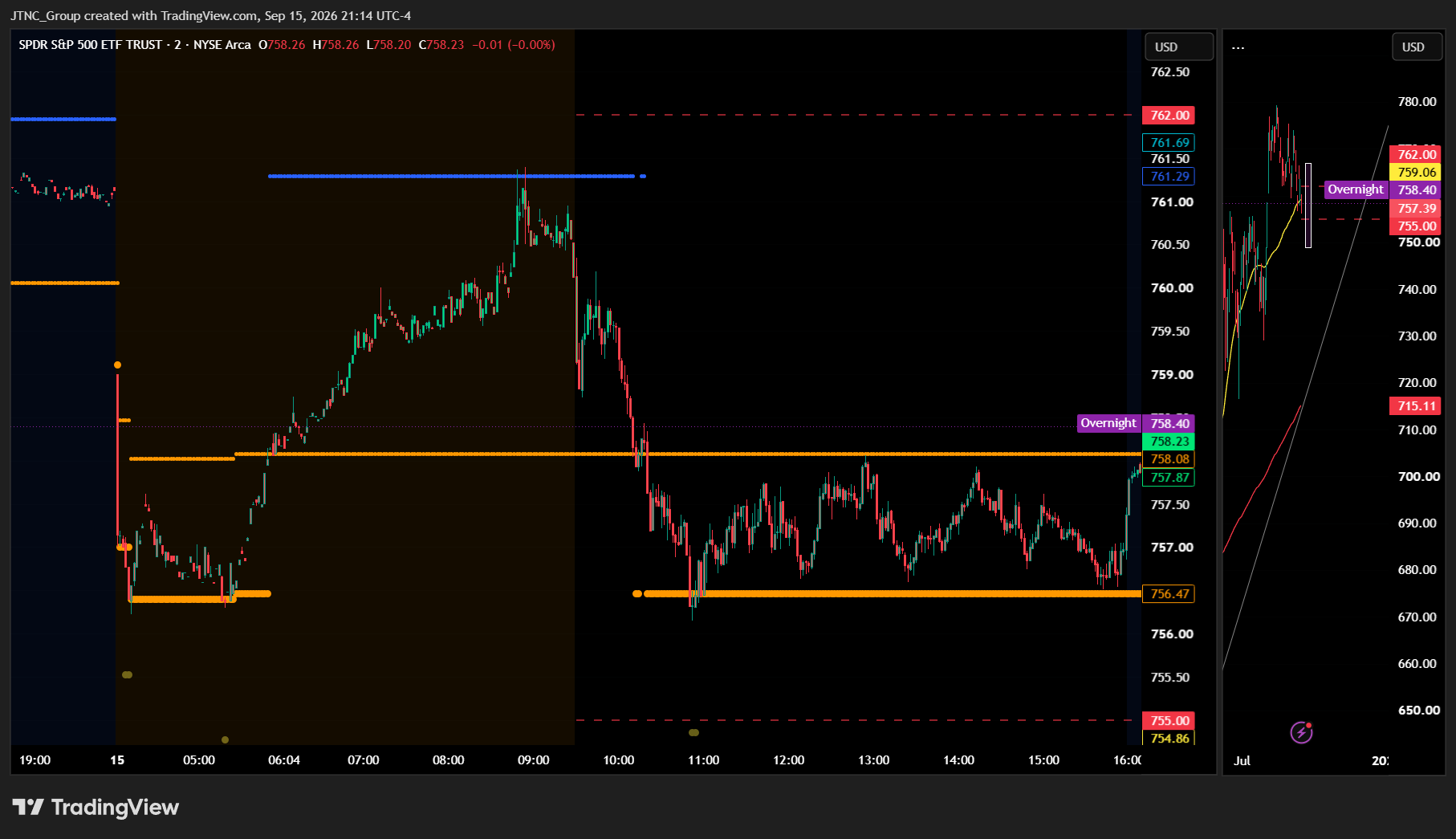
Current Market State Overview:
The MSI ended in a Bearish Trending Market State with SPY closing at $757.44. Since SPY closed inside the MSI range, support remains at $756.47 and resistance remains at $758.08 heading into Wednesday. Extended targets were not printing at the close. Extended targets were active during the premarket session printing above near the 761-762 area, reflecting early bullish pressure that ultimately failed to hold. The MSI rescaled lower overnight from a ranging state into a bearish state, then moved back to a ranging state in the premarket before rescaling lower again into a bearish state during the AM session. Once that bearish rescaling took hold, SPY tested the overnight lows quickly and then spent the remainder of the session grinding between MSI support and resistance without resolution. A late surge in the final minutes brought SPY right up to MSI resistance, leaving that level looking vulnerable. The MSI width is moderate at $1.61, suggesting some room for movement but not enough to indicate a decisive trending environment. Without extended targets printing at the close and with the MSI in a relatively narrow bearish state, the MSI is forecasting a slow grind lower on Wednesday, though without extended targets below the downside may be limited and is likely to find support at key levels. MSI support is $756.47 with resistance at $758.08.
Key Levels and Market Movements:
Monday we stated, "Bears want to see $760.06 support fail and the MSI rescale into a Bearish Trending state," and added, "expect a test of today's lows at $758 and a possible retest of the highs at $762 absent any external catalyst," while also noting, "failed breakouts and failed breakdowns at either MSI boundary are the highest-probability setups." Tuesday delivered on the bearish case almost to the letter. SPY opened at $760.12 with extended targets printing above near the 761-762 area during the premarket, suggesting early bullish momentum that never materialized into a sustained move. By the open, the MSI appeared to be holding near those higher levels, but the rally quickly stalled. Around mid-morning, the MSI rescaled lower into a Bearish Trending state with SPY dropping sharply to a session low of $756.15 — that drop from the open to the lows was the first clean trade of the day, offering sellers a well-defined entry near MSI resistance targeting MSI support below. After hitting the lows, SPY spent the bulk of the session churning between $756.47 support and $758.08 resistance with the MSI holding its bearish state throughout. That range-bound behavior within the bearish channel provided a second trade as price bounced from support back toward resistance late in the session. A final surge into the close brought SPY to $757.44, right up against MSI resistance. The VIX rose 2.22% to 17.48, a continued elevation in fear consistent with cautious positioning ahead of the FOMC rate decision. At minimum it was a 2-for-2 session for traders following the framework. It was an easy day to read albeit not an easy day to trade given the tight choppy range. But substantial setups were present, all identified through proper context, patience, and flexibility while leveraging the MSI, premarket levels, and market structure rather than forcing trades. The MSI continues to prove its reliability as the cornerstone of our trading process.
Trading Strategy Based on MSI:
Wednesday has light economic news so the market is likely to grind lower given the Bearish Trending state at the close, though the move may be modest given the absence of extended targets below and the moderate $1.61 MSI spread. The FOMC interest rate decision looms as the dominant macro backdrop, and until that announcement hits, price action is likely to remain constrained with SPY coiling somewhere between $755 and $762. The narrow bearish state suggests less conviction and Wednesday is equally capable of producing a relief rally or an overnight rescale back into a ranging state before any real resolution occurs. Use softer language in your own planning here — the MSI may continue lower but the path is far from guaranteed without extended targets confirming the move.
Bulls want to see overnight price hold above $756.47 MSI support and press toward $758.08 resistance. If the MSI rescales into a Ranging or Bullish Trending state with extended targets printing above, the late session surge gains credibility and price could push toward $760 and potentially the $762 area where major resistance sits. Bears want to see $756.47 support fail overnight and the MSI hold its Bearish Trending state. If extended targets begin printing below, price could press toward $755 and potentially lower levels. Given the narrow spread and the absence of extended targets at the close, failed breakouts at MSI resistance near $758.08 remain the highest-probability setups while any failed breakdown at $756.47 support should be respected as a potential long entry targeting resistance above.
The long-term bull trend remains intact above $640 and failed breakouts and failed breakdowns continue to offer the highest-probability setups. Remain flexible, avoid trading during Ranging Market States unless a clear failed breakout or breakdown presents itself, and ensure all trades are fully aligned with MSI signals. Providing real-time insights into market control, momentum shifts, and actionable levels, the MSI when integrated with our Pre-Market and Post-Market Reports continues to sharpen execution precision and elevate trade quality. If you haven't yet integrated MSI and our model levels into your process, now is the time. Contact your representative to get started as these tools are designed to support consistency and enhance performance.
Dealer Positioning Analysis
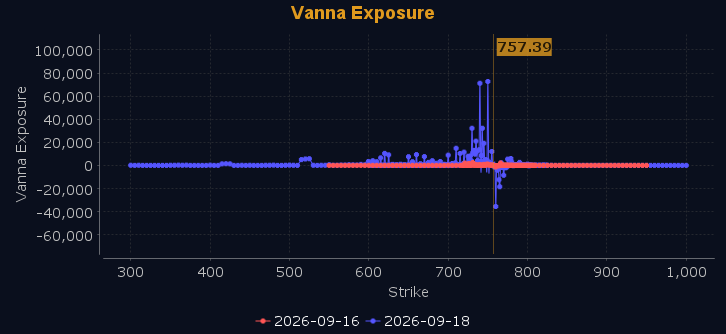
Dealers are selling SPY $765 to $783 and higher strike Calls while buying $758 to $764 Calls, indicating the Dealers' desire to participate in any rally on Wednesday. The ceiling for Wednesday appears to be $766. To the downside, Dealers are buying $757 to $698 and lower strike Puts in a 4:1 ratio to the Calls they're selling, displaying heightened concern that prices could move lower. Dealers are not selling ATM Puts, signaling limited conviction on direction for Wednesday. Dealers are however buying ATM Calls, looking to participate in any rally off the 50 DMA, though that conviction is tempered by their refusal to sell ATM Puts. Below $760 is bearish and above $765 is bullish, with everything in between choppy and trap filled. Should SPY fail to hold $760, $757 and $755 should keep prices from falling further, while above $760 it's likely to be a slog to get much higher than $766 without an external catalyst. Dealer positioning is unchanged at bearish.
Looking Ahead to Next Friday:
Dealers are selling SPY $767 to $795 and higher strike Calls while buying $758 to $766 Calls, indicating the Dealers' desire to participate in any rally that materializes this week. The ceiling for the week appears to be $779. To the downside, Dealers are buying $757 to $645 and lower strike Puts in a 5:1 ratio to the Calls they're selling, displaying significant concern that prices could move meaningfully lower. Dealers added to their hedges and the concern about much lower prices is clear in their positioning. Dealers are not selling ATM Puts despite buying ATM Calls, reinforcing a cautious posture heading into the week. Below $760 is bearish and above $767 is bullish, with the range in between choppy and trap filled. There is major support at $752 with major resistance above $767, and the sheer size of dealer hedges suggests they are positioned for any scenario that may develop. For the week Dealer positioning is unchanged at bearish. We advise reviewing Dealer positioning daily for directional clues. These positions evolve quickly and tracking them is essential for staying ahead of shifting market sentiment.
Recommendation for Traders
With SPY closing at $757.44 and the 10-year yield sitting right at 5.000%, the bias is firmly bearish. Favor shorts on any bounce toward $760, with stops above $760.34. A break below $756.15 opens further downside. Keep size lean given below-average volume and a VIX now at 17.48.
Manage risk tightly — this is not the environment to overstay positions. Review the premarket analysis posted before 9 AM ET for any updates to the model's outlook and Dealer Positioning.
Good luck and good trading!
