
Market Insights: Monday, September 14th, 2026
Market Overview
US stocks fell Monday but recovered a chunk of their early losses as the session wore on, with the Dow sliding 0.3% and both the S&P 500 and Nasdaq-100 dropping around 0.5% — though the Nasdaq had been down as much as 1.5% before Big Tech stepped in to cushion the blow. The selling was triggered by a pair of bombshells from the AI world: Anthropic CEO Dario Amodei published a lengthy essay calling for an industrywide slowdown in AI development to address safety concerns, and OpenAI's Sam Altman publicly agreed — a stance that put both companies squarely at odds with Wall Street, which has been pricing in relentless AI progress. The fallout was broad. OpenAI said it's delaying its IPO until 2027, chip stocks got hit hard, and Schwab's Kevin Gordon warned that a real slowdown in AI capex could be a "relatively big risk" for both markets and the economy — potentially recessionary if the pullback is sharp, given how much of this year's growth has been driven by hyperscaler spending on data centers and infrastructure.
Adding to the pressure, oil prices kept climbing after Saudi Arabia shut down a key Middle East pipeline, pushing Brent crude near $106, while the 10-year Treasury yield briefly crossed 5% for the first time since 2023. Bank of America shares dropped more than 5% after CEO Brian Moynihan guided investment banking fees to $1.6–$1.8 billion for Q3, down roughly 10–20% from the $2 billion it earned in the same period last year. On the policy front, Fed rate hike odds jumped to 88% heading into Wednesday's FOMC meeting, while Washington's response to AI safety concerns looks likely to move at a crawl, with lawmakers distracted by midterms and President Trump signaling he prefers to keep regulators on the sidelines.
SPY Performance
SPY opened at $759 and spent the session in a modest but uneasy drift, never finding the kind of buying conviction that would have built on yesterday's encouraging rebound. The high of $763.52 was tagged early as bulls made an attempt to follow through, but that effort stalled out and the tape gradually leaked lower from there. The low of $757.93 came into play as sellers reasserted control, and while the close at $760.81 did recover off the worst levels, it landed in the lower half of the day's range — not the kind of finish that inspires confidence.
SPY finished down 0.46%, giving back a portion of yesterday's gains and signaling that the one-day bounce hasn't yet turned into anything with real staying power. Volume came in at 39.60 million shares, below average, meaning the selling wasn't especially aggressive — but light participation on a down day can cut both ways. It suggests there wasn't a rush for the exits, but it also means buyers weren't showing up in any meaningful force to defend the tape. The VIX rose 6.63% to close at 16.89, reversing a chunk of yesterday's sharp fear decline and suggesting the market hasn't fully shaken its unease. The bulls showed something yesterday, but today was a reminder that one solid session doesn't erase the underlying uncertainty — they'll need to string together more convincing price action before this rally attempt earns real credibility.
Major Indices Performance
The Russell 2000 and the Dow held up the best in a tough session, with small-caps slipping just 0.27% and blue chips dropping 0.29%. That's a notable shift from recent trading where large caps were leading — today, the smallest and most rate-sensitive names in the market actually showed relative resilience, though "resilience" is relative when everything is in the red. The Dow's modest decline suggests that defensive positioning within large caps helped cushion the blow, with investors leaning on more established names while growth-heavy areas of the market took the brunt of the selling pressure.
The Nasdaq was the clear laggard among the major indexes, falling 0.56% as growth and tech names came under pressure. While much of the Magnificent Seven held up, the index couldn't escape the drag from its weakest links, and high-multiple stocks remain vulnerable anytime sentiment turns cautious. The S&P 500 also finished lower on the session, reinforcing the broadly negative tone across the tape.
The VIX climbed 6.63% to close at 16.89, which is a meaningful spike in fear that tells you options traders were actively reaching for protection during the session. A move of that magnitude in the fear gauge in a single session signals that the market's comfort level is eroding, and when hedging demand picks up like this, it tends to create headwinds for any recovery attempt as buyers sit on their hands waiting for clarity.
Notable Stock Movements
Alphabet stepped into the spotlight as the biggest mover inside the Magnificent Seven today, surging up to 3.22% to lead the group higher. That's an impressive run from one of the heavier names in the complex, and when Alphabet is putting up numbers like that, it brings a real lift to the mega-cap story. Strong moves from the search-and-cloud giant tend to carry weight beyond just its own ticker — it signals that investors are still willing to reach for growth when the right catalyst shows up.
The overall Magnificent Seven picture was mostly green, which sounds encouraging on the surface, but the exceptions are hard to ignore. Amazon, Tesla, and NVIDIA all finished in the red, with NVIDIA leading the downside at -3.36%. That's a meaningful stumble from the chip giant, and on a day when the broader market was already under pressure, a drop of that size from NVIDIA is the kind of drag that keeps sentiment in check. When the group's most closely watched AI-infrastructure name is falling that hard, it puts a ceiling on how much optimism the green names can generate.
So while Alphabet's leadership was genuinely impressive, the split inside the group tells a more complicated story. Four green and three red — with the red names including some of the heaviest hitters — means this wasn't a clean, coordinated rally from mega-cap tech. It's more of a mixed bag that reflects the uncertainty sitting over the broader market. The VIX climbing 6.63% to 16.89 confirms that nervousness is creeping back in, and the Magnificent Seven, taken as a whole today, mirrors that tension rather than resolving it.
Commodity and Cryptocurrency Updates
Crude oil extended its run today, adding another 1.66% to close at $101.71, and black gold continues to defy any model expectation that would have had it cooling off. The combination of tight supply and persistent geopolitical pressure keeping this market bid shows no signs of letting up, and at these levels the inflationary implications are hard to ignore. Energy costs this elevated feed directly into the data policymakers watch most closely, and a sustained presence above $70 makes any serious conversation about easing feel increasingly disconnected from reality.
Gold had a rough session, giving back 1.87% to close at $4,326. After the bounce buyers brought in yesterday, today's pullback is a reminder that even structurally supported markets don't move in a straight line. The longer-term case built on central bank demand and macro uncertainty hasn't changed, but the metal will need to reclaim some footing before the uptrend can be considered fully back on track.
Bitcoin had a strong day, climbing 2.87% to close just below $79,046. Back-to-back green days are exactly what the bulls needed to see after the recent pressure, and today's move carries a bit more conviction than yesterday's. That said, the show-me phase isn't over — Bitcoin still needs a sustained string of higher closes with real volume behind them before aggression is rewarded over patience. Today is encouraging, but the burden of proof remains.
Treasury Yield Information
The 10-year Treasury yield gave back a small amount of ground today, slipping 0.28% to close at 4.960%. It's a modest pullback, and while any movement away from the 5% threshold is technically welcome, one day of minor relief doesn't change the broader picture. Yields are still sitting deep in hostile territory, and the structural pressure on equities remains fully intact.
Context matters here. The framework hasn't shifted just because yields dipped by a fraction. Above 4.5% continues to apply a persistent discount rate headwind that compresses multiples and makes growth stocks expensive to justify — that's been the operating environment for some time now. The 4.8% crossover already shifted the tone from uncomfortable to genuinely dangerous, and at 4.960% today, the market is still four basis points away from the 5% threshold that signals significant and broad equity risk. Four basis points is not a cushion. It's a rounding error.
The real question isn't whether today's small decline feels like a win — it's whether it represents the beginning of a meaningful retreat or just noise within a still-elevated range. For equity bulls to reclaim any credible footing, yields need to close convincingly back below 4.8%, and nothing about today's 0.28% move accomplishes that. The 5.2% level — where the framework calls for a correction of 20% or greater — remains uncomfortably close in the other direction. One hot inflation print, one strong jobs number, or one hawkish Fed signal could erase today's decline and put 5% back in play before the open. Until yields make a sustained move lower, every equity rally is still operating on borrowed time.
Previous Day’s Forecast Analysis
Yesterday's forecast called for SPY to trade within a seventeen-point range bounded by $753 on the downside and $770 as the max upside target, with Friday's close at $764.20 sitting in the upper half of that window and shifting the near-term bias to bullish heading into Monday's session. The VIX dropping 10.82% to 15.91 was cited as a key tailwind, with volatility compression of that magnitude interpreted as institutional hedges being unwound and genuine confidence returning to the tape rather than a low-conviction bounce. The model flagged $764 as the critical gate for tape repair, with bulls needing to hold that level on the open and push through $765 to build real momentum. Above there, $768 was identified as the first meaningful stall zone and $770 as the heaviest overhead concentration and true max upside target.
On the downside, $763 was the first line of defense, $761 an early warning level, and $760 the critical line in the sand where a clean break would signal Friday's strength was a head fake and open the door toward $757, with $753 as max downside. The recommended position sizing was 55-65% with stop-losses held in the 0.75-1% band from entry. For a bullish scenario, the preferred long entry was a pullback and hold around $762-$763 in the first hour, with an initial profit target of $768-$769 and a stretch target of $772-$773. Stops on longs were set below $760. For a bearish scenario, a clean rejection at $762-$763 was the short trigger, targeting $758-$759 initially and $755-$756 if selling accelerated, with stops above $766.50. Chasing any gap-up open above $767 on light or narrowing tape was explicitly discouraged.
Market Performance vs. Forecast
Monday's session opened with a gap down that immediately shifted the tone away from the bullish base case the forecast had established heading into the week. SPY opened at $759, well below the critical $764 gate identified as the level bulls needed to hold, and never recovered that territory at any point in the session. The high of $763.52 did attempt to test the lower end of the forecast's structural support zone, but sellers reasserted control before price could build any meaningful momentum. External catalysts introduced selling pressure that drove the open below the projected floor of the preferred long entry zone, and as always, the model does not account for unpredictable developments that can front-run intraday setups entirely.
What the framework got right was the structural significance of the downside levels. The forecast explicitly identified $763 as the first line of defense and $760 as a critical line in the sand — Monday's session played out almost entirely within that corridor, with the close landing at $760.81, right at the boundary the model flagged as the point where seller control becomes confirmed. The falling market scenario outlined $762-$763 flipping from support to resistance, and that is exactly how price behaved — the session high of $763.52 tagged that zone and rejected, a textbook expression of the structural dynamics the model mapped out. The forecast also warned that any low-volume fade back below $763 was a reason to reassess quickly, and with volume coming in below average, that signal was present and readable in real time. Stops on longs were flagged below $760, and risk management protocols protected capital as price pressed toward that level without a credible buyer response. The VIX rising 6.63% to 16.89 confirmed the kind of fast fear repricing the forecast specifically cautioned about, noting that any surprise catalyst could push vol back into the mid-to-high teens quickly. The framework anticipated that possibility and built the risk parameters around it — that preparation is exactly why disciplined position sizing and defined stops remain non-negotiable tools heading into Tuesday's session.
Premarket Analysis Summary
The premarket analysis posted at market open set SPY's projected range for the session between $751 as max downside and $768 as max upside, with spot entering at $759.54 in a put-dominated tape pinned right back at the critical $760 line that had served as the defining level for three consecutive sessions. The expected move had once again widened to nine points, signaling that participants were bracing for larger-than-normal swings to kick off the week. The defining gate level was identified at $760 — the line in the sand that had held all of last week — where a clean reclaim and hold would flip the tone toward buyers while failure would keep sellers in control. Above $760, $762 was the first target, $764 the next stall point, $766 the level bulls truly needed to repair the tape, and $768 the max upside cap. On the downside, $759 was the first warning level sitting just beneath spot, $757 was flagged as the most important level below and the site of the heaviest battle, $755 was the point of last hope, and $751 was the max downside at the bottom of the expected move. The analysis framed the first hour as decisive — reclaim $760 and $762 comes quickly, lose $759 and expect little cushion until $757.
The market delivered a mixed but largely sideways resolution that neither camp could fully claim. SPY opened right at $759, immediately testing the first downside warning level flagged in the premarket, before dipping to a low of $757.93 — touching within cents of the critical $757 battle level the analysis had identified as the line where things could get ugly fast. That level held, and price recovered through $760 on the way to a high of $763.52, clearing the $762 first upside target and briefly pushing toward $764 before fading. The session closed at $760.81, technically reclaiming $760 but not with the conviction the premarket said bulls needed to shift the tape's character. The downside stack absorbed a legitimate test, $757 held as advertised, and the VIX rose 6.63% to 16.89, confirming that defensive pressure remained very much alive even as price managed to claw back above the gate.
Validation of the Analysis
Today's session gave traders a textbook example of how powerful a well-constructed premarket framework can be, and every major level called out before the open played a direct role in shaping the action. SPY opened right at $759, which the premarket flagged as the first level to watch beneath spot — and that open immediately told the story. The analysis was explicit: losing 759 cleanly puts Friday's slide back in motion, and that's exactly what the tape threatened in the early going. Price dipped to a low of $757.93, testing the premarket's most important downside level of 757, described as where the heaviest battle sits. That battle played out in real time — 757 held as support, buyers showed up right where the framework said they would, and the session never broke below it in any meaningful way.
From that 757 area floor, SPY reversed and fought its way back toward the defining level of the entire setup — 760. The premarket was unambiguous: reclaim and hold 760 and the tone flips, fail there and sellers stay in control. SPY closed at $760.81, a clean reclaim of that gate level into the settlement print, validating the bull case on the closing basis even as the session carried a modest loss. On the upside, 762 was the first target above and the high of $763.52 tagged it convincingly before stalling, confirming that 762 acted exactly as a decision point and cap for the move. The VIX rising 6.63% to 16.89 was consistent with the put-dominated, wide-range tape the premarket described. From the 759 open to the 757 battle holding firm to the 762 high and the 760 reclaim into the close, this framework delivered precise, tradeable structure at every turn.
Looking Ahead
With the economic calendar showing no high-impact releases scheduled for Tuesday, traders head into the session without a major macro catalyst to anchor price action. No Fed speakers on the docket, no inflation prints, no labor market data to parse — just the market operating on its own momentum as participants continue to feel out the post-Monday setup. That kind of open runway shifts the focus entirely to how the tape responds to recent price action and whether any directional bias has the conviction to follow through.
On a quiet Tuesday like this, the internals take center stage. Breadth trends, sector rotation, and how key support and resistance levels hold under any early pressure will reveal far more about true market conviction than any headline-driven move could. The lack of scheduled catalysts also means any unplanned commentary from a Fed official or an unexpected geopolitical development would carry outsized weight. Staying disciplined, letting price lead the way before adding exposure, and keeping risk well-defined are the right habits heading into a session where the tape has room to write its own story.
Market Sentiment and Key Levels
The directional bias today leans bearish, with sellers maintaining enough pressure to push the major indices lower across the board and the VIX surging 6.63% to 16.89 — a meaningful fear spike that signals traders are actively adding protection rather than fading risk. A VIX move of that magnitude in a single session tells you hedging demand is picking up, and combined with broad weakness across the Nasdaq, Dow, and Russell 2000, the bears have the short-term edge. The below-average volume of 39.60M does limit the conviction behind today's selling, but light volume pullbacks can still do technical damage if they crack key levels.
Key resistance now sits at $763.52, today's session high, which SPY touched early but couldn't hold. A clean reclaim of that level on expanding volume would shift the tone back toward the bulls and put $766 and beyond back in play. On the downside, $757.93 — the session low — is the line in the sand. A close below that level would be technically damaging and could accelerate selling pressure toward the $755 area, where buyers would need to step up in a meaningful way to prevent further deterioration. The 10-year yield sitting at 4.960 keeps the market uncomfortably close to the 5% danger zone, and that proximity alone is enough to keep risk appetite suppressed. Gold sliding 1.87% to $4,326 removes some of the safe-haven narrative, while Bitcoin's 2.87% gain offers a flicker of risk-on appetite that seems at odds with the equity tape. Until SPY can reclaim resistance on volume, the path of least resistance favors the sellers.
Expected Price Action
Tuesday's session brings actionable intelligence generated by our AI model, with SPY projected to trade within a range framed by $751 on the downside and $768 as the max upside target. That seventeen-point window puts this squarely in trending territory, meaning traders should expect a directional move rather than a grind — position accordingly because this is not a setup built for choppy sideways action. Monday's close at $760.81 sits in the lower half of the projected range, which shifts the near-term bias to bearish heading into Tuesday's open. The VIX surging 6.63% to 16.89 is a warning sign worth taking seriously — rising volatility rarely goes hand in hand with smooth upside continuation, and that kind of fear expansion tends to keep sellers engaged at resistance.
The defining level to watch on Tuesday is $760, which the premarket analysis identifies as the gate that held all last week and now serves as the critical line in the sand. Monday's close managed to reclaim it but only barely, which means bulls need to hold it convincingly on the open and push through $762 to build any real momentum. Above there, $764 is the next decision point where price should want to stall, and $766 is where the tape truly repairs — that's the level bulls need to reach to flip the tone fully in their favor, with $768 sitting as max upside at the top of the expected move. On the downside, $759 is the first level to defend and losing it cleanly puts sellers back in motion. The most important level below is $757 — a clean break there could get ugly fast, with $755 offering a final line of hope before $751 opens up as max downside. With the tape pinned near $760 and volatility expanding, the first hour decides the day — reclaim and hold $760 and $762 comes quickly, but lose $759 and expect very little cushion until $757.
Trading Strategy
The VIX rising 6.63% to 16.89 is a meaningful shift in the risk environment that traders cannot afford to ignore. A move of that magnitude in a single session tells you hedging demand is picking back up and institutional players are beginning to reprice uncertainty into their books. At 16.89, fear is not at an alarming level, but the direction matters just as much as the absolute reading — and right now, vol is moving in the wrong direction for complacent bulls. When the VIX climbs this sharply on a session characterized by broad but measured selling and below-average participation, it often signals that the path of least resistance for volatility is higher, not lower. Any continuation above 17.50-18 would warrant reducing exposure and tightening stops across open positions. For now, keep position sizing in the 50-60% range and maintain stop-losses in the 0.75-1% band from entry. The tape is not broken, but it is not healthy enough to justify aggressive sizing until the vol spike proves to be a one-day reaction rather than the start of a broader repricing.
In a rising market scenario, the bulls need to defend $760 and build back through $763 with conviction to neutralize Friday's weakness. The preferred long entry is a controlled pullback and hold around $760-$761 in the first hour, where dip buyers absorb the overnight risk and price stabilizes above the prior close. If that level holds with volume improving off the lows, the initial profit target is $765-$766, with a stretch target of $769-$770 if the tape broadens and sellers fail to reassert themselves into the afternoon. Stops on longs belong below $758 to protect against a failed reclaim that slides back through the session's low. Do not chase a gap-up open above $765 on thin participation — wait for price to consolidate and confirm the level before committing size.
In a falling market scenario, $762-$763 becomes the critical resistance zone to watch. A clean rejection at that area with sellers stepping in on the first meaningful bounce is your short trigger, opening the door to $757-$758 as the primary profit target, with $754-$755 in play if volume accelerates on the break and buyers go quiet. Stops on shorts belong above $765 to guard against a sharp reversal that clears the prior session's intraday high. If the market opens flat and immediately fades without any credible buyer response near $761, that is a measured short entry at controlled size. With the VIX at 16.89 and trending higher, the risk of a fast, disorderly move to the downside is elevated — cover into support levels methodically and do not overstay winning short positions in a vol environment that can reprice aggressively in both directions on any unexpected catalyst.
Model’s Projected Range
SPY's projected maximum range for Tuesday is $755 to $767, with the Put side dominating in an expanding band that suggests trending price action with intermittent chop. Tuesday brings no significant economic data but the Fed meeting next week looms large, keeping traders cautious as they position ahead of the rate decision. SPY closed at $760.81, up 0.54% on the day, after opening at $759 and trading between a high of $763.52 and a low of $757.93 on average volume. SPY is trading near the middle of the $755 to $767 range, with the Fed meeting next week serving as the key catalyst that will determine the next directional move. The long-term bull trend remains intact above $640 with SPY well above structural support. As long as price holds above key structural levels, this remains a broader dip-buying environment. If our first resistance at $762 breaks, price targets $765, while a break of first support at $760 would target $758. Should $755 fail to hold, there is little to keep price from falling toward $750. Absent a catalyst, resistance sits at $762, $765, $767 and $768 with support at $760, $758, $755 and $750. The VIX closed at 16.89, up 6.63%, reflecting a notable increase in fear as the market positions ahead of next week's Fed decision. SPY closed near the middle of the trend channel with structural support well below current price levels.
Market State Indicator (MSI) Forecast
Current Market State Overview:
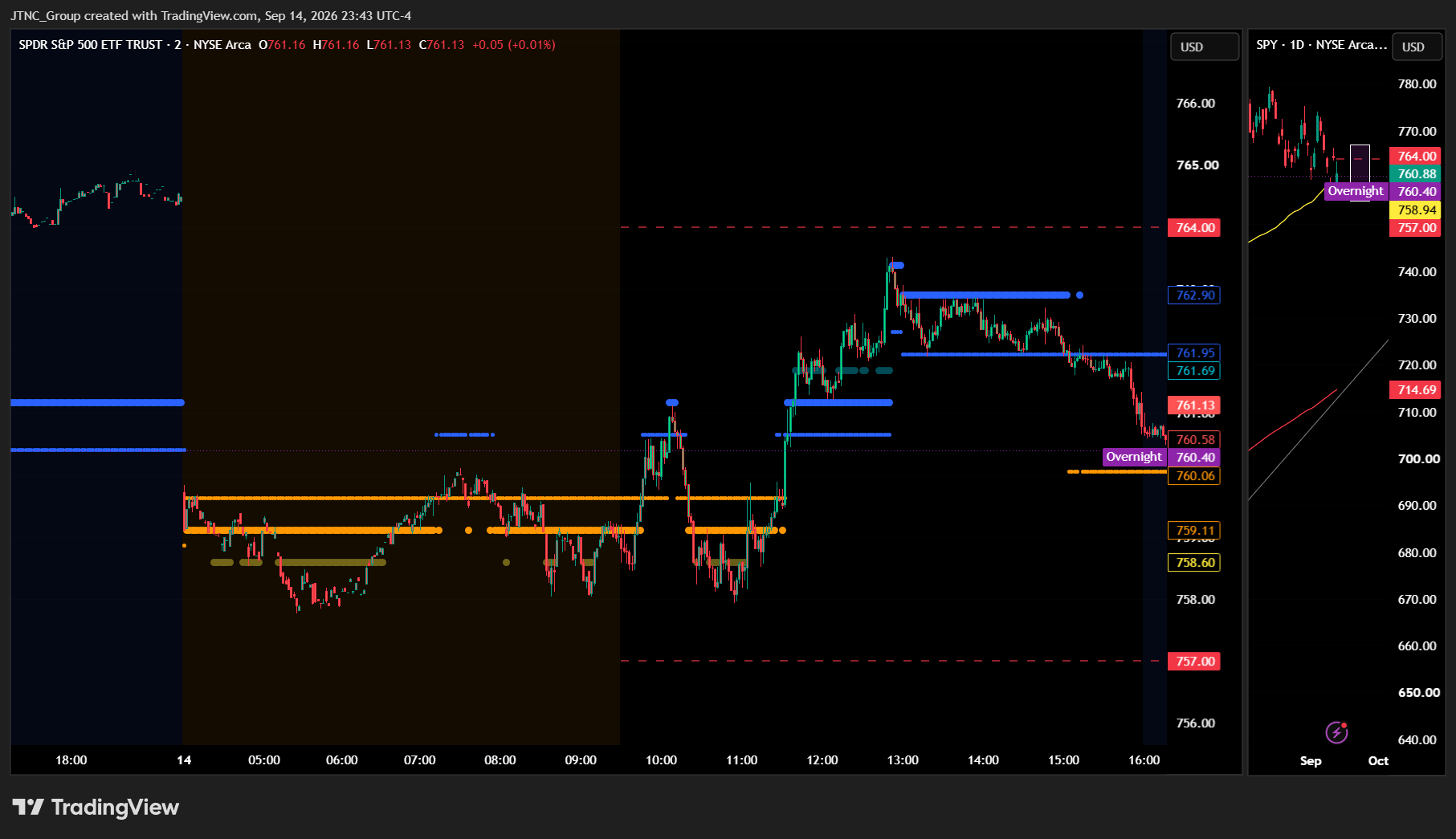
The MSI ended in a Ranging Market State with SPY closing at $760.81. Since SPY closed inside the MSI range, support remains at $760.06 and resistance remains at $761.95 heading into Tuesday. Extended targets were not printing at the close. Extended targets were active during premarket printing below as the MSI flipped between bearish and ranging states keeping price under pressure, and then above during the AM session as the rapid rescalings higher lifted price from $758 to new highs above $762 by early afternoon. The MSI opened overnight in a ranging state flipping between bearish and ranging states with extended targets below keeping price under pressure through the premarket session. At the open the MSI began rescaling higher with a series of rapid rescalings lifting price from $758 to new highs above $762 by early afternoon. The MSI settled into a narrow ranging state into the close with price unable to hold a bullish state. Without extended targets at the close the MSI is forecasting sideways consolidation on Tuesday with perhaps a test of today's lows at $758 and a possible retest of the highs at $762 absent any external catalyst. With the Fed meeting next week, watch the MSI closely for clues as to which direction the market resolves. The narrow $1.89 Ranging spread suggests consolidation. MSI support is $760.06 with resistance at $761.95.
Key Levels and Market Movements:
Thursday we stated the MSI was forecasting two-way trading and Monday delivered exactly that with a session that tested both extremes before settling into a tight range. SPY opened at $759 and quickly sold off to a session low of $757.93 as the MSI remained in its bearish/ranging overnight state — that test of the lows offered the first trade of the day. The reversal was decisive as the MSI began a series of rapid rescalings higher with extended targets printing above, lifting price from $758 to a session high of $763.52 by early afternoon — the second clean trade. A third setup emerged as SPY failed to hold the highs and the MSI rescaled back to ranging, with the pullback from $763.52 back toward $761 offering a short entry. SPY closed at $760.81 right in the middle of the day's range. The VIX surged 6.63% to 16.89, a significant expansion in fear that reflects positioning ahead of next week's Fed meeting. At minimum it was a three-for-three session for traders following the framework. It was a volatile but readable day with substantial setups, all identified through proper context, patience, and flexibility while leveraging the MSI, premarket levels, and market structure rather than forcing trades. The MSI continues to prove its reliability as the cornerstone of our trading process.
Trading Strategy Based on MSI:
Tuesday brings no significant economic data so the market is likely to move more sideways than trend given the Ranging Market State at the close. Without extended targets and with the narrow $1.89 spread, expect a test of today's lows at $758 and a possible retest of the highs at $762 absent any external catalyst. With the Fed meeting next week, watch the MSI closely for clues as to which direction the market resolves.
Bulls want to see overnight price hold above $760.06 MSI support and press toward $761.95 resistance. If the MSI rescales into a Bullish Trending state with extended targets above, the rally from Monday's lows gains credibility and price could push toward $764 and higher. Bears want to see $760.06 support fail and the MSI rescale into a Bearish Trending state. If extended targets print below, price could revisit $758 and lower levels. Given the Ranging state, failed breakouts and failed breakdowns at either MSI boundary are the highest-probability setups.
The long-term bull trend remains intact above $640 and failed breakouts and failed breakdowns continue to offer the highest-probability setups. Remain flexible, avoid trading during Ranging Market States unless a clear failed breakout or breakdown presents itself, and ensure all trades are fully aligned with MSI signals. Providing real-time insights into market control, momentum shifts, and actionable levels, the MSI when integrated with our Pre-Market and Post-Market Reports continues to sharpen execution precision and elevate trade quality. If you haven't yet integrated MSI and our model levels into your process, now is the time. Contact your representative to get started as these tools are designed to support consistency and enhance performance.
Dealer Positioning Analysis
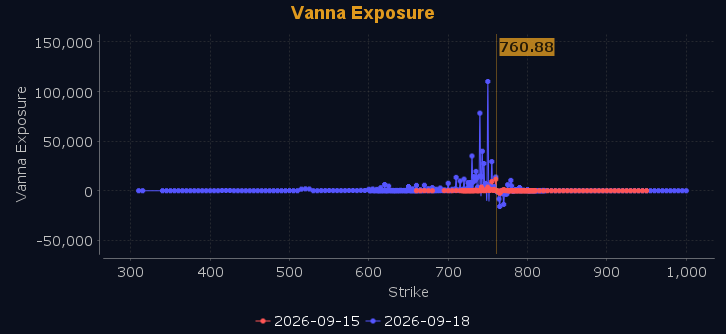
Dealers are selling SPY $762 to $778 and higher strike Calls, indicating the Dealers see a ceiling above for Tuesday. The ceiling for Tuesday appears to be $764. To the downside, Dealers are buying $758 to $698 and lower strike Puts in a 4:1 ratio to the Calls they're selling, displaying heightened concern that prices could move lower. Dealers are no longer selling ATM Puts, indicating limited conviction on direction for Tuesday. Below $758 is bearish and above $760 is bullish. Should SPY fail to hold $758, the zone from $752 to $758 expect indecisive price action with false breakouts in both directions. Dealer positioning is unchanged at bearish.
Looking Ahead to Next Friday:
Dealers are selling SPY $762 to $790 and higher strike Calls for the week ahead. The ceiling for the week appears to be $768. To the downside, Dealers are buying $756 to $645 and lower strike Puts in a 5:1 ratio to the Calls they're selling, displaying significant concern that prices could move lower. Dealers are no longer selling ATM Puts despite the massive positive Vanna exposure further out. The significant negative exposure near current price implies dealers remain heavily hedged and cautious into September 18. There is a ceiling at $768 with major resistance at $762 to $768. Remain bullish above $756 but below $754 and especially $750 we are bearish. Between $750 and $756 expect indecisive price action with false breakouts in both directions. Dealers are positioned for any scenario that may develop given the size of their hedges. For the week Dealer positioning has changed to bearish. We advise reviewing Dealer positioning daily for directional clues. These positions evolve quickly and tracking them is essential for staying ahead of shifting market sentiment.
Recommendation for Traders
With SPY closing at $760.81 and VIX jumping 6.63% to 16.89, the bias shifts cautiously bearish. Favor shorts on any bounce toward $763.52 resistance, with stops above that level. Support to watch is $757.93 — a break below opens further downside.
Keep size lean given the below-average volume and elevated VIX. Always review the premarket analysis posted before 9 AM ET for any changes in the model's outlook and Dealer Positioning.
Good luck and good trading!
