
Market Insights: Friday, August 28th, 2026
Market Overview
US stocks finished Friday in the red as investors reacted to Fed Chair Kevin Warsh's keynote at the Jackson Hole Symposium, which markets interpreted as mildly hawkish. The S&P 500 slid nearly 0.3% and the Nasdaq dropped 0.5% after briefly gaining as much as 0.5% earlier in the session, while the Dow ended roughly flat. Bets on a September rate hike jumped to 57% after Warsh said inflation was still running too high and that price stability would be the Fed's predominant focus — comments that pushed short-term Treasury yields higher by several basis points. Former Fed vice chairman Alan Blinder summed it up plainly: "That sounded to me like somebody who thought interest rates should go up." Despite Friday's pullback, all three major indexes still closed the week with gains, and an upward revision to the University of Michigan's consumer sentiment reading offered a small bright spot on the economic front.
In individual stocks, PayPal cratered more than 12% after Stripe and Advent backed out of a proposed $50 billion takeover bid, leaving the payments company to execute its turnaround plan under new CEO Enrique Lores. Marvell Technology also fell on disappointing second-quarter results. On the brighter side, Chevron rose 0.9% and Halliburton gained over 2% on reports that both companies are nearing deals to expand operations in Venezuela, with Energy Secretary Chris Wright expected to travel there next week. Friday also marked a notable milestone — August 31 is Tim Cook's final day as Apple's CEO, capping a tenure that grew the company's market cap from roughly $350 billion to over $4 trillion.
SPY Performance
SPY opened at $771.76 and spent the session struggling to find its footing, briefly pushing up to a high of $775.29 before sellers stepped in and erased those gains. The low of $768.31 and close of $769.38 tell the story — price faded from the top of the range and settled in the lower half, which is not the kind of close that inspires confidence. The session range of $6.98 was wider than you might expect for a quiet tape, but the inability to hold the early strength is what matters most here. When a market gaps up, runs, and then retreats to finish near the lows of the day, that's the bears making a statement.
SPY finished down 0.22% on the day, a modest pullback in percentage terms but one that carries a bit more weight given the context of where it closed relative to the range. Volume came in at 33.20 million shares, below average and essentially in line with the prior session's pace — not a lot of conviction on either side, but the sellers clearly had the edge in the back half of the day. The VIX slipping just 0.48% to 14.44 is a notably muted move compared to the prior session's compression — volatility didn't expand meaningfully, which keeps the broader environment from turning outright bearish, but it also didn't provide the kind of confidence signal that would back up a bullish thesis. For now, this reads as a market catching its breath after the prior day's advance.
Major Indices Performance
The Dow was the relative winner on the day, though calling a -0.02% finish a win speaks to just how rough the session was across the board. The blue-chip index essentially flatlined, sidestepping the broader selling pressure that hit growth and small-cap names hard. Defensive positioning and the steadier nature of Dow components kept it afloat while the rest of the market struggled to find its footing.
The Nasdaq slid 0.52%, a modest but telling decline that reflected pressure on the growth side of the market. With the S&P 500 also finishing in the red, the risk-off tone was clear, and the Nasdaq's rate-sensitive growth names bore the brunt of it. Rising Treasury yields continued to act as a headwind for high-multiple tech stocks, making investors think twice before chasing momentum in a session where the macro backdrop wasn't doing them any favors.
The Russell 2000 was the real laggard, dropping 1.26% and once again reminding traders why small-caps have been such a difficult trade in this environment. Small-cap companies tend to carry more floating-rate debt, which makes them especially vulnerable when yields are elevated and credit conditions are tight. Today's selloff in the Russell reinforced the pattern we've been seeing — when the macro picture gets murky and rates stay sticky, small-caps get punished first and hardest. Until there's a meaningful shift in the rate outlook, this group is likely to keep underperforming on the down days.
Notable Stock Movements
Amazon stepped up as the standout name of the session, surging up to 3.97% to lead what was otherwise a quietly mixed day for the Magnificent Seven. When the group's biggest e-commerce and cloud name posts a move like that while the broader tape is barely treading water, it tells you there's still selective conviction behind these large-cap tech plays. Amazon's strength wasn't just about one stock — it anchored the group's overall tone and gave bulls something to point to even as the major indices struggled to find direction.
The rest of the Magnificent Seven were mostly green on the day, which is a respectable showing given the mild pressure felt across the broader market. The notable exception was on the downside, where NVIDIA led the laggards with a decline of up to -4.57%. That's a meaningful reversal from yesterday's explosive move, and while one-day pullbacks in high-momentum names aren't unusual after a surge of that magnitude, a drop of nearly five percent is hard to ignore. Tesla joined NVIDIA in the red, leaving two names dragging against a mostly positive group backdrop.
The overall read from the Magnificent Seven today is cautiously constructive. Five names finishing green on a soft tape day shows the group still has buyers willing to step in at these levels. But NVIDIA's sharp reversal is a reminder that the enthusiasm from yesterday's breakout wasn't universally sustained, and the market is still sorting out whether that move had staying power. With the VIX edging down just 0.48% to 14.44, the fear backdrop is calm but not particularly inspiring — this was a day of selective strength rather than broad conviction.
Commodity and Cryptocurrency Updates
Crude oil barely budged on the session, slipping just 0.19% to settle at $83.37. Black gold continues to hold well above $70, and that story hasn't changed one bit — geopolitical tensions, supply dynamics, and resilient global demand are still calling the shots here. Today's dip is nothing more than noise in a market that has shown no real intention of rolling over. As long as crude parks itself at these levels, it stays on the Fed's radar as an inflationary wildcard that makes the central bank's job that much harder.
Gold had a rough session, giving back 2.25% to close at $4,506. That's a meaningful pullback from recent highs, but it would take more than a single down day to shake the conviction behind this bull run. Central bank demand, macro uncertainty, and inflation concerns haven't disappeared — they've just taken a breather — and buyers have consistently shown up to defend dips before. The longer-term trend remains intact, and one bad session doesn't rewrite the story.
Bitcoin got hit today, dropping 3.45% to close below $77,490. After the encouraging bounce from the prior session, today's reversal is a reminder that crypto can give back gains just as quickly as it claims them. The $80,000 level that looked so constructive yesterday is now back in the rearview mirror, and sellers clearly had the upper hand. The underlying bid hasn't necessarily vanished, but Bitcoin will need to reclaim lost ground convincingly before the constructive tone can be restored.
Treasury Yield Information
The 10-year Treasury yield pushed higher again today, adding another 1.03% to close at 4.720%. That's a meaningful move, and it continues a troubling pattern — yields are not consolidating, they're climbing. What was beginning to feel like a stubborn plateau is now looking more like a slow-motion march in the wrong direction, and each session that closes higher makes the equity market's situation a little more uncomfortable.
At 4.720%, the yield now sits 22 basis points above the 4.5% threshold where real equity strain begins — 5 basis points higher than yesterday's already concerning position. The distance to the 4.8% danger zone has narrowed to just 8 basis points. That's an uncomfortably thin margin, and it wouldn't take much — one hotter-than-expected inflation reading, one poorly received Treasury auction — to push yields into territory where selling accelerates and market damage moves beyond manageable. The cushion that existed even a few sessions ago is nearly gone.
The 5% level, where this framework signals significant risk for equities, sits 28 basis points away, and the 5.2% threshold that historically precedes 20%-plus corrections is still some distance out. But the direction of travel matters as much as the absolute level, and right now that direction is unambiguously higher. Rallies in this environment tend to be shallow and short-lived because the yield ceiling keeps compressing the room for bulls to operate. Until yields make a credible move back toward — and ideally below — 4.5%, the pressure on equities remains structural, not situational. The 4.8% level is the one to watch most closely in the sessions ahead.
Previous Day’s Forecast Analysis
Friday's forecast called for SPY to trade within a fifteen-point range stretching from $761 on the downside to $776 at max upside, with Thursday's close at $771.10 positioning price in the upper half of that projected window. The bias heading into Friday was bullish, supported by the VIX shedding 4.60% to close at 14.51 — a signal that fear was draining out of the market in a meaningful way and that the path of least resistance favored the upside.
On the resistance side, $772 was identified as the defining level to clear, representing Thursday's session high and the heaviest overhead concentration. A sustained hold above $772 was expected to open the door to $774, with $776 capping the full expected move. For bulls, converting $772 from resistance to support was the first priority of the session. To the downside, $770 served as the near-term gate, with $767 flagged as the most critical defensive line — a level that had capped price for multiple sessions before Thursday's breakout and needed to hold on any pullback. A clean break below $767 was expected to carry real momentum and expose $764 next, with $761 sitting as the structural floor.
The recommended trading approach suggested position sizing in the 70-80% range given the low-volatility environment, with stops held in the 0.75-1.0% band from entry. The preferred long setup was a morning dip into $768-$768.50, targeting $773 initially and $775-$776 on extension, with stops set below $767.16. Aggressive long additions were only advised on a volume-confirmed break above $772.35. On the short side, a clean breakdown below $767.16 on accelerating volume was the trigger, targeting $764 first and $761-$762 as the secondary destination, with stops above $772.
Market Performance vs. Forecast
Friday's session delivered another solid proof of concept for the model's level structure, with price action respecting the projected range boundaries and behaving in a way that gave disciplined traders clear, actionable setups throughout the day. SPY opened at $771.76, right in line with the prior close and squarely within the expected range, and the session ultimately resolved inside the $761 to $776 projected window — the framework held the structure from open to close.
What the forecast got right was the range construction and the critical level work. The $772 resistance level identified as the key overhead concentration proved its worth immediately — SPY tapped $775.29 on the session high, tested that zone, and rolled back, exactly the kind of stall behavior the forecast flagged when it noted that $774 to $776 is where bulls would most likely hit resistance and price would tend to exhaust. The $768 to $768.50 preferred long entry zone called out in the rising market scenario was also tagged intraday, with the low of $768.31 landing virtually on top of that support band — a near-perfect touch of the identified level. Traders who used that zone as an entry point had a clearly defined structure to work with, and stop placement below $767.16 kept risk well-managed through the session's modest softness. The VIX cooperated again, slipping 0.48% to close at 14.44, continuing the low-volatility regime the model had anticipated and keeping the overall environment constructive even as the tape digested Thursday's gains. The slight negative close of 0.22% represents healthy consolidation following a strong directional move, and the framework's level-based approach gave traders the tools to navigate that chop with precision. The model doesn't account for intraday headline-driven noise, but the structural map it provided remained entirely valid throughout Friday's action, and that consistency is exactly where the durable edge in this approach lives.
Premarket Analysis Summary
The premarket analysis posted at market open identified SPY spot at $771.08 in a call-dominated tape, extending the prior session's breakout and sitting three points above the range that had capped price for most of the week. The expected move was set at six points, and the defining level of the day was $772 — flagged as the gate right above spot and the heaviest concentration on the way up, with a clean reclaim needed to keep the move going. Upside targets were set at $773, $775, $777, and $779, with $773 as the first target on a hold of $772, $775 as the next decision point where price was expected to want to stall, $777 as the level bulls really needed to close the week on the front foot, and $779 standing as max upside. On the downside, $770 was flagged as the most important level of the day and the floor holding the breakout together, with $769 as the next decision point below, $767 as the point of last hope where major support comes in, and $765 standing as max downside at the bottom of the expected move.
The actual session leaned bearish and validated the downside risk flagged around the tight $770–$772 cluster. SPY opened at $771.76 and made an early push to a high of $775.29, briefly tagging the $775 target before sellers took over. From there price reversed sharply, broke back through $770, and undercut the $769 level before finding a low of $768.31 — right in the territory between the $767 point of last hope and the $769 decision point. The close at $769.38 for a loss of 0.22% left price below the critical $770 floor, putting the breakout back in question exactly as the analysis warned a loss of that level would. The VIX dropping 0.48% to 14.44 offered little comfort given the price action, and with below-average volume accompanying the fade, the session ended the week on a cautious note.
Validation of the Analysis
Friday's session gave traders a two-sided tape that tested both sides of the premarket framework before settling with the bears in control, and the analysis called the key levels with precision throughout. SPY opened at $771.76, right in the middle of the battle zone the premarket described — 770 as the floor and 772 as the gate above. The first order of business was whether bulls could clear 772 and get 773 in play, and the answer came quickly as SPY pushed to a high of $775.29, tagging the 775 target identified as the next decision point and a natural stall zone. That was not a coincidence — the analysis flagged 775 explicitly as the level where price should want to stall, and that is precisely where the rally ran out of steam.
From that high, the tape flipped and the downside framework took over. The premarket warned that losing 770 cleanly would put the entire breakout back in question, and that is exactly what happened as SPY broke beneath 770, through 769, and carved out a low of $768.31 — slicing into the 767 zone the analysis described as the point of last hope where major support comes in. Price found its footing right in that neighborhood, consistent with the support structure the framework laid out. The close at $769.38 landed between 769 and 770, reflecting the contested ground the analysis identified as the most critical battle of the session. Traders who faded the 775 stall had a clean entry with a defined target back toward 770, and those who watched 770 for a breakdown got a structured short toward 767. The premarket gave traders both trades on a silver platter.
Looking Ahead
Monday's economic calendar is light, with no high-impact releases scheduled to shake the market heading into the final trading day of August. That gives traders a relatively clean slate to work with, but don't mistake a quiet calendar for a quiet session. August 31st carries its own weight as the month-end close, and that means portfolio rebalancing and window dressing flows will be in full effect. Fund managers will be putting the finishing touches on how their books look when the month prints, and those mechanics alone can generate sharp, counterintuitive moves that have nothing to do with fundamentals.
With no hard data to anchor sentiment, Monday becomes a tape-reading session where price action and internals tell the whole story. The absence of a macro catalyst actually raises the stakes for whatever trend has carried into the weekend — if momentum is strong, a clean calendar gives it room to extend into the close. But if the market has been grinding on thin conviction, month-end mechanics can expose that weakness in a hurry. Watch volume patterns closely, because how aggressively buyers or sellers show up on a data-free Monday will say a lot about where the market's head is as it steps into September.
Market Sentiment and Key Levels
The directional bias today leans bearish, though not dramatically so. SPY slipped 0.22% on below-average volume of 33.20M shares, which tells you sellers were in control but without a lot of urgency behind the move. The VIX dropping 0.48% to 14.44 is a mild but notable counterpoint — volatility is still subdued, which keeps a full-blown bearish breakdown from feeling imminent. The Russell 2000 taking the hardest hit at -1.26% while the Dow barely budged at -0.02% signals that the weakness was concentrated in risk-sensitive, smaller-cap names rather than spreading evenly across the market — that kind of divergence deserves attention.
Key resistance sits at $775.29, today's intraday high. A clean push above that level on rising volume would flip the narrative back toward the bulls and suggest the day's selling was nothing more than a brief pause. On the downside, $768.31 — today's low — is the immediate floor to defend. A confirmed break below that level opens the door to faster selling pressure, likely triggering stops and putting the bears firmly in charge of the short-term tape. Gold sliding 2.25% to $4,506 and Bitcoin falling 3.45% to close below $77,490 are meaningful signals that risk appetite is cooling, and that backdrop doesn't favor a quick bullish reversal. The 10-year Treasury yield climbing 1.03% to close at 4.720% adds another layer of pressure on equities — yields at that level give the market very little margin for error, and any further drift higher in rates could be the catalyst that turns modest softness into something more serious. Bulls need a volume surge and a reclaim of key levels to change the story here.
Expected Price Action
Monday's session brings actionable intelligence generated by our AI model, with SPY projected to trade within a range defined by $765 on the downside and $779 as the max upside target. That fourteen-point window keeps this in trending territory, meaning participants should be positioned for a directional move rather than expecting the kind of sideways grind that traps traders on both sides. Friday's close at $769.38 sits in the lower half of that projected range, and with the VIX slipping 0.48% to 14.44, the fear gauge remains subdued even as price failed to hold the week's highs — a setup that tilts the near-term bias cautiously bearish until proven otherwise.
The defining level to reclaim on Monday is $770, which the premarket notes flagged as the most important floor holding the recent breakout together and where the heaviest battle sits just beneath spot. Friday's session closed below it, which puts the burden squarely on the bulls to reclaim and hold $770 early in the session. Do that convincingly and $772 becomes the next gate — that's the heaviest concentration on the way up and the level that needs to clear before $775 comes back into play as the next meaningful decision point. Above $775, the max upside sits at $779 and represents the level where bulls would truly be calling the shots heading into next week. On the downside, $769 is the immediate support the tape is sitting on right now, and losing it cleanly would accelerate selling pressure toward $767, which the premarket notes identified as the point of last hope where major support comes in. A failure at $767 leaves very little cushion before $765 at the bottom of the expected move becomes the target. With Friday's close below that critical $770 floor and price in the lower portion of the projected range, the first clean break of either $770 to the upside or $767 to the downside will set the tone for how Monday — and potentially the week — intends to trade.
Trading Strategy
The VIX dropping 0.48% to 14.44 is a modest but steady continuation of the low-volatility regime that's been in place. At 14.44, the options market is pricing in virtually no near-term threat, and that kind of complacency deserves respect — but also caution. A move of less than half a percent in the VIX on a mixed session tells you the market isn't alarmed by the softness, but it's not exactly celebrating either. With below-average volume accompanying the session's mild losses, there's no strong directional conviction to lean into. Position sizing in the 70-75% range is appropriate here — the volatility environment remains cooperative, but the lack of volume-backed momentum keeps you from going fully loaded in either direction. Hold stop-losses in the 0.75-1.0% band from entry and wait for the market to show its hand before adding size.
In a rising market scenario, bulls have a workable setup as long as price can reclaim and hold above the $771-$772 zone. The preferred long entry is a pullback into the $768.50-$769 area, which aligns with the prior close and represents near-term intraday support. The initial profit target is $773, with a stretch target at $775-$775.29 if buyers can generate meaningful volume expansion. Stops on longs belong below $768.31 — the session's established low — to protect against a false bounce scenario. Only add aggressively to long exposure once price clears $772 with conviction behind it, not a quiet drift that fades on thin tape.
In a falling market scenario, $768.31 is the first line of defense. A clean breakdown below that level on accelerating selling pressure opens a short entry targeting $764 as the primary profit destination, with $761-$762 as the secondary target if sellers gain real traction. Stops on shorts belong above $772 to keep risk well-defined and avoid getting squeezed on a sudden reversal. If the market opens soft and rolls straight through $768.31 without stabilizing, treat that as your trigger to initiate shorts with measured size. Cover into support levels methodically and don't let the calm 14.44 VIX reading breed complacency — suppressed volatility has a well-earned reputation for snapping hard when the tape shifts, and a quiet market can move fast once direction is established.
Model’s Projected Range
SPY's projected maximum range for Monday is $764 to $774, with the Call side dominating in an expanding band that suggests trending price action with intermittent chop. Monday brings no economic news due out so the market will trade on technicals. Friday's session saw SPY open at $771.76, tag a high of $775.29, and fade into the close at $769.38, down 0.22% on the day, with the low touching $768.31 as sellers absorbed the early strength — volume came in lower than average, keeping the move relatively contained. SPY remains in the $765 to $770 range that has defined recent trading, with ongoing trade policy uncertainty continuing to act as a ceiling on conviction from the bull side. On the upside, our model shows the first resistance at $770, and a clean break above that level targets $774 next — on the downside, the first support sits at $765, and a break below that opens the door to $764, and if that gives way there is little to keep price from falling toward $760. The long-term bull trend remains intact above $640 with SPY well above structural support. As long as price holds above key structural levels, this remains a broader dip-buying environment. Absent a catalyst, resistance sits at $770, $774, $775, $776, while support rests at $765, $764, $762, $760. Given that SPY closed near the lower end of the projected range, we favor buying dips at $765 on any early weakness Monday. Bitcoin slid 3.45% to close below $77,490, showing notable weakness heading into the weekend, while MAG stocks were mostly green led by Amazon surging as much as 3.97%, with NVIDIA being the clear laggard falling as much as 4.57% — the mixed action between crypto and tech leadership means bulls will need to see both stabilize before putting on size. The VIX closed at 14.44, down 0.48%, suggesting fear remains well contained and the options market is not pricing in any imminent shock. SPY closed near the lower boundary of its near-term uptrend channel, with structural support from our model holding in the $764 to $765 zone as the key line in the sand heading into Monday's session.
Market State Indicator (MSI) Forecast
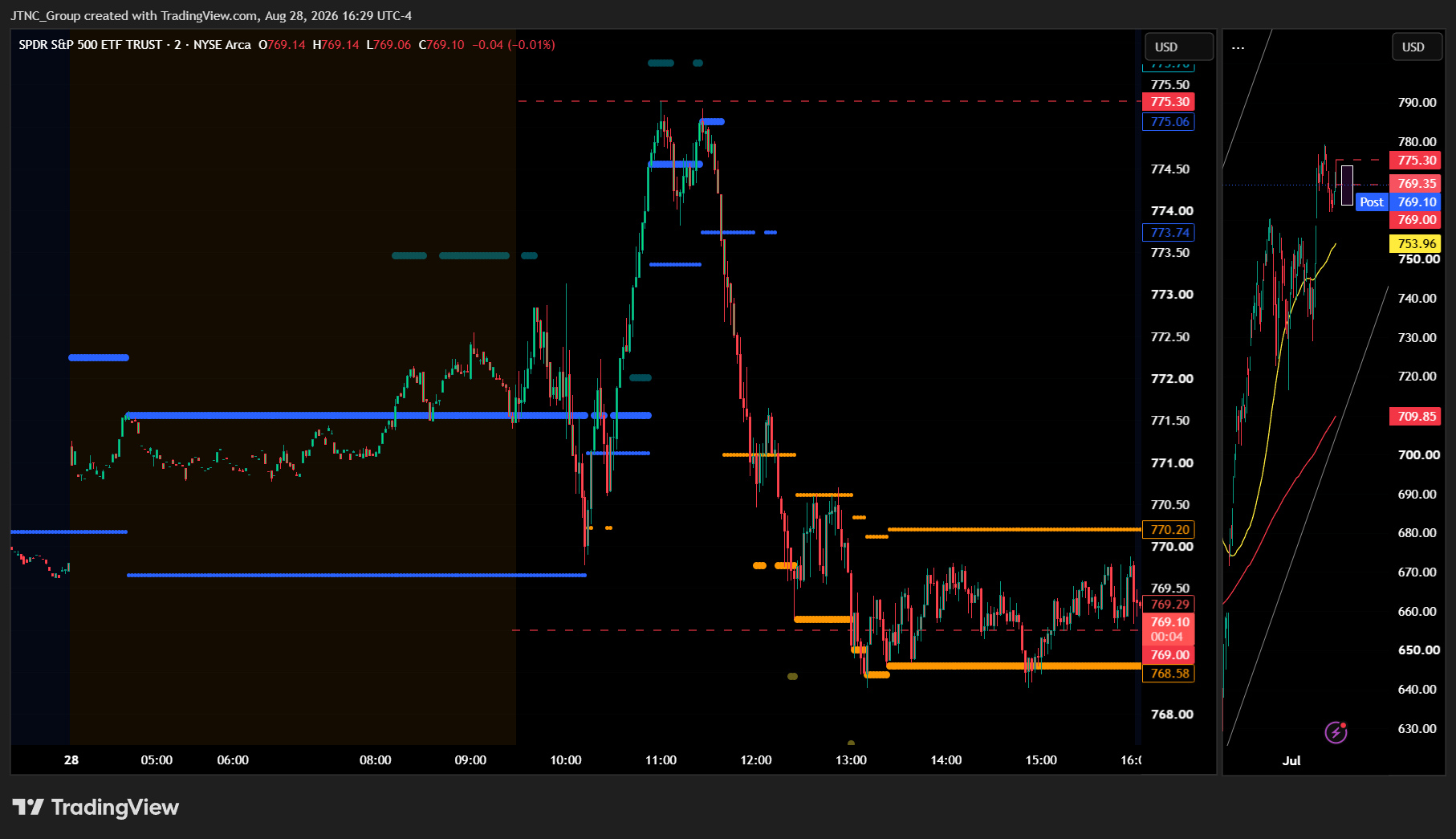
Current Market State Overview:
The MSI ended in a Bearish Trending Market State with SPY closing at $769.38. MSI resistance sits at $770.2 and support at $768.58, and those levels remain intact heading into Monday. Extended targets were not printing at the close, though they did print below during both the AM session and the PM session, giving traders a clear read on where bearish momentum was living throughout the day. The premarket showed extended targets visible above, which telegraphed early upside intent before the regular session even opened, though that energy proved short-lived once the session got underway. The MSI rescaled lower overnight but held a bullish state into the premarket, where extended targets above began printing and foretold the rally that followed the open. SPY pushed right down to MSI support and reversed fast, reaching MSI resistance before pulling back slightly. The MSI then rescaled higher and with extended targets above printing, SPY pressed into major resistance at $775 before failing. The moment extended targets stopped printing with SPY sitting at MSI resistance, price retraced the entire move higher, and the MSI rescaled lower several times through midday and into the close as SPY pushed toward the day's lows before settling into the current Bearish Trending state. The MSI width is moderate at a $1.62 spread, which gives the structure enough room to work with but is not so wide as to suggest an aggressive trending move is imminent. With a moderate Bearish Trending state and no extended targets printing below at the close, the MSI is forecasting a slow grind lower for Monday, though the absence of those targets means the downside may be limited and is likely to find support at key levels below. MSI support is $768.58 with resistance at $770.2.
Key Levels and Market Movements:
Thursday we stated, "Bulls want to see overnight price hold above $770.17 and the MSI maintain or strengthen its Bullish Trending state, which would open the door to testing $772.25 above and potentially pressing beyond that level if extended targets begin printing above during Friday's session," and added, "If the MSI confirms that structure overnight and $770.17 holds as support, buying dips toward that level and targeting $772.25 and above becomes the preferred approach for Friday," while also noting, "A Ranging state at Friday's open is entirely plausible if overnight price action is indecisive, and in that environment failed breakouts above $772.25 and failed breakdowns below $770.17 offer the highest-probability setups." That framework gave traders a clear and well-structured foundation heading into what ultimately became one of the more dramatic reversals the MSI has framed in recent sessions.
The MSI rescaled lower overnight but held its bullish state, keeping the overnight tape stable enough to give bulls a reasonable starting point. Extended targets above were visible in the premarket near $771.50, alerting traders that upside pressure was building before the open and signaling that a push higher was likely once the session got going. SPY opened at $771.76 and wasted little time finding its way down to MSI support, where it reversed sharply and ran directly toward MSI resistance, a clean long setup that the MSI framework identifies with consistent reliability and one that experienced traders know carries better than 70% odds of completing the range. Extended targets continued printing above and SPY pressed beyond MSI resistance, scaling all the way up to the session high of $775.29 as the MSI rescaled higher and a wide Bullish Trending configuration took shape. That was the peak of the bullish case. The moment extended targets stopped printing above with SPY at MSI resistance, sellers stepped in decisively and SPY began its reversal. The MSI rescaled lower several times through midday and into the afternoon, each rescale pulling the resistance and support levels down with it and offering fresh shorting opportunities for traders who recognized the shift. Extended targets printed below during both the AM session and the PM session, confirming the bearish momentum and guiding traders toward the short side as SPY pressed toward the day's low of $768.31. SPY closed at $769.38, down 0.22% on volume of 33.20 million shares, which came in below average and suggests the selling was measured rather than panicked. The VIX dropped 0.48% to 14.44, a small move that reflects a market still not overly anxious despite the intraday reversal. At minimum it was a 3-for-3 session for traders following the framework. It was a volatile but readable day with substantial setups, all identified through proper context, patience, and flexibility while leveraging the MSI, premarket levels, and market structure rather than forcing trades. The MSI continues to prove its reliability as the cornerstone of our trading process.
Trading Strategy Based on MSI:
Monday has light economic news so the market is likely to grind lower given the Bearish Trending state at the close, though the move may be modest since extended targets were not printing below at the close and price is likely to find support at key levels below. The MSI is closing with a moderate spread of $1.62, which gives Monday's session room to develop but without extended targets confirming downside conviction, any push toward or through MSI support should be treated with some caution rather than aggressively chased on the short side. The bears did meaningful work on Friday to establish control, and the MSI is leaning toward continuation lower, but the absence of extended targets at the close is a meaningful distinction that tempers the case for an aggressive short bias heading into Monday.
Bears want to see overnight price stay beneath $770.2 and the MSI maintain or deepen its Bearish Trending state, which would keep pressure on $768.58 below and potentially open the door to testing Friday's session low at $768.31 and lower levels beneath the current range if extended targets begin printing below during Monday's session. If the MSI confirms that bearish structure overnight and $770.2 holds as resistance, selling any rally back toward that level and targeting $768.58 and below becomes the preferred approach for Monday. Bulls, on the other hand, want to see $770.2 reclaimed overnight and the MSI rescale higher, which would shift the early pressure back toward a test of the levels above the current range. Any failure of bears to defend $770.2 as resistance is worth watching closely at the open, as a reclaim of that level could quickly flip the narrative and squeeze any early shorts.
The most actionable setup in a moderate Bearish Trending MSI without extended targets at the close is to let the MSI confirm its state overnight before committing to a direction. If the MSI holds or rescales lower overnight and $770.2 caps any early rally, selling that resistance and targeting $768.58 is the preferred trade for Monday. If instead the MSI rescales higher overnight and $770.2 is reclaimed as support, buying dips toward that level and targeting higher ground becomes the cleaner setup. A Ranging state at Monday's open is entirely plausible if overnight price action is indecisive, and in that environment failed breakouts above $770.2 and failed breakdowns below $768.58 offer the highest-probability setups. The bears are likely to maintain some pressure to the downside, but the lack of extended targets at the close means that pressure may need a fresh catalyst to push meaningfully below $768.58 and sustain any breakdown beneath it.
The long-term bull trend remains intact above $640 and failed breakouts and failed breakdowns continue to offer the highest-probability setups. Remain flexible, avoid trading during Ranging Market States unless a clear failed breakout or breakdown presents itself, and ensure all trades are fully aligned with MSI signals. Providing real-time insights into market control, momentum shifts, and actionable levels, the MSI when integrated with our Pre-Market and Post-Market Reports continues to sharpen execution precision and elevate trade quality. If you haven't yet integrated MSI and our model levels into your process, now is the time. Contact your representative to get started as these tools are designed to support consistency and enhance performance.
Dealer Positioning Analysis
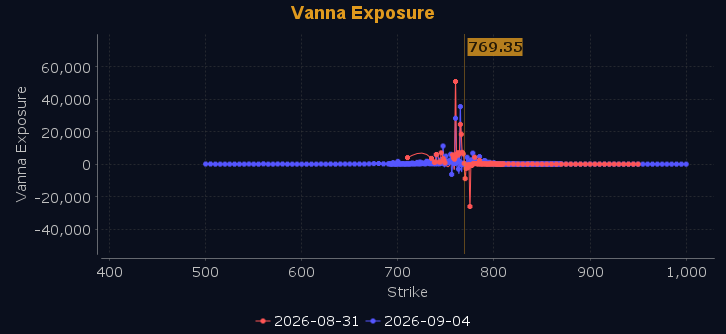
Dealers are selling SPY $776 to $790 and higher strike Calls, while buying $770 to $775 Calls, indicating the Dealers' desire to participate in any relief rally on Monday. The ceiling for Monday appears to be $780. Notably, Dealers are no longer selling ATM Puts and likely closed the Puts sold in yesterday's session for solid gains, which removes any identifiable floor from the picture for Monday. To the downside, Dealers are buying $769 to $710 and lower strike Puts in a 2:1 ratio to the Calls they're selling, displaying measured concern that prices could move lower, though their hedges remain unchanged rather than increased, suggesting they are somewhat less bullish than today and that a period of consolidation or weakness is possible. Below $767 is bearish and above $776 is bullish, with everything in between likely to be choppy and full of traps. Should SPY fail to hold $766, $760 is in play, while above $776 there is a wall of resistance to $780 which will slow any ascent. Dealer positioning is unchanged at bullish.
Looking Ahead to Next Friday:
Dealers are selling SPY $770 to $805 and higher strike Calls, indicating the Dealers' desire to participate in any rally into next Friday. The ceiling for next Friday appears to be $778. Dealers are no longer selling ATM Puts broadly but are selling well out-of-the-money Puts at $763 to $756, and Dealers do not sell ATM Puts unless they believe there is a floor in the market at $756, implying that even if prices continue to pull back, they don't expect the decline to go far. To the downside, Dealers are buying $769 to $655 and lower strike Puts in a 4:1 ratio to the Calls they're selling, displaying significant hedging despite their lean into next Friday. Remain bullish above $771, but below $766 the posture shifts bearish, with the zone in between offering nothing but chop and traps. For the week Dealer positioning is unchanged at bearish. We advise reviewing Dealer positioning daily for directional clues. These positions evolve quickly and tracking them is essential for staying ahead of shifting market sentiment.
Recommendation for Traders
With SPY closing at $769.38 and VIX at 14.44, the near-term bias stays cautiously long — look to buy dips toward $768 with stops below $768.31, and target a recovery toward $772-$775. Any break below $768 shifts the lean defensive fast.
Keep risk tight given the soft close and watch the 10-year yield holding at 4.720 — a continued push toward 4.8% will pressure equities quickly. Review the premarket analysis posted before 9 AM ET for any changes in the model's outlook and Dealer Positioning.
Good luck and good trading!
