
Market Insights: Wednesday, August 26th, 2026
Market Overview
US stocks traded mixed Wednesday as investors digested a fresh PCE inflation reading and held their breath ahead of Nvidia's earnings after the bell. The Dow slipped 0.2% while the S&P 500 and Nasdaq both drifted just below the flat line, giving back some of Tuesday's broad gains. Core PCE came in at 3.3% in July — in line with expectations and unchanged from the prior month — but the sticky reading still added to bond market jitters heading into the Jackson Hole symposium, where Fed Chair Kevin Warsh is set to outline the central bank's future policy direction.
On the earnings front, Nvidia's report became the day's main event, serving as the market's latest litmus test for the AI trade as investors increasingly zero in on whether companies can generate real returns on their massive AI spending. Abercrombie & Fitch had a strong showing of its own, surging 35% after raising guidance. Meta also caught a bid after agreeing to settle a social media addiction lawsuit for roughly $16.7 billion — the case centered on allegations from 29 states that the company deliberately hooked young users, misled the public about product safety, and improperly collected personal data.
SPY Performance
SPY opened at $764.73 and didn't waste much time finding its footing, though calling this an active session would be a stretch. The high of $767.35 was reached at some point during the day, but with a low of $763.93, the total range clocked in at just $3.42 — tighter than the prior session and not exactly the kind of price action that gets traders fired up. Price settled at $766.01, landing comfortably inside the day's range rather than pressing toward either extreme, which tells you this was largely a market treading water and waiting for something to react to.
SPY finished up just 0.01% on the day, which is essentially flat — a rounding error more than a real directional statement. Volume came in at 24.46 million shares, below average, meaning there wasn't much conviction behind the tape in either direction. Low-volume, near-flat closes aren't inherently bearish, but they're not something bulls can hang their hats on either. The VIX dropping 1.10% to 15.28 is a mild positive — volatility continues to grind lower, and that quiet backdrop is at least consistent with a market that isn't bracing for immediate trouble. Still, when price barely moves and volume thins out, the market is essentially in a holding pattern, conserving energy while it waits for a real catalyst to show up and pick a direction.
Major Indices Performance
The Nasdaq led the major benchmarks today, though "led" is relative — it finished down just 0.08%, making it the least negative of the bunch in a session where every major index hugged the flat line. The near-zero move reflects a market that couldn't find a convincing reason to commit in either direction, with sellers unable to push through meaningfully and buyers showing up just enough to keep things from falling apart. Tech names were a mixed bag on the day, which kept the Nasdaq pinned right around unchanged.
The Russell 2000 came in second, slipping 0.07% in what amounts to essentially flat trading for small-caps. Given the recent volatility this group has absorbed, staying close to unchanged could almost be framed as a win — but with rates still elevated, small-caps continue to lack the fuel needed for a sustained push higher. This is a rate-sensitive corner of the market that needs a clearer path forward on borrowing costs before it can mount anything meaningful.
The Dow was the day's laggard, dropping 0.21% and underperforming both the Nasdaq and the Russell. Blue-chip weakness in a flat tape is a mild concern — when the defensive, dividend-heavy names in the Dow are dragging, it suggests some rotation out of the more value-oriented trade rather than broad conviction buying. Overall, it was a forgettable session across the board, with the S&P 500 finishing essentially flat and no real catalyst strong enough to break the market out of the tight range it's been grinding through.
Notable Stock Movements
NVIDIA flipped the script today, going from yesterday's leader to today's biggest drag on the Magnificent Seven, sliding -1.59% to pace what was a mostly red session for the group. When the AI infrastructure bellwether leads to the downside, it sends a different message than when it leads to the upside — institutional patience has limits, and on a day where the broader tape is essentially flat, seeing the highest-conviction AI name give back ground suggests the bid in these names is a little softer than it looked yesterday. NVIDIA carries more narrative weight than any other name in this cohort, so its stumble today puts a ceiling on how constructive the overall read can be.
The rest of the Magnificent Seven leaned red as well, which is consistent with the muted, slightly negative tone across the major indices today. The exceptions were Apple, Meta, and Microsoft, which managed to finish in the green — a silver lining, but not enough to offset the drag from the names that were selling off. Three green out of seven on a flat-to-down tape isn't a signal of broad strength, it's a signal of selective resilience. The market isn't abandoning these names wholesale, but it's not chasing them either.
The overall picture from the Magnificent Seven today reinforces a cautious read on near-term sentiment. Yesterday's mostly green showing felt like quiet base-building — today's mostly red follow-through chips away at that narrative a bit. With the VIX pulling back just slightly to 15.28 and the broader indices barely budging, this isn't a fear-driven selloff, but it's also not the kind of session that builds confidence. The group needs a clean, coordinated push higher to signal that institutional conviction is returning in force, and today wasn't that day.
Commodity and Cryptocurrency Updates
Crude oil dipped just 0.47% on the session to settle at $81.97, which amounts to little more than a pause after the prior day's sharp selloff. Black gold remains well above $70, continuing to defy longer-term expectations and keeping the pressure on from an inflationary standpoint. The structural forces behind this elevated price environment — geopolitical tensions, supply dynamics, and resilient global demand — are still very much in play, and one quiet session doesn't change that calculus. As long as crude holds these levels, the Fed's inflation fight gets that much harder, and energy remains a wildcard that policymakers can't afford to ignore.
Gold gave back a touch of its recent momentum, edging up just 0.23% to close at $4,649. That's a modest gain following the prior session's impressive run, and the overall trend remains firmly intact. Central bank demand, macro uncertainty, and inflation concerns haven't gone anywhere, and buyers are still showing up consistently rather than letting the metal pull back in any meaningful way. The bull case here continues to look solid.
Bitcoin was essentially flat, slipping just 0.08% to close just below $78,500. Much like the prior session, this is noise rather than signal — the kind of quiet price action that tends to frustrate short-term traders but doesn't rattle the broader trend. Buyers remain patient and the overall tone for crypto stays constructive. Nothing in today's tape suggests the path of least resistance has changed.
Treasury Yield Information
The 10-year Treasury yield reversed course today, climbing 0.54% to close at 4.660%. After two consecutive sessions of encouraging pullback, yields crept back higher — erasing some of the progress that had given equities a bit of breathing room. It's a reminder that the path lower for yields is rarely a straight line, and one session is all it takes to reassemble the pressure that had been easing.
At 4.660%, the yield is now sitting 16 basis points above the 4.5% threshold where this framework says equities begin feeling real strain. That's not a crisis level, but it's not comfortable either. The ceiling on any meaningful rally remains firmly in place, and today's marginal flatness across the major indices reflects exactly that dynamic — there's simply not enough room to run when yields are parked this high. The 4.8% level, where selling tends to accelerate and real market damage sets in, sits 14 basis points away. That's a thin cushion, and it deserves respect.
The 5% danger zone is now 34 basis points out, and the 5.2% correction territory — where a 20% or more drawdown enters the conversation — remains the distant worst case. But the trajectory today was the wrong direction, and that matters. Two steps forward, one step back is still progress, but only if the trend holds. What the market needs to see is a resumption of the pullback that was building earlier this week. A move back toward 4.5% would meaningfully change the calculus for equities. Until then, yields remain the dominant headwind, and today's uptick is a warning that this fight isn't over. Watch the next inflation data point and any upcoming Treasury auctions closely — either one could be the catalyst that pushes yields back toward dangerous territory.
Previous Day’s Forecast Analysis
Wednesday's forecast called for SPY to trade within a projected range of $761 on the downside and $773 as the max upside target, a twelve-point window that the model classified as trending territory — meaning directional conviction was expected rather than choppy, range-bound action. The bias leaned modestly bullish heading into the session, supported by Tuesday's close at $765.85 sitting near the middle of the range and the VIX dropping 2.52% to 15.45, signaling that fear was quietly fading and the hedging community was backing off its defensive posture.
On the upside, $768 was identified as the defining line separating genuine repair from another stall, with $769 and $770 as the next logical decision points above that. $771 was the level bulls truly needed to hold in order to shift near-term tone meaningfully higher, with $773 capping the expected move as the ceiling bulls would need to clear to change the broader narrative. On the downside, $766 was the first level to respect, with $765 serving as the most important battleground below — the level where sellers would take real control on a clean break. $764 was identified as the point of last hope and the structural floor for the week, with $761 waiting at the bottom of the expected move if that level failed.
The recommended trading approach called for position sizing in the 65-75% range, with stop-losses maintained in the 0.75-1.0% band from entry. The preferred long setup was a controlled pullback and hold of the $764-764.50 zone, targeting $767.50 initially and $769-770 on sustained momentum. The short trigger was a decisive break below $763.05 with volume, targeting $760-761 and $758 as the secondary destination. The overarching instruction was to add on strength rather than chase, and to avoid letting the low VIX reading breed complacency given how quickly suppressed volatility can reverse when sellers show up.
Market Performance vs. Forecast
Wednesday's session validated the model's structural framework with precision. SPY opened at $764.73, right in the neighborhood of the preferred long entry zone of $764 to $764.50 that the strategy had specifically flagged for early morning softness — giving disciplined traders exactly the controlled pullback entry the forecast had outlined. From there, price pushed up to a high of $767.35, clearing the $766.78 prior session high that bulls needed to reclaim with follow-through and tagging the $767.50 initial profit target almost to the dollar. That's the model delivering actionable levels that played out in real time.
What the forecast got right was the range, the entry zone, and the directional lean. The full session span of $763.93 to $767.35 sat comfortably within the projected $761 to $773 window, and the close at $766.01 confirmed buyers held the $765 to $766 support band that had been identified as the first critical defense. The model had warned that $766 would be the initial test and that losing it cleanly could stall the bounce — and price never broke that level with conviction, instead respecting it throughout the session. Volume at 24.46 million came in below average, which aligned directly with the strategy's guidance to avoid chasing extended moves without volume confirmation and to treat this as a measured, grind-higher environment rather than a momentum breakout. The VIX continued cooperating, dropping another 1.10% to 15.28, reinforcing the low-anxiety tape the model had anticipated. Position sizing in the 65-75% range and stops in the 0.75-1.0% band kept risk tightly managed through a session that ultimately resolved flat but technically sound. The framework continues to map the structure accurately, and that consistency is where the edge lives.
Premarket Analysis Summary
The premarket analysis posted at market open identified SPY spot at $765.57 in a put-dominated tape, with price giving back the prior day's bounce and sitting right back on the level that had turned the market on Monday. The expected move was set at six points, and the defining level of the day was $767 — flagged as the gate above spot where the tape would begin to repair and the same level buyers had failed to hold the session before. Upside targets were set at $768, $769, $771, and $772, with $768 as the first target on a reclaim of $767, $769 as the next decision point, $771 as the level bulls needed to clear to put the chop behind them, and $772 standing as max upside at the top of the expected move. On the downside, $765 was identified as the most important level of the day and the site of the heaviest battle, having held twice already that week, with $764 as the next decision point, $763 as the point of last hope and the floor holding the range together, and $760 standing as max downside. The analysis flagged this as a coiled setup with spot pinned on $765 and $767 capping every attempt higher, noting whichever side broke first should get a fast move.
The actual session played out almost entirely within the premarket framework without breaking decisively in either direction. SPY opened at $764.73, immediately below the $765 battleground, testing the downside scenario right out of the gate. The low of $763.93 tagged just above the $763 point-of-last-hope level before buyers stepped in, validating that floor's significance. From there price recovered back through $765 and pushed toward $767, with the high of $767.35 just barely clipping the defining level before fading. The close at $766.01 for a gain of just 0.01% was essentially a flat print on the session — a third consecutive day of churning the same handful of points without a clean resolution. The VIX dropping 1.10% to 15.28 provided a modestly constructive read on sentiment, but a tape that tested both $763 support and $767 resistance without committing to either direction left the setup just as coiled heading into the next session.
Validation of the Analysis
Wednesday's session validated the premarket framework with precision across every key level identified before the open, and the coiled setup the analysis described delivered exactly the kind of controlled resolution traders needed to navigate it. SPY opened at $764.73, right in the teeth of the 765 level flagged as the most important battleground of the day — the heaviest contest on the board and a line that had held twice already this week. The premarket was explicit: losing 765 cleanly would open the door for acceleration lower, and the open slipping beneath it signaled bears had their shot. The low of $763.93 drove directly into the 763 zone identified as the point of last hope and the floor holding the range together, stopping the pressure cold and giving the tape exactly the structural support the analysis anticipated it would find there.
From that floor, price worked back through 765 and closed at $766.01, reclaiming the level that absorbed the morning selling — a textbook validation of the 763-to-765 zone as the critical support band the premarket outlined in detail. The high of $767.35 reached up into the 767 gate identified as the defining level above spot and the ceiling buyers needed to clear to begin repairing the tape. That level capped the recovery move almost to the tick, exactly as the analysis warned it would. The VIX dropping 1.10% to 15.28 confirmed the controlled, range-bound nature of the session — no panic, no breakout, just the chop the premarket described churning through familiar levels. Traders who faded the open beneath 765, targeted 763 as a bounce entry, and trimmed into the 767 rejection had a clean, well-structured day with defined risk and meaningful opportunity at every pivot.
Looking Ahead
Thursday's economic calendar is quiet, with no high-impact releases on the schedule to move the needle in either direction. That puts the focus entirely on price action and how the market digests whatever momentum carries over from Wednesday's session. Without a macro catalyst to anchor the narrative, Thursday becomes another tape-reading day where breadth, internals, and volume conviction do the work that data normally would.
With no numbers to trade around, Thursday shapes up as a pure positioning session where the trend either earns its credibility or starts to crack under the weight of its own indecision. Watch for whether buyers show up with real size or whether the market continues to drift without a fresh catalyst to rally around. A quiet calendar cuts both ways — it gives a healthy trend room to breathe, but it also has a way of exposing thin momentum that was only holding together because nobody had a reason to push back yet.
Market Sentiment and Key Levels
The directional bias today is essentially neutral with a slight bearish lean — the major indices finished in the red or flat, and SPY's nearly unchanged close of 0.01% on below-average volume of 24.46M shares tells you this market is in a holding pattern rather than trending with purpose. The bulls can take some comfort from the VIX dropping 1.10% to 15.28, which shows fear isn't building, but the lack of meaningful upside follow-through keeps the tape from feeling genuinely constructive. The Dow and Nasdaq both finishing in the red, combined with muted price action across the board, suggests the path of least resistance remains choppy until a real catalyst shows up.
Key resistance sits at $767.35, today's intraday high. A decisive break above that level backed by above-average volume would flip the tone bullish and signal that buyers are stepping in with real conviction, potentially opening the door to a push toward the next technical zone higher. On the support side, $763.93 — today's intraday low — is the number to watch. A breakdown below that level with force would hand bears the short-term narrative and could accelerate selling as stops get triggered beneath that floor. Gold adding 0.23% to close at $4,649 is modest but still reflects a quiet bid for safety lurking under the surface. Bitcoin dipping 0.08% and closing below $78,500 is another signal that risk appetite isn't exactly firing on all cylinders right now. Yields ticking higher remain a headwind worth respecting, and any further move to the upside there could add pressure to equities. Bulls need a volume surge to change the story — until then, caution is warranted.
Expected Price Action
Thursday's session brings actionable intelligence generated by our AI model, with SPY projected to trade within a range defined by $760 on the downside and $772 as the max upside target. That twelve-point window keeps this firmly in trending territory, meaning directional conviction is on the table and participants should be prepared for a meaningful move once the tape picks a side. With Wednesday's close at $766.01 sitting near the middle of the projected range and the VIX dropping 1.10% to 15.28, fear continues to bleed out of the market quietly, leaving the bias modestly bullish heading into Thursday's open.
The $767 level is the defining line standing between continued chop and real tape repair. This is the gate that buyers have now failed to clear on multiple sessions, and a clean reclaim of $767 is the first order of business for bulls. Push through there and $768 becomes the first target, with $769 as the next decision point where price will want to prove itself before extending. Above $769, $771 is the level that matters most — bulls genuinely need to plant a flag there to put this grinding consolidation behind them and shift the near-term tone higher. Beyond that, $772 stands as the max upside and the ceiling that defines the full expected move. On the downside, $765 is the most critical level in the range — it has held twice already this week and carries enormous weight precisely because of it. Spot drifted back toward that zone by Wednesday's close, which means a clean loss of $765 Thursday morning would carry real force with it. Beneath there, $764 is the next decision point, then $763 stands as the last line of defense holding this week's structure intact. Failure at $763 leaves very little cushion before price accelerates toward $760 at the bottom of the expected move. Bias leans modestly bullish given fading fear and the positive close, but with the tape coiled between $765 below and $767 above, the first clean break through either level should produce a fast, directional move worth trading.
Trading Strategy
The VIX dropping 1.10% to 15.28 is a mild but meaningful confirmation that fear remains subdued heading into the next session. At 15.28, we're sitting in low-anxiety territory where volatility pricing suggests the options market isn't bracing for anything dramatic. The modest VIX decline on a near-flat close with below-average participation tells you this is a market in wait-and-see mode — not panicking, not charging higher, just coiling. That kind of compressed volatility can be deceptive. When the VIX is this low and volume is thin, it doesn't take much of a catalyst to generate an outsized move in either direction. Keep position sizing in the 65-75% range — the VIX is calm enough to stay engaged, but the lack of volume conviction keeps full allocation off the table. Maintain stop-losses in the 0.75-1.0% band from entry and resist the urge to oversize into what looks like a quiet tape.
In a rising market scenario, bulls need to reclaim and hold above $767.35 with genuine follow-through to signal the next leg higher. The preferred long entry is a controlled morning pullback into the $764-$764.50 zone, where the prior session's open and low offer natural support. Initial profit target sits at $769, with the stretch target at $770-$771 if buyers can drive volume expansion and break cleanly above the recent range. Stops on longs belong below $763.93 to protect against a failed recovery attempt. This is a confirm-before-committing environment — only add to long exposure once price clears $767.35 with real participation backing the move, not just a low-volume drift.
In a falling market scenario, the key floor to watch is $763.93. A decisive break below that level on building selling pressure opens the door to a short entry targeting $761 as the primary profit destination, with $758-$759 as the secondary target if sellers find traction and volume starts accelerating to the downside. Stops on shorts belong above $767 to keep risk well-defined and avoid getting squeezed by a quick reversal. If the market opens soft and rolls straight through $763.93 without a recovery bid forming, treat that breach as the trigger to initiate shorts with measured size. Cover into support levels methodically and don't let the calm VIX reading at 15.28 breed complacency — suppressed volatility has a way of snapping hard when sentiment shifts, and a tape this quiet can move fast once direction is established.
Model’s Projected Range
SPY's projected maximum range for Thursday is $760 to $775, with the Call side dominating in an expanding band that suggests trending price action with intermittent chop. Thursday brings no economic news due out so the market will trade on technicals. SPY had a nearly flat session, closing at $766.01, up just 0.01%, after trading in a tight range between a low of $763.93 and a high of $767.35 off an open of $764.73 — low volume kept things subdued with trading coming in below average. SPY is trading near our model's first support at $765, and with geopolitical headlines remaining in the background, price is holding its ground but hasn't shown any conviction either way. If SPY can push through the first resistance at $770, the next target becomes $775, while a break below $765 opens the door toward $760, and if that gives way there is little to keep price from falling toward $755. The long-term bull trend remains intact above $640 with SPY well above structural support. As long as price holds above key structural levels, this remains a broader dip-buying environment. Absent a catalyst, resistance sits at $770, $775, $780, while support rests at $765, $760, $755. Given how close SPY closed to that first support, we favor buying dips at $765 as long as it holds on a closing basis. Bitcoin slipped a modest 0.08% to close below $78,500, while the MAG stocks were mostly red led by NVIDIA dropping 1.59%, though Apple bucked the trend with a gain of 1.15% — sustained weakness across both leadership groups would be required to signal a deeper pullback. The VIX closed at 15.28, down 1.10%, suggesting a modest reduction in fear as SPY held its ground near key model support. SPY closed just above the lower line of the uptrend channel, with structural support near $765 keeping the broader trend intact for now.
Market State Indicator (MSI) Forecast
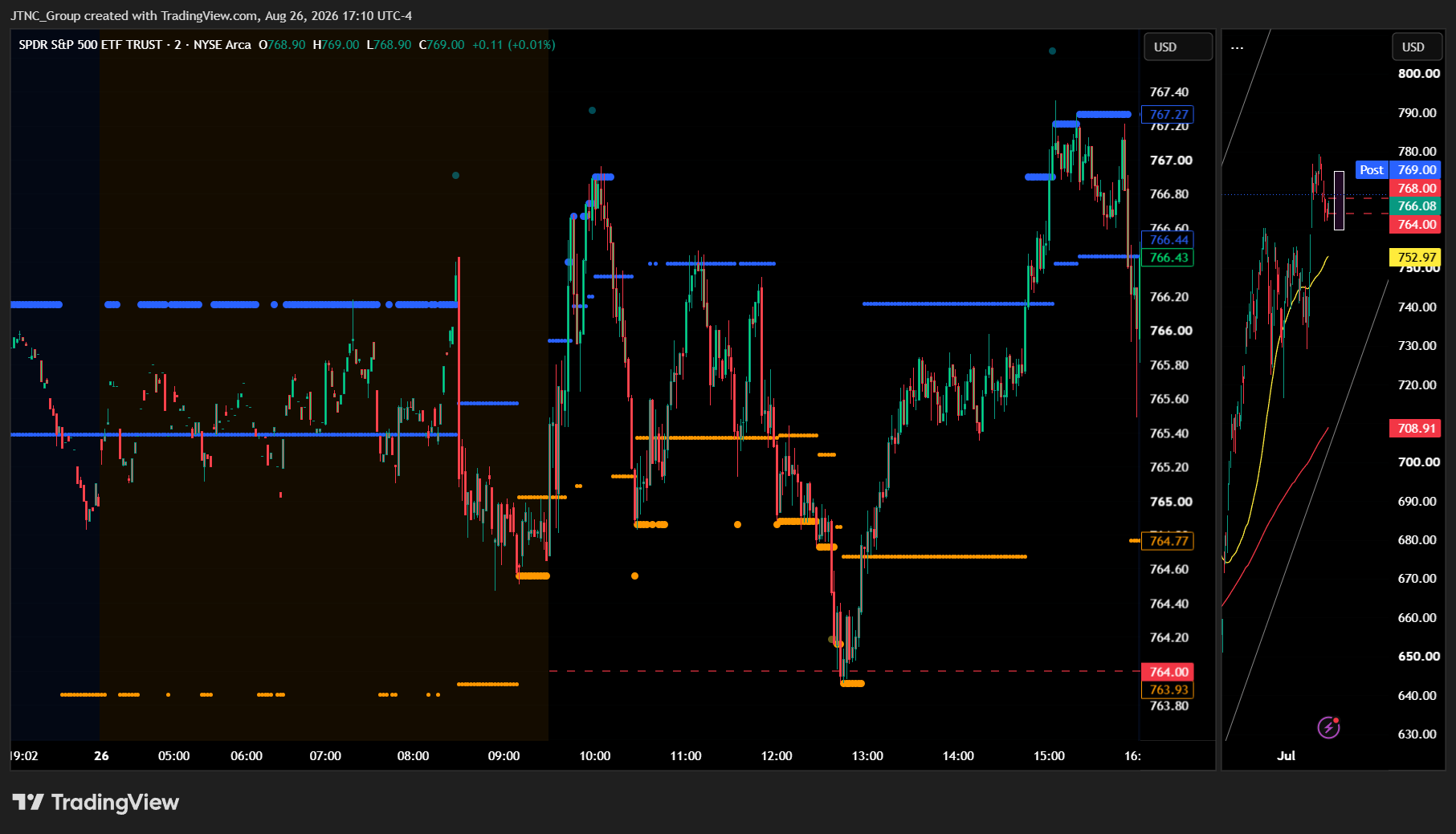
Current Market State Overview:
The MSI ended in a Bullish Trending Market State with SPY closing at $766.01. SPY closed below MSI support, which means $766.44 now flips to act as resistance heading into Thursday, with $767.27 remaining as the upper boundary to watch. Extended targets were printing above at the close, and they were visible during the premarket, AM session, PM session, and into the close, signaling persistent bullish pressure from the bulls throughout the day even as price struggled to sustain traction. The MSI did not rescale overnight and remained in a bullish state without extended targets above. SPY traded mostly sideways until the premarket, when the MSI rescaled lower into a very narrow bearish state. That didn't last long as SPY found a base near $764 and the MSI began rescaling higher through a ranging state back into a bullish configuration. But that too gave way to more of the same, with SPY cycling through all three states until the early afternoon when price finally picked a direction and the MSI rescaled higher into the close, ending in a wide Bullish Trending state without extended targets above. That final condition matters because a wide bullish close without extended targets suggests price may continue higher but likely without much impetus unless fueled by an external catalyst like NVDA earnings or war-related news. The spread at the close of just $0.83 is extremely compressed, and that kind of tightness reflects a market coiling rather than committing. The MSI is forecasting a session that is likely sideways to possibly higher as the narrow bullish MSI suggests consolidation rather than strong trending. That said, the bulls are likely to maintain pressure to the upside. Any failure of MSI support is likely to see SPY retest the day's lows. MSI support is $766.44 with resistance at $767.27.
Key Levels and Market Movements:
Tuesday we stated, "Bulls want to see overnight price hold above $765.39 and the MSI maintain or strengthen its Bullish Trending state, which would open the door to testing $766.15 above and potentially pressing higher if extended targets begin printing above," and added, "If the MSI confirms that structure overnight and $765.39 holds as support, buying dips toward that level and targeting $766.15 and above becomes the preferred approach for Wednesday," while also noting, "A Ranging state at Wednesday's open is entirely plausible given the compressed close, and in that environment failed breakouts above $766.15 and failed breakdowns below $765.39 offer the highest-probability setups." That framework gave traders a clear roadmap heading into what became a choppy, state-cycling session that ultimately resolved to the upside only in the final hours.
The MSI held its bullish structure overnight without extended targets above, keeping price stable but without meaningful directional energy into the premarket. When the premarket arrived the MSI rescaled lower into a very narrow bearish state, reflecting an early shift in sentiment as sellers tested the resolve of the prior day's close. SPY found a base near $764 and the MSI began working its way back higher, cycling through a ranging state before returning to a bullish configuration. The problem was that this pattern repeated itself throughout the session, with SPY moving through all three MSI states as neither bulls nor bears could establish clean control. Traders who respected the MSI framework and stayed patient were rewarded by the setup it kept providing — buying dips to MSI support and targeting resistance on the other side, and fading failed breakouts above resistance when the state was in question. Extended targets were printing above across the premarket, AM session, PM session, and into the close, which gave traders a consistent read on where upside pressure lived even when the state itself was cycling. It wasn't until around midday that SPY finally picked a direction, and the MSI rescaled higher into the close in a wide bullish state, ending the session with extended targets printing above. SPY opened at $764.73, ran to a high of $767.35, dipped to a low of $763.93, and closed at $766.01, finishing the day up just 0.01% on volume of 24.46 million shares, well below average and reflective of a low-conviction tape. The VIX dropped 1.10% to 15.28, suggesting anxiety continued to ease even as price churned. At minimum it was a 4-for-4 session for traders following the framework. It was an easy day to read albeit not an easy day to trade given the tight choppy range. But substantial setups were present, all identified through proper context, patience, and flexibility while leveraging the MSI, premarket levels, and market structure rather than forcing trades. The MSI continues to prove its reliability as the cornerstone of our trading process.
Trading Strategy Based on MSI:
Thursday has light economic news so the market is likely to move more sideways to up than trend given the Bullish Trending state at the close. With the MSI closing in a Bullish Trending state but carrying a spread of just $0.83, the energy behind any directional move is limited. That kind of compression in a bullish configuration typically means the market is pausing to gather itself rather than launching into a sustained rally, and without a high-impact catalyst on the calendar to shake price loose in either direction, consolidation remains the most likely path. That said, NVDA earnings or any significant geopolitical development could change that calculus quickly and inject the kind of momentum the MSI width alone does not currently support. With extended targets printing above at the close, bulls do have a signal worth respecting, but the narrow spread tempers the conviction behind it and demands patience before committing to a directional trade.
Bulls want to see overnight price hold above $766.44 and the MSI maintain or strengthen its Bullish Trending state, which would open the door to testing $767.27 above and potentially pressing higher still if extended targets continue printing above into Thursday's session. If the MSI confirms that structure overnight and $766.44 holds as support, buying dips toward that level and targeting $767.27 and above becomes the preferred approach for Thursday. Bears, on the other hand, want to see $766.44 fail to hold overnight, which would put renewed pressure on Wednesday's session low at $763.93 and open the door to lower levels beneath the current range. Any failure of $766.44 as support is likely to see SPY retest the day's lows quickly, so that level deserves close attention at the open.
The most actionable setup in a narrow Bullish Trending MSI with extended targets at the close is to let the MSI confirm its state overnight before committing to a direction. If the MSI holds or rescales higher overnight and $766.44 supports price, buying dips toward that level and targeting $767.27 is the preferred trade for Thursday. If instead the MSI rescales lower and $766.44 fails at the open, selling any rally back toward that level and targeting Wednesday's session lows becomes the cleaner setup. A Ranging state at Thursday's open is entirely plausible given how compressed the close was, and in that environment failed breakouts above $767.27 and failed breakdowns below $766.44 offer the highest-probability setups. The bulls are likely to maintain pressure to the upside, but the narrow MSI spread means that pressure may not have the energy to follow through without a fresh catalyst to confirm the move.
The long-term bull trend remains intact above $640 and failed breakouts and failed breakdowns continue to offer the highest-probability setups. Remain flexible, avoid trading during Ranging Market States unless a clear failed breakout or breakdown presents itself, and ensure all trades are fully aligned with MSI signals. Providing real-time insights into market control, momentum shifts, and actionable levels, the MSI when integrated with our Pre-Market and Post-Market Reports continues to sharpen execution precision and elevate trade quality. If you haven't yet integrated MSI and our model levels into your process, now is the time. Contact your representative to get started as these tools are designed to support consistency and enhance performance.
Dealer Positioning Analysis
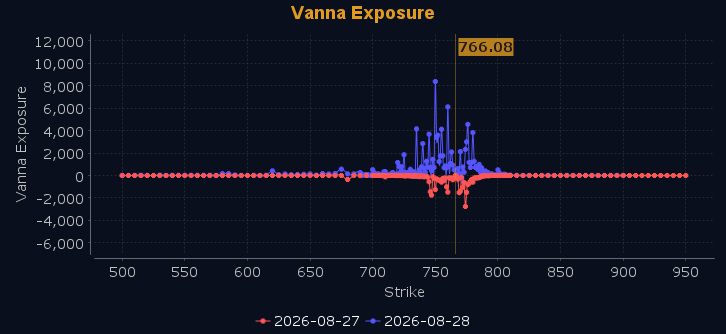
Dealers are selling SPY $766 to $771 and higher strike Calls, while buying $772 to $786 Calls, indicating the Dealers' desire to participate in any rally on Thursday. The ceiling for Thursday appears to be $771. Notably, Dealers are selling ATM Puts in large size at $765 to $746, and Dealers do not sell ATM Puts unless they believe there is a floor in the market at $747. This signals real conviction that prices will continue to rise Thursday. To the downside, Dealers are buying $744 to $705 and lower strike Puts in a 2:1 ratio to the Calls they're selling, displaying measured concern that prices could move lower, though their reduced hedges imply growing upside conviction. Below $765 is bearish and above $766 is bullish. Should SPY fail to hold $764, the zone from $758 to $763 has support which will contain any decline, while above $770 there is a wall of resistance to $774. Dealer positioning is unchanged at bearish.
Looking Ahead to Next Friday:
Dealers are selling SPY $772 to $790 and higher strike Calls, while buying $767 to $771 Calls, indicating the Dealers' desire to participate in any rally into next Friday. The ceiling for next Friday appears to be $776. Dealers are no longer selling ATM Puts broadly, which shifts the near-term tone, but they are actively buying ATM Calls looking to participate in any continuation of the rally into late August. To the downside, Dealers are buying $766 to $655 and lower strike Puts in a 4:1 ratio to the Calls they're selling, displaying significant hedging despite their bullish lean into the end of the week. Remain bullish above $765, but below $764 the posture shifts bearish. Dealers are positioned for a continuation of the rally anticipating further upside into late August. For the week Dealer positioning is unchanged at bearish. We advise reviewing Dealer positioning daily for directional clues. These positions evolve quickly and tracking them is essential for staying ahead of shifting market sentiment.
Recommendation for Traders
With SPY closing at $766.01 and VIX at 15.28, the tape is essentially flat — favor longs above $766 with stops below $763.93, and flip cautious on any break under that level.
Volume was light and conviction was low, so size accordingly and keep risk tight. Review the premarket analysis posted before 9 AM ET for any changes in the model's outlook and Dealer Positioning.
Good luck and good trading!
