
Market Insights: Monday, August 10th, 2026
Market Overview
Stocks started the week on a soft note Monday as rising oil prices and a wait-and-see attitude kept buyers on the sidelines. The S&P 500 dipped nearly 0.1%, the Dow slipped 0.1%, and the Nasdaq fell 0.3% after last week's strong run. Nvidia led the drag, falling nearly 3% after the Financial Times reported the AI chip giant is working with Apollo Global and Blackstone to put together a $500 billion AI infrastructure funding package. Intel also slid after announcing plans to issue shares to raise $15 billion.
The geopolitical front stayed messy, with Iran teasing that a Strait of Hormuz deal is "very close" — sending Brent crude up to $87 per barrel as traders weighed the mixed signals. Wednesday's CPI report is now the week's main event, with Fed officials still divided on rate policy as they watch the oil shock from the Middle East conflict filter into inflation data. Earnings are winding down with over 80% of S&P 500 companies already reporting, but AI infrastructure names including CoreWeave, Nebius, Cerebras Systems, and Super Micro Computer are still on deck and could shape the conversation around the AI build-out.
SPY Performance
SPY opened at $772.60 and spent the session drifting in a tight range, tagging a high of $775.03 before fading back toward the open and settling at a close of $773.05. The low of $771.89 held without much of a test, keeping the session contained and relatively uneventful from a technical standpoint. After yesterday's clean bullish follow-through, today's price action was more of a pause than a reversal — the kind of consolidation that isn't alarming on its own but does require watching if it starts to extend.
SPY finished essentially flat, down just 0.03%, which tells you sellers didn't exactly show up with conviction either. Volume came in at 31.96 million shares, below average, suggesting neither camp was willing to make a bold statement in either direction. The more notable development on the day came from the VIX, which rose 3.49% to close at 15.42 — a meaningful uptick that stands in contrast to the calm price action in SPY itself. When the index barely moves but volatility is quietly climbing, it suggests participants are starting to hedge or at minimum grow a little less comfortable under the surface. That divergence between a flat tape and a rising VIX is worth keeping on the radar, because it can sometimes be an early tell that uncertainty is building even when price hasn't broken yet. One quiet red day doesn't change the narrative, but the VIX behavior adds a wrinkle to what otherwise looked like a straightforward consolidation session.
Major Indices Performance
The Dow was the relative outperformer among the major indices today, though "outperformer" is doing a lot of heavy lifting when the best showing was a decline of just 0.11%. Blue-chip names held up better than their growth-oriented counterparts, which makes sense given the defensive rotation that tends to take over when sentiment gets shaky. The Dow's more modest dip suggests institutional money found some shelter in the larger, more stable names that make up the index.
The Nasdaq slipped 0.32%, underperforming the broader market in a session that lacked any real appetite for growth exposure. When tech and growth names are getting trimmed on a relatively quiet tape, it usually points to some underlying unease rather than a clean, decisive move in either direction. The marginal losses added up just enough to keep the bulls from making any meaningful progress.
The Russell 2000 was the weakest of the group, falling 0.49% and once again flashing the kind of caution signal that small-cap watchers have been keeping a close eye on. Small-caps are often the first place risk appetite shows up — or disappears — and today they were clearly on the wrong end of the ledger. The S&P 500 essentially went nowhere, finishing nearly flat, which paints the picture of a market that was treading water rather than making a statement in either direction. With all major indices in the red or flat, the tape had a hesitant, unconvincing feel, and the bulls didn't come close to mounting anything worth writing home about.
Notable Stock Movements
Amazon stepped up as the standout name in the Magnificent Seven today, climbing 1.32% to lead what was otherwise a mixed and slightly disappointing session from the group. After yesterday's broadly constructive sweep, seeing the cohort struggle to maintain that momentum is a reminder of just how fragile the current risk appetite really is. Amazon at least gave the bulls something to hang onto, and its gains carried some weight given how sensitive the stock is to consumer sentiment and cloud spending narratives.
The rest of the Magnificent Seven were mostly green, which sounds better than it felt in practice, because the drag from the downside was significant. NVIDIA led the losses in a meaningful way, sliding -2.86% and pulling the overall tone of the group lower despite the green majority. When NVIDIA drops that hard, it's difficult to feel good about the tech tape regardless of what else is working — the stock carries enormous weight in the AI and semiconductor conversation, and that kind of single-session pullback leaves a mark on sentiment across the entire growth complex.
Apple joined NVIDIA in the red, adding a second notable blemish to what could have been a cleaner day for the cohort. Two meaningful losers against a backdrop of modest gains elsewhere isn't the kind of broad participation the bulls were hoping to carry forward from yesterday's session. The energy here feels more like consolidation with cracks than genuine follow-through. When the Magnificent Seven can't sustain a clean green sweep for back-to-back sessions, it aligns with the slightly defensive, low-conviction tone the broader market showed today — and the VIX climbing to 15.42 only reinforces that the market isn't entirely comfortable with where things stand right now.
Commodity and Cryptocurrency Updates
Crude oil surged 5.05% today, settling at $82.13, and that's a move that demands attention. The commodity has now rallied well above $70, defying longer-term expectations, and the forces driving it — geopolitical tensions, supply disruptions, and persistent demand — show no signs of letting up. A jump of this size in a single session suggests something more than routine market noise, and with crude sitting comfortably in the low $80s, energy's inflationary footprint is getting harder to ignore. A sustained move at these levels could complicate the Fed's calculus if energy prices continue contributing to broader inflationary pressures — not exactly the environment that makes rate cuts an easy call.
Gold extended its remarkable run, climbing another 2.52% to close at $4,450. The metal just keeps pushing into uncharted territory, and the fact that it's building on recent gains rather than consolidating tells you everything about the conviction behind this move. The structural drivers — uncertainty, central bank demand, inflation concerns — remain fully intact, and today's session only adds to the case that buyers have no interest in stepping aside. The record keeps getting rewritten.
Bitcoin slipped 1.29% today, closing just above $64,005. After the strong recovery session yesterday, a modest pullback isn't surprising, and the $64,000 zone continues to act as a meaningful support level. The quick return to that area after yesterday's bounce suggests the market is digesting recent gains rather than breaking down. As long as Bitcoin continues holding above this floor on dips, the broader setup remains constructive.
Treasury Yield Information
The 10-year Treasury yield moved in the wrong direction today, climbing 0.84% to close at 4.700%. That erases the modest progress made in yesterday's session and pushes yields back to a level that demands attention. The brief dip bulls were hoping would signal a trend reversal now looks more like a one-day pause in what remains an uncomfortable upward grind.
At 4.700%, the yield sits 20 basis points above the 4.5% threshold where equity pressure becomes a genuine factor, and the gap to the 4.8% selloff trigger has narrowed back down to just 10 basis points. That's a razor-thin cushion. The pattern here is becoming harder to ignore — yields dip slightly, give back the gains, and inch closer to that critical 4.8% level. Each time the buffer shrinks, the risk of a more serious market reaction grows. Today's modest equity losses across the major indices are consistent with the kind of slow-burn pressure elevated yields tend to produce.
The 5% and 5.2% danger zones are still not imminent, but the path there looks less far-fetched than it did a couple of weeks ago. The key number to watch is 4.8% — if the 10-year yield breaches that level on a closing basis, history under this framework suggests the market will respond with broader and more decisive selling. On the flip side, any move back toward 4.6% would relieve some of the pressure and give equities more room to breathe. Until yields show a genuine and sustained pullback, the bond market remains the dominant force setting the ceiling on how far this equity market can run.
Previous Day’s Forecast Analysis
Yesterday's forecast set up Monday with a bullish lean and a projected SPY trading range spanning $764 on the downside to $778 as the max upside ceiling — a fourteen-point window wide enough to signal directional movement rather than choppy consolidation. With Friday's close at $773.22 sitting comfortably in the upper half of that range, the model handed the early advantage to bulls heading into the session. The key line in the sand was $772, identified as the defining battleground where holding above kept the path open toward $773, then $775 where the heaviest resistance was expected to cluster. A push through $775 with solid participation was projected to target $777 and $778 as the expected move top and max upside ceiling. On the downside, $770 was flagged as the round-number battleground where a clean break would reopen $769, with $768 serving as the most critical defensive level — losing it cleanly was the trigger that would shift control to sellers and put $764 in play.
The trading strategy leaned into the constructive VIX reading of 14.87, supporting position sizing in the 85-95% range with stop-losses held tight in the 1.0-1.25% range from entry. For bulls, the preferred long entry was a stabilizing dip toward $770-771 with real buying pressure, targeting $773 first and $775-776 on follow-through, with stops placed below $767. A clean breakout through $775 on volume was projected to open $778-779 as the next profit zone. On the short side, a failure to hold $769 set up a short targeting $766-767 with stops above $774, and a conviction break through $766 on volume pointed toward $763-764 as the next meaningful floor. The overall message was clear — bias was bullish above $772, but volume confirmation at entry was non-negotiable in a quiet-tape environment where strength has a habit of fading without institutional backing.
Market Performance vs. Forecast
Monday's session opened at $772.60, stepping directly into the battleground the forecast identified as the defining test for the bulls — the $772 line-in-the-sand that the model flagged as the gate that needed to hold to keep the upside thesis alive. That level held from the open, with the intraday low of $771.89 dipping only slightly beneath it before buyers reasserted control, a clean demonstration of the support architecture the framework built in advance. Price then pushed to a high of $775.03, piercing the $775 resistance zone the forecast identified as the point where the heaviest interest sat and the real test would arrive — and the tape responded precisely as the model projected, with price stalling at that level rather than extending cleanly through it.
The close at $773.05 represents a virtually flat session, down just 0.03%, landing right in the middle of the projected range and well within the $772-$775 zone the forecast outlined as the core battleground for the day. The rising market scenario called for bulls to hold $773 and push toward $775-$776 early to signal momentum had legs, and the intraday action delivered exactly that sequence — a push to $775.03 followed by a measured pullback to close just above the $773 pivot. The forecast specifically cautioned that quiet-tape strength has a habit of fading without warning when participation doesn't back it up, and below-average volume on Monday validated that warning in real time. The VIX rising 3.49% to 15.42 introduced slightly more caution than the prior session's calm suggested, but at 15.42 the fear gauge remains well within the range the framework treats as normal trading conditions. The directional read, the key levels, and the range architecture all held — and that's the framework delivering exactly what it promises.
Premarket Analysis Summary
The premarket analysis posted at market open identified SPY spot at $773.51 in a call-dominated environment, framing the session as a bullish reclaim attempt after last week's stall with buyers stepping back in and putting themselves in position to resume the trend. The expected move was structured with $780 as the maximum upside cap and $767 as the maximum downside floor. The defining gate above was set at $775 — the level carrying the heaviest interest and the key to confirming another leg higher. Above $775, the roadmap pointed to $776 as the first target, $777 as the next decision point, then $779 leading into $780 as the top of the expected range. On the downside, $773 was flagged as the immediate line to hold given spot was sitting right on it, with $772 as the next decision point, $771 as the level where selling could accelerate, $770 as the most critical battleground carrying the heaviest concentration of interest, and $767 as the max downside floor. The analysis warned that Monday reclaims can fade without follow-through and that losing $773 early would likely trigger a quick test of $771 before a real fight developed at $770.
The actual session failed to deliver the follow-through the bull case required. SPY opened at $772.60, immediately below the $773 hold line, signaling early weakness and keeping buyers on the defensive from the start. The session high of $775.03 did technically tag the defining gate but couldn't close above it with any conviction, and the close came in at $773.05, a loss of just 0.03% on below-average volume — a stalemate rather than a reclaim. The low of $771.89 dipped into the $772-to-$771 danger zone flagged in the premarket, briefly validating the downside warning before buyers managed a modest bounce. The VIX rising 3.49% to 15.42 reflected a session with more anxiety than the flat close suggests, and the inability to hold $773 cleanly leaves the setup unresolved heading into the next session.
Validation of the Analysis
Monday's session delivered a textbook example of why the premarket levels matter, with SPY threading through the exact zones the analysis mapped out before the open and giving traders clear setups at every turn. The premarket identified 773 as the first level to watch on the downside and warned that losing it cleanly would stall the reclaim attempt right out of the gate — SPY opened at $772.60, immediately below that threshold, and that warning proved prescient from the first print. The session never managed to reclaim 773 with any conviction, and the close at $773.05 confirmed buyers were fighting to hold that line rather than push through it, exactly the indecisive tone the analysis flagged as the risk for a Monday reclaim that lacked follow-through.
The downside levels also delivered clean setups throughout the day. The premarket identified 772 as the next decision point below 773 and 771 as where selling could pick up speed — the session low of $771.89 drove right into that zone and found buyers almost on cue, stopping just above the 771 level before stabilizing. That's not coincidence, that's the market responding to the exact same technical gravity the analysis described before the open. Traders who had 771 to 772 circled as a potential long entry with a defined stop below 770 had a clear and actionable setup. The high of $775.03 briefly tagged the 775 gate the premarket named as the most critical level above, confirming that resistance was real and the bulls couldn't punch through it with conviction. The VIX rising 3.49% to 15.42 added to the cautious tone the analysis described when 773 breaks early. From the opening gap below 773 to the rejection at 775 to the low holding at 771.89, the premarket framework called this session with precision.
Looking Ahead
Tuesday's economic calendar is quiet, with no high-impact releases scheduled to move the needle. That gives traders a relatively clean session to reassess positioning after Monday's action and get their levels dialed in without a data catalyst forcing their hand. Price action in a vacuum like this tends to be driven by technicals and sentiment rather than fundamentals, so pay attention to how the market behaves around key support and resistance levels.
The real focus starts to build toward Wednesday, when Core CPI and headline CPI both land — and that's the print that could genuinely shift the conversation around Fed policy and rate expectations. Use Tuesday's session to get positioned and know your risk, because once the inflation data hits, the market will have something concrete to react to and the moves could be swift in either direction.
Market Sentiment and Key Levels
The directional bias today leans cautiously neutral to slightly bearish, though calling it a decisive bear day would be an overstatement. SPY shed just -0.03% and closed in the middle-to-lower portion of its intraday range, which is neither inspiring nor alarming — it's more of a market catching its breath than rolling over. Volume came in at 31.96 million shares, below average, so conviction was thin on both sides. The VIX rising 3.49% to 15.42 is the detail that deserves attention here. That's a meaningful uptick in fear pricing, and it signals that under the surface, the options market is starting to hedge a bit more aggressively even on a near-flat tape. When the VIX climbs on a quiet session, it often means traders are quietly buying protection — worth keeping an eye on.
Key resistance sits at $775.03, today's intraday high. A clean break above that level on improving volume would flip the short-term narrative back in the bulls' favor and put the $777 to $779 range in play, where overhead supply is likely to build. Sustained momentum through that zone would need to be accompanied by broadening participation from the broader indices and small-caps to carry real credibility. On the support side, $771.89 is the immediate floor from today's session. A decisive break below that level on rising volume would be a red flag, potentially opening the door toward the $769 area as the next meaningful test. From a macro standpoint, gold surging 2.52% to $4,450 is a signal that safe-haven demand is quietly building, and a crude oil spike of 5.05% to $82.13 adds inflationary pressure that could complicate the Fed's path. Yields remain a factor worth monitoring closely. The bulls need a stronger showing — and more volume behind it — to regain control of this tape.
Expected Price Action
Tuesday's session brings actionable intelligence generated by our AI model, with SPY projected to trade within a range defined by $767 on the downside and $780 as the max upside target. That thirteen-point window clears the trending threshold, meaning Tuesday is set up for directional movement rather than sideways consolidation. With Monday's close at $773.05 sitting in the middle of the projected range, neither side has a commanding advantage heading into the session — but the call-dominated environment and the bulls reclaiming ground after last week's stall give a modest edge to the upside.
The $775 level is the defining battleground heading into Tuesday. The premarket model flagged it as the gate above and where the heaviest interest sits, making it the critical level that must be cleared with conviction to resume the trend. A clean break above $775 opens the door to $776, then $777 as the next decision point, with $779 leading into $780 as the expected move top and max upside ceiling. On the downside, $773 is the first line of defense and essentially where Monday settled — losing it cleanly would stall the reclaim attempt early and bring $772 into view, then $771 where selling could accelerate. Below $771, $770 becomes the most important battleground as the round-number floor where the heaviest defensive fight would occur. A clean break of $770 would flip the tone decisively and put $767 in play as the floor of the expected move. The VIX climbing 3.49% to 15.42 is worth watching — it signals a modest uptick in anxiety that warrants caution on extended longs. Bias remains cautiously bullish as long as $773 holds, but $775 needs to be taken with conviction for Tuesday to become another leg higher.
Trading Strategy
The VIX rising 3.49% to 15.42 is a mild caution signal heading into the next session. Options traders adding a bit of protection suggests some hedging activity is picking up under the surface, and while 15.42 is far from an alarming reading, it does warrant trimming position sizing slightly to the 75-85% range rather than running full exposure. The near-flat close on SPY with below-average volume leaves the tape in an ambiguous spot — no clear conviction from either bulls or bears, which makes the next directional move that much more important to confirm before committing size. Keep stop-losses in the 1.0-1.25% range from entry and stay patient — low-to-moderate volatility environments like this one can lull traders into complacency right before a sharper move develops, and the slight VIX uptick is worth respecting even if it hasn't flashed a full warning signal yet.
In a falling market scenario, the first zone to watch is $771-772, where any early weakness would immediately retest the session's low. A failure to hold $771.89 on a retest opens a short entry targeting $768-769, with stops placed above $775 to protect against a reversal back through the prior close. If sellers push through $768 with conviction and volume picks up to confirm the breakdown, the next meaningful support sits at $765-766, setting up a short targeting $763-764. Avoid chasing shorts deep into that range without a fresh catalyst — at 15.42, the VIX is elevated enough to support some downside follow-through, but not so extreme that a sharp snap reversal should be ruled out.
In a rising market scenario, bulls need to defend $773 and build toward a push above $775 early in the session to signal that buyers are in control. A clean breakout through $775.03 with improving participation targets $778-779 as the next profit zone, with $773.05 serving as the key pivot that must hold on any intraday dip. The more conservative long entry is a pullback toward $770-771 that stabilizes and bounces with visible buying pressure, targeting $773 as the first profit area and $775-776 on follow-through. Stops on longs belong below $768 to guard against a deeper slide into prior support. With the VIX at 15.42 and nudging higher, confirm that volume is actually materializing at your entry before adding size — a quiet tape with rising volatility expectations is not the environment to front-run moves without clear confirmation.
Model’s Projected Range
SPY's projected maximum range for Tuesday is $767 to $778, with the Call side dominating in an expanding band that suggests trending price action with intermittent chop. Tuesday brings no economic news due out so the market will trade on technicals. SPY closed at $773.05, down 0.03%, in what was essentially a flat session as price oscillated in a tight range from a low of $771.89 to a high of $775.03, with the open at $772.60 keeping things close to unchanged all day. SPY remains in the $770 to $775 range that has defined recent trading, with ongoing geopolitical uncertainty continuing to keep traders cautious despite the relatively calm price action. On Tuesday, the first resistance our model shows is $775, and a clean break above that level targets $777 next — on the flip side, if $770 support gives way, the next level down at $767 comes into play quickly, and if that fails there is little to keep price from falling toward $760. The long-term bull trend remains intact above $640 with SPY well above structural support. As long as price holds above key structural levels, this remains a broader dip-buying environment. Absent a catalyst, resistance sits at $775, $777, $778, $780, while support rests at $770, $767, $765, $760. With SPY closing near the middle of the range at $773.05, we favor buying dips at $770 where our model shows a key support cluster. Bitcoin slipped 1.29% to close above $64,005, showing some softness in the crypto space, while MAG stocks were mostly green led by Amazon gaining up to 1.32%, with the notable exception of NVIDIA dragging lower by as much as 2.86% — the mixed action between crypto weakness and equities leadership divergence is worth watching, and sustained weakness across both leadership groups would be required to signal a deeper pullback. The VIX closed at 15.42, rising 3.49%, suggesting elevated fear given that the move came despite SPY finishing nearly flat, which points to some underlying hedging activity beneath the surface calm. SPY closed near the midpoint of its trend channel with structural support near $770, keeping the broader uptrend intact for now.
Market State Indicator (MSI) Forecast
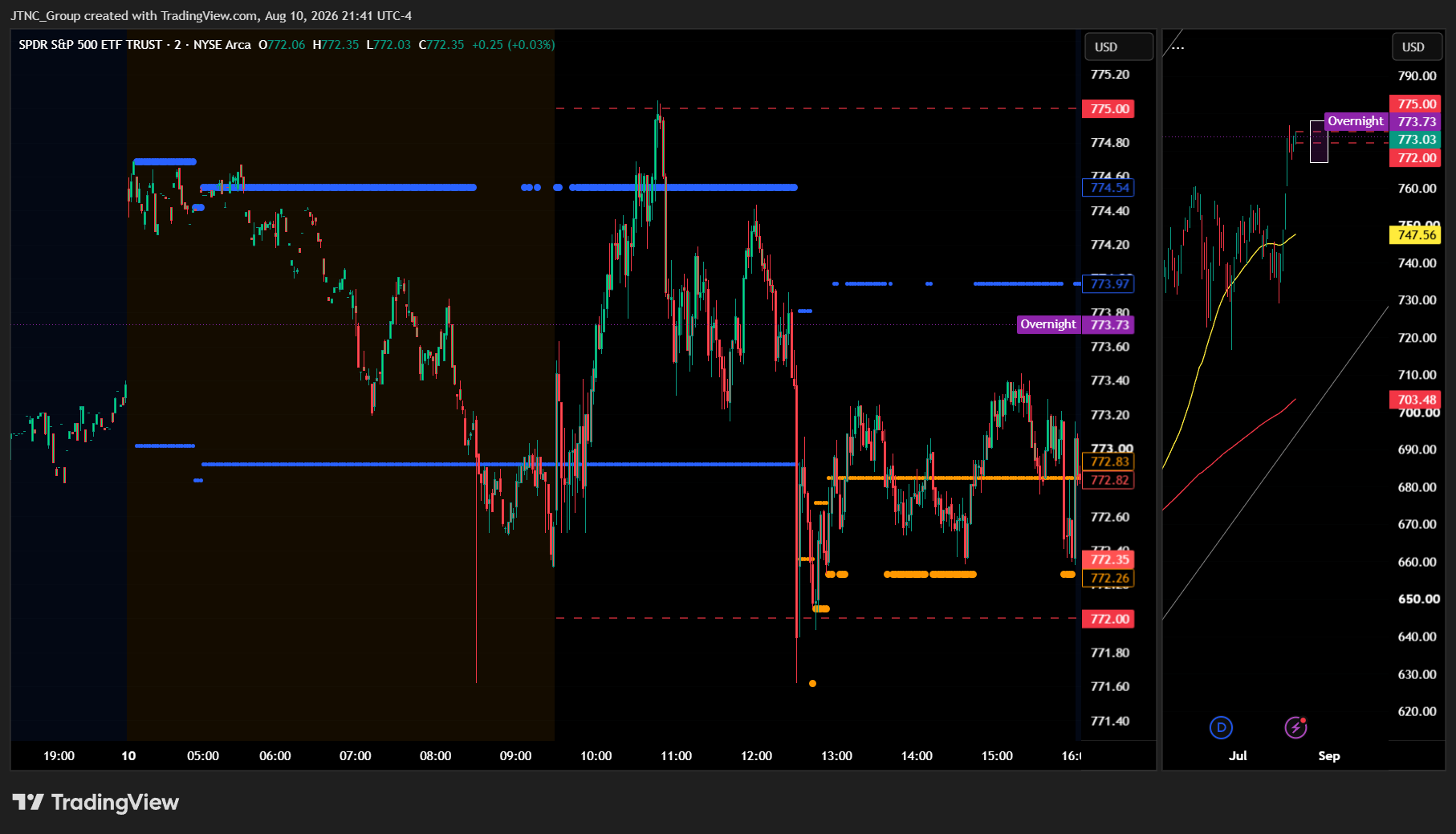
Current Market State Overview:
The MSI ended in a Bearish Trending Market State with SPY closing at $773.05. Since SPY closed above MSI resistance, that former resistance level at $772.83 now flips to become support heading into Tuesday, and what was MSI support at $772.26 becomes a secondary reference level below. Extended targets were not printing at the close, though they did print below during both the AM session and the PM session. In premarket, no extended targets were visible, though the MSI did rescale higher overnight with extended targets present on hope that a geopolitical resolution might be near. By the open that optimism faded, and the MSI rescaled slightly lower, signaling the broader market was not buying into the move and that any push higher was likely to get sold. Sure enough, an early dip below MSI support pushed SPY back toward the all-time high, where it reached MSI resistance without much trouble — but that was as far as the bulls could push it. Without extended targets to sustain the bid, the market stalled and selling pressure took over. The MSI rescaled lower several times, but even in a Bearish Trending state it rescaled back higher on multiple occasions, indicating the move lower lacked smart money conviction. That dynamic sent SPY into a grinding back-and-forth between MSI support and MSI resistance for much of the afternoon, transitioning into a Ranging state several times. With no high-impact economic events Tuesday to serve as a catalyst, the MSI is forecasting likely sideways to possibly up as the narrow bearish MSI suggests consolidation rather than strong trending. That said, the bears are likely to maintain pressure to the downside. Any failure of MSI support is likely to see SPY retest the day's lows. SPY opened at $772.60, traded a high of $775.03 and a low of $771.89, and closed at $773.05, down just 0.03% on volume of 31.96 million shares, which came in below average. The VIX rose 3.49% to 15.42. The MSI range remains exceptionally narrow at a $0.57 spread, indicating tight consolidation and a market coiling for its next move. MSI support is $772.26 with resistance at $772.83.
Key Levels and Market Movements:
Friday we stated, "Bulls want to see overnight price hold the flipped support level at $770.7 and the MSI rescale into a Bullish Trending state with extended targets printing above," and added, "Bears want to see $770.7 fail and the MSI rescale lower with extended targets printing below. If that occurs, SPY is likely to retest Friday's low at $769.61 and potentially press toward lower levels beneath the session range," while also noting, "The first MSI state of Monday's session will be the key tell — follow it and do not force a trade before it updates." That forecast held up well through the morning, though Monday ultimately proved to be a day where patience and discipline mattered more than boldness. The bulls did hold $770.7 overnight, and the MSI rescaled higher heading in with a brief period of extended targets on geopolitical optimism, but the herd never joined that move. By the open the MSI had already rescaled slightly lower, stripping away any extended target support and signaling the upside was on borrowed time. An early dip below MSI support briefly threatened the bullish setup before SPY bounced and rallied back toward MSI resistance near the all-time high, which it tagged cleanly. That resistance test gave traders a clean sell setup at $772.83, targeting MSI support at $772.26, and price obliged. From there the session became a choppy grind as the MSI rescaled lower several times but kept bouncing back higher, confirming neither side had the conviction to sustain a trend. Extended targets printed below during both the AM and PM sessions, giving traders brief windows to trade the short side with confirmation before the MSI's repeated rescales higher muddied the picture. The afternoon settled into a Ranging state with SPY bouncing repeatedly between MSI support and MSI resistance — a setup we do not favor trading into without a clear failed breakout or breakdown to anchor the entry. At minimum it was a 3-for-3 session for traders following the framework. It was an easy day to read albeit not an easy day to trade given the tight choppy range. But substantial setups were present, all identified through proper context, patience, and flexibility while leveraging the MSI, premarket levels, and market structure rather than forcing trades. The MSI continues to prove its reliability as the cornerstone of our trading process.
Trading Strategy Based on MSI:
Tuesday has light economic news so the market is likely to move more sideways than trend given the Bearish Trending at the close. But with such a narrow range it is also likely the MSI rescales overnight and a short squeeze ensues which will push price back to test higher levels. The $0.57 spread is among the tightest readings we see, and a range that compressed almost always resolves with a directional move — the question is which way. Wednesday's Core CPI and CPI data will begin to cast a shadow on Tuesday's session as traders position ahead of that report, which could introduce some pre-event drift in either direction. But for Tuesday itself, there is no high-impact catalyst forcing the MSI's hand, which means the MSI's own behavior overnight will be the primary guide.
Bulls want to see overnight price hold the flipped support at $772.83 and the MSI rescale into a Bullish Trending state with extended targets printing above. If that happens, the door opens for a retest of Monday's high at $775.03 and a push toward higher levels beyond that. The narrow range means even a modest overnight bid could trigger a squeeze that carries real momentum. Bears want to see $772.83 fail and the MSI rescale lower with extended targets printing below. If that occurs, SPY is likely to retest Monday's low at $771.89 and press toward lower levels beneath the session range. Given the Bearish Trending close and the bears' persistent pressure throughout Monday's session, a breakdown scenario cannot be dismissed even without a clear catalyst.
The most actionable setup on a light-news day with a narrow Bearish Trending MSI is to buy dips to $772.83 if it holds as support overnight, targeting a push back toward $775, or to sell rallies to $772.83 if it has reverted to resistance, targeting $772.26 and the levels below. Do not anticipate — let the MSI confirm the state at the open before committing to either side. A Ranging state at the open is the most likely scenario given Monday's close, and in that environment the highest-probability plays are failed breakouts above $772.83 and failed breakdowns below $772.26. Trade the rejection, not the breakout, until the MSI gives a clear trending signal with extended targets to back it up.
The long-term bull trend remains intact above $640 and failed breakouts and failed breakdowns continue to offer the highest-probability setups. Remain flexible, avoid trading during Ranging Market States unless a clear failed breakout or breakdown presents itself, and ensure all trades are fully aligned with MSI signals. Providing real-time insights into market control, momentum shifts, and actionable levels, the MSI when integrated with our Pre-Market and Post-Market Reports continues to sharpen execution precision and elevate trade quality. If you haven't yet integrated MSI and our model levels into your process, now is the time. Contact your representative to get started as these tools are designed to support consistency and enhance performance.
Dealer Positioning Analysis
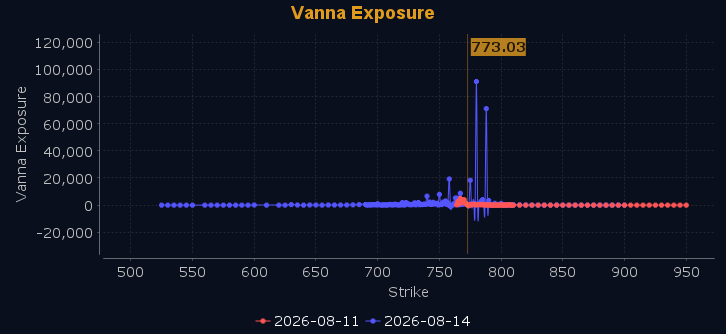
Dealers are selling SPY $774 to $810 and higher strike Calls, indicating the Dealers' belief that the market may hover in its current range while waiting for an external catalyst. The ceiling for Tuesday appears to be $780. Notably, Dealers are not selling ATM Puts or buying ATM Calls, and they have not increased their hedges, which implies a market that could take some time to consolidate before attempting a move higher. To the downside, Dealers are buying $773 to $720 and lower strike Puts in a 3:1 ratio to the Calls they're selling, displaying moderate concern that prices could move lower. For Tuesday, below $767 is bearish and above $775 is bullish, with nothing but chop in between. There is heavy resistance at $777 and $780, while support at $767 will slow any decline. Dealer positioning is unchanged at neutral/slightly bullish.
Looking Ahead to Next Friday:
Dealers are selling SPY $774 to $820 and higher strike Calls, indicating the Dealers' belief that prices may struggle to push meaningfully higher without a clear catalyst. The ceiling for next week appears to be $775. To the downside, Dealers are buying $773 to $700 and lower strike Puts in a 4:1 ratio to the Calls they're selling, displaying heightened concern that prices could move lower. Dealers remained hedged but have not increased their protection heading into next week, and they are no longer selling Puts at $760, suggesting they are less certain about where prices will land this week. With earnings season winding down, the next directional move will likely come from an economic data point or an external catalyst such as a resolution to the war in the Middle East. We recommend traders remain bullish above $776 but below $770 remain bearish, with chop in between. There is major support at $767 with major resistance at $780, which will slow any ascent above these levels. For the week Dealer positioning is unchanged at bearish. We advise reviewing Dealer positioning daily for directional clues. These positions evolve quickly and tracking them is essential for staying ahead of shifting market sentiment.
Recommendation for Traders
With SPY closing at $773.05 and the VIX rising 3.49% to 15.42, lean cautious — favor longs on dips toward $771.89 support with stops below $771, and trim near $775 if momentum stalls. The 10-year holding at 4.700 keeps pressure on equities, so avoid chasing strength.
Keep size small given below-average volume and a slightly edgy VIX. Always review the premarket analysis posted before 9 AM ET for any changes in the model's outlook and Dealer Positioning.
Good luck and good trading!
