
Market Insights: Tuesday, June 23rd, 2026
Market Overview
Stocks took a beating on Tuesday as a selloff in memory chipmakers reignited doubts about AI valuations across the board. The Nasdaq led the decline with a roughly 2.1% drop, while the S&P 500 shed 1.4% and the Dow barely escaped, finishing just below flat. The pain was centered squarely in tech, with SK Hynix and Samsung Electronics both cratering more than 12% in South Korea, dragging the Kospi Composite down 10% and sending shockwaves through the AI trade globally. That brutal session in Seoul put a fresh spotlight on Micron, which reversed hard from Monday's record close and tumbled over 13% — with its earnings due Wednesday now carrying even more weight as a barometer for memory demand.
SpaceX added another layer of drama, briefly wiping out all of its post-IPO gains before recovering to close slightly in the green. On the macro side, US-Iran nuclear negotiations continued to show progress, with the US issuing a 60-day sanction waiver on Iranian oil and satellite data confirming increased tanker traffic through the Strait of Hormuz — sending both Brent and WTI crude futures lower.
SPY Performance
SPY opened at $733.81 and never really gave the bulls much to work with, as selling pressure emerged early and the market struggled to find any sustained footing throughout the session. There was no clean momentum attempt, no meaningful bounce off intraday support — just a slow bleed that reflected a market still working through overhead resistance and broader macro uncertainty.
The session high of $739.63 was printed relatively early and quickly rejected, which told you everything you needed to know about the day's tone. From there, SPY worked its way down to a low of $732.30 before settling at $733.73, a loss of 1.43% that adds another layer of technical damage to what has already been a choppy, difficult tape. The close near the lows of the session is not a constructive sign — it suggests sellers were in control through the final hour with no meaningful dip-buying to push back. Volume came in at 55.45 million shares, near average, which is actually the more notable detail here. A 1.43% down day on near-average volume means this wasn't a panic flush driven by forced selling — it was measured, deliberate distribution, and that's arguably more concerning than a high-volume spike down would be. The VIX surged 12.44% to close at 19.43, a meaningful jump that signals fear is creeping back into the market in a real way. Back-to-back VIX expansion days at this magnitude suggest the volatility unwind that had been building is now reversing, and bulls will need to reclaim recent levels quickly before the technical picture deteriorates further.
Major Indices Performance
The Nasdaq was the clear laggard on the session, shedding 2.21% as heavy selling in large-cap tech dragged the index lower and pulled the broader S&P 500 down with it. The weakness was concentrated in the mega-cap growth names that have been carrying the market on their backs, and when that cohort rolls over, the Nasdaq feels it more than anywhere else. That kind of concentrated selling in the highest-weight names has an outsized effect on the index, and today was another reminder of just how much the Nasdaq's fate is tied to a handful of stocks.
The Dow held up comparatively well, slipping just 0.09% and essentially going nowhere. Its heavier tilt toward value and industrials insulated it from the tech wreckage happening elsewhere, and the index's relative calm stood in sharp contrast to the damage being done in growth land. That divergence between the Dow's near-flat finish and the Nasdaq's steep decline tells you a lot about where the selling pressure was concentrated today.
The Russell 2000 fell 0.94%, a discouraging reversal after the small-cap index had shown some encouraging signs in recent sessions. Small-caps tend to be sensitive to risk sentiment broadly, and on a day when growth was getting hit hard and the VIX was spiking, it's not surprising to see them pulled lower. What's notable is that the Russell underperformed the Dow pretty significantly, suggesting this wasn't just sector rotation — it was more of a broad risk-off move that caught smaller, more vulnerable names in the crossfire alongside their large-cap growth counterparts.
Notable Stock Movements
Tesla took center stage in the Magnificent Seven for all the wrong reasons, shedding 5.79% in a session that put immediate pressure on the broader group and reinforced the risk-off tone spreading across large-cap tech. A loss of that size from one of the cohort's most momentum-driven names carries outsized psychological weight — when Tesla breaks down hard, it has a way of rattling confidence across the entire mega-cap space, and today was no exception.
The mostly red showing from the Magnificent Seven fit cleanly with what was happening across the broader tape, where the Nasdaq's 2.21% decline made clear that technology was the epicenter of today's selling. Microsoft and Amazon managed to finish in the green, standing as the lone exceptions in an otherwise rough session for the group — but two green names out of seven isn't a vote of confidence, it's damage control. The fact that even the more defensively positioned names within the cohort couldn't generate meaningful upside tells you that institutional appetite for mega-cap tech is under real pressure right now.
What's notable is that unlike the prior session, where Alphabet's drop looked at least partly stock-specific, today's weakness feels more broadly sentiment-driven. The Russell 2000's 0.94% decline confirms this wasn't a rotation story either — money wasn't moving down the cap spectrum, it was pulling back across the board. The VIX surging 12.44% to 19.43 alongside a heavily red Magnificent Seven signals that the fragility flagged in recent sessions is now hardening into something more consequential, and with Tesla leading losses at the scale it did today, the group's ability to stabilize and reclaim leadership of any meaningful rally attempt is very much in question heading into tomorrow.
Commodity and Cryptocurrency Updates
Crude oil slipped another 1.99% on the session to $73.33, extending the recent pullback but still holding comfortably above $70 and well clear of longer-term model expectations. The black gold has rallied well above where most had anticipated it would be trading, and the underlying supply dynamics and geopolitical tensions that got it here haven't shown any meaningful reversal. One thing that hasn't changed is the Fed's headache — a sustained presence above $70 keeps energy costs in the inflation conversation whether policymakers like it or not, and that reality isn't going away on the back of a couple of down sessions.
Gold dropped 1.19% to $4,132 today, a more notable pullback than yesterday's shallow dip but still nothing that threatens the yellow metal's dominant longer-term positioning. At these historically elevated levels, some give-back is entirely normal, and institutional holders aren't abandoning a core hedge just because of a single rough session. The macro environment — equity volatility, policy uncertainty, and general unease — continues to provide a strong fundamental case for gold, and the broader uptrend remains very much intact.
Bitcoin had a tough session, falling 2.46% to close just above $62,377, reversing yesterday's encouraging divergence from broader market weakness. Today the crypto market moved in lockstep with the risk-off tone that hit equities hard, particularly tech, and that correlation is a reminder that Bitcoin isn't immune to macro-driven selling pressure. That said, closing above $62,377 keeps buyers in a reasonably constructive technical zone, and the next catalyst will go a long way toward determining whether yesterday's independent strength was a preview of things to come or just a one-day blip.
Treasury Yield Information
The 10-year Treasury yield edged higher today, climbing 0.94% to close at 4.490%. That's an interesting spot — it's technically just below the 4.5% threshold where rate pressure begins to bite, but given yesterday's close at 4.510%, yields are essentially hovering right at that critical line. The market is trading in a zone where any incremental move higher puts stocks back into contested territory, and any relief would require yields to pull convincingly away from this level.
The buffers in our framework remain thin. There are 31 basis points between current yields and the 4.8% level where selling pressure historically accelerates, 51 basis points before the 5% threshold that signals serious market risk, and 71 basis points before the 5.2% level associated with a correction of 20% or more. Those gaps offer some cushion, but with yields grinding higher over recent sessions, the direction of travel continues to favor caution. A market that's already selling off on heavy volume doesn't need yields to break 4.8% to feel the pain — proximity to 4.5% is enough to keep institutional buyers on the sideline.
What's notable today is that yields didn't need to spike dramatically to contribute to broad-based weakness. The VIX surged 12.44% to 19.43, and the Nasdaq dropped sharply — that kind of volatility expansion alongside stubbornly elevated yields is exactly the combination that keeps the risk-off tone alive. The question now is whether 4.490% marks a temporary pause before another leg higher, or whether yields are beginning to stabilize. Any Fed commentary leaning hawkish or any inflation surprise to the upside could push yields back above 4.5% quickly, and from there the path toward 4.8% becomes the dominant concern for equities.
Previous Day’s Forecast Analysis
Yesterday's forecast set up a seventeen-point trading range for SPY with $738 as the downside floor and $755 as the max upside target, carrying a modestly bearish bias into the session given Monday's close at $744.28 just below the critical $745 level. The model identified $748 as the single most important level of the day — the heavy concentration zone and directional gate that would determine the next leg. Bulls needed to reclaim $745 first and then push through $748 with conviction to flip the structure constructive and open the door to $750, $751, and ultimately the $753 call wall. On the downside, $744 was flagged as the first point where selling could accelerate, with $742 as the next decision point below that, $740 as the last major structural defense, and $738 as the model's max downside if that floor gave way.
The trading strategy leaned toward caution given the VIX rising to 17.42, recommending position sizes trimmed to around 80-85% of normal and slightly wider stops to account for elevated noise. Long setups were outlined in the $743-744 zone targeting $748-750 initially, with a stretch run to $752-754 on strong participation, and stops defined below $741. Short setups carried more conviction, with the $748-750 band identified as the natural fade zone on any bounce attempt, targeting $743-744 first and $739-741 on a deeper flush. A definitive break below $743 was the trigger for adding short exposure targeting $739-740 with stops above $746. The overarching message was discipline on sizing, defined risk on every setup, and stops kept in the 1.5-2% range from entry — no chasing moves in either direction.
Market Performance vs. Forecast
Tuesday's session delivered a decisive downside move that tested the outer boundaries of the model's projected range, with SPY opening well below Monday's close and never mounting a serious challenge to the key levels the forecast had identified as the bulls' primary battleground. The open at $733.81 landed below the model's $738 max downside target, meaning external forces drove price action beyond the projected range before the first trade was even printed — a reminder that no model can fully account for overnight catalysts and geopolitical developments that introduce volatility exceeding the base case scenario. That said, the framework's structural logic remained sound throughout the session, and the directional lean toward continued weakness that shaped Tuesday's strategy proved exactly right.
What the forecast got right was the overall bearish orientation. The prior session's close below $745 in a heavy negative gamma zone was flagged as a serious concern, and the model was explicit that the burden fell on bulls to reclaim $748 before any recovery could take shape — a burden they never came close to meeting. The forecast also identified $744 as the first level where selling could accelerate, and $740 as the point of last hope where structural support would be tested. Tuesday's price action blew through both of those thresholds in sequence, validating the directional framework even as the magnitude exceeded the model's base case. The VIX expanding another 12.44% to 19.43 reinforced the message the prior session had already delivered — fear was being repriced aggressively, and traders who followed the guidance to trim position sizes to 80-85% of normal and maintain stops below $741 had risk management protocols working exactly as designed, protecting capital through an outsized move. The model identified the right direction, the right tone, and the right structural levels — and that analytical clarity is precisely the edge the framework continues to deliver as the tape evolves.
Premarket Analysis Summary
Our premarket analysis posted at market open identified SPY at $735.78 in a put-dominated environment, gapping sharply lower under significant pressure, with the expected move widening to 15 points as traders braced for a major volatility event. The defining gate was set at $737 — the level where broken structure could attempt to repair — with upside targets at $740 as the round-number pivot, $742 as the major call wall, $744 as the next resistance, and $750 capping the expected move as max upside. The analysis was clear that in a put-dominated setup with heavy negative gamma stacked overhead, the burden sat squarely on the bulls until $737 was reclaimed and held. On the downside, $735 was flagged as the first critical level given the heaviest negative gamma concentration sitting there, with a clean break expected to accelerate selling toward $734, then $732 as the next decision point. The $729 level was identified as the point of last hope given the significant put wall there, and $721 was set as max downside at the bottom of the expected move. The analysis specifically warned that if $735 failed early, minimal cushion existed before $732 and a fast test toward $729.
The actual session validated the downside framework almost perfectly. SPY opened at $733.81, already below the critical $735 zone the analysis had flagged as the accelerant trigger, meaning sellers had control from the opening bell. The session low of $732.30 sliced directly into the $732 decision point the analysis outlined, and the close at $733.73 landed squarely in the breakdown zone between $735 and $732 where we warned selling could pick up speed. The upside targets at $737, $740, $742, $744, and $750 went entirely untested, with the session high of $739.63 briefly threatening $740 but ultimately rejected well short of the $742 call wall. VIX surging 12.44% to 19.43 confirmed the violent, put-dominated conditions the premarket analysis had specifically warned about.
Validation of the Analysis
Today's session was a near-textbook confirmation of the premarket analysis, with SPY interacting directly with the key levels mapped out before the open. The analysis flagged 735 as "the heaviest negative gamma zone" and warned that losing it cleanly would "open the door for an acceleration lower" — that's exactly what the market delivered. SPY opened at $733.81, already beneath 735, signaling from the first tick that the bears were in control and that the premarket downside framework was the operative roadmap for the day.
The downside targets played out with impressive precision. The premarket identified 734 as the level where "selling could pick up speed" and 732 as "the next decision point" — SPY sliced through both on its way to a session low of $732.30, tagging the 732 zone almost exactly before finding any meaningful stabilization. Traders armed with the premarket map had a clean, well-defined setup: once 735 failed to hold at the open and 734 gave way without a fight, the path to 732 was the obvious trade, with minimal cushion in between exactly as the analysis warned. That low of $732.30 also confirmed 729 held as structural support, never getting tested — consistent with the analysis framing 729 as the "point of last hope" rather than a foregone destination.
On the upside, the 737 gate proved its worth as a ceiling. SPY briefly surged to $739.63, punching through 737 and tagging close to the 740 round-number pivot called out as "first target above 737" — an ideal fade entry for traders who trusted the framework. Price could not sustain above 737, rejected the 740 zone, and collapsed back to close at $733.73, never threatening 742 or the call wall above. The VIX spiking 12.44% to 19.43 validated the put-dominated, high-volatility conditions the premarket explicitly flagged, and the wide expected move of 15 points accurately contained the full session range. From the failed open at 735 to the flush into 732 and the rejection of 737-740 on the bounce, the premarket analysis delivered a precise, actionable map for every major move of the day.
Looking Ahead
Wednesday's economic calendar is quiet, with no high-impact releases scheduled to move the needle. That makes it another positioning session — a chance for traders to fine-tune exposure ahead of Thursday's big data dump without any macro headlines forcing their hand. When the calendar is this clean, price action and market internals take over as the primary guides.
The real weight falls on Thursday, when Core PCE and Final GDP both hit before the open. PCE is the Fed's preferred inflation measure, meaning any surprise in that print could shift rate expectations in a hurry. Final GDP will either reinforce or complicate the current growth narrative. With both of those sitting just one session away, Wednesday is essentially the market's last quiet window to get positioned cleanly — because once Thursday morning arrives, the opportunity to react on your own terms gets considerably narrower.
Market Sentiment and Key Levels
Bears are firmly back in control after Tuesday's session, and this one carried more conviction than the prior day's modest retreat. SPY dropped 1.43% and closed at $733.73, finishing just above the session low, which tells you sellers were active right into the close and buyers had little appetite to defend ground. The VIX surging 12.44% to 19.43 is the real warning signal here — that's a meaningful spike in fear that pushes the index closer to territory where institutional hedging activity tends to accelerate. Near-average volume at 55.45 million shares means this wasn't a low-liquidity drift lower — there was genuine selling pressure behind the move.
The key resistance level to watch is $739.63 — today's intraday high that was rejected decisively. SPY couldn't sustain anything above that level, and a recovery back through it would need strong volume and a shift in broader sentiment to carry any weight. A convincing close above $739.63 would suggest bulls are mounting a credible defense and the pullback may be stabilizing. On the downside, $732.30 is the immediate support line, marked by today's session low. A break below that level on elevated volume opens the door to a more serious test of the $730 area and potentially lower. The divergence across indices is worth noting — the Dow barely budged while Nasdaq absorbed the brunt of the damage, pointing to tech-specific pressure rather than a uniform market collapse. Gold pulling back alongside equities limits the flight-to-safety story, and Bitcoin's decline adds a mild risk-off confirmation. With the VIX pushing toward 20 and yields hovering just under the 4.5% threshold, the burden of proof sits squarely on the bulls heading into the next session.
Expected Price Action
Wednesday's session presents actionable intelligence generated by our AI model, with SPY projected to trade within a range defined by $721 on the downside and $750 as the max upside target. That twenty-nine-point window signals the market will trend rather than consolidate, and with Tuesday's close at $733.73 sitting well below the critical $737 level, the bias leans clearly bearish heading into Wednesday — the put-dominated environment and widened expected move of fifteen points tell you traders are positioned defensively, and the burden falls squarely on the bulls to reclaim $737 before any meaningful recovery can take shape.
The defining level heading into Wednesday is $737, which the model identifies as the gate above current price where broken structure could attempt to repair. The close beneath that level is a serious concern — negative gamma stacked overhead means any rally attempt faces significant resistance before it can build momentum. If the bulls manage to reclaim $737 and hold it with conviction, the structure becomes constructive and opens the door to $740, then $742 as the major call wall and key decision point, with $744 as the next resistance and $750 capping the expected move at the top. On the downside, $735 is the first line to watch — that's the heaviest negative gamma zone, and losing it cleanly opens the door for an acceleration lower. Below there, $734 is where selling could pick up speed, followed by $732 as the next decision point. The $729 level represents the point of last hope, where a significant put wall and major structural support converge — a failure there would be a serious warning sign and open $721 as the model's max downside. How SPY responds at $737 on any early bounce, and whether $735 holds on continued weakness, will be the two most critical tells for how Wednesday ultimately resolves.
Trading Strategy
The VIX rising 12.44% to 19.43 is a significant escalation in fear pricing — this is no longer a mild caution signal but a genuine warning that the options market is repricing risk at a pace that demands immediate attention to position sizing and stop placement. At 19.43, volatility is knocking on the door of levels that historically precede more disorderly price action, and that means trimming exposure to around 70-75% of normal sizing while widening stops enough to account for the kind of intraday whipsaws that elevated VIX environments routinely produce. The near-average volume on a session marked by broad weakness tells you this selloff wasn't driven by panic liquidation, but the sharp underperformance in tech and the soft close near session lows give the tape a heavy, defensive quality that deserves serious respect heading into tomorrow.
Long setups become interesting near the $730-732 zone, which aligns with the session low and represents the first credible area where buyers could step in to defend the trend. Entries in that range target $736-738 as the initial profit zone, with a secondary target near $739-740 if momentum builds and participation improves. Stops on long trades belong below $729, keeping risk tight and preventing a deeper breakdown from turning a manageable loss into a damaging one. In a rising market scenario, a decisive reclaim of $739-740 with solid follow-through becomes the trigger to add exposure, targeting $743-744 on the upside with stops trailed up to $736 to lock in gains as the trade progresses.
Short setups carry stronger conviction given the VIX surge and the close that held dangerously close to the session low. The $736-738 band is the natural area to fade any attempted bounce, especially if that rally develops on light participation and stalls before recapturing the open. Downside targets sit at $732-733, with a deeper flush toward $729-730 if selling pressure returns with any intensity. In a declining market scenario, a clean break below $732 reopens short entries targeting $728-730, with stops placed above $735. With the VIX at 19.43, keep stop-loss parameters in the 1.5-2% range from entry, reduce size on every new setup, and avoid the temptation to chase extended moves in either direction — at this volatility level, discipline on risk management isn't just a suggestion, it's the only way to stay in the game.
Model’s Projected Range
SPY's projected maximum range for Wednesday is $725 to $743, with the Put side dominating in an expanding band that suggests trending price action with intermittent chop. Wednesday brings no economic news due out so the market will trade on technicals. SPY closed at $733.73, down 1.43%, after opening at $733.81, tagging a high of $739.63, and sliding to a low of $732.30 before settling near session lows on below-average volume — a session that showed early optimism fade into steady selling pressure. SPY remains in the $730 to $735 range that has defined recent trading, with ongoing macro uncertainty continuing to keep bulls cautious near recent highs. If SPY can reclaim and hold $735, our model points toward $740 as the next upside target, but if $730 gives way, price would quickly be looking at $725 as the next line in the sand — and if that breaks, there is little to keep price from falling toward $720. The long-term bull trend remains intact above $640 with SPY well above structural support. As long as price holds above key structural levels, this remains a broader dip-buying environment. Absent a catalyst, resistance sits at $735, $740, $743, $745, while support rests at $730, $725, $720. Given the close near the lower end of the range, we favor buying dips at $730 rather than chasing this weakness lower. Bitcoin dropped 2.46% to close above $62,377, and MAG stocks were mostly red led by Tesla's 5.79% decline, with Microsoft the lone bright spot up 1.80% — sustained weakness across both leadership groups would be required to signal a deeper pullback. The VIX closed at 19.43, up 12.44%, suggesting elevated fear given the broad selling and lack of any meaningful bounce into the close. SPY closed near the lower line of the trend channel, with structural support near $730 keeping the near-term structure intact for now.
Market State Indicator (MSI) Forecast
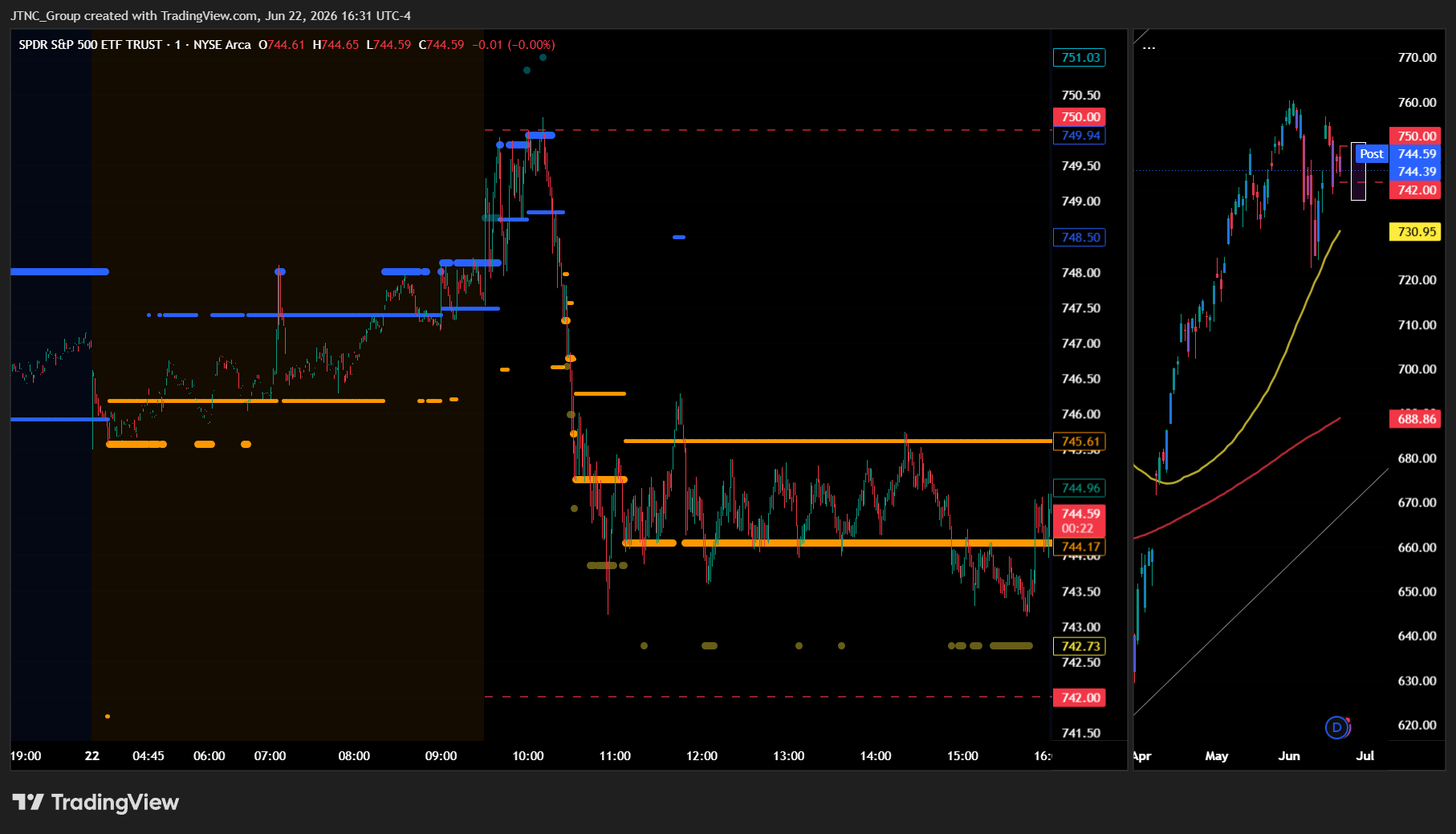
Current Market State Overview:
The MSI ended in a Bearish Trending Market State with SPY closing at $733.73. MSI support holds at $733 and resistance at $736.78, and since SPY closed inside the range, those levels remain in their respective roles heading into Wednesday. Extended targets were not printing at the close, though they did appear above during the AM session, offering a brief window of upside energy early in the day before sellers reasserted control. In premarket, no extended targets were visible, which kept the overnight tone measured and offered no early directional conviction for buyers. The MSI gapped lower overnight and rescaled into a wide Bearish Trending state, which remained in place for the bulk of the session. While SPY attempted several recoveries, the MSI moved to a wide Ranging state at various points, refusing to buy into any rally. By the close, SPY had drifted back toward the lows of the day, firmly within the Bearish Trending structure. The wide spread of $3.78 gives price room to breathe within the current bands, and with no extended targets printing below during the regular session, the bears were unable to press for a sustained directional flush. Instead, the session was largely a slow, grinding decline with failed recovery attempts keeping bulls on the defensive all day. The VIX rising over 12% to 19.43 reflects elevated anxiety that remains a headwind for any meaningful bounce. Looking ahead, the MSI is forecasting a slow grind lower for Wednesday, though without extended targets at the close the downside may be limited and is likely to find support at key levels below. MSI support is $733 with resistance at $736.78.
Key Levels and Market Movements:
Monday we stated, "Bears want to see $745.61 continue to cap any overnight rally and press price back toward $744.17 MSI support, and if that level fails to hold, a retest of the day's low near $743.13 becomes the next natural target as the MSI would likely rescale lower and reintroduce fresh downside momentum," and added, "If the MSI rescales overnight into a Bullish Trending state, look to buy dips to MSI support and hold toward resistance with conviction. If the Bearish Trending state holds, keep expectations measured and trade the edges," while also noting, "Given the narrow spread and the absence of extended targets at the close, failed breakouts and failed breakdowns within the range are the highest-probability setups Tuesday, and traders should respect whichever direction the MSI resolves toward rather than front-running a bias." The bears delivered decisively on Tuesday. Rather than the short squeeze or overnight rescale higher that the narrow configuration had made plausible, the MSI gapped lower overnight into a wide Bearish Trending state and spent the rest of the day grinding sellers into a clear advantage. The session played out almost entirely in line with the bearish edge the framework warned traders to respect.
The Ranging state that carried through premarket set an early neutral tone, but the transition to Bearish Trending at the open was swift and clean. SPY opened at $733.81 and made an early push toward the high of $739.63, with extended targets briefly printing above during the AM session, offering bulls a defined long setup — buy MSI support and target resistance above as the tape tried to squeeze higher. That attempt ultimately failed to hold, and when the AM session extension disappeared and the wide Bearish Trending state reasserted itself, sellers stepped back in with purpose. The first setup came as SPY tested the upper MSI resistance near $736.78 in the AM session and rejected, giving traders a clean short entry targeting MSI support at $733. With no extended targets printing below during the regular session, SPY did not make a dramatic directional plunge but instead spent the afternoon grinding lower in a controlled, methodical way. A second setup materialized as the session moved into the PM and SPY attempted another modest recovery that stalled near resistance, offering another opportunity to fade the rally back toward the lower end of the range. SPY closed at $733.73, just above MSI support, with the bears firmly in control but lacking the extended target confirmation needed to press for lower prices with real conviction. At minimum it was a 2-for-2 session for traders following the framework. It was an easy day to read albeit not an easy day to trade given the wide but slow-grinding range. Substantial setups were present, all identified through proper context, patience, and flexibility while leveraging the MSI, premarket levels, and market structure rather than forcing trades. The MSI continues to prove its reliability as the cornerstone of our trading process.
Trading Strategy Based on MSI:
Wednesday has light economic news so the market is likely to grind lower given the Bearish Trending state at the close, though the move may be modest. The MSI closed in a wide Bearish Trending state with a spread of $3.78, and while the wide configuration confirms the bears are in control and gives price room to work lower, the absence of extended targets at the close is an important caveat. Without that downside confirmation, a sustained directional flush is less probable, and dips toward and below $733 MSI support may start to attract buyers looking for value at lower levels. Wednesday should be approached with that duality in mind — the path of least resistance still favors the bears, but the lack of extended targets below suggests the downside is likely to be measured rather than aggressive.
Bulls want to see overnight strength hold above $733 MSI support and push price back through $736.78 resistance with enough conviction to trigger a rescale into a Ranging or Bullish Trending state, which would signal that buyers have absorbed the recent selling pressure and are willing to defend higher ground. A clean break and hold above $736.78 would be the clearest sign that Wednesday can stage a meaningful recovery and begin working back toward levels lost over the past two sessions. Bears want to see $736.78 continue to cap any overnight strength and press price back toward $733 MSI support, and if that level gives way on volume, deeper tests toward lower premarket levels become the next natural target as the MSI would likely rescale lower and reintroduce more meaningful downside momentum. Any rally toward $736.78 that stalls and reverses is a potential shorting opportunity targeting $733 MSI support and the levels below it, while any dip that holds and bounces near $733 could offer a quick long setup targeting $736.78 resistance above. Given the wide Bearish Trending state and the absence of extended targets at the close, fading rallies toward resistance remains the highest-probability approach Wednesday, but traders should remain alert to any failure of $733 that could shift the framework's posture more aggressively lower. If the MSI rescales overnight into a Ranging state, keep expectations measured and trade the edges — failed breakouts near $736.78 and failed breakdowns near $733 offer the clearest entries. If the Bearish Trending state holds into the open, lean short on any test of resistance and respect the structure the MSI is maintaining.
The long-term bull trend remains intact above $640 and failed breakouts and failed breakdowns continue to offer the highest-probability setups. Remain flexible, avoid trading during Ranging Market States unless a clear failed breakout or breakdown presents itself, and ensure all trades are fully aligned with MSI signals. Providing real-time insights into market control, momentum shifts, and actionable levels, the MSI when integrated with our Pre-Market and Post-Market Reports continues to sharpen execution precision and elevate trade quality. If you haven't yet integrated MSI and our model levels into your process, now is the time. Contact your representative to get started as these tools are designed to support consistency and enhance performance.
Dealer Positioning Analysis
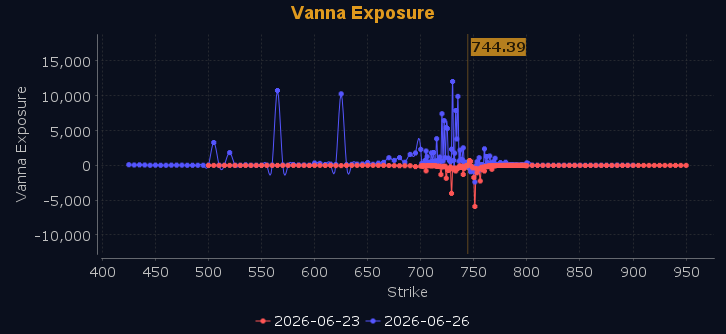
Dealers are selling SPY $734 to $780 and higher strike Calls, while buying $746 to $750 Calls, indicating the Dealers' desire to participate in any rally on Wednesday. The ceiling for Wednesday appears to be undefined at this time. To the downside, Dealers are buying $709 to $650 and lower strike Puts in a 4:1 ratio to the Calls they're selling, displaying strong concern that prices could move lower. Dealers are also selling OTM Puts from $733 to $710, indicating their belief that prices will find a floor above $710 and potentially move sideways to higher. Dealers do not sell ATM Puts unless they believe there is a floor in the market at $710. That said, Dealers have added to their hedges just in case the market continues to fall. Below $745 is bearish and above $746 is bullish, with a wall of resistance and support at $735 acting as the dividing line for Wednesday. Dealer positioning is unchanged at bearish.
Looking Ahead to Next Friday:
Dealers are selling SPY $748 to $780 and higher strike Calls, while buying $734 to $747 Calls, indicating the Dealers' desire to participate in any rally that develops this week. The ceiling for next week appears to be $760. To the downside, Dealers are buying $733 to $625 and lower strike Puts in a 5:1 ratio to the Calls they're selling, displaying strong concern that prices could move lower. Dealers are buying ATM Calls in size to participate in any rally this week, though they are clearly positioned for more weakness. Notably, they have not added to their hedges on a weekly basis and are no longer selling ATM Puts. There is a zone between $730 and $735 that may contain price into Friday. Remain bullish above $747 but below $746 fade any rallies. For the week Dealer positioning is unchanged at bearish. We advise reviewing Dealer positioning daily for directional clues. These positions evolve quickly and tracking them is essential for staying ahead of shifting market sentiment.
Recommendation for Traders
With SPY closing at $733.73 and the VIX surging 12.44% to 19.43, the bias is clearly defensive heading into the next session. Watch $732.30 as near-term support — a break below that level opens the door to further downside and favors shorts. Bulls need to reclaim $739.63 to shift momentum. Keep position sizes small and lean toward shorts until the tape stabilizes.
Rising volatility demands tighter stops and disciplined risk management — don't overstay losing trades. Review the premarket analysis posted before 9 AM ET for any changes in the model's outlook and Dealer Positioning.
Good luck and good trading!
