
Market Insights: Wednesday, June 17th, 2026
Market Overview
US stocks took a broad hit Wednesday after the Federal Reserve held rates steady in its first decision under new Chair Kevin Warsh, but delivered a hawkish surprise — nine of the 18 FOMC members who submitted projections now see a rate hike coming before year-end. That was enough to push traders to fully price in one quarter-point hike by year-end, according to Bloomberg data. The Nasdaq and S&P 500 each slid over 1%, while the Dow gave back nearly 1%, or around 500 points, surrendering most of Tuesday's record-setting gains. The shift in the dot plot reflects a firming job market and inflation running at its highest level in three years, largely driven by elevated energy costs tied to the Middle East conflict.
The Iran situation remains a wildcard. While the US and Iran agreed on a draft 14-point memorandum and are aiming for a formal signing on Friday, President Trump threw cold water on the deal at the G7 summit, saying the memo wasn't final and warning that military action could resume if he didn't like the terms. That uncertainty weighed on sentiment around how quickly oil flows through the Strait of Hormuz might actually resume. SpaceX also reversed course, falling over 3% and snapping a three-session post-IPO rally that had briefly pushed Elon Musk's rocket company past Amazon in market value.
SPY Performance
SPY opened at $751.29 and almost immediately ran into trouble, with sellers stepping in early and never really letting up as the session unfolded. The open came modestly above the prior close, but any notion of a recovery attempt was quickly dismissed as price failed to hold its footing and the bears reasserted control in a more forceful way than the prior session suggested was coming. The tone turned decidedly negative as the morning progressed, with the market unable to manufacture any meaningful countertrend move that might have suggested institutional buyers were willing to defend the tape.
The session high of $752.15 was set almost right out of the gate, representing a mere $0.86 move from the open before the selling accelerated and dragged price toward the lows. The low of $739.25 marked the ugliest point of the day and reflected genuine broad-based pressure rather than isolated sector weakness. SPY finished at $741.04, a loss of 1.24% that stands in sharp contrast to the subdued pullback from the prior session and signals something more than routine profit-taking. Volume surged to 69.64 million shares, well above average, which is a meaningful red flag — heavy participation on a down day like this points to institutional distribution rather than a quiet drift lower. Confirming the shift in sentiment, the VIX exploded 12.55% higher to close at 18.47, a significant single-session spike that tells you traders rushed back to protection and the constructive fear-compression trend that had been building is now firmly under pressure.
Major Indices Performance
The Nasdaq led the decline on Wednesday, shedding 1.34% as growth-oriented names came under sustained pressure throughout the session. Technology stocks once again found themselves at the center of the storm, with the mega-cap space driving the index lower as investors showed little appetite for high-multiple names in a risk-off environment. The selling was broad enough across the sector to make it clear this wasn't isolated weakness — it was a meaningful repricing of risk in the market's most crowded corner.
The Dow wasn't spared either, dropping 0.98% in a session that offered no real safe harbor among the major benchmarks. Unlike the prior day, when blue-chip names managed to hold their ground while growth stocks absorbed the damage, Wednesday's selling swept across both value and growth territories. The fact that even the more defensively composed Dow couldn't escape the pressure signals that sentiment deteriorated on a wider scale, rather than being concentrated in any one area of the market.
The Russell 2000 actually held up the best of the group, falling 0.77%, though a loss is still a loss. Small-cap names have been persistently fragile in recent sessions, and while the index's relative outperformance might look encouraging on the surface, it's more likely a reflection of the day's heaviest selling being concentrated in large-cap growth rather than any renewed enthusiasm for smaller companies. The S&P 500 also closed sharply lower, confirming the session was a broad retreat with no major index left unscathed.
Notable Stock Movements
Meta's -5.44% decline headlined a mostly red session for the Magnificent Seven, with the social media giant's sharp drop standing out as the group's biggest single-day loser and adding meaningful pressure to an already struggling technology complex. The broader cohort largely followed Meta's lead, with most names finishing in negative territory and reinforcing the cautious tone that swept across growth-oriented equities throughout the day. The Nasdaq's -1.34% decline confirmed that the group's weakness wasn't isolated — it was a market-wide signal that institutional appetite for high-multiple technology names was running thin on the session.
The contrast with the prior day's fragmented action is notable. Yesterday's session saw selective buying defend certain names even as others slipped, but today's dynamic leaned more uniformly bearish across the group, removing the mixed signals that had offered some sense of underlying support. Meta specifically has become an important read on sentiment around digital advertising and consumer-facing tech, so a loss of that magnitude tends to carry weight beyond just one stock's chart. When the market's biggest and most widely held names are declining in unison like this, it suggests institutional players aren't just trimming positions at the margin — they're broadly reducing exposure to the sector's most momentum-driven names.
The mostly red performance across the Magnificent Seven fits squarely within the broader risk-off tone of the session, where every major index finished lower and the VIX's sharp move higher signaled a meaningful pickup in investor anxiety. The group's collective weakness suggests that today's selling wasn't about rotation so much as outright defensiveness, with buyers stepping back and leaving the Magnificent Seven largely without the institutional sponsorship that has historically underpinned their recoveries.
Commodity and Cryptocurrency Updates
Crude oil slipped 0.85% to $75.40, continuing to hold well above the $70 threshold despite the modest pullback as the energy market showed relative resilience compared to broader risk assets. The black gold has rallied well above longer-term model expectations in recent months, and while today's decline was far more contained than yesterday's steep drop, a sustained presence above $70 continues to carry real implications for Federal Reserve policy if energy prices keep contributing to broader inflationary pressures. The underlying supply dynamics and geopolitical factors that have kept crude elevated haven't meaningfully shifted, leaving energy costs as a persistent complicating factor for policymakers trying to navigate the path toward lower rates.
Gold pulled back 1.63% to $4,260, giving back a portion of its recent gains as the precious metal took a breather following its strong run. The yellow metal's retreat came despite a risk-off tone in equities, suggesting some profit-taking after the prior session's impressive performance. Even with today's decline, gold has remained well-supported at elevated levels, and institutional players continue to view the precious metal as a core portfolio hedge amid the uncertain macro backdrop.
Bitcoin declined 1.83%, closing just above $64,400 as the leading cryptocurrency tracked the broader risk-off tone that weighed on growth-oriented assets throughout the session. Digital asset traders remained cautious, with buyers reluctant to step in aggressively given the headwinds visible across equities and other risk assets. Bitcoin's continued sensitivity to broader market sentiment kept traders in a consolidation mindset, watching for clearer directional signals before committing to a more decisive move in either direction.
Treasury Yield Information
The 10-year Treasury yield continued its retreat today, slipping another 0.53% to close at 4.460% and holding just below the critical 4.5% threshold that historically begins to pressure equity valuations. On its own, that's a constructive data point — yields are behaving, and the 10-year is staying on the right side of the line that matters most to stock market bulls. The problem is that the market didn't buy it. Equities sold off broadly anyway, with the major indices all finishing in the red and the VIX surging 12.55% to 18.47, signaling a meaningful spike in fear that had nothing to do with the rate picture. When yields cooperate and stocks still fall hard, it tells you the selling pressure is coming from somewhere else entirely.
At 4.460%, the 10-year sits 34 basis points below the 4.8% level where selling tends to accelerate, 54 basis points below the 5% threshold that signals serious trouble, and 74 basis points below the 5.2% level associated with a 20% or greater correction. Those buffers remain intact and are nothing to dismiss, but today's session is a reminder that a friendly yield environment is a necessary condition for a healthy bull market — not a sufficient one. The disconnect between falling yields and falling stocks is a yellow flag worth watching closely.
From here, the key is whether the 10-year can stay anchored below 4.5% even as risk sentiment deteriorates. A flight-to-safety bid could push yields lower in the near term, which would be technically supportive for equities even if the macro backdrop feels uncomfortable. But any hawkish catalyst — hotter inflation prints, strong jobs data, or a shift in Fed tone — could quickly push the 10-year back above 4.5% and add a rate headwind on top of whatever is already unsettling the market. Keep that level front and center.
Previous Day’s Forecast Analysis
Wednesday's forecast called for SPY to trade within a projected range of $749 on the downside and $762 as the maximum upside target, with the bias leaning cautiously bearish given Tuesday's close at $750.35 sitting right at the lower boundary of that range. The model flagged $750 as the single most important level to watch — a major round-number pivot and the heaviest battle zone on the downside — with the first thirty minutes of trading expected to be decisive in determining the day's direction. To the upside, $752 and $753 needed to be reclaimed to shift the tone more constructive, with $757 serving as the immediate upside gate before any run at $760, which carried significant call interest and round-number significance. The expected move top sat at $761, with $762 as the hard ceiling for the session. On the downside, a clean failure at $750 was identified as a meaningful warning sign that would immediately shift attention to $749 as the floor.
The recommended strategy leaned short given the weak close, with tactical short entries on failed rally attempts into the $753-755 resistance cluster targeting $748-749 and deeper extensions toward $743-746 if selling accelerated. Long setups were still viable on dips into the $748-750 support zone, targeting $754-755 with extended upside toward $758-760 on a momentum recovery. A confirmed break above $753 would validate long positioning aimed at the $757-760 region with stops below $750, while a breakdown below $749 shifted focus to the $743-746 zone with stops above $752. The VIX reading at 16.12 supported standard position sizing and conventional stop placement in the 1.5-2% range, keeping defensive hedging off the table and favoring clean directional entries over chasing intraday noise.
Market Performance vs. Forecast
Wednesday's session delivered a sharp move lower that pushed SPY well outside the projected range, driven by the kind of sudden external pressure that no quantitative model is designed to absorb in advance. SPY opened at $751.29 — right in line with the model's framework — before sellers took full control and drove price to a low of $739.25, ultimately closing at $741.04, a decline of 1.24% on volume of 69.64 million shares, running notably above average. The VIX surging 12.55% to 18.47 confirmed that fear returned to the market with conviction, introducing volatility that exceeded the model's base case scenario. External catalysts drove price action beyond the projected range, and the model does not account for unpredictable geopolitical shocks, surprise macro developments, or sudden shifts in institutional sentiment that can overwhelm well-defined technical structures in a single session.
What the forecast got right was the directional bias. The analysis leaned cautiously bearish heading into Wednesday, flagging the weak close near session lows as evidence that sellers maintained control and buyers hadn't yet reclaimed the initiative. That read proved accurate — Wednesday confirmed the bearish thesis with authority. The model also correctly identified $750 as the critical line in the sand and warned that a clean failure at that level early in the session would be a meaningful warning sign. That warning proved prescient, as SPY's inability to hold $750 in the opening hour became exactly the directional tell the forecast described. The short setup outlined for failed rally attempts into $753-755 with downside targets toward $743-746 aligned well with how the session ultimately unfolded, with price pressing into that extension zone by the close. Risk management protocols protected capital for those who respected the stop disciplines and framework levels the model established. The analytical engine now recalibrates with fresh data from a high-conviction directional session, and the same framework that identified the bearish lean before Wednesday's open remains the most reliable tool for mapping what comes next.
Premarket Analysis Summary
Our premarket analysis posted at market open identified SPY at $750.39 in a call-dominated environment sitting right on the critical 750 round-number pivot following a period of consolidation. We established the defining level at 751 as the immediate gate needed to confirm bullish momentum, with upside targets at 753 as the heaviest call concentration zone of the day, 755 as the next major decision point, 757 marking the major call wall, and 759 capping the expected move as max upside. The analysis emphasized that reclaiming 751 with conviction was the key tell for buyers pressing the advantage, with strong positive gamma above expected to pull price toward 753 once that gate cleared. On the downside, we identified 749 as the first critical level just below spot, warning that losing the 750 handle cleanly would shift the tone fast given the heavy negative gamma sitting there. Below that, 747 was flagged as an acceleration point, 745 as the next decision zone with significant put interest building, 743 as the point of last hope, and 742 as the bottom of the expected move and absolute line in the sand. We specifically warned that if 750 failed to hold early, negative gamma below could amplify a quick slide toward 747.
The actual session validated our downside framework decisively and then some. SPY opened at $751.29, briefly clearing the 751 gate before failing to sustain any meaningful upside momentum, peaking at $752.15 and falling well short of the 753 call concentration zone. From there the 750 pivot gave way, and the selling accelerated exactly as we warned it would — price sliced through 749, 747, 745, and 743 in succession, ultimately tagging a session low of $739.25 and blowing well past our $742 max downside target in an aggressive unwind. SPY closed at $741.04, down 1.24% on the session with elevated volume confirming the conviction behind the move. The 751 upside tell briefly flashed but quickly reversed, the 750 pivot failed to hold, and the VIX surging 12.55% to 18.47 confirmed the fear-driven nature of the selloff that carried well beyond our expected range.
Validation of the Analysis
The premarket analysis delivered another precise roadmap today, though this session played out as a decisive downside breakdown rather than the bull scenario. SPY opened at $751.29, right in line with the analysis flagging 751 as "the immediate gate just above us" — and while the open technically cleared that level, the follow-through never materialized. Price pushed to a high of $752.15, a clean interaction with the resistance zone the analysis identified between 751 and 753, where the "heaviest concentration zone of the day sits." That ceiling held perfectly, and with buyers unable to press through 753, the script flipped to the downside framework fast.
From there, the analysis warned explicitly that "losing the 750 handle cleanly would shift the tone fast given the heavy negative gamma sitting right there" — and that's exactly what happened. Once 750 gave way, the cascade the analysis projected began executing level by level. The 749 level was tagged, then 747, where the analysis said "selling could accelerate," and accelerate it did. The 745 decision point fell next, with the analysis noting "significant put interest building" below 747. The low of $739.25 pushed well through 743, the "point of last hope," ultimately testing the territory just below the 742 max downside line. SPY closed at $741.04, right in the zone the analysis defined as the outer boundary of the expected move. The VIX surging 12.55% to 18.47 confirmed the negative gamma amplification the analysis warned about. Every level mapped in the premarket became a tradeable milestone on the way down — this framework continues to be an invaluable edge.
Looking Ahead
Thursday's economic calendar is quiet, with no high-impact releases scheduled following Wednesday's Fed-heavy session. That actually gives traders a bit of breathing room to digest everything the FOMC delivered — the rate decision, the updated dot plot, and whatever tone Powell struck during his press conference. After a session that had the potential to whipsaw markets in multiple directions, a calm Thursday is a chance to let the dust settle and see where price wants to go once the knee-jerk reactions fade.
With no major data to fight against, Thursday's price action will likely be driven by follow-through from the Fed reaction. If the market liked what it heard, expect buyers to build on any strength. If Powell left traders uneasy, the session could see continued repositioning as participants recalibrate their rate expectations. Either way, Thursday is a good day to watch how the market behaves without a catalyst — sometimes that tells you more about underlying conviction than a data-driven move ever could.
Market Sentiment and Key Levels
Bears took firm control Wednesday as SPY fell 1.24% and closed near session lows at $741.04, a sign that sellers were aggressive throughout the day and showed little interest in letting buyers stage any meaningful recovery. The VIX surging 12.55% to 18.47 confirms that fear is picking up in a real way — this isn't a slow drift higher in volatility, it's a spike, and spikes like that tend to reflect genuine concern rather than routine hedging. With the Nasdaq leading declines at -1.34%, the Dow off -0.98%, and the Russell 2000 down -0.77%, there was no place to hide across major indices, which makes this a broad-based bearish session rather than a sector-specific rotation story. Gold dropping 1.63% to $4,260 and Bitcoin sliding 1.83% to close just above $64,400 signal that even alternative assets offered no refuge, suggesting risk-off sentiment was hitting on all cylinders.
The session high of $752.15 is now the immediate resistance level bulls need to reclaim, and given how decisively price sold off from that early peak, any rally attempt back toward that level will likely face supply. Above there, the $750-752 zone broadly represents the area where overhead sellers are now camped, and a convincing move through it on strong volume would be required to shift the near-term tone back in the bulls' favor. On the downside, $739.25 — Wednesday's intraday low — is the first line of support to watch. A decisive break below that level on elevated volume opens the door to a test of the $736-737 zone, and if that gives way, the bears gain serious momentum heading into the next session. The fact that SPY closed at $741.04, only about $1.79 off the low, puts the market in a vulnerable position with minimal cushion. From here, the key factors driving price action include any shift in Treasury yield momentum, whether crude oil's softness hints at demand concerns, and whether Wednesday's spike in volatility attracts further defensive positioning or creates a contrarian dip-buying opportunity for the bulls.
Expected Price Action
Thursday's session presents actionable intelligence generated by our AI model, with SPY projected to trade within a range defined by $742 on the downside and $759 as the max upside target. That seventeen-point window signals the market will trend rather than consolidate, and with Wednesday's close at $741.04 sitting just below the floor of the projected range, the bias leans decidedly bearish heading into Thursday. The VIX surging 12.55% to 18.47 reflects a meaningful uptick in fear, and a close beneath the model's expected move bottom suggests sellers were firmly in control and the burden of proof now falls squarely on buyers.
The critical line in the sand is $742, which our model identifies as the bottom of the expected move and the line in the sand for Thursday. With Wednesday's close already sitting under that level, the first order of business for bulls is reclaiming $742 early and then clearing $743, identified as the last point of hope before downside pressure accelerates. Above there, $745 is the next meaningful decision point with significant put interest built in, and clearing it with conviction opens a path toward $747, where selling could have previously accelerated on the way down. For the bulls to fully flip the script, they need to reclaim the $750 pivot — that round-number level remains the defining battleground and the gate to positive gamma territory. A push through $750 and then $751 would shift tone constructively and put $753 and ultimately $757 and $759 in play as the upside caps. On the downside, any failure to reclaim $742 early keeps the door wide open for continuation lower, and how SPY responds in the first thirty minutes around that level will be the single most important tell for how Thursday ultimately resolves.
Trading Strategy
The heavy selling on elevated participation shifts the technical landscape meaningfully, and the VIX surging 12.55% to 18.47 signals a notable uptick in market stress that warrants tighter position sizing and wider stop buffers than standard conditions would typically allow. The 18.47 reading is still below historically alarming thresholds, but the magnitude of the single-day spike demands respect — traders should scale back to roughly 75% of normal position size and avoid overloading on directional bets until the volatility expansion shows signs of stabilizing. Long entries can be considered near the $739-741 zone, which encompasses today's close of $741.04 and the session low of $739.25, with profit targets at $746-748 and an extended move toward $750-751 if buyers can reclaim the opening range. Stops on long trades should sit below $737 to account for the elevated intraday swings the VIX reading now implies.
Short setups carry the stronger near-term conviction given the decisive breakdown, with tactical entries on any failed rally back into the $746-748 resistance zone where former support flips to overhead supply. Downside targets on short trades sit at $735-737 with a deeper extension toward $730-732 if broad selling pressure resumes. Watch for low-conviction bounces into the $748-750 area with fading participation — that region aligns with the prior session's defended zone and now represents a ceiling that sellers can lean against confidently. Stops on short entries should be placed above $751 to avoid getting squeezed by sharp intraday reversals that elevated volatility environments routinely produce.
In a rising market scenario, a clean reclaim above $748 on solid follow-through confirms long positioning targeting $751-754, with stops below $745. A declining scenario shifts full focus to breakdown trades below $739 toward the $733-735 zone, with stops above $742. The 18.47 VIX level supports widening stop-loss parameters to the 2-2.5% range from entry points, and traders should resist the urge to add aggressively into moves until price action stabilizes around a clear level. Keep position sizing measured, prioritize defined risk on every trade, and avoid chasing momentum in either direction until the volatility expansion confirms a directional commitment.
Model’s Projected Range
SPY's projected maximum range for Thursday is $732 to $753, with the Put side dominating in an expanding band that suggests trending price action with intermittent chop. Thursday brings no economic news due out so the market will trade on technicals. Wednesday's session was a rough one — SPY opened at $751.29, tagged a high of $752.15 early on, then sold off hard through the day to a low of $739.25 before closing at $741.04, down 1.24% on lower than average volume, with the bears firmly in control for most of the session. SPY is trading near our model's first support at $740, and the selling pressure comes against a backdrop of ongoing geopolitical uncertainty keeping risk appetite in check. On the upside, the first resistance our model shows is $745, and a clean break above that opens the door to $748 next — on the downside, a loss of $740 puts $735 in play, and if that fails to hold, there is little to keep price from falling toward $730. The long-term bull trend remains intact above $640 with SPY well above structural support. As long as price holds above key structural levels, this remains a broader dip-buying environment. Absent a catalyst, resistance sits at $745, $748, $750, $753, while support rests at $740, $735, $732, $730. We favor shorting rallies near $745 given the close at $741.04 puts SPY closer to the lower end of the range with the put side dominant. Bitcoin slid 1.83% to close just above $64,400, and MAG stocks were mostly red across the board led by Meta collapsing to -5.44% — sustained weakness across both leadership groups would be required to signal a deeper pullback, but today's price action is not encouraging for the bulls. The VIX closed at 18.47, up 12.55%, suggesting elevated fear given the broad selloff and weakness in the Mag Seven names. SPY closed just above the lower line of the trend channel, with structural support near $740 — a break below that level would put the channel floor firmly in jeopardy.
Market State Indicator (MSI) Forecast
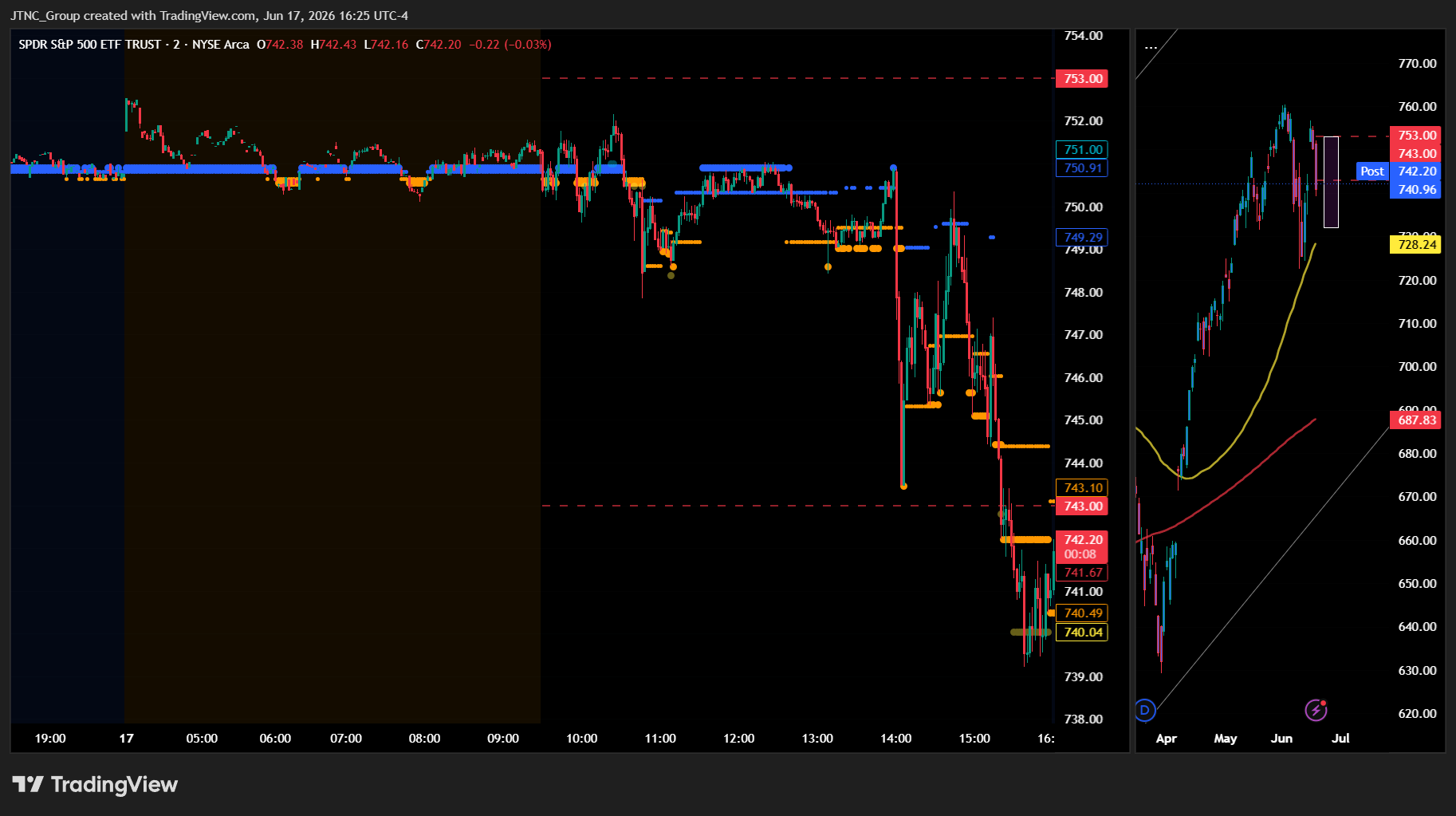
Current Market State Overview:
The MSI ended in Bearish Trending Market State with SPY closing at $741.04. Since SPY closed below MSI support, that former support level at $740.49 now becomes resistance for the next session, with MSI resistance at $743.1 also acting as a ceiling above. Extended targets were not printing at the close, though they did print below during both the AM and PM sessions, offering sustained bearish momentum throughout the regular session before fading into the close. In premarket, no extended targets were visible, which meant the early overnight recovery lacked the conviction to carry the bullish structure much further. The MSI rescaled to a very narrow bullish state overnight, flipping between a ranging and bullish state that allowed SPY to recover slightly into the open. The morning session then shifted to bearish to ranging as traders positioned ahead of the FOMC statement, and once that data hit, the MSI continued rescaling between ranging and bearish states before turning solidly negative in the late PM session, rescaling lower several times in rapid succession with extended targets printing below. By the close those had ceased, leaving the MSI in a moderate bearish configuration with a $2.61 spread between $740.49 and $743.1. That moderate width, combined with the absence of extended targets at the close, suggests the downside may be limited on Thursday. The MSI is forecasting a slow grind lower, though without those extended targets in place, the move is likely to find support at key levels below rather than breaking down aggressively. SPY opened at $751.29, reached a high of $752.15, and fell all the way to a low of $739.25 before closing at $741.04, posting a loss of 1.24%. Volume came in at 69.64 million shares, well above average, and the VIX surged 12.55% to 18.47, reflecting a meaningful spike in fear following the FOMC-driven selloff. MSI support is $740.49 with resistance at $743.1.
Key Levels and Market Movements:
Tuesday we stated, "Bulls want to see overnight strength hold current levels and push toward levels above $750.65, defending former MSI support now flipped to resistance and using the FOMC catalyst as fuel to break higher and challenge levels back toward $755," and added, "Bears want to see $750.56 fail to hold as resistance and press price toward lower levels around $749.88, where Tuesday's session low sits, and potentially deeper if sellers can maintain control through the FOMC announcement," while also noting, "Traders should expect wide swings around the FOMC press conference and be prepared to let the MSI guide entries and exits in real time rather than committing to a directional bias ahead of the release." The bulls made their run early — SPY opened at $751.29, tagged a high of $752.15, and showed some early promise as the MSI held in a ranging to bullish state from the overnight session into the open. But that strength proved to be fleeting. As the morning session progressed, the MSI began shifting toward bearish and ranging states in anticipation of the FOMC announcement, which was a clear warning that conviction was absent and bears were beginning to press. Once the Fed released its statement, any remaining bullish structure collapsed entirely. The MSI began rescaling lower aggressively, cycling between ranging and bearish states before turning solidly negative in the late PM session, rescaling lower several times in rapid succession with extended targets printing below — a textbook signal of a strong trending move to the downside. For traders following the framework, the primary setup became clear once the MSI transitioned away from ranging and into Bearish Trending with price falling away from resistance. The strategy was straightforward: sell rallies back toward MSI resistance as the bands continued to reprice lower, targeting premarket support levels below since SPY had broken well outside the MSI range. Each successive rescale lower created a fresh resistance level and a new trade setup, and price consistently followed the MSI downward toward the session low of $739.25. By the close, extended targets had stopped printing and the MSI settled into a moderate bearish configuration. At minimum it was a 2-for-2 session for traders following the framework. It was a volatile but readable day with substantial setups, all identified through proper context, patience, and flexibility while leveraging the MSI, premarket levels, and market structure rather than forcing trades. The MSI continues to prove its reliability as the cornerstone of our trading process.
Trading Strategy Based on MSI:
Thursday has light economic news so the market is likely to grind lower given the Bearish Trending at the close, though the move may be modest. It is worth noting that Thursday is quad witching, which means traders should be prepared for large swings in both directions as expiration-related flows can introduce sharp and sometimes erratic price action that does not always follow clean technical setups. With the MSI closing in Bearish Trending Market State with a moderate spread, bears retain control heading into Thursday, but the absence of extended targets at the close suggests the downside may be contained and that key support levels below are likely to draw buyers back in before any larger move develops. The moderate width of $2.61 means there is more room for price to move within the MSI range than a narrow configuration would imply, but without extended targets confirming a strong continuation, traders should not assume a sharp breakdown is imminent. The most probable path is a slow, choppy grind lower with potential for sudden reversals driven by quad witching flows. Bulls want to see overnight strength hold current levels and push back toward former MSI support at $740.49, which has now flipped to resistance, and then above $743.1 to neutralize the bearish structure and open the door to a meaningful recovery. Bears want to see $740.49 continue to act as resistance and press price toward lower premarket levels below $739.25 where the session low sits, and deeper still if sellers can maintain control through the Thursday open. Any rally toward MSI resistance at $743.1 that stalls is a potential shorting opportunity targeting lower levels if bears maintain control, while any dip that holds and bounces near key support below could offer a quick long setup targeting levels back toward $740.49. Given the quad witching dynamic, failed breakouts and failed breakdowns are especially relevant on Thursday — sharp moves that reverse quickly are common in this environment and the MSI is the clearest tool available to separate real moves from noise. Traders should remain patient, avoid chasing extended moves, and let the MSI confirm direction before committing to a bias. The long-term bull trend remains intact above $640 and failed breakouts and failed breakdowns continue to offer the highest-probability setups. Remain flexible, avoid trading during Ranging Market States unless a clear failed breakout or breakdown presents itself, and ensure all trades are fully aligned with MSI signals. Providing real-time insights into market control, momentum shifts, and actionable levels, the MSI when integrated with our Pre-Market and Post-Market Reports continues to sharpen execution precision and elevate trade quality. If you haven't yet integrated MSI and our model levels into your process, now is the time. Contact your representative to get started as these tools are designed to support consistency and enhance performance.
Dealer Positioning Analysis
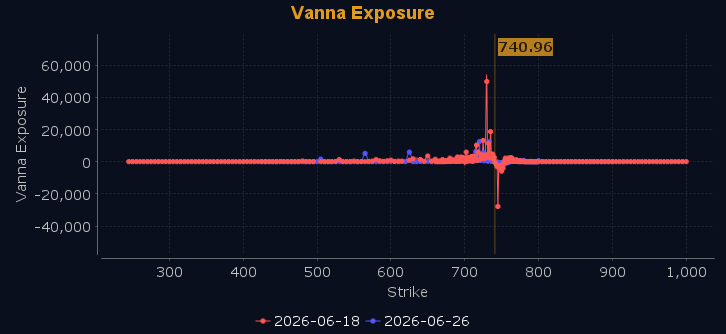
Dealers are selling SPY $746 to $777 and higher strike Calls while buying $741 to $745 Calls, indicating the Dealers' desire to participate in any rally on Thursday. The ceiling for Thursday appears to be $760. To the downside, Dealers are buying $740 to $670 and lower strike Puts in a 3:1 ratio to the Calls they're selling, displaying strong concern that prices could move lower. Dealers are also buying ATM Calls in size, indicating their belief that prices may recover a bit on Thursday. Below $742 is bearish and above $743 is bullish, while in between is likely choppy, trappy price action. Dealer positioning is unchanged at bearish.
Looking Ahead to Next Friday:
Dealers are selling SPY $755 to $783 and higher strike Calls while buying $741 to $754 Calls, indicating the Dealers' desire to participate in any rally heading into the end of the week. The ceiling for next week appears to be $760. To the downside, Dealers are buying $740 to $580 and lower strike Puts in a 4:1 ratio to the Calls they're selling, displaying strong concern that prices could move lower. Dealers are also buying ATM Calls, indicating their desire to participate in any relief rally. With the Federal Reserve putting rate hikes back on the table this year, the market may move lower. Remain bullish above $752 but below $738 we are bearish, while in between is a wide range which will be full of chop and traps with two way trading. For the week Dealer positioning is unchanged at bearish. We advise reviewing Dealer positioning daily for directional clues. These positions evolve quickly and tracking them is essential for staying ahead of shifting market sentiment.
Recommendation for Traders
With SPY closing at $741.04 after a sharp rejection from the open, the bias is clearly bearish. Watch $739.25 as immediate support — a break below that level opens the door to further downside. Any bounce toward $751-$752 should be treated as a shorting opportunity unless buyers can reclaim that zone with conviction. Longs should stay patient and wait for stabilization before stepping in.
Size down and keep stops tight given the elevated VIX at 18.47 and above-average volume confirming the selling pressure. Review the premarket analysis posted before 9 AM ET for any changes in the model's outlook and Dealer Positioning.
Good luck and good trading!
