
Market Insights: Wednesday, February 4th, 2026
Market Overview
US stocks fell for a second consecutive session on Wednesday as renewed pressure across technology and software stocks outweighed selective strength in blue-chip names, reinforcing the sense that markets remain unsettled by AI-related uncertainty and policy risk. The S&P 500 slid roughly 0.5%, while the Nasdaq Composite dropped more than 1.5%, extending Tuesday’s weakness and marking a continuation of the tech-led drawdown. In contrast, the Dow Jones Industrial Average rose about 0.4% as investors rotated out of high-growth technology and into more defensive, value-oriented names. The divergence highlighted a market struggling to regain its footing after a sharp shift in sentiment driven by fears that the massive AI buildout could become a headwind rather than a tailwind for earnings.
Selling pressure remained concentrated in megacap and software stocks, spilling into a broader global selloff that also weighed on European and Asian markets. Nvidia fell more than 3% as concerns persisted around the competitive landscape and the sustainability of AI-related margins, while Alphabet slipped nearly 2% ahead of its earnings release. Amazon dropped more than 2%, Tesla sank over 3%, and Meta also moved lower, underscoring how broadly the AI-related trade came under pressure. JPMorgan warned that even earnings beats are no longer enough to support stock prices unless companies can clearly demonstrate that AI investment will drive profitability rather than erode margins through ballooning capital expenditures. Those concerns were amplified by Advanced Micro Devices, whose shares plunged after the chipmaker issued a weak sales outlook that cast doubt on its ability to meaningfully challenge Nvidia’s dominance in AI accelerators.
Macro data added another layer of caution. An ADP report showed private employers added just 22,000 jobs in January, far below expectations, raising concerns about emerging cracks in the labor market. With official government employment data delayed due to the recently ended shutdown, private reports have taken on outsized importance, increasing the market’s sensitivity to any sign of slowing growth. Geopolitical risk also remained elevated amid ongoing US-Iran tensions, helping support demand for safe-haven assets earlier in the session. Gold initially gained but failed to sustain its rebound from last week’s historic collapse, slipping back below the $5,000 level, while Bitcoin extended losses and briefly traded near $72,000, reflecting continued stress across speculative assets.
Corporate headlines outside of technology delivered mixed signals. Eli Lilly shares jumped after the company issued an upbeat 2026 profit forecast driven by surging demand for its weight-loss drugs, while rival Novo Nordisk tumbled after forecasting a steep drop in sales, stunning investors. After the close, Alphabet shares whipsawed in extended trading after the company beat on earnings and revenue but announced significantly higher-than-expected capital expenditures, projecting 2026 spending of $175 to $185 billion versus Wall Street estimates closer to $120 billion. Meanwhile, Apple stood out as a rare bright spot during the session, rising more than 2% as investors focused on strong iPhone sales, a record installed base, and optimism around upcoming AI-enabled features and longer-term product catalysts. Overall, Wednesday’s action reflected a market still grappling with the implications of AI investment, labor-market uncertainty, and geopolitical risk, while bulls continued to defend key technical levels despite persistent volatility.
SPY Performance
SPY saw another volatile session marked by a steady selloff followed by a sharp recovery off the lows. The ETF opened at $690.32, traded to an intraday high of $691.45, and then sold off aggressively through midday to a low of $681.76 before buyers stepped in. The rebound was swift and decisive, with SPY rallying more than $6 off the lows to close at $686.11, down 0.50% on the day. Trading volume surged to 98.43 million shares, well above average, underscoring heightened participation and emotion. Despite briefly breaking below the 50-day moving average, SPY reclaimed the critical $685 level by the close, once again reinforcing the repeated pattern that dips toward structural support continue to attract aggressive buying.
Major Indices Performance
Index performance remained uneven. The Nasdaq fell 1.51%, driven by broad weakness across technology and software. The S&P 500 declined 0.50%, reflecting tech’s outsized influence, while the Dow gained 0.53% as investors rotated into non-tech components. The Russell 2000 dropped 0.96%, signaling renewed caution toward small-cap stocks amid elevated volatility.
Notable Stock Movements
It was the most broadly red session across the Magnificent Seven in several weeks, led lower by Tesla, which fell as much as 3.80%. The notable green exceptions were Apple, up 2.57%, along with Microsoft and Netflix, which managed to hold modest gains. Broad weakness across megacap technology continued to weigh on sentiment, though sustained downside across both megacaps and crypto would still be required to confirm a larger trend change.
Commodity and Cryptocurrency Updates
Commodities and crypto reflected continued stress. Crude oil rose 1.74% to $64.31, remaining above the $60 level our model has been forecasting for several months. While further volatility is possible, sustained trade above $56 keeps the door open for a rally toward $70. Gold gained 0.57% to $4,963, stabilizing after its recent historic swings but failing to reclaim $5,000. Bitcoin fell another 3.64% to close above $73,400, marking continued weakness in speculative assets.
Treasury Yield Information
The 10-year Treasury yield edged higher by 0.09% to close near 4.276%. In our framework, yields above 4.5% pose meaningful challenges for equities, sustained trade above 4.8% typically coincides with sharper selloffs, and a move above 5% signals significant equity risk, with a 20% or greater correction likely near 5.2%. Wednesday’s move added modest pressure but did not materially alter the broader setup.
Previous Day’s Forecast Analysis
Tuesday’s framework emphasized that as long as SPY held above $685, bulls would retain control despite elevated volatility and headline-driven risk. We warned that February is historically prone to surprise selloffs and that sharp intraday moves were likely to be met with aggressive dip buying.
Market Performance vs. Forecast
Wednesday’s session aligned with that outlook. SPY sold off aggressively, briefly breaking below the 50-day moving average, but buyers once again stepped in near $682 and reclaimed $685 by the close, preserving the broader bull structure.
Premarket Analysis Summary
In Wednesday’s premarket notes published at 7:18 AM, SPY was trading near $691.22 with a bias level at $691.70. Upside targets were identified at $691.70, $693.70, and $696, while downside levels sat at $690, $689, $687.70, and $685. The plan favored a constructive rally if the bias level could be reclaimed, while acknowledging the risk of consolidation or deeper downside if it failed.
Validation of the Analysis
The session initially failed to reclaim the bias level, triggering sustained selling pressure that carried SPY well below the lower downside targets. Once extended downside momentum faded near $682, buyers stepped in aggressively, and the recovery unfolded largely as anticipated, reclaiming key support by the close.
Looking Ahead
Thursday brings Unemployment Claims and delayed JOLTS data, while Friday features Average Hourly Earnings, Non-Farm Payrolls, the Unemployment Rate, and University of Michigan sentiment. With the jobs report possibly delayed again, near-term data could carry more weight than usual.
Market Sentiment and Key Levels
Sentiment remains cautiously bullish but fragile. SPY holding above $685 keeps bulls in control, though conviction has weakened. Resistance sits at $689, $692, $696, and $700, while support rests at $684, $682, and $680. The $694–$700 zone remains heavily defended, favoring failed-breakout shorts, while longs are favored above $685.
Expected Price Action
SPY’s projected maximum range for Thursday is $680 to $698, with the Call side dominating in a wide and expanding band that signals trending price action with intermittent chop. With economic data back in focus, volatility is likely to remain elevated.
Trading Strategy
As long as SPY holds above $684–$685, longs remain favored on pullbacks. Shorts are preferred on failed breakouts near $694–$700, while acceptance below $682 would shift near-term control toward the bears. Discipline and patience remain critical in this environment.
Model’s Projected Range
SPY’s projected maximum range for Thursday is $680 to $698, with the Call side dominating in a wide and expanding band that signals trending price action with intermittent chop. Thursday has Unemployment Claims and JOLTS, which was delayed a couple of days, and with the Friday Jobs Report possibly delayed as well, tomorrow’s economic data may have more impact than usual absent another external catalyst. Today’s PMI and ADP did little to move the market and neither was especially positive. Ongoing fears of a war with Iran and the continued government shutdown drove today’s action, with SPY opening just above $690 and selling off steadily into midday. Once again, the bulls stepped in and bought the dip, this time much lower than yesterday near $682. The recovery was sharp, with SPY rallying more than $6 off the lows to close down just -0.48% at $686.19, still above the $685 level that defines bull control. However, the break of the 50 DMA does not bode well for February, even with the bulls managing to reclaim $685 by the close. We have repeated for weeks that above $685 the bulls control the market, and today’s response reinforces that view with $700 still firmly in play. Volume was significantly above average again, which cuts both ways, as the aggressive selloff came somewhat out of left field, but the recovery off the lows was fully supported by volume, consistent with the behavior seen for months. Big down followed by big up equals big confusion, which is the hallmark of a trading range, suggesting the market is waiting for an external catalyst, potentially the jobs report, to resolve this wide range. Overnight, the bulls want to hold above $686, essentially where the market closed. If $686 holds, bulls will target $688 and possibly $692, where upside is likely to stall. A break below $686 puts today’s lows back in play, and if those fail, bears will press lower with $675 easily in sight. Even if $682 fails, bears are unlikely to engage aggressively without a clean break of $680. We have warned for weeks that February is historically prone to surprise selloffs, and any deeper pullback should be viewed as a buy-the-dip opportunity for a spring or summer rally, as the long-term bull trend remains intact above $640. Absent a catalyst, resistance sits at $689, $692, $696, and $700, while support rests at $684, $682, and $680. The $694–$700 zone remains heavily defended, favoring failed-breakout shorts, while longs are favored above $685 and shorts below $682 are a reasonable bet. Crypto sold off sharply again today and most MAG stocks declined, with the exception of Apple, Microsoft, and Netflix. Sustained weakness across both groups would be required for a larger pullback, leaving the question open whether this is the start of something more ominous or just another attempt to shake out weak longs. VIX rose 3.50% to 18.63, nearing bearish territory. SPY closed just inside a redrawn bull trend channel from the April lows, with structural support near $685.
Market State Indicator (MSI) Forecast
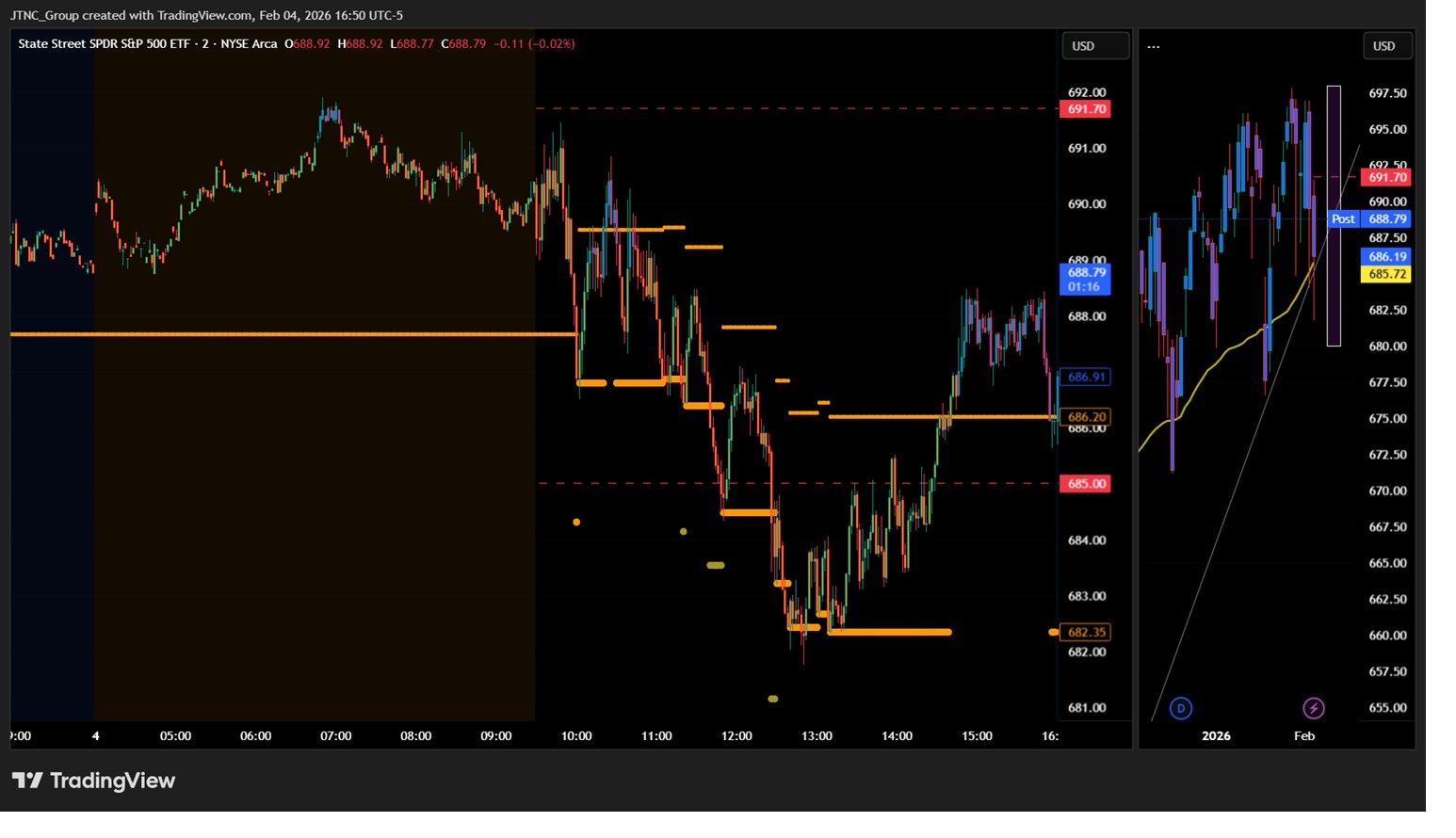
Current Market State Overview:
The MSI ended the session in wide Ranging Market State with SPY closing just above MSI support. There were no extended targets at the close but for several hours in the morning session until 12 pm, extended targets to the downside displayed the herd was participating in the day’s decline. Overnight the MSI remained in its wide Ranging Market State from the close and at the open, the MSI rescaled to a tighter ranging state before the sell off began, rescaling lower in a bearish state until 2 pm when it rescaled to its current state. For Thursday the MSI forecasts choppy trading which could retest the day’s lows or rip higher to MSI resistance or both. MSI resistance is $693.90 with support at $686.20.
Key Levels and Market Movements:
Tuesday we stated, “external catalysts remain a clear and ongoing risk,” and added, “Absent an external catalyst, the primary trend remains bullish as long as SPY holds above $685,” while also noting, “The bias for Wednesday favors selling failed breakouts above $695 and buying dips down to $688, while shorts are favored on acceptance below $688.” With the MSI opening in a wide Ranging Market State, it was once again not immediately obvious which direction the market would resolve, and as expected price moved up and down during the first hour before committing. The MSI rescaled to a bearish state just after 10:30 am and from that point forward price moved almost straight down, with extended targets below confirming and supporting the bearish move. Once $688 failed, as outlined yesterday, and with the MSI firmly bearish, the correct approach was shorts only, trading level to level into MSI support for multiple targets. When extended targets stopped printing, shorts should have been closed on the failed breakdown around 12:50 pm, at which point longs became attractive. That long setup played out cleanly, first targeting the premarket level at $685 and then MSI resistance, with the trade exited once the MSI rescaled back to a ranging state. The session delivered two clean and well-defined setups and once again reinforced the importance of context, patience, and flexibility, using the MSI, premarket levels, and market structure together to guide execution rather than forcing trades when conditions are less than ideal. These were the only actionable setups of the day and they were clearly identified by adhering to the premarket levels, post-market roadmap, and MSI signals within our established framework for structure, trend, and execution. The MSI continues to prove its reliability as the cornerstone of our trading process.
Trading Strategy Based on MSI:
Wednesday’s economic news is unlikely to move the market, but external catalysts remain a clear and ongoing risk. This week includes earnings from several large companies and Friday’s Jobs report, either of which could support higher prices or introduce additional weakness. Absent an external catalyst, the primary trend remains bullish as long as SPY holds above $685 and the bulls continue to defend that level. This reinforces what we have said for weeks: above $685, the bulls have full control and the bears struggle to gain traction. A sustained hold above $695 opens the door for a push toward $700 and potentially higher. The bias for Wednesday favors selling failed breakouts above $695 and buying dips down to $688, while shorts are favored on acceptance below $688. Expect trending price action and use the MSI to determine the intraday trend as it rescales. For the bears to regain any meaningful traction, SPY must break below $680 and remain there. The long-term bull trend remains intact above $640. Failed breakouts and failed breakdowns continue to offer the highest-probability setups, so remain flexible, avoid trading during Ranging Market States, and ensure all trades are fully aligned with MSI signals. Providing real-time insights into market control, momentum shifts, and actionable levels, the MSI when integrated with our Pre-Market and Post-Market Reports continues to sharpen execution precision and elevate trade quality. If you haven’t yet integrated MSI and our model levels into your process, now is the time. Contact your representative to get started as these tools are designed to support consistency and enhance performance.
Dealer Positioning Analysis
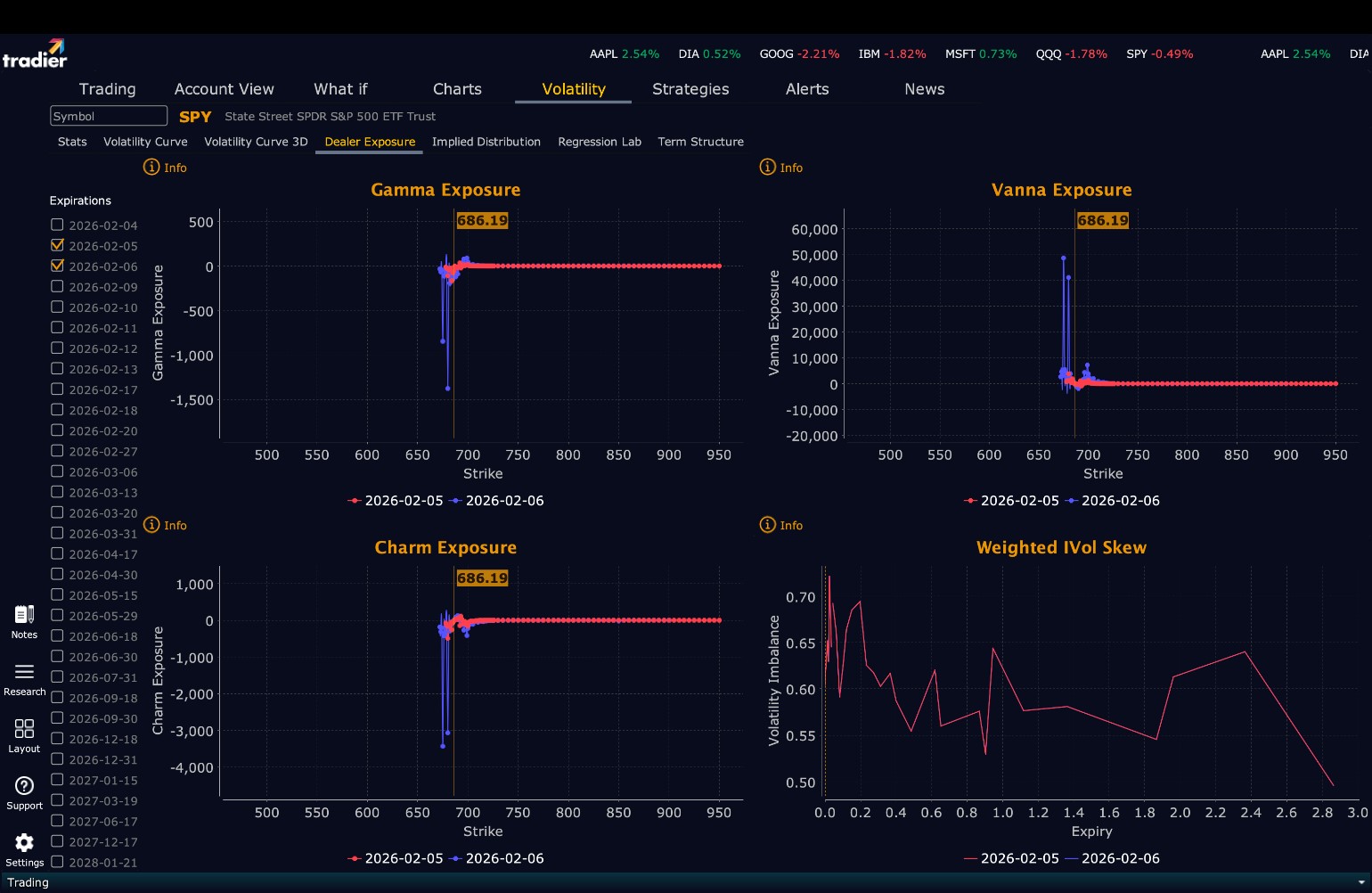
Dealers are selling SPY $689 to $715 and higher strike Calls while also buying $687 to $688 Calls indicating the Dealers’ desire to participate in any continuation of the relief rally on Thursday. The ceiling for tomorrow appears to be $696. To the downside, Dealers are buying $686 to $635 and lower strike Puts in a 3:1 ratio to the Calls they’re selling/buying displaying some concern that prices could move lower. Dealer positioning is unchanged from neutral/slightly bearish to neutral/slightly bearish.
Looking Ahead to Friday:
Dealers are selling SPY $690 to $720 and higher strike Calls while also buying $687 to $689 Calls indicating the Dealers’ desire to participate in any continuation of the relief rally this week. The ceiling for the week appears to be $699, although $696 will be formidable resistance. To the downside, Dealers are buying $686 to $585 and lower strike Puts in a 5:1 ratio to the Calls they’re selling/buying, reflecting a market that is concerned about lower prices. For the week Dealer positioning is unchanged from bearish to bearish. We advise reviewing Dealer positioning daily for directional clues. These positions evolve quickly and tracking them is essential for staying ahead of shifting market sentiment.
Recommendation for Traders
Into Thursday, respect the bullish structure but remain selective. Favor buying pullbacks that hold above $684–$688 and selling failed breakouts near $697–$700. Avoid trading during Ranging Market States and let MSI signals, structure, and confirmation guide execution rather than reacting to headlines.
Good luck and good trading!
