
Market Insights: Monday, January 26th, 2026
Market Overview
US stocks kicked off the final full week of January with moderate gains as investors balanced cautious optimism against a dense lineup of catalysts that include Big Tech earnings and the Federal Reserve’s policy decision later this week. The Dow Jones Industrial Average rose roughly 0.6%, the S&P 500 gained about 0.5%, and the Nasdaq Composite added approximately 0.4%, helping stabilize markets after back-to-back weekly losses and a period of sharp volatility earlier in the month. Sentiment improved modestly as investors grew more confident that near-term political and fiscal risks would remain contained. President Trump sought to ease tensions following the fatal shooting of a protester in Minnesota by announcing he would dispatch border czar Tom Homan to oversee ICE operations in the state, a move markets interpreted as an attempt to prevent political fallout from derailing negotiations aimed at avoiding a federal shutdown. That cautious relief helped temper demand for risk-off positioning, even as uncertainty remained elevated.
At the same time, a weaker US dollar continued to fuel a powerful rally in precious metals. Gold surged above $5,000 per ounce for the first time over the weekend and extended gains on Monday, while silver also climbed to new record levels, underscoring persistent demand for hard-asset hedges amid geopolitical, fiscal, and monetary uncertainty. The rally in metals occurred even as equities moved higher, highlighting a market environment where investors are simultaneously participating in risk assets while seeking protection against tail risks. Focus now turns squarely to earnings, with results from several of the largest technology companies set to dominate headlines. Microsoft, Meta, and Tesla are scheduled to report midweek, followed by Apple the next day, with investors particularly focused on AI spending plans after Intel’s downbeat outlook last week raised questions about the pace and efficiency of the AI buildout. Alongside earnings, the Federal Reserve’s two-day meeting concludes Wednesday, with policymakers widely expected to hold rates steady. Markets are increasingly focused on the Fed’s forward guidance and how long officials may wait before delivering the next rate cut amid internal divisions and growing political pressure. President Trump has also suggested he could name his preferred replacement for Fed Chair Jerome Powell as soon as this week, with BlackRock’s Rick Rieder reportedly emerging as a leading candidate, adding another layer of policy uncertainty as markets navigate a critical stretch.
SPY Performance
SPY built on its recent rebound and finished the session higher, reflecting steady but unconvincing upside progress. The ETF opened at $690.51, traded to an intraday high of $694.13, and set a low at $689.92 before closing at $692.76, up 0.51% on the day. Trading volume totaled 53.51 million shares, slightly below average, reinforcing the view that much of the day’s gains occurred overnight and that regular-session trading was dominated by choppy, sideways-to-up price action. SPY spent much of the afternoon pinned near the highs before late-session profit taking pulled price more than $2 off the peak, a familiar pattern during consolidation phases. Importantly, price remained well above the $685 level that defines bull control, keeping the broader uptrend intact despite the lack of strong momentum.
Major Indices Performance
Performance across the major indices reflected modest risk-on behavior with underlying selectivity. The Dow rose 0.64%, supported by strength in industrials and select cyclicals. The Nasdaq gained 0.43% as technology stabilized ahead of earnings, while the S&P 500 also finished higher. The Russell 2000 fell 0.35%, indicating continued hesitation toward small-cap stocks and reinforcing that leadership remains concentrated rather than broad-based.
Notable Stock Movements
It was a split session across the Magnificent Seven, with roughly half the group finishing green and half red. Apple led to the upside with gains of up to 2.97%, providing meaningful support to the Nasdaq, while Tesla was the weakest performer, down as much as 3.09%. The mixed performance underscored ongoing rotation within megacap leadership rather than coordinated buying or selling, a hallmark of rangebound markets. Sustained weakness across both megacap technology and crypto would be required to signal a larger pullback.
Commodity and Cryptocurrency Updates
Commodities and crypto continued to reflect crosscurrents beneath the surface. Crude oil slipped 0.47% to $60.78 after recently reaching the $60 level our model has been forecasting for several months. While additional downside is possible, sustained trade above $56 keeps the door open for a renewed push toward $70. Gold surged another 1.42% to $5,088, extending its historic rally as investors continued to hedge geopolitical, fiscal, and monetary risks. Bitcoin rose 1.18% to close above $87,500, recovering modestly but still struggling to reclaim the $90,000 level, signaling stabilization rather than a decisive breakout.
Treasury Yield Information
The 10-year Treasury yield fell 0.59% to close near 4.215%, easing pressure on equities after last week’s volatility. In our framework, yields above 4.5% begin to create headwinds for stocks, while sustained trade above 4.8% often coincides with sharper selloffs. A move above 5% historically signals significant equity risk, with a 20% or greater correction becoming likely near 5.2%. Monday’s decline in yields provided a modest tailwind but did not spark aggressive risk-taking.
Previous Day’s Forecast Analysis
The prior framework emphasized that the market remained in a digestion phase following sharp up-and-down moves earlier in the month and that as long as SPY held above $685, bulls would retain control despite choppy conditions. We highlighted the likelihood of rangebound trade absent an external catalyst.
Market Performance vs. Forecast
Monday’s session aligned with that outlook. SPY held comfortably above $685, pushed toward the upper end of the range near $694, and then faded into the close without breaking support. The lack of downside follow-through reinforced that bears remain sidelined while the market waits for clearer direction from earnings and the Fed.
Premarket Analysis Summary
In Monday’s premarket notes published at 7:13 AM, SPY was trading near $688.97 with upside targets at $689, $690.15, and $691.75, and downside levels at $687.70, $686.70, and $685.25. The plan anticipated fickle, two-way trade, with upward progress favored only if price could hold above the $689 bias level.
Validation of the Analysis
The intraday tape validated that framework. SPY held above the bias level early, drifted higher overnight, and then spent the regular session chopping sideways to modestly higher. Downside probes were shallow and quickly absorbed, while upside progress stalled near resistance, producing the expected rangebound behavior.
Looking Ahead
Tuesday has no scheduled economic releases, leaving markets sensitive to earnings headlines and geopolitical developments. Wednesday brings the Federal Funds Rate decision and FOMC statement, followed by Unemployment Claims on Thursday and PPI on Friday. Earnings from large-cap technology are likely to be the primary catalysts capable of breaking the current range.
Market Sentiment and Key Levels
Sentiment remains cautiously bullish but uncertain. SPY’s ability to hold above $685 keeps bulls in control, though conviction remains limited. Resistance sits at $694, $695, $697, and $700, while support rests at $690, $687, $686, and $683. The $695–$700 zone remains heavily defended and is likely to cap upside on initial tests.
Expected Price Action
SPY’s projected maximum range for Tuesday is $688 to $697, with the Call side dominating in a narrowing and extremely tight band that signals choppy price action with few intermittent trending periods. With no scheduled data, overnight earnings and headlines are likely to drive movement.
Trading Strategy
As long as SPY holds above $685, longs remain favored on pullbacks toward $687–$683. Shorts are viable on failed breakout attempts between $695 and $700. Chasing strength is discouraged, and patience remains critical in a rangebound environment defined by big up and big down moves that produce confusion rather than trend.
Model’s Projected Range
SPY’s projected maximum range for Tuesday is $688 to $697, with the Call side dominating in a narrowing and extremely tight band that signals choppy price action with few intermittent trending periods. Tuesday has no scheduled economic news, but earnings from major companies begin this week, so movement is still likely, especially overnight and from unexpected geopolitical announcements. SPY built on its rebound and gained 0.52% to close at $692.73, well above the $685 level that defines bull control. As long as price holds above $685, the path toward $700 remains open. Overnight SPY pulled back to retest $687, which was once again bought, leaving SPY just above $690 at the open. Most of the day’s gains occurred overnight, and after the open price action was choppy with a sideways-to-up drift that was difficult to trade. SPY reached highs just above $694 and spent much of the afternoon pinned near that level. Late in the session, profit taking set in and SPY closed more than $2 below the highs. Volume remained below average, reflecting a market digesting the run toward all-time highs while waiting for Wednesday’s FOMC decision. As noted Friday, big up + big down = big confusion, which is the hallmark of a trading range, and that dynamic dominated the session. This range is likely to persist until an external catalyst emerges, such as large-cap tech earnings, FOMC, or White House headlines. As long as SPY stays above $685, bulls remain in control, and bears stay sidelined unless price closes below $680. Overnight, bulls want to hold above $690 to maintain upside momentum. Bears are unlikely to engage unless $685 fails, and even then, $680 must break before bearish pressure increases. If $690 holds overnight, bulls will likely attempt a push toward $695, where the first and possibly second tests are expected to fail. The long-term trend remains intact above $640, and with February historically prone to surprise selloffs, deeper weakness would not be shocking and should be viewed as a potential buying opportunity for a spring or summer rally. Absent a catalyst, for tomorrow resistance sits at $694, $695, $697, and $700, while support rests at $690, $687, $686, and $683. The $695 to $700 zone is heavily defended, making failed breakouts attractive for shorts, while longs remain favored above $685. Crypto rallied but failed to reclaim $90K, while MAG stocks were mixed. Sustained weakness across both leadership groups would be required for a larger pullback. VIX rose 0.50% to 16.17 and remains in risk-on territory. SPY is back inside a redrawn bull trend channel from the April lows, with structural support near $680.
Market State Indicator (MSI) Forecast
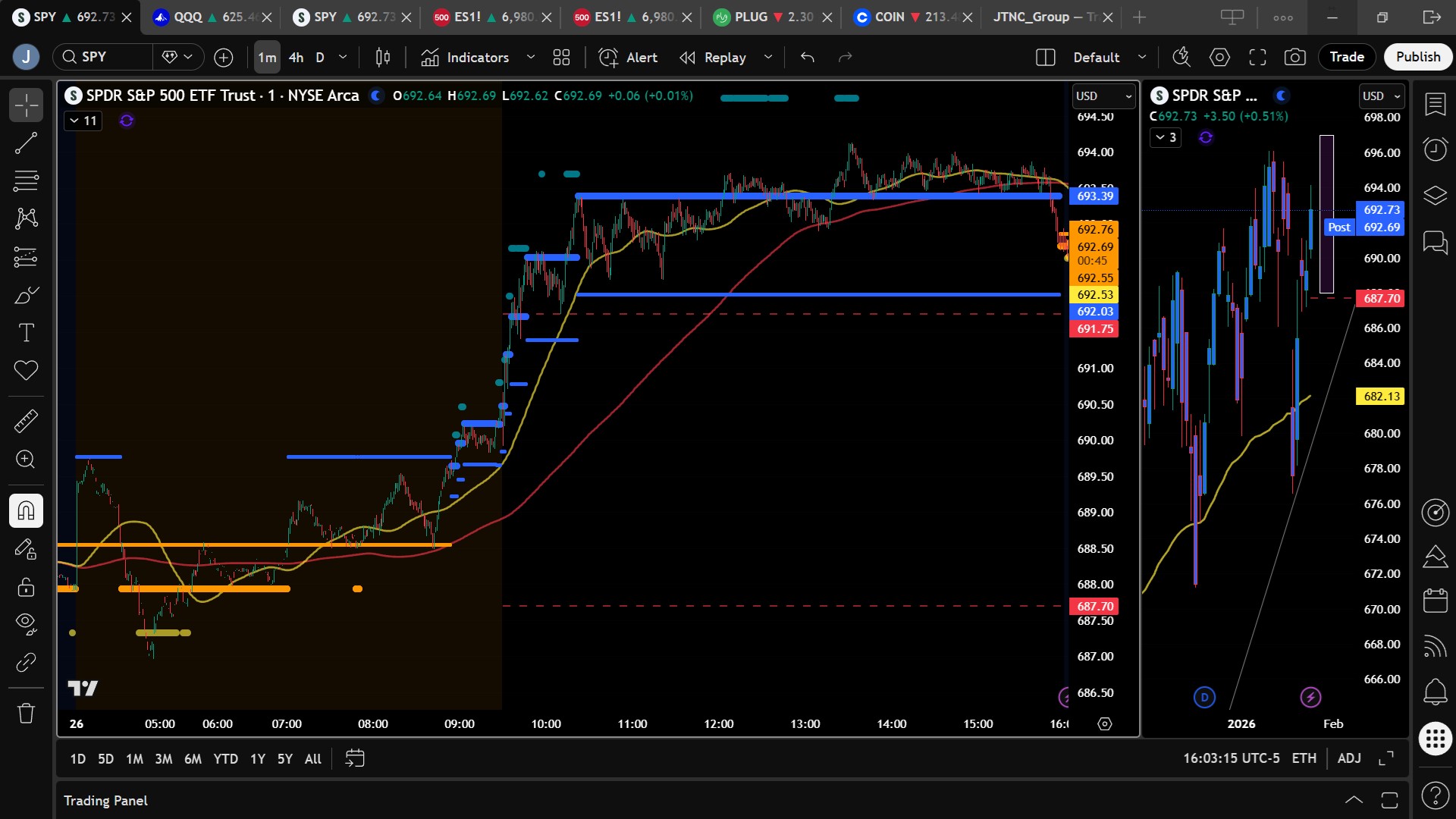
Current Market State Overview:
The MSI ended the session in narrow, Bearish Trending Market State with SPY at MSI support. There were no extended targets at the close but several in the morning and overnight session above price until about 1:30 pm, indicating the herd was participating in the push to $694. But the herd walked away for the afternoon session which gave way to SPY pulling back and basically ending the day up but only slightly. Overnight the MSI initially rescaled lower to a bearish state but it was a narrow bearish state and once extended targets below stopped printing, SPY reversed from the overnight lows and the MSI began a series of rapid rescalings higher so by the open, SPY was well above Friday’s close. Extended targets and more rescalings higher pushed SPY to the day’s highs. But the MSI stopped rescaling just before 10:30 am and remained in a wide bullish state until the last 2 minutes of the regular session, ending the say in a narrow bearish state. For tomorrow the MSI is forecasting a bit more of a pullback but not one likely to move below $690. Instead with the narrow bearish range, its likely SPY attempts to retest the day’s highs with the MSI rescaling to a ranging state before picking a direction. MSI support is $692.70 with resistance at $692.88.
Key Levels and Market Movements:
Friday we stated, “The bias for Monday favors selling failed breakouts above $693 and as high as $696, while buying dips as low as $682,” and added, “The projected range is narrowing, which suggests volatility may continue to contract and produce choppy price action,” while also noting, “For the bears to reassert themselves, SPY must break below $680 and stay there.” With the MSI opening in a Bullish Trending Market State and extended targets printing after several rapid rescalings higher, the only logical trade was to buy MSI support and trade it to the next level up. The premarket report anticipated a top near $692, so with an open at $690.47, a dip buy at MSI support near $690 still offered room to the upside. We consistently recommend using MSI levels for entries and targets, as the success rate for level-to-level longs exceeds 70%, with shorts only slightly lower. Combining MSI levels with the premarket roadmap, a long on the early dip produced two clean targets and allowed for a runner that could be managed either to MSI resistance or until the failed breakout near the day’s highs. We prefer to keep runners as long as possible and rely on structure for exits. With no premarket level above $692, that structure came from the MSI and the failed breakout around 1:20 pm, which clearly signaled that taking profits made sense. The post-market report also outlined a short setup above $693 and up to $696 on a failed breakout, which provided another straightforward opportunity near $694 that could be held into the close for multiple targets. As always, extended targets should never be faded, and countertrend trades should only be taken after they stop printing. Traders who followed the premarket and post-market road maps, respected MSI signals, stayed patient, and maintained discipline were rewarded, as the session aligned cleanly with our broader framework for structure, trend, and execution. The MSI once again proved its reliability as the cornerstone of our trading process.
Trading Strategy Based on MSI:
Tuesday has no economic news, but with earnings season is in full swing so market direction is likely to come from company results and forward guidance. We continue to advise staying alert to headlines and macro developments as well so strategy can be adjusted as conditions change. The bulls currently have the advantage, and a close above $685 keeps that edge intact. A sustained hold above $690 sets the stage for a push toward $700. The bias for Tuesday favors selling failed breakouts above $695 and as high as $697, while buying dips as low as $685. For the bears to reassert themselves, SPY must break below $680 and stay there. The projected range is narrow, which suggests volatility will continue to contract and produce choppy price action until an external catalyst, such as FOMC changes the dynamic. The long-term bull trend remains intact above $640, making disciplined risk management and trading what price presents essential. Failed breakouts and failed breakdowns continue to offer the highest-probability setups, so remain flexible, avoid trading during Ranging Market States, and ensure all trades are fully aligned with MSI signals. Providing real-time insights into market control, momentum shifts, and actionable levels, the MSI when integrated with our Pre-Market and Post-Market Reports continues to sharpen execution precision and elevate trade quality. If you haven’t yet integrated MSI and our model levels into your process, now is the time. Contact your representative to get started as these tools are designed to support consistency and enhance performance.
Dealer Positioning Analysis
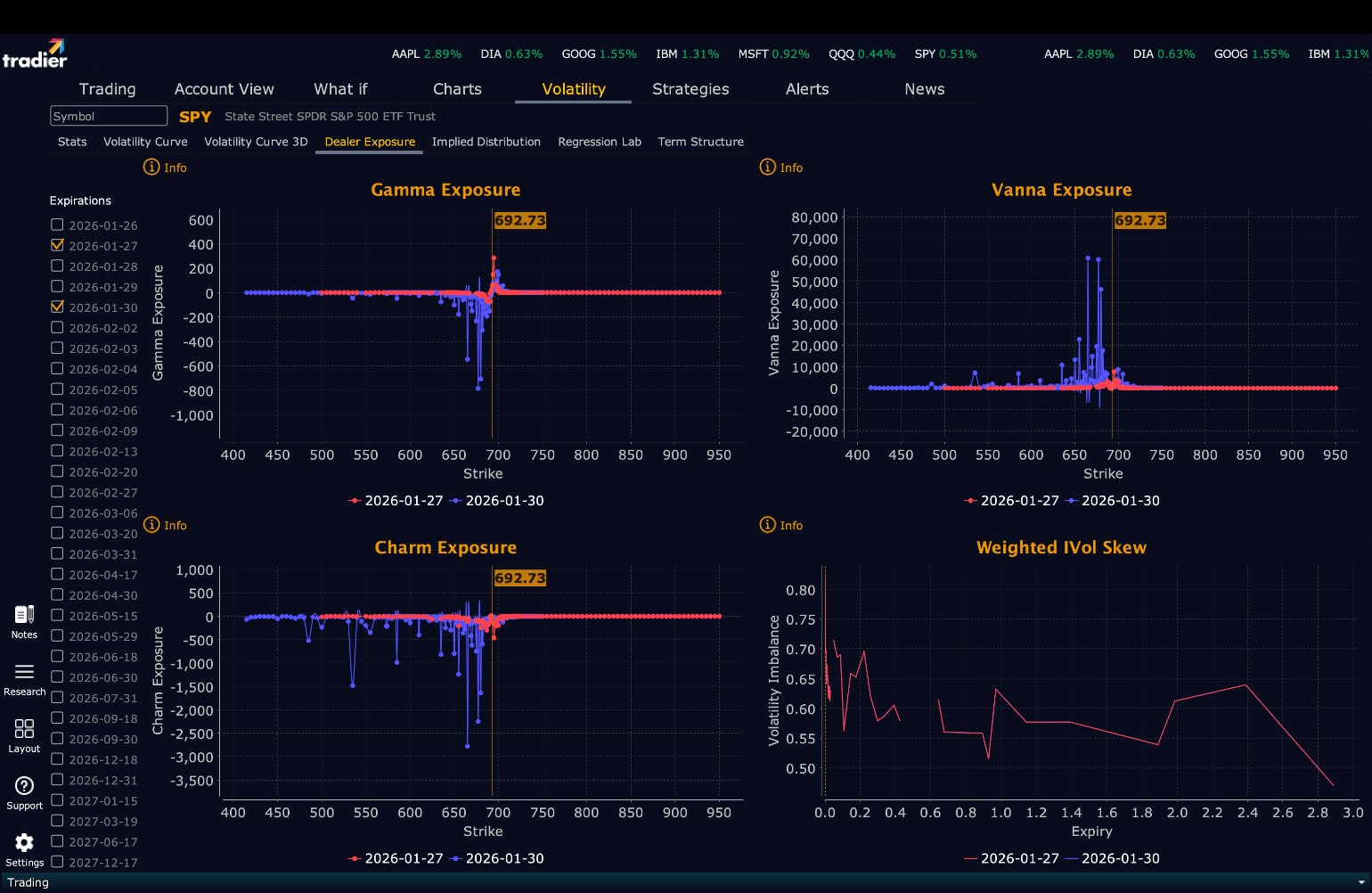
Dealers are selling SPY $693 to $715 and higher strike Calls indicating the Dealers’ belief that prices may stabilize at current levels. The ceiling for Tuesday appears to be $695. To the downside, Dealers are buying $692 to $635 and lower strike Puts in a 2:1 ratio to the Calls they’re selling/buying displaying less concern that prices could move lower. Dealer positioning has changed from neutral/slightly bearish to neutral/slightly bullish.
Looking Ahead to Friday:
Dealers are selling SPY $693 to $720 and higher strike Calls indicating the Dealers’ belief that prices may not move much this week. The ceiling for the week appears to be $700. To the downside, Dealers are buying $692 to $585 and lower strike Puts in a 4:1 ratio to the Calls they’re selling, reflecting a market that is a bit more concerned about lower prices than previous weeks. For the week Dealer positioning is unchanged from slightly bearish to slightly bearish. We advise reviewing Dealer positioning daily for directional clues. These positions evolve quickly and tracking them is essential for staying ahead of shifting market sentiment.
Recommendation for Traders
Into Tuesday, respect the bullish structure while remaining alert to headline and earnings risk. Favor buying pullbacks that hold above $683 and avoid chasing strength into the $695–$700 zone. Failed breakouts near resistance and failed breakdowns near support continue to offer the highest-probability setups. Manage risk tightly, stay flexible, and trade what price presents rather than what you expect.
Good luck and good trading!
