
Market Insights: Wednesday, January 21st, 2026
Market Overview
US stocks staged a powerful rebound on Wednesday as fears of a renewed trade war with Europe eased and investors rushed back into risk assets following President Trump’s announcement that the US and NATO had formed a framework for a future deal regarding Greenland. The rally marked a sharp reversal from Tuesday’s panic-driven selloff, with the Dow Jones Industrial Average surging more than 550 points, or roughly 1.2%, while the S&P 500 and Nasdaq Composite each climbed about 1.2% after briefly slipping into negative territory for the year earlier in the week. The S&P 500’s advance pushed the index back into positive territory for 2026, signaling that investors were willing to look past geopolitical uncertainty once tariff threats were taken off the table. Stocks accelerated higher in afternoon trading after President Trump posted on Truth Social that he and NATO Secretary General Mark Rutte had reached a framework agreement covering Greenland and the surrounding Arctic region, adding that he would not impose the tariffs that had been scheduled to take effect on February 1st. The announcement followed a noticeably softer tone from Trump earlier in the day during his keynote address at the World Economic Forum in Davos, where he called for immediate negotiations and emphasized that the US would not use force to gain control of the Danish territory. Markets interpreted the comments as a clear de-escalation after days of mounting concern that tariff threats could spiral into a full-scale trade conflict between the US and Europe. Prior to the announcement, fears of retaliatory action from the European Union had kept the so-called “Sell America” trade alive, with EU officials warning they were fully prepared to respond to any new tariffs. Additional uncertainty came from Washington, where the Supreme Court heard arguments related to the Trump administration’s attempt to remove Federal Reserve Governor Lisa Cook. The court appeared skeptical of the move, with several justices suggesting that such action could undermine the Fed’s independence and destabilize markets. On the corporate front, earnings season continued to deliver mixed signals. Netflix shares fell after its quarterly results failed to impress investors, highlighting a growing trend in which earnings beats are being met with muted or negative stock reactions. Reports from Johnson & Johnson, Charles Schwab, and other mid-sized financial firms added to the flow of information, but it was the removal of tariff risk that ultimately drove the day’s decisive shift in sentiment.
SPY Performance
SPY delivered a strong recovery session, opening at $679.45 and surging throughout the day to an intraday high of $688.74 before settling slightly lower into the close at $685.33, up 1.14% on the day. The rally erased the prior session’s breakdown and marked a decisive reclaim of the top of the $675–$685 range that has acted as a price magnet for weeks. Trading volume surged to 118.31 million shares, nearly double the daily average, confirming that the move was supported by strong institutional participation rather than short-covering alone. After briefly slipping overnight toward $677, SPY reversed sharply following Trump’s Greenland comments, rallying nearly $10 from low to high and effectively negating Tuesday’s fear-driven decline. Closing above $685 restored full bull control and reopened the path toward higher resistance levels.
Major Indices Performance
Gains were broad-based across the major indices, signaling a decisive shift back toward risk-on positioning. The Nasdaq Composite rose 1.18%, supported by renewed strength in large-cap technology. The Dow Jones Industrial Average gained 1.21%, reflecting broad participation across industrials and financials. The S&P 500 finished firmly higher, while the Russell 2000 surged 1.96%, highlighting improving sentiment toward smaller-cap stocks after recent underperformance.
Notable Stock Movements
The Magnificent Seven finished largely higher, reinforcing the constructive tone of the session. All members of the group closed green except Netflix and Microsoft, with Microsoft down 2.29% and Netflix sliding following its earnings report. Strength across the rest of the megacap complex suggested that Tuesday’s selloff was driven more by headline fear than a structural breakdown in leadership.
Commodity and Cryptocurrency Updates
Commodities and crypto continued to reflect underlying demand for both growth and protection. Crude oil rose 0.55% to $60.69, reaching the level our model has been forecasting for several months. While it remains possible that crude pulls back, sustained trade above $56 keeps the door open for a future rally toward $70. Gold climbed 1.25% to $4,825, extending its historic rally as investors continued to hedge geopolitical and policy risk despite the equity rebound. Bitcoin gained 0.73% to close above $90,100, signaling renewed confidence in risk assets after Tuesday’s sharp pullback.
Treasury Yield Information
The 10-year Treasury yield fell 0.98% to close near 4.253%, easing pressure on equities after Tuesday’s spike. In our framework, yields above 4.5% begin to create headwinds for stocks, while sustained trade above 4.8% often coincides with sharper selloffs. A move above 5% historically signals significant equity risk, with a 20% or greater correction becoming likely near 5.2%. Wednesday’s decline in yields helped fuel the equity rebound and reduced near-term stress in financial conditions.
Previous Day’s Forecast Analysis
The prior framework emphasized that the sharp selloff on Tuesday was driven primarily by geopolitical fear rather than deteriorating fundamentals, and that as long as SPY remained within the $675–$685 range, the long-term bull trend remained intact. We warned that any de-escalation on tariffs could trigger a fast reversal.
Market Performance vs. Forecast
Wednesday’s action validated that outlook. SPY briefly tested the lower portion of the range overnight before reversing sharply higher, reclaiming $685 and closing back above the level that defines bull control. The speed and strength of the recovery underscored how quickly sentiment can shift when headline risk is removed.
Premarket Analysis Summary
In Wednesday’s premarket notes published at 7:01 AM, SPY was trading near $676.39 with upside targets at $677, $680.20, and $681.85, and downside levels at $675 and $670. We noted that a recovery would require sustained intraday buying and cautioned against overly aggressive downside expectations given the market’s potential to rally sharply.
Validation of the Analysis
The session unfolded in line with those expectations. Early weakness gave way to strong buying, and once SPY reclaimed the $677 bias level, upside momentum accelerated rapidly. Targets above were surpassed decisively as geopolitical relief sparked a powerful rally.
Looking Ahead
Thursday brings a heavy slate of economic data, including GDP, PCE, and Unemployment Claims, all of which have the potential to move markets. With geopolitical tensions temporarily easing, macro data will take center stage in shaping near-term direction.
Market Sentiment and Key Levels
Sentiment has shifted back toward cautious optimism. SPY’s close above $685 restores bullish control, though bears remain active after recent volatility. Resistance sits at $687, $690, and $692, while support rests at $682, $680, and $676. Holding above $685 favors continuation toward $700, while a failure back below $680 would reopen downside risk.
Expected Price Action
SPY’s projected maximum range for Thursday is $680 to $692, with the Call side dominating in a wide but narrowing band that signals trending action with periods of chop. With multiple economic releases scheduled, volatility is likely to remain elevated.
Trading Strategy
With bull control restored, buying dips near $682–$680 is favored on confirmed support. Shorts are preferred only on failed breakouts between $690 and $695. Traders should remain flexible and responsive to data-driven moves.
Model’s Projected Range
SPY’s projected maximum range for Thursday is $680 to $692, with the Call side dominating in a wide but narrowing band that signals trending action with periods of chop. Thursday brings Unemployment Claims, GDP, and PCE, all of which can move markets. Today President Trump reassured investors that tariffs on EU allies and action on Greenland were off the table, which reversed yesterday’s fear-driven selloff. SPY surged more than 1.15% to close at $685.40, reclaiming the top of the $675–$685 range and finishing above the $685 level that restores full bull control. Yesterday’s panic faded quickly as bulls once again bought the dip and reopened the path toward $700. Overnight SPY staged a relief rally to just below $685 before dropping to $677 and retesting the prior day’s lows, briefly setting up what looked like a bull trap. That changed immediately after comments on a Greenland framework deal, which sparked a sharp rally of nearly $10, lifting SPY to just under $689 before settling back at the $685 magnet level we have highlighted for weeks. Volume was nearly double the daily average, effectively negating yesterday’s decline. As long as price holds within or above the $675–$685 range, the long-term bull edge remains intact, and with today’s close above $685, bears have once again been sidelined, though they remain increasingly active and still hold a slight near-term edge. Overnight the market is likely to test today’s highs and attempt to reclaim $690, which would set the stage for new highs this week. If $685 holds, upside continuation is favored, but if it fails, $680 must hold to prevent bears from pressing lower. The long-term trend remains intact above $640, meaning even a move toward $650 would likely attract dip buyers. February is historically prone to surprise selloffs, so deeper weakness would not be shocking and should be viewed as a potential setup for a spring or summer rally. Traders should monitor geopolitical headlines closely and trade what price presents. Absent a catalyst, resistance sits at $687, $690, and $692, while support rests at $682, $680, and $676. The $690–$695 zone is heavily defended and likely caps upside on first tests. Failed-breakdown longs near $680 remain viable only after clear recovery, while shorts are favored between $690 and $695. Crypto rallied sharply today, and all MAG stocks except Netflix and Microsoft advanced. Broad weakness across both groups would be required for a larger pullback. VIX dropped more than 15% to 16.92, returning to risk-on territory. SPY spent only one session below the April bull channel and has now reclaimed it, with trend support back near $685.
Market State Indicator (MSI) Forecast
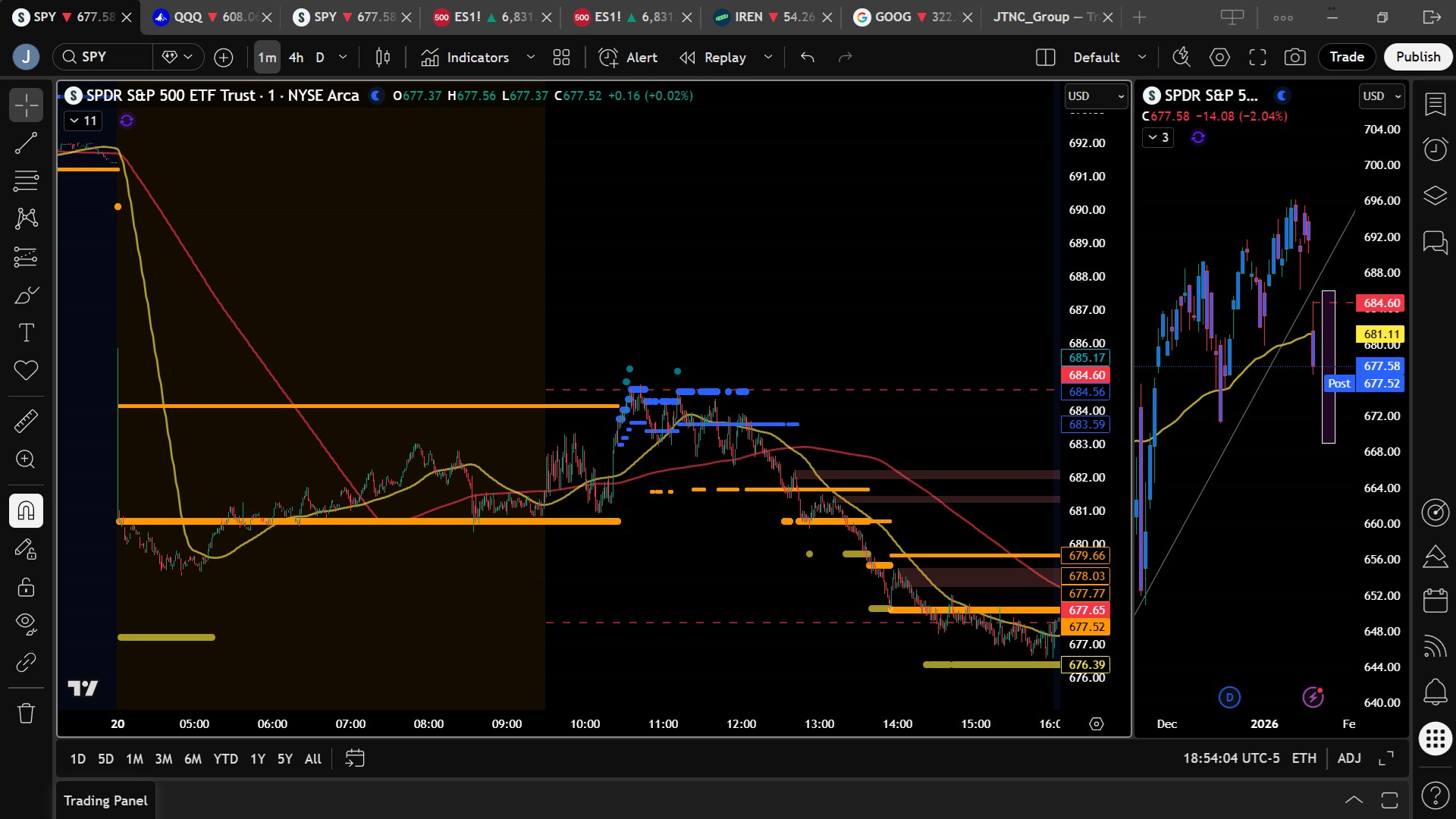
Current Market State Overview:
The MSI ended the session in a Bullish Trending Market State with SPY closing just above MSI support. There were no extended targets at the close but several in the morning during the relief rally and again, after the Greenland announcement. The MSI rescaled higher several times in the premarket and am session but around noon until 2 pm, the MSI entered a ranging state which saw price retest the prior day’s lows. After the Greenland news the MSI put in a series of rescaling higher with extended targets and eventually ended the day in a wide bullish state which forecasts higher prices on Thursday, but perhaps with a bit of consolidation before launching to new all-time highs. MSI support is $685.50 with resistance at $688.51.
Key Levels and Market Movements:
Wednesday we stated “Wednesday has enough geopolitical risk to keep traders on their toes, so be wary of headlines out of Davos and the White House “ and added “Bears currently have the edge and will continue to press as long as price remains below $685 “ noting “The bias for tomorrow favors selling tests between $680 and $685, or buying tests of $675 “. With the MSI opening in a narrow bullish state and rescaling higher several times, the MSI was clearly signaling the relief rally would continue and those using this valuable tool knew to get long and use the MSI resistance levels as targets. Once extended target stopped printing, it made sense with SPY failing just shy of $685 to reverse short and trade SPY for a retest of the prior day’s lows. This was called out clearly in yesterday’s newsletter as the likely strategy for today. But again without extended targets below, buying the dip also made sense with the MSI supporting a long and had you taken this trade, you would have been very happy as the news broke and pushed SPY and the MSI back to record territory. This session once again highlighted how to best use the newsletter framework with the Market State Indicator as the primary guide, resulting in a straightforward day with two to three solid trades and strong gains. Traders who followed the post and premarket road maps, respected the MSI signals, stayed patient, and remained disciplined were rewarded, as the session aligned cleanly with our broader framework for structure, trend, and execution. The MSI continues to prove its reliability as the cornerstone of our trading process.
Trading Strategy Based on MSI:
Thursday has quite a bit of economic data which could move the market. We have seen the past two days how geopolitical risks can rock the market both ways, so be wary of headlines and be prepared to adjust your plan as new data is introduced to the market. Bulls currently have the edge and will continue to press as long as price remains above $685. A sustained move above $685 sets the bulls up for a run at $700 putting downside pressure to rest. The bias for tomorrow favors selling $690 on failed breakouts and buying any dips to $680. For the bears to get back involved, SPY needs to get below $680 and stay there. The projected range is wide but narrowing, so volatility may remain elevated with trending price action mixed with intermittent chop. Macro risks remain so stay alert to headlines and closely watch reactions at $680, $685, and $690. The long-term bull trend remains intact above $640, so risk management and trading what you see remain critical. Failed breakouts and failed breakdowns continue to offer the highest-probability setups, so remain flexible, avoid trading during Ranging Market States, and ensure all trades are fully aligned with MSI signals. Providing real-time insights into market control, momentum shifts, and actionable levels, the MSI when integrated with our Pre-Market and Post-Market Reports continues to sharpen execution precision and elevate trade quality. If you haven’t yet integrated MSI and our model levels into your process, now is the time. Contact your representative to get started as these tools are designed to support consistency and enhance performance.
Dealer Positioning Analysis
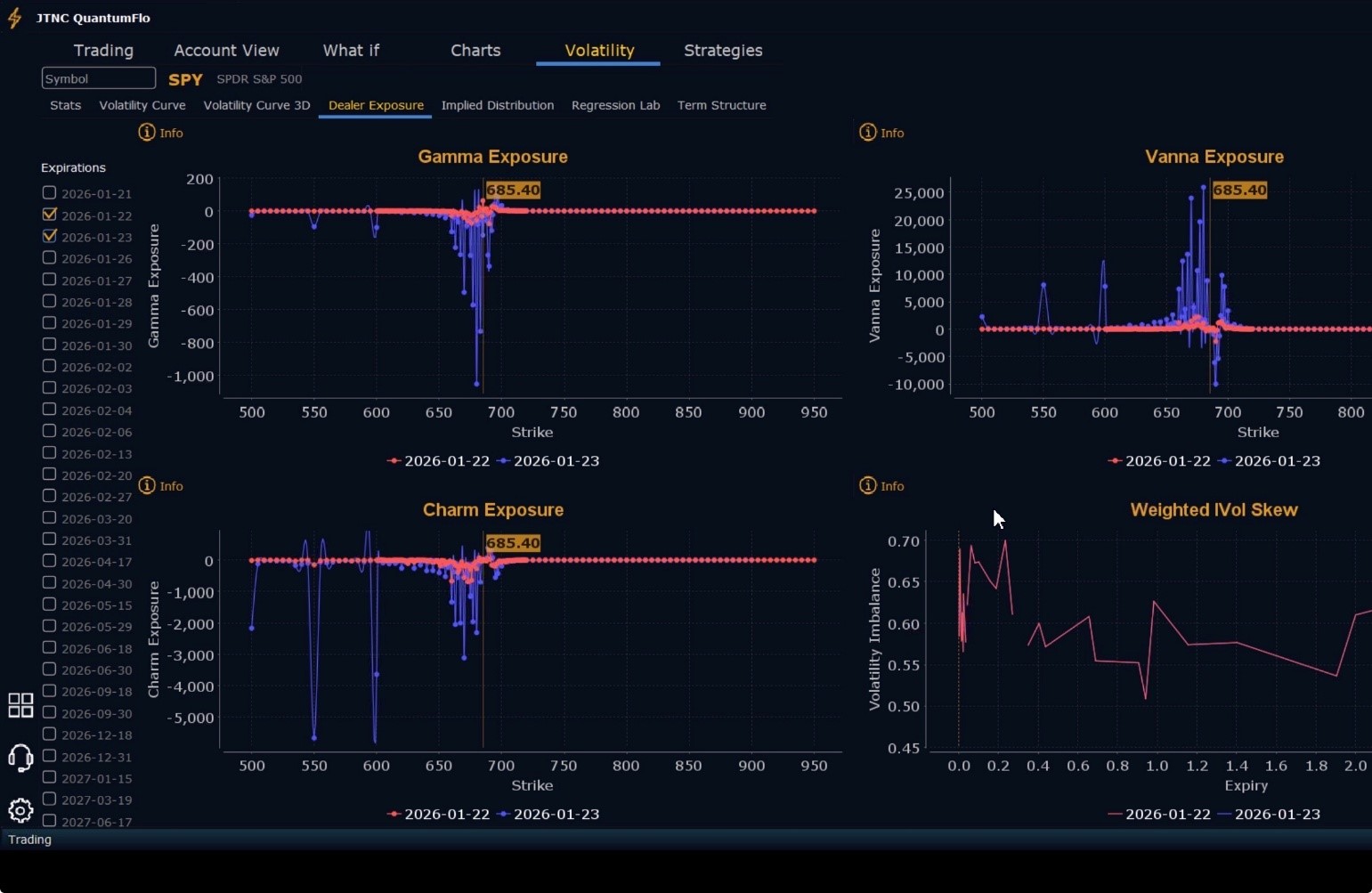
Dealers are selling SPY $691 to $718 and higher strike Calls while also selling $682 to $685 Puts and buying $690 Calls in size indicating the Dealers’ desire to participate in any continuation rally tomorrow. Dealers only sell ATM Puts when they believe prices will rally. The Dealers seem to believe there is a floor in the market for tomorrow no lower than $682. The ceiling for tomorrow appears to be $692. To the downside, Dealers are buying $681 to $635 and lower strike Puts in a 3:1 ratio to the Calls/Puts they’re selling/buying displaying some concern that prices could move lower. Dealer positioning is unchanged from neutral/slightly bearish to neutral/slightly bearish.
Looking Ahead to Friday:
Dealers are selling SPY $694 to $720 and higher strike Calls while also buying $686 to $693 Calls indicating the Dealers’ desire to participate in any rally into Friday. The ceiling for the week appears to be $695. To the downside, Dealers are buying $685 to $585 and lower strike Puts in a 3:1 ratio to the Calls they’re selling/buying, reflecting a market that is not concerned about lower prices. For the week Dealer positioning is unchanged from neutral/slightly bearish to neutral/slightly bearish. We advise reviewing Dealer positioning daily for directional clues. These positions evolve quickly and tracking them is essential for staying ahead of shifting market sentiment.
Recommendation for Traders
Into Thursday, respect the restored bullish structure while remaining alert to headline and data risk. Favor buying pullbacks that hold above $680 and avoid chasing strength into the $690–$695 zone. Manage risk tightly, stay flexible, and trade what price confirms rather than what headlines suggest.
Good luck and good trading!
