
Market Insights: Tuesday, January 20th, 2026
Market Overview
US stocks were hit hard on Tuesday in their worst session since October as a sharp escalation in geopolitical tensions and renewed trade-war fears triggered a broad risk-off move across global markets. The Dow Jones Industrial Average plunged roughly 1.8%, losing more than 800 points, while the S&P 500 fell just over 2% and the Nasdaq Composite sank more than 2.4%, as investors rushed out of riskier assets following an already weak stretch for equities. The selloff wiped out year-to-date gains for both the S&P 500 and Nasdaq and marked a return to the tariff-driven volatility that rattled markets last spring. Pressure intensified after President Trump reignited tensions with Europe over his pursuit of Greenland, warning over the weekend that eight NATO countries would face new 10% import duties unless the US secured a deal to purchase the Danish territory. On Monday, Trump doubled down on the threat as the European Union discussed a potential $108 billion package of retaliatory tariffs and signaled it could deploy its so-called anti-coercion instrument, raising the risk of a full-blown US-EU trade conflict. Trump further escalated rhetoric by threatening a 200% tariff on French wine after President Emmanuel Macron declined an invitation to join his proposed “Board of Peace,” and when asked how far he was willing to go to acquire Greenland, he responded, “You’ll find out,” adding to investor unease. At the same time, bond markets came under pressure as a selloff in Japanese government bonds spilled into US Treasuries, pushing the 10-year yield to its highest level in four months and compounding equity weakness. The renewed “sell America” trade weighed on the dollar while driving haven demand for precious metals, with gold and silver surging to fresh record highs. Technology stocks bore the brunt of the selloff as investors rotated out of AI-linked names, with Nvidia and Broadcom leading declines, highlighting growing concern that elevated valuations leave little room for geopolitical shocks. Attention now turns to the World Economic Forum in Davos, where global leaders are expected to voice concerns over US trade policy and geopolitical stability, keeping headline risk firmly in focus as earnings season begins.
SPY Performance
SPY suffered a sharp breakdown on heavy volume, reflecting the intensity of the risk-off move. The ETF opened at $681.54, attempted an early bounce to an intraday high of $684.77, and then sold off steadily through the session to a low of $676.57 before a modest late-day bounce. SPY closed at $677.61, down 2.03% on the day. Trading volume surged to 104.25 million shares, nearly double the daily average, signaling strong institutional participation and confirming that the move was driven by genuine risk reduction rather than thin liquidity. The session marked a decisive failure to reclaim former support near $685, which now acts as resistance.
Major Indices Performance
Losses were broad-based across the major indices. The Nasdaq fell 2.39%, leading the downside as technology stocks were hit hardest. The Dow declined 1.76%, weighed down by industrials and financials, while the S&P 500 dropped more than 2%. The Russell 2000 fell 1.19%, showing relative resilience but still reflecting a clear shift toward risk aversion.
Notable Stock Movements
It was an all-red session across the Magnificent Seven, underscoring the breadth of the selloff. Nvidia led the group lower with a decline of 4.38%, while weakness was evident across the entire megacap complex. The simultaneous selloff in both megacap technology and crypto-linked equities marked a key development, as broad weakness across these leadership groups is typically required for deeper market pullbacks to unfold.
Commodity and Cryptocurrency Updates
Commodities and crypto reflected heightened stress beneath the surface. Crude oil rose modestly by 0.20% to $59.46, continuing to hover near the $60 level our model has been forecasting for several months. While further downside remains possible, holding above $56 keeps the door open for a future rally toward $70. Gold surged 3.64% to $4,762, extending its historic rally as investors sought protection from geopolitical and policy risk. Bitcoin fell 3.59% but managed to close above $89,600, signaling a sharp pullback without yet confirming a structural breakdown.
Treasury Yield Information
The 10-year Treasury yield jumped 1.42% to close near 4.293%, adding meaningful pressure to equities. In our framework, yields above 4.5% begin to create significant headwinds for stocks, while sustained trade above 4.8% often coincides with sharper selloffs. A move above 5% historically signals major equity risk, with a 20% or greater correction becoming likely near 5.2%. Tuesday’s surge in yields reinforced the risk-off tone and bears close monitoring.
Previous Day’s Forecast Analysis
The prior published framework emphasized that while the longer-term bull trend remains intact above $640, elevated valuations and geopolitical risk made the market vulnerable to sharp pullbacks. We noted that a failure to hold above $685 would shift control toward the bears in the near term.
Market Performance vs. Forecast
Tuesday’s action confirmed that risk. SPY failed to reclaim $685, and former support quickly turned into resistance. Once that level was rejected, selling pressure intensified and carried price back into the $675–$685 range that has acted as a magnet for weeks.
Premarket Analysis Summary
In Tuesday’s premarket notes published at 9:11 AM, SPY was trading near $681.28 with a bearish bias below $682.70. Upside targets were identified at $682.70, $684.60, $687.60, $690.20, and $692, while downside levels sat at $680.15 and $677.65. The plan called for selling rejections while remaining open to rally attempts if key levels were reclaimed.
Validation of the Analysis
The session validated that roadmap. SPY remained below the bias level, failed to sustain early bounce attempts, and sold off toward the $677 area, tagging the lower targets before stabilizing. Repeated failures near former support reinforced the bearish near-term structure.
Looking Ahead
Wednesday features the World Economic Forum in Davos, with President Trump speaking in the premarket. Any commentary on trade, tariffs, or Greenland could inject additional volatility. Traders should remain alert to geopolitical headlines throughout the day.
Market Sentiment and Key Levels
Sentiment has shifted decisively toward caution. SPY has returned to the $675–$685 range, where bulls retain the long-term edge but bears currently control the near-term tape. Resistance sits at $679, $680, $684, and $685, while support rests at $675, $671, and $668. A sustained break above $685 would restore bullish control, while a clean break below $675 opens the door to a deeper move toward December lows.
Expected Price Action
SPY’s projected maximum range for Wednesday is $669 to $686. The Put side dominates in a wide and expanding band, signaling trending action with periods of chop. Volatility is likely to remain elevated as geopolitical risk continues to drive overnight moves.
Trading Strategy
For Wednesday, selling bounces remains the preferred approach while SPY trades below $680–$685. Failed-breakdown longs near $675 are viable only after a clear recovery signal. Shorts are favored on tests between $680 and $685, and any longs before $680 is reclaimed carry elevated risk. Flexibility and discipline are essential in this environment.
Model’s Projected Range
SPY’s projected maximum range for Wednesday is $669 to $686. The Put side dominates in a wide and expanding band, signaling trending action with periods of chop. Wednesday features the Davos World Economics Forum all day, with President Trump speaking in the premarket, and it would not be surprising to hear global leaders voice concerns over U.S. policy on Greenland and tariffs, which could add to volatility. SPY fell more than 2% today to close at $677.58, returning to the $675–$685 range that has acted as a price magnet for several weeks. The market appears to be running low on momentum to push to new highs, though it is still unclear whether this marks the start of something more ominous. While 2% down days are rare, they do occur, and after the massive rally from April, the market has been due for a pullback. Much of today’s weakness occurred overnight as markets reacted to renewed geopolitical tension tied to the administration. SPY attempted to bounce, and it briefly looked like the overnight dip to $680 might hold and allow a move back above $685, but that failed as former support turned into resistance. By noon, SPY began drifting lower and continued to do so until reaching $676, where a modest bounce into the close lifted price slightly. Volume was nearly double the daily average, which does not bode well for the bull trend. Still, as long as price remains within the $675–$685 range, the bulls retain the long-term edge, although the bears are clearly becoming more active and currently hold the near-term advantage. Bears will try to keep price trapped in this range and ultimately break it to push toward lows not seen since last month. It is worth remembering that SPY tested $670 on December 17 before bouncing, suggesting there may be more downside before a durable bottom forms. Overnight, the market is likely to retest today’s lows, and if they hold, a relief rally could follow with an attempt to reclaim $680 and possibly $685. If today’s lows fail, SPY is likely to test and potentially break the December low, with $650 as a realistic bear target. As we have stated for months, the long-term trend remains intact above $640, meaning even a move to $650 would likely be a buy-the-dip opportunity for bulls. We have also warned that February is notorious for surprise selloffs, so a deeper decline would not be shocking and should be viewed as a potential setup for a spring or summer rally. Traders should closely monitor geopolitical headlines and trade what they see. Absent a catalyst, resistance for Wednesday sits at $679, $680, $684, and $685, while support is at $675, $671, and $668. The $680 level is heavily defended up to $685 and is likely to cap upside, while a sustained break above $685 would put the bulls back firmly in control. Failed-breakdown longs near $675 remain viable, but only after price falls and clearly recovers. Shorts are favored on tests between $680 and $685, and any longs before $680 is reclaimed are unwise. Selling bounces is the preferred approach for Wednesday, and a clean break and hold below $675 presents an opportunity to get short and stay short. Crypto sold off sharply today, dropping nearly 5%, and every MAG stock declined, led by Nvidia down more than 4%. We have said for weeks that broad weakness across both groups is required for a larger pullback, and today marks day one, with attention now on whether days two and three follow. VIX jumped 6.63% to 20.09, returning to warning territory and signaling increased risk. SPY also broke below the lower channel of the bull trend from the April lows, with former support at $685 now acting as resistance.
Market State Indicator (MSI) Forecast
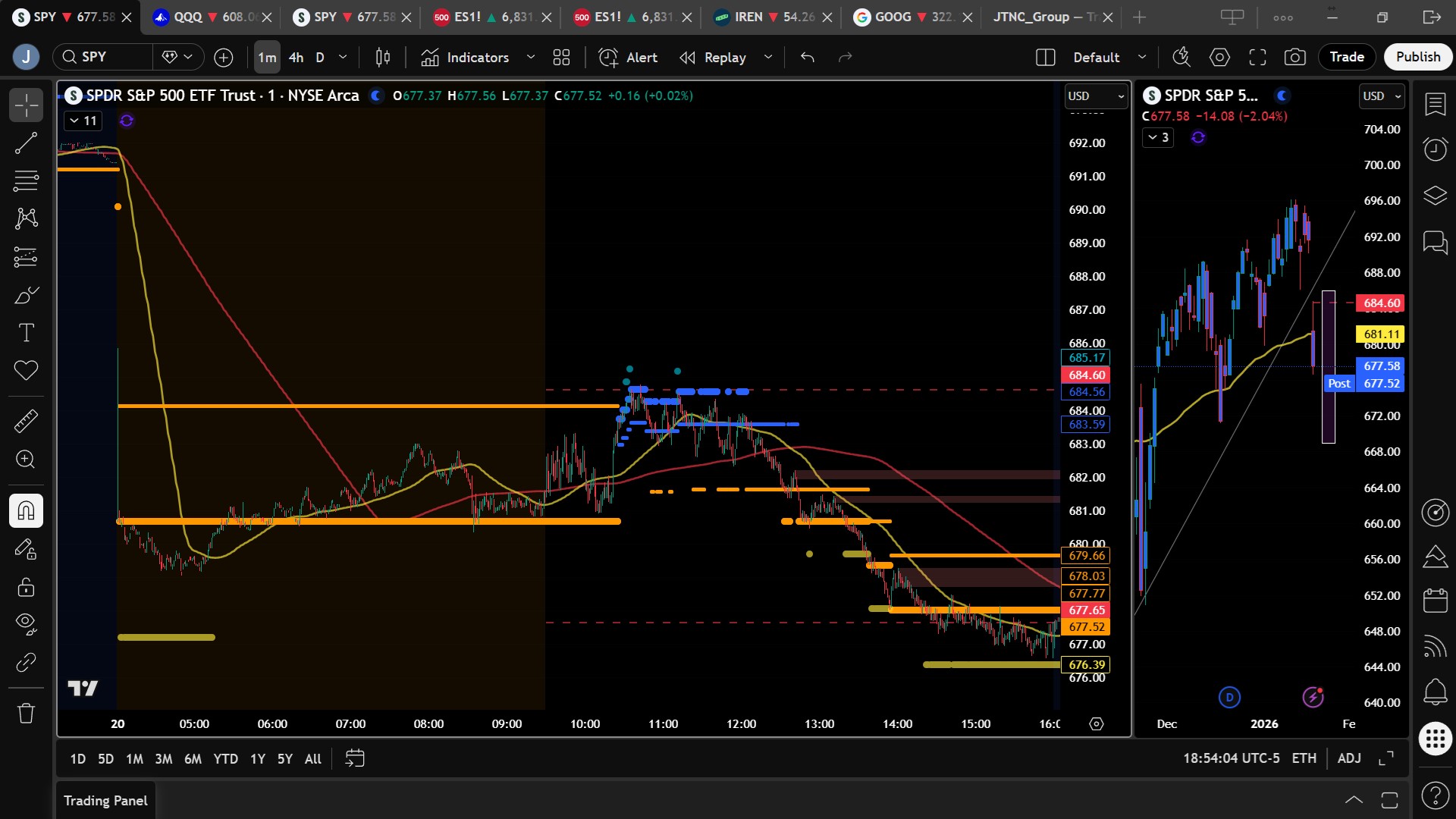
Current Market State Overview:
The MSI ended the session in a Bearish Trending Market State with SPY closing just above MSI support. There were extended targets at the close as well as for most of the afternoon session. There were extended targets briefly in the morning session as well which trapped bulls into thinking the market was going to move higher. But instead, SPY rolled over and after the MSI rescaled higher several times, with each to a very narrow bullish range, the MSI began rescaling lower several times printing extended targets below. By 2 pm, however, the MSI had stopped rescaling lower and the day ended with the MSI unchanged the last rescale at 2 pm. Overnight with SPY gaping lower, the MSI rescaled to a wide bearish state but again, just after 10 am, the MSI rescaled higher several times before succumbing to the day’s selling. For Wednesday the MSI is forecasting further weakness with the possibility of a retest of the day’s lows and or a restest of $680 before selling resuming any sell off. MSI support is $678.01 with resistance at $679.66.
Key Levels and Market Movements:
We did not publish a newsletter Friday due to AWS issues with our data suppliers, so today was a pure “trade what you see” session using the MSI and the premarket report. With the MSI opening in a wide bearish state but without extended targets below, a long off MSI support was the correct call. Targeting MSI resistance as the first objective worked well, and combining MSI signals with premarket levels produced a clean long with multiple targets. The premarket clearly identified $684.50 as major resistance, so taking profits there, and potentially reversing short, made sense. Once the MSI began rescaling lower, shorting MSI resistance to MSI support became the high-probability play, a setup with roughly a 70% win rate. That opportunity appeared three separate times and each played out cleanly. This session highlighted how to best use the newsletter framework with the Market State Indicator as the primary guide, resulting in a straightforward day with two to three solid trades and strong gains. Traders who followed the post and premarket road maps, respected the MSI signals, stayed patient, and remained disciplined were rewarded, as the session aligned cleanly with our broader framework for structure, trend, and execution. The MSI continues to prove its reliability as the cornerstone of our trading process.
Trading Strategy Based on MSI:
Wednesday has enough geopolitical risk to keep traders on their toes, so be wary of headlines out of Davos and the White House. Bears currently have the edge and will continue to press as long as price remains below $685. A sustained move above $685 hands control back to the bulls and likely puts downside pressure to rest. The bias for tomorrow favors selling tests between $680 and $685, or buying tests of $675 that hold, but only on clear failed breakdowns. The projected range is wide, so volatility should remain elevated with trending price action mixed with sharp rotations. Upside moves into the $680–$685 zone are likely to be slow, choppy, and difficult to sustain. Macro risks remain front and center, so stay alert to headlines and closely watch reactions at $680, $685, and especially $675, where bears will aggressively press their advantage if it fails. The long-term bull trend remains intact above $640, so risk management and trading what you see remain critical. Failed breakouts and failed breakdowns continue to offer the highest-probability setups, so remain flexible, avoid trading during Ranging Market States, and ensure all trades are fully aligned with MSI signals. Providing real-time insights into market control, momentum shifts, and actionable levels, the MSI when integrated with our Pre-Market and Post-Market Reports continues to sharpen execution precision and elevate trade quality. If you haven’t yet integrated MSI and our model levels into your process, now is the time. Contact your representative to get started as these tools are designed to support consistency and enhance performance.
Dealer Positioning Analysis
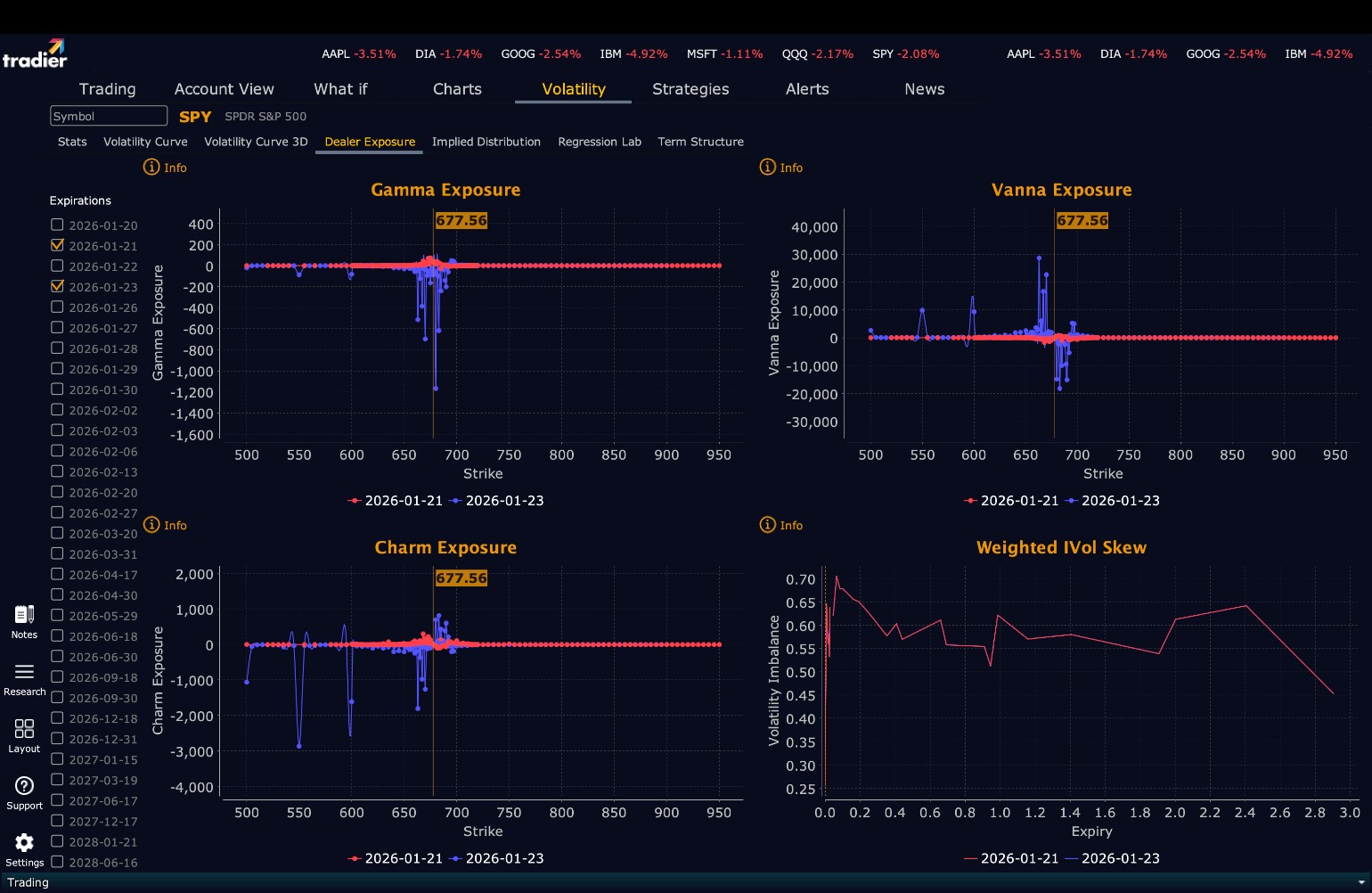
Summary of Current Dealer Positioning:
Dealers are selling SPY $681 to $700 and higher strike Calls while also selling $668 to $677 Puts and buying $680 and $685 Calls in size indicating the Dealers’ desire to participate in any relief rally tomorrow. Dealers only sell ATM Puts when they believe prices will rally. The Dealers seem to believe there is a floor in the market for tomorrow no lower than $675. The ceiling for tomorrow appears to be $684. To the downside, Dealers are buying $667 to $635 and lower strike Puts in a 3:1 ratio to the Calls/Puts they’re selling/buying displaying some concern that prices could move lower. Dealer positioning has changed from neutral/slightly bullish to neutral/slightly bearish.
Looking Ahead to Friday:
Dealers are selling SPY $690 to $720 and higher strike Calls while also buying $678 to $689 Calls indicating the Dealers’ desire to participate in any rally into Friday. The ceiling for the week appears to be $695. To the downside, Dealers are buying $677 to $585 and lower strike Puts in a 3:1 ratio to the Calls they’re selling/buying, reflecting a market that is not concerned about lower prices. For the week Dealer positioning is unchanged from neutral/slightly bearish to neutral/slightly bearish. We advise reviewing Dealer positioning daily for directional clues. These positions evolve quickly and tracking them is essential for staying ahead of shifting market sentiment.
Recommendation for Traders
Into Wednesday, respect the heightened risk environment. Favor selling bounces below $680–$685 and avoid aggressive longs until price clearly reclaims key resistance. Failed-breakdown setups near $675 can be traded tactically, but only with confirmation. Manage risk tightly, stay alert to geopolitical headlines, and trade what you see rather than what you expect.
Good luck and good trading!
